
|
|
|
|
|
 |
Contents |
 |
|
|
|
|
|
|
|
|
|
|
|
|
* Residue conservation analysis
|
|
|
|
|
|
|
|
|
|
Enzyme class:
|
|
Chains A, B, C, D:
E.C.2.7.11.1
- non-specific serine/threonine protein kinase.
|
|
|
|
|
|
|
Reaction:
|
|
|
1.
|
L-seryl-[protein] + ATP = O-phospho-L-seryl-[protein] + ADP + H+
|
|
2.
|
L-threonyl-[protein] + ATP = O-phospho-L-threonyl-[protein] + ADP + H+
|
|
|
|
|
|
|
L-seryl-[protein]
|
+
|
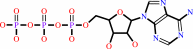 ATP
ATP
|
=
|
O-phospho-L-seryl-[protein]
|
+
|
 ADP
ADP
|
+
|
H(+)
|
|
|
|
|
|
|
L-threonyl-[protein]
|
+
|
ATP
|
=
|
O-phospho-L-threonyl-[protein]
|
+
|
ADP
|
+
|
H(+)
|
|
|
|
|
|
|
|
|
|
|
|
|
Molecule diagrams generated from .mol files obtained from the
KEGG ftp site
|
|
|
|
|
|
|
|
|
|
|
|
|
|
 |
|
|
|
|
|
|
| |
|
|
| |
|
DOI no:
|
EMBO J
23:3918-3928
(2004)
|
|
PubMed id:
|
|
|
|
|
|
| |
|
Structural insights into the regulation of PDK1 by phosphoinositides and inositol phosphates.
|
|
D.Komander,
A.Fairservice,
M.Deak,
G.S.Kular,
A.R.Prescott,
C.Peter Downes,
S.T.Safrany,
D.R.Alessi,
D.M.van Aalten.
|
|
|
|
|
| |
ABSTRACT
|
|
|
|
| |
|
|
3-phosphoinositide-dependent protein kinase-1 (PDK1) phosphorylates and
activates many kinases belonging to the AGC subfamily. PDK1 possesses a
C-terminal pleckstrin homology (PH) domain that interacts with
PtdIns(3,4,5)P3/PtdIns(3,4)P2 and with lower affinity to PtdIns(4,5)P2. We
describe the crystal structure of the PDK1 PH domain, in the absence and
presence of PtdIns(3,4,5)P3 and Ins(1,3,4,5)P4. The structures reveal a 'budded'
PH domain fold, possessing an N-terminal extension forming an integral part of
the overall fold, and display an unusually spacious ligand-binding site.
Mutagenesis and lipid-binding studies were used to define the contribution of
residues involved in phosphoinositide binding. Using a novel quantitative
binding assay, we found that Ins(1,3,4,5,6)P5 and InsP6, which are present at
micromolar levels in the cytosol, interact with full-length PDK1 with nanomolar
affinities. Utilising the isolated PDK1 PH domain, which has reduced affinity
for Ins(1,3,4,5,6)P5/InsP6, we perform localisation studies that suggest that
these inositol phosphates serve to anchor a portion of cellular PDK1 in the
cytosol, where it could activate its substrates such as p70 S6-kinase and p90
ribosomal S6 kinase that do not interact with phosphoinositides.
|
|
|
|
|
|
| |
Selected figure(s)
|
|
|
|
| |
|
|

|
|

|
|
Figure 2.
Figure 2 Comparison of Ins(1,3,4,5)P[4] binding to the PH
domains of PDK1, DAPP1 and PKB  .
Interactions of Ins(1,3,4,5)P[4] (marine) with protein residues
(green in PDK1, orange in DAPP1/PKB )
in the phosphoinositide-binding site are shown in a stereo
representation. Hydrogen bonds are indicated as black dotted
lines, and conserved water molecules are shown as yellow
spheres. (A) Protein -ligand interactions of PDK1 PH domain with
Ins(1,3,4,5)P[4]. A layer of ordered water molecules (coloured
in magenta) separates the ligand from VL1, only one of which is
conserved in other PH domain structures (coloured in gold). (B)
Ins(1,3,4,5)P[4] binding to DAPP1 (pdb-id 1fao; Ferguson et al,
2000). The D5-phosphate is closely enveloped by VL1. (C)
Ins(1,3,4,5)P[4] binding to PKB (pdb-id
1h10; Thomas et al, 2001). The ligand is rotated and VL1
contacts the D1-phosphate, while the D5-phosphate is solvent
exposed. (D) Overlay of the structures of the PDK1 (green),
DAPP1 (orange) and PKB (blue)
PH domains. The Ins(1,3,4,5)P[4] ligand and the layer of ordered
water molecules of PDK1 are shown, and coloured according to (A). .
Interactions of Ins(1,3,4,5)P[4] (marine) with protein residues
(green in PDK1, orange in DAPP1/PKB )
in the phosphoinositide-binding site are shown in a stereo
representation. Hydrogen bonds are indicated as black dotted
lines, and conserved water molecules are shown as yellow
spheres. (A) Protein -ligand interactions of PDK1 PH domain with
Ins(1,3,4,5)P[4]. A layer of ordered water molecules (coloured
in magenta) separates the ligand from VL1, only one of which is
conserved in other PH domain structures (coloured in gold). (B)
Ins(1,3,4,5)P[4] binding to DAPP1 (pdb-id 1fao; Ferguson et al,
2000). The D5-phosphate is closely enveloped by VL1. (C)
Ins(1,3,4,5)P[4] binding to PKB (pdb-id
1h10; Thomas et al, 2001). The ligand is rotated and VL1
contacts the D1-phosphate, while the D5-phosphate is solvent
exposed. (D) Overlay of the structures of the PDK1 (green),
DAPP1 (orange) and PKB (blue)
PH domains. The Ins(1,3,4,5)P[4] ligand and the layer of ordered
water molecules of PDK1 are shown, and coloured according to (A).
|
|
Figure 4.
Figure 4 Phosphoinositide-binding properties of wild type and
mutant PDK1. (A) Representation of the Ins(1,3,4,5)P[4]-binding
pocket on the PDK1 PH domain. The residues that make contacts
with Ins(1,3,4,5)P[4] and that are mutated in this study are
labelled. (B) The ability of the indicated wild type and mutant
forms of PDK1 to interact with phosphoinositides was analysed
using a protein-lipid overlay assay. Serial dilutions of the
indicated phosphoinositides (250, 100, 50, 25, 12.5, 6.3, 3.1
and 1.6 pmol) were spotted onto nitrocellulose membranes, which
were then incubated with the purified GST-PDK1 species. The
membranes were washed, and the GST-PDK1 bound to the membrane by
virtue of their interaction with lipid was detected using a GST
antibody (Dowler et al, 2002). A representative of at least two
separate experiments is shown. (*) indicates a long exposure of
the film to detect weak binding.
|
|
|
|
|
|
| |
The above figures are
reprinted
from an Open Access publication published by Macmillan Publishers Ltd:
EMBO J
(2004,
23,
3918-3928)
copyright 2004.
|
|
| |
Figures were
selected
by an automated process.
|
|
|
|
|
|
|
|
|
|
|
|
|
|
|
|
 |
 |
 |
|
Literature references that cite this PDB file's key reference
|
|
|
| |
PubMed id
|
|
Reference
|
|
|
|
|
|
C.Azevedo,
Z.Szijgyarto,
and
A.Saiardi
(2011).
The signaling role of inositol hexakisphosphate kinases (IP(6)Ks).
|
| |
Adv Enzyme Regul,
51,
74-82.
|
|
|
|
|
|
|
S.B.Shears,
N.A.Gokhale,
H.Wang,
and
A.Zaremba
(2011).
Diphosphoinositol polyphosphates: What are the mechanisms?
|
| |
Adv Enzyme Regul,
51,
13-25.
|
|
|
|
|
|
|
A.Chakraborty,
M.A.Koldobskiy,
N.T.Bello,
M.Maxwell,
J.J.Potter,
K.R.Juluri,
D.Maag,
S.Kim,
A.S.Huang,
M.J.Dailey,
M.Saleh,
A.M.Snowman,
T.H.Moran,
E.Mezey,
and
S.H.Snyder
(2010).
Inositol pyrophosphates inhibit Akt signaling, thereby regulating insulin sensitivity and weight gain.
|
| |
Cell,
143,
897-910.
|
|
|
|
|
|
|
A.Najafov,
E.M.Sommer,
J.M.Axten,
M.P.Deyoung,
and
D.R.Alessi
(2010).
Characterization of GSK2334470, a novel and highly specific inhibitor of PDK1.
|
| |
Biochem J,
433,
357-369.
|
|
|
|
|
|
|
A.T.Alberobello,
V.D'Esposito,
D.Marasco,
N.Doti,
M.Ruvo,
R.Bianco,
G.Tortora,
I.Esposito,
F.Fiory,
C.Miele,
F.Beguinot,
and
P.Formisano
(2010).
Selective disruption of insulin-like growth factor-1 (IGF-1) signaling via phosphoinositide-dependent kinase-1 prevents the protective effect of IGF-1 on human cancer cell death.
|
| |
J Biol Chem,
285,
6563-6572.
|
|
|
|
|
|
|
L.R.Pearce,
D.Komander,
and
D.R.Alessi
(2010).
The nuts and bolts of AGC protein kinases.
|
| |
Nat Rev Mol Cell Biol,
11,
9.
|
|
|
|
|
|
|
M.A.Hadders,
and
R.L.Williams
(2010).
Kinases charging to the membrane.
|
| |
Cell,
143,
865-867.
|
|
|
|
|
|
|
M.D.Best,
H.Zhang,
and
G.D.Prestwich
(2010).
Inositol polyphosphates, diphosphoinositol polyphosphates and phosphatidylinositol polyphosphate lipids: structure, synthesis, and development of probes for studying biological activity.
|
| |
Nat Prod Rep,
27,
1403-1430.
|
|
|
|
|
|
|
M.Falasca,
D.Chiozzotto,
H.Y.Godage,
M.Mazzoletti,
A.M.Riley,
S.Previdi,
B.V.Potter,
M.Broggini,
and
T.Maffucci
(2010).
A novel inhibitor of the PI3K/Akt pathway based on the structure of inositol 1,3,4,5,6-pentakisphosphate.
|
| |
Br J Cancer,
102,
104-114.
|
|
|
|
|
|
|
T.G.Kutateladze
(2010).
Translation of the phosphoinositide code by PI effectors.
|
| |
Nat Chem Biol,
6,
507-513.
|
|
|
|
|
|
|
C.Waugh,
L.Sinclair,
D.Finlay,
J.R.Bayascas,
and
D.Cantrell
(2009).
Phosphoinositide (3,4,5)-triphosphate binding to phosphoinositide-dependent kinase 1 regulates a protein kinase B/Akt signaling threshold that dictates T-cell migration, not proliferation.
|
| |
Mol Cell Biol,
29,
5952-5962.
|
|
|
|
|
|
|
N.Veiga,
J.Torres,
H.Y.Godage,
A.M.Riley,
S.Domínguez,
B.V.Potter,
A.Díaz,
and
C.Kremer
(2009).
The behaviour of inositol 1,3,4,5,6-pentakisphosphate in the presence of the major biological metal cations.
|
| |
J Biol Inorg Chem,
14,
1001-1013.
|
|
|
|
|
|
|
S.A.Matthews,
and
D.A.Cantrell
(2009).
New insights into the regulation and function of serine/threonine kinases in T lymphocytes.
|
| |
Immunol Rev,
228,
241-252.
|
|
|
|
|
|
|
S.B.Shears
(2009).
Diphosphoinositol polyphosphates: metabolic messengers?
|
| |
Mol Pharmacol,
76,
236-252.
|
|
|
|
|
|
|
T.Balla
(2009).
Green light to illuminate signal transduction events.
|
| |
Trends Cell Biol,
19,
575-586.
|
|
|
|
|
|
|
V.Calleja,
M.Laguerre,
P.J.Parker,
and
B.Larijani
(2009).
Role of a novel PH-kinase domain interface in PKB/Akt regulation: structural mechanism for allosteric inhibition.
|
| |
PLoS Biol,
7,
e17.
|
|
|
|
|
|
|
V.Laketa,
S.Zarbakhsh,
E.Morbier,
D.Subramanian,
C.Dinkel,
J.Brumbaugh,
P.Zimmermann,
R.Pepperkok,
and
C.Schultz
(2009).
Membrane-permeant phosphoinositide derivatives as modulators of growth factor signaling and neurite outgrowth.
|
| |
Chem Biol,
16,
1190-1196.
|
|
|
|
|
|
|
C.Garcia-Echeverria,
and
W.R.Sellers
(2008).
Drug discovery approaches targeting the PI3K/Akt pathway in cancer.
|
| |
Oncogene,
27,
5511-5526.
|
|
|
|
|
|
|
C.Modak,
and
P.Bryant
(2008).
Casein Kinase I epsilon positively regulates the Akt pathway in breast cancer cell lines.
|
| |
Biochem Biophys Res Commun,
368,
801-807.
|
|
|
|
|
|
|
C.Peifer,
and
D.R.Alessi
(2008).
Small-molecule inhibitors of PDK1.
|
| |
ChemMedChem,
3,
1810-1838.
|
|
|
|
|
|
|
D.Komander,
M.Patel,
M.Laurin,
N.Fradet,
A.Pelletier,
D.Barford,
and
J.F.Côté
(2008).
An alpha-helical extension of the ELMO1 pleckstrin homology domain mediates direct interaction to DOCK180 and is critical in Rac signaling.
|
| |
Mol Biol Cell,
19,
4837-4851.
|
|
|
PDB code:
|
|
|
|
|
|
|
|
D.Mahadevan,
G.Powis,
E.A.Mash,
B.George,
V.M.Gokhale,
S.Zhang,
K.Shakalya,
L.Du-Cuny,
M.Berggren,
M.A.Ali,
U.Jana,
N.Ihle,
S.Moses,
C.Franklin,
S.Narayan,
N.Shirahatti,
and
E.J.Meuillet
(2008).
Discovery of a novel class of AKT pleckstrin homology domain inhibitors.
|
| |
Mol Cancer Ther,
7,
2621-2632.
|
|
|
|
|
|
|
J.R.Bayascas,
S.Wullschleger,
K.Sakamoto,
J.M.García-Martínez,
C.Clacher,
D.Komander,
D.M.van Aalten,
K.M.Boini,
F.Lang,
C.Lipina,
L.Logie,
C.Sutherland,
J.A.Chudek,
J.A.van Diepen,
P.J.Voshol,
J.M.Lucocq,
and
D.R.Alessi
(2008).
Mutation of the PDK1 PH domain inhibits protein kinase B/Akt, leading to small size and insulin resistance.
|
| |
Mol Cell Biol,
28,
3258-3272.
|
|
|
PDB code:
|
|
|
|
|
|
|
|
P.Várnai,
and
T.Balla
(2008).
Live cell imaging of phosphoinositides with expressed inositide binding protein domains.
|
| |
Methods,
46,
167-176.
|
|
|
|
|
|
|
R.Luo,
L.M.Miller Jenkins,
P.A.Randazzo,
and
J.Gruschus
(2008).
Dynamic interaction between Arf GAP and PH domains of ASAP1 in the regulation of GAP activity.
|
| |
Cell Signal,
20,
1968-1977.
|
|
|
|
|
|
|
R.Zaru,
P.Mollahan,
and
C.Watts
(2008).
3-phosphoinositide-dependent kinase 1 deficiency perturbs Toll-like receptor signaling events and actin cytoskeleton dynamics in dendritic cells.
|
| |
J Biol Chem,
283,
929-939.
|
|
|
|
|
|
|
W.S.Park,
W.D.Heo,
J.H.Whalen,
N.A.O'Rourke,
H.M.Bryan,
T.Meyer,
and
M.N.Teruel
(2008).
Comprehensive identification of PIP3-regulated PH domains from C. elegans to H. sapiens by model prediction and live imaging.
|
| |
Mol Cell,
30,
381-392.
|
|
|
|
|
|
|
A.Rosenhouse-Dantsker,
and
D.E.Logothetis
(2007).
Molecular characteristics of phosphoinositide binding.
|
| |
Pflugers Arch,
455,
45-53.
|
|
|
|
|
|
|
D.F.Ceccarelli,
I.M.Blasutig,
M.Goudreault,
Z.Li,
J.Ruston,
T.Pawson,
and
F.Sicheri
(2007).
Non-canonical interaction of phosphoinositides with pleckstrin homology domains of Tiam1 and ArhGAP9.
|
| |
J Biol Chem,
282,
13864-13874.
|
|
|
PDB codes:
|
|
|
|
|
|
|
|
H.Al-Ali,
T.J.Ragan,
X.Gao,
and
T.K.Harris
(2007).
Reconstitution of modular PDK1 functions on trans-splicing of the regulatory PH and catalytic kinase domains.
|
| |
Bioconjug Chem,
18,
1294-1302.
|
|
|
|
|
|
|
H.Yoshizaki,
N.Mochizuki,
Y.Gotoh,
and
M.Matsuda
(2007).
Akt-PDK1 complex mediates epidermal growth factor-induced membrane protrusion through Ral activation.
|
| |
Mol Biol Cell,
18,
119-128.
|
|
|
|
|
|
|
J.D.Carpten,
A.L.Faber,
C.Horn,
G.P.Donoho,
S.L.Briggs,
C.M.Robbins,
G.Hostetter,
S.Boguslawski,
T.Y.Moses,
S.Savage,
M.Uhlik,
A.Lin,
J.Du,
Y.W.Qian,
D.J.Zeckner,
G.Tucker-Kellogg,
J.Touchman,
K.Patel,
S.Mousses,
M.Bittner,
R.Schevitz,
M.H.Lai,
K.L.Blanchard,
and
J.E.Thomas
(2007).
A transforming mutation in the pleckstrin homology domain of AKT1 in cancer.
|
| |
Nature,
448,
439-444.
|
|
|
PDB codes:
|
|
|
|
|
|
|
|
K.J.Hwang,
F.Mahmoodian,
J.A.Ferretti,
E.D.Korn,
and
J.M.Gruschus
(2007).
Intramolecular interaction in the tail of Acanthamoeba myosin IC between the SH3 domain and a putative pleckstrin homology domain.
|
| |
Proc Natl Acad Sci U S A,
104,
784-789.
|
|
|
|
|
|
|
P.Várnai,
and
T.Balla
(2007).
Visualization and manipulation of phosphoinositide dynamics in live cells using engineered protein domains.
|
| |
Pflugers Arch,
455,
69-82.
|
|
|
|
|
|
|
T.P.Devarenne,
and
G.B.Martin
(2007).
Manipulation of plant programmed cell death pathways during plant-pathogen interactions.
|
| |
Plant Signal Behav,
2,
188-189.
|
|
|
|
|
|
|
A.M.Riley,
M.Trusselle,
P.Kuad,
M.Borkovec,
J.Cho,
J.H.Choi,
X.Qian,
S.B.Shears,
B.Spiess,
and
B.V.Potter
(2006).
scyllo-inositol pentakisphosphate as an analogue of myo-inositol 1,3,4,5,6-pentakisphosphate: chemical synthesis, physicochemistry and biological applications.
|
| |
Chembiochem,
7,
1114-1122.
|
|
|
|
|
|
|
A.Nirula,
M.Ho,
H.Phee,
J.Roose,
and
A.Weiss
(2006).
Phosphoinositide-dependent kinase 1 targets protein kinase A in a pathway that regulates interleukin 4.
|
| |
J Exp Med,
203,
1733-1744.
|
|
|
|
|
|
|
D.E.Hokanson,
J.M.Laakso,
T.Lin,
D.Sept,
and
E.M.Ostap
(2006).
Myo1c binds phosphoinositides through a putative pleckstrin homology domain.
|
| |
Mol Biol Cell,
17,
4856-4865.
|
|
|
|
|
|
|
J.L.Edwards,
and
M.A.Apicella
(2006).
Neisseria gonorrhoeae PLD directly interacts with Akt kinase upon infection of primary, human, cervical epithelial cells.
|
| |
Cell Microbiol,
8,
1253-1271.
|
|
|
|
|
|
|
N.Veiga,
J.Torres,
S.Domínguez,
A.Mederos,
R.F.Irvine,
A.Díaz,
and
C.Kremer
(2006).
The behaviour of myo-inositol hexakisphosphate in the presence of magnesium(II) and calcium(II): protein-free soluble InsP6 is limited to 49 microM under cytosolic/nuclear conditions.
|
| |
J Inorg Biochem,
100,
1800-1810.
|
|
|
|
|
|
|
P.Cohen
(2006).
The twentieth century struggle to decipher insulin signalling.
|
| |
Nat Rev Mol Cell Biol,
7,
867-873.
|
|
|
|
|
|
|
S.Deleu,
K.Choi,
J.M.Reece,
and
S.B.Shears
(2006).
Pathogenicity of Salmonella: SopE-mediated membrane ruffling is independent of inositol phosphate signals.
|
| |
FEBS Lett,
580,
1709-1715.
|
|
|
|
|
|
|
S.Morgan-Lappe,
K.W.Woods,
Q.Li,
M.G.Anderson,
M.E.Schurdak,
Y.Luo,
V.L.Giranda,
S.W.Fesik,
and
J.D.Leverson
(2006).
RNAi-based screening of the human kinome identifies Akt-cooperating kinases: a new approach to designing efficacious multitargeted kinase inhibitors.
|
| |
Oncogene,
25,
1340-1348.
|
|
|
|
|
|
|
C.K.Kikani,
L.Q.Dong,
and
F.Liu
(2005).
"New"-clear functions of PDK1: beyond a master kinase in the cytosol?
|
| |
J Cell Biochem,
96,
1157-1162.
|
|
|
|
|
|
|
C.P.Downes,
A.Gray,
and
J.M.Lucocq
(2005).
Probing phosphoinositide functions in signaling and membrane trafficking.
|
| |
Trends Cell Biol,
15,
259-268.
|
|
|
|
|
|
|
D.Komander,
G.Kular,
M.Deak,
D.R.Alessi,
and
D.M.van Aalten
(2005).
Role of T-loop phosphorylation in PDK1 activation, stability, and substrate binding.
|
| |
J Biol Chem,
280,
18797-18802.
|
|
|
PDB code:
|
|
|
|
|
|
|
|
V.Niggli
(2005).
Regulation of protein activities by phosphoinositide phosphates.
|
| |
Annu Rev Cell Dev Biol,
21,
57-79.
|
|
|
|
|
|
The most recent references are shown first.
Citation data come partly from CiteXplore and partly
from an automated harvesting procedure. Note that this is likely to be
only a partial list as not all journals are covered by
either method. However, we are continually building up the citation data
so more and more references will be included with time.
Where a reference describes a PDB structure, the PDB
code is
shown on the right.
|
 |


 Links
Links





