 |
PDBsum entry 1vzu

|
|
|
|
|
 |
Contents |
 |
|
|
|
|
|
|
|
|
|
|
|
|
|
|
* Residue conservation analysis
|
|
|
|
|
|
PDB id:
|
|
|
|
| Name: |
|
Transferase
|
|
|
Title:
|
|
Roles of active site tryptophans in substrate binding and catalysis by alpha-1,3 galactosyltransferase
|
|
Structure:
|
|
N-acetyllactosaminide alpha-1,3-galactosyltransferase. Chain: a, b. Fragment: catalytic domain, residues 80-368. Synonym: galactosyltransferase, udp-galactose, beta-d-galactosyl-1,4- n-acetyl-d-glucosaminide alpha-1,3-galactosyltransferase. Engineered: yes. Mutation: yes. Other_details: residue w314y
|
|
Source:
|
|
Bos taurus. Bovine. Organism_taxid: 9913. Expressed in: escherichia coli dh5[alpha]. Expression_system_taxid: 668369.
|
|
Resolution:
|
|
|
1.97Å
|
R-factor:
|
0.154
|
R-free:
|
0.202
|
|
|
Authors:
|
|
Y.Zhang,A.Deshpande,Z.Xie,R.Natesh,K.R.Acharya,K.Brew
|
|
Key ref:
|
|
Y.Zhang
et al.
(2004).
Roles of active site tryptophans in substrate binding and catalysis by alpha-1,3 galactosyltransferase.
Glycobiology,
14,
1295-1302.
PubMed id:
|
|
|
Date:
|
|
|
27-May-04
|
Release date:
|
08-Jul-04
|
|
|
|
|
|
|
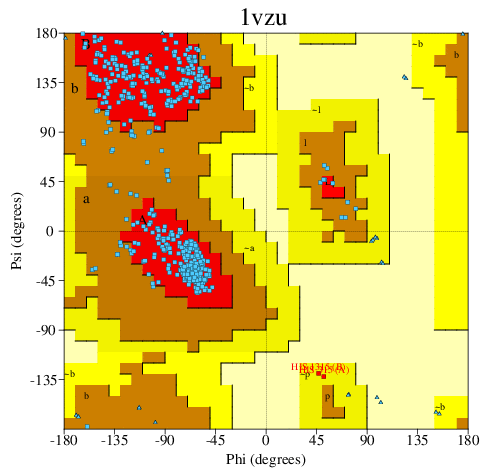
PROCHECK
|
|
|
|
|
|
Headers
|
|
|
|
References
|
|
|
|
|
|

|
|
P14769
(GGTA1_BOVIN) -
N-acetyllactosaminide alpha-1,3-galactosyltransferase from Bos taurus
|
|
|
|
Seq:
Struc:
|
|
|
|
368 a.a.
287 a.a.*
|
|

|

|

|
|
|
|
|
|
|
|
|
|
|
Key: |
 |
PfamA domain |
|
|
 |
Secondary structure |
|
 |
CATH domain |
|
|
*
PDB and UniProt seqs differ
at 1 residue position (black
cross)
|
|
|
|
|
|
|
|
|
|
|
|
|
Enzyme class:
|
|
E.C.2.4.1.87
- N-acetyllactosaminide 3-alpha-galactosyltransferase.
|
|
|
|
|
|
|
Reaction:
|
|
a beta-D-galactosyl-(1->4)-N-acetyl-beta-D-glucosaminyl derivative + UDP- alpha-D-galactose = an alpha-D-galactosyl-(1->3)-beta-D-galactosyl- (1->4)-N-acetyl-beta-D-glucosaminyl derivative + UDP + H+
|
|
|
|
|
|
beta-D-galactosyl-(1->4)-N-acetyl-beta-D-glucosaminyl derivative
|
+
|
UDP- alpha-D-galactose
|
=
|
alpha-D-galactosyl-(1->3)-beta-D-galactosyl- (1->4)-N-acetyl-beta-D-glucosaminyl derivative
|
+
|
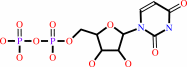 UDP
UDP
|
+
|
H(+)
Bound ligand (Het Group name = )
corresponds exactly
|
|
|
|
|
|
|
|
|
|
|
|
|
Molecule diagrams generated from .mol files obtained from the
KEGG ftp site
|
|
|
|
|
|
|
|
|
|
|
|
|
|
 |
|
|
|
|
|
|
| |
|
|
| |
|
|
Glycobiology
14:1295-1302
(2004)
|
|
PubMed id:
|
|
|
|
|
|
| |
|
Roles of active site tryptophans in substrate binding and catalysis by alpha-1,3 galactosyltransferase.
|
|
Y.Zhang,
A.Deshpande,
Z.Xie,
R.Natesh,
K.R.Acharya,
K.Brew.
|
|
|
|
|
| |
ABSTRACT
|
|
|
|
| |
|
|
Aromatic amino acids are frequent components of the carbohydrate binding sites
of lectins and enzymes. Previous structural studies have shown that in alpha-1,3
galactosyltransferase, the binding site for disaccharide acceptor substrates is
encircled by four tryptophans, residues 249, 250, 314, and 356. To investigate
their roles in enzyme specificity and catalysis, we expressed and characterized
variants of the catalytic domain of alpha-1,3 galactosyltransferase with
substitutions for each tryptophan. Substitution of glycine for tryptophan 249,
whose indole ring interacts with the nonpolar B face of glucose or GlcNAc,
greatly increases the K(m) for the acceptor substrate. In contrast, the
substitution of tyrosine for tryptophan 314, which interacts with the
beta-galactosyl moiety of the acceptor and UDP-galactose, decreases k(cat) for
the galactosyltransferase reaction but does not affect the low UDP-galactose
hydrolase activity. Thus, this highly conserved residue stabilizes the
transition state for the galactose transfer to disaccharide but not to water.
High-resolution crystallographic structures of the Trp(249)Gly mutant and the
Trp(314)Tyr mutant indicate that the mutations do not affect the overall
structure of the enzyme or its interactions with ligands. Substitutions for
tryptophan 250 have only small effects on catalytic activity, but mutation of
tryptophan 356 to threonine reduces catalytic activity for both transferase and
hydrolase activities and reduces affinity for the acceptor substrate. This
residue is adjacent to the flexible C-terminus that becomes ordered on binding
UDP to assemble the acceptor binding site and influence catalysis. The results
highlight the diverse roles of these tryptophans in enzyme action and the
importance of k(cat) changes in modulating glycosyltransferase specificity.
|
|
|
|
|
|
|
|
|
|
|
|
|
|
|
|
|
|
 |
 |
 |
|
Literature references that cite this PDB file's key reference
|
|
|
| |
PubMed id
|
|
Reference
|
|
|
|
|
|
C.J.Bosques,
B.E.Collins,
J.W.Meador,
H.Sarvaiya,
J.L.Murphy,
G.Dellorusso,
D.A.Bulik,
I.H.Hsu,
N.Washburn,
S.F.Sipsey,
J.R.Myette,
R.Raman,
Z.Shriver,
R.Sasisekharan,
and
G.Venkataraman
(2010).
Chinese hamster ovary cells can produce galactose-α-1,3-galactose antigens on proteins.
|
| |
Nat Biotechnol,
28,
1153-1156.
|
|
|
|
|
|
|
P.Tumbale,
and
K.Brew
(2009).
Characterization of a metal-independent CAZy family 6 glycosyltransferase from Bacteroides ovatus.
|
| |
J Biol Chem,
284,
25126-25134.
|
|
|
|
|
|
|
B.A.Macher,
and
U.Galili
(2008).
The Galalpha1,3Galbeta1,4GlcNAc-R (alpha-Gal) epitope: a carbohydrate of unique evolution and clinical relevance.
|
| |
Biochim Biophys Acta,
1780,
75-88.
|
|
|
|
|
|
|
P.Tumbale,
H.Jamaluddin,
N.Thiyagarajan,
K.R.Acharya,
and
K.Brew
(2008).
Screening a limited structure-based library identifies UDP-GalNAc-specific mutants of alpha-1,3-galactosyltransferase.
|
| |
Glycobiology,
18,
1036-1043.
|
|
|
PDB codes:
|
|
|
|
|
|
|
|
L.L.Lairson,
A.G.Watts,
W.W.Wakarchuk,
and
S.G.Withers
(2006).
Using substrate engineering to harness enzymatic promiscuity and expand biological catalysis.
|
| |
Nat Chem Biol,
2,
724-728.
|
|
|
|
|
|
|
M.S.Sujatha,
and
P.V.Balaji
(2006).
Fold-recognition and comparative modeling of human alpha2,3-sialyltransferases reveal their sequence and structural similarities to CstII from Campylobacter jejuni.
|
| |
BMC Struct Biol,
6,
9.
|
|
|
|
|
|
The most recent references are shown first.
Citation data come partly from CiteXplore and partly
from an automated harvesting procedure. Note that this is likely to be
only a partial list as not all journals are covered by
either method. However, we are continually building up the citation data
so more and more references will be included with time.
Where a reference describes a PDB structure, the PDB
codes are
shown on the right.
|
|


 Links
Links


