 |
PDBsum entry 1vzt

|
|
|
|
|
 |
Contents |
 |
|
|
|
|
|
|
|
|
|
|
|
|
|
|
* Residue conservation analysis
|
|
|
|
|
|
PDB id:
|
|
|
|
| Name: |
|
Transferase
|
|
|
Title:
|
|
Roles of individual residues of alpha-1,3 galactosyltransferases in substrate binding and catalysis
|
|
Structure:
|
|
N-acetyllactosaminide alpha-1,3-galactosyltransferase. Chain: a, b. Fragment: catalytic domain, residues 80-368. Synonym: galactosyltransferase, udp-galactose, beta-d-galactosyl-1,4- n-acetyl-d-glucosaminide alpha-1,3-galactosyltransferase. Engineered: yes. Mutation: yes
|
|
Source:
|
|
Bos taurus. Bovine. Organism_taxid: 9913. Expressed in: escherichia coli. Expression_system_taxid: 562. Expression_system_variant: dh5-alpha.
|
|
Resolution:
|
|
|
2.00Å
|
R-factor:
|
0.193
|
R-free:
|
0.220
|
|
|
Authors:
|
|
Y.Zhang,G.J.Swaminathan,A.Deshpande,R.Natesh,X.Xie,K.R.Acharya,K.Brew
|
Key ref:

|
|
Y.Zhang
et al.
(2003).
Roles of individual enzyme-substrate interactions by alpha-1,3-galactosyltransferase in catalysis and specificity.
Biochemistry,
42,
13512-13521.
PubMed id:
DOI:
|
|
|
Date:
|
|
|
26-May-04
|
Release date:
|
26-May-05
|
|
|
Supersedes:
|
|
|
|
|
|
|
|
PROCHECK
|

|
|
|
|
|
Headers
|
|
|
|
References
|
|
|
|
|
|

|
|
P14769
(GGTA1_BOVIN) -
N-acetyllactosaminide alpha-1,3-galactosyltransferase from Bos taurus
|
|
|
|
Seq:
Struc:
|
|
|
|
368 a.a.
287 a.a.*
|
|

|

|

|
|
|
|
|
|
|
|
|
|
|
Key: |
 |
PfamA domain |
|
|
 |
Secondary structure |
|
 |
CATH domain |
|
|
*
PDB and UniProt seqs differ
at 1 residue position (black
cross)
|
|
|
|
|
|
|
|
|
|
|
|
|
Enzyme class:
|
|
E.C.2.4.1.87
- N-acetyllactosaminide 3-alpha-galactosyltransferase.
|
|
|
|
|
|
|
Reaction:
|
|
a beta-D-galactosyl-(1->4)-N-acetyl-beta-D-glucosaminyl derivative + UDP- alpha-D-galactose = an alpha-D-galactosyl-(1->3)-beta-D-galactosyl- (1->4)-N-acetyl-beta-D-glucosaminyl derivative + UDP + H+
|
|
|
|
|
|
beta-D-galactosyl-(1->4)-N-acetyl-beta-D-glucosaminyl derivative
|
+
|
UDP- alpha-D-galactose
|
=
|
alpha-D-galactosyl-(1->3)-beta-D-galactosyl- (1->4)-N-acetyl-beta-D-glucosaminyl derivative
|
+
|
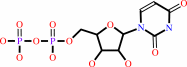 UDP
UDP
|
+
|
H(+)
Bound ligand (Het Group name = )
corresponds exactly
|
|
|
|
|
|
|
|
|
|
|
|
|
Molecule diagrams generated from .mol files obtained from the
KEGG ftp site
|
|
|
|
|
|
|
|
|
|
|
|
|
|
 |
|
|
|
|
|
|
| |
|
|
| |
|
DOI no:
|
Biochemistry
42:13512-13521
(2003)
|
|
PubMed id:
|
|
|
|
|
|
| |
|
Roles of individual enzyme-substrate interactions by alpha-1,3-galactosyltransferase in catalysis and specificity.
|
|
Y.Zhang,
G.J.Swaminathan,
A.Deshpande,
E.Boix,
R.Natesh,
Z.Xie,
K.R.Acharya,
K.Brew.
|
|
|
|
|
| |
ABSTRACT
|
|
|
|
| |
|
|
The retaining glycosyltransferase, alpha-1,3-galactosyltransferase (alpha3GT),
is mutationally inactivated in humans, leading to the presence of circulating
antibodies against its product, the alpha-Gal epitope. alpha3GT catalyzes
galactose transfer from UDP-Gal to beta-linked galactosides, such as lactose,
and in the absence of an acceptor substrate, to water at a lower rate. We have
used site-directed mutagenesis to investigate the roles in catalysis and
specificity of residues in alpha3GT that form H-bonds as well as other
interactions with substrates. Mutation of the conserved Glu(317) to Gln weakens
lactose binding and reduces the k(cat) for galactosyltransfer to lactose and
water by 2400 and 120, respectively. The structure is not perturbed by this
substitution, but the orientation of the bound lactose molecule is changed. The
magnitude of these changes does not support a previous proposal that Glu(317) is
the catalytic nucleophile in a double displacement mechanism and suggests it
acts in acceptor substrate binding and in stabilizing a cationic transition
state for cleavage of the bond between UDP and C1 of the galactose. Cleavage of
this bond also linked to a conformational change in the C-terminal region of
alpha3GT that is coupled with UDP binding. Mutagenesis indicates that His(280),
which is projected to interact with the 2-OH of the galactose moiety of UDP-Gal,
is a key residue in the stringent donor substrate specificity through its role
in stabilizing the bound UDP-Gal in a suitable conformation for catalysis.
Mutation of Gln(247), which forms multiple interactions with acceptor
substrates, to Glu reduces the catalytic rate of galactose transfer to lactose
but not to water. This mutation is predicted to perturb the orientation or
environment of the bound acceptor substrate. The results highlight the
importance of H-bonds between enzyme and substrates in this glycosyltransferase,
in arranging substrates in appropriate conformations and orientation for
efficient catalysis. These factors are manifested in increases in catalytic rate
rather than substrate affinity.
|
|
|
|
|
|
|
|
|
|
|
|
|
|
|
|
|
|
 |
 |
 |
|
Literature references that cite this PDB file's key reference
|
|
|
| |
PubMed id
|
|
Reference
|
|
|
|
|
|
B.Schuman,
M.Persson,
R.C.Landry,
R.Polakowski,
J.T.Weadge,
N.O.Seto,
S.N.Borisova,
M.M.Palcic,
and
S.V.Evans
(2010).
Cysteine-to-serine mutants dramatically reorder the active site of human ABO(H) blood group B glycosyltransferase without affecting activity: structural insights into cooperative substrate binding.
|
| |
J Mol Biol,
402,
399-411.
|
|
|
PDB codes:
|
|
|
|
|
|
|
|
R.Hurtado-Guerrero,
T.Zusman,
S.Pathak,
A.F.Ibrahim,
S.Shepherd,
A.Prescott,
G.Segal,
and
D.M.van Aalten
(2010).
Molecular mechanism of elongation factor 1A inhibition by a Legionella pneumophila glycosyltransferase.
|
| |
Biochem J,
426,
281-292.
|
|
|
PDB codes:
|
|
|
|
|
|
|
|
T.Pesnot,
M.M.Palcic,
and
G.K.Wagner
(2010).
A novel fluorescent probe for retaining galactosyltransferases.
|
| |
Chembiochem,
11,
1392-1398.
|
|
|
|
|
|
|
H.Nassif,
H.Al-Ali,
S.Khuri,
and
W.Keirouz
(2009).
Prediction of protein-glucose binding sites using support vector machines.
|
| |
Proteins,
77,
121-132.
|
|
|
|
|
|
|
P.Tumbale,
and
K.Brew
(2009).
Characterization of a metal-independent CAZy family 6 glycosyltransferase from Bacteroides ovatus.
|
| |
J Biol Chem,
284,
25126-25134.
|
|
|
|
|
|
|
C.J.Thibodeaux,
C.E.Melançon,
and
H.W.Liu
(2008).
Natural-product sugar biosynthesis and enzymatic glycodiversification.
|
| |
Angew Chem Int Ed Engl,
47,
9814-9859.
|
|
|
|
|
|
|
L.L.Lairson,
B.Henrissat,
G.J.Davies,
and
S.G.Withers
(2008).
Glycosyltransferases: structures, functions, and mechanisms.
|
| |
Annu Rev Biochem,
77,
521-555.
|
|
|
|
|
|
|
P.Tumbale,
H.Jamaluddin,
N.Thiyagarajan,
K.R.Acharya,
and
K.Brew
(2008).
Screening a limited structure-based library identifies UDP-GalNAc-specific mutants of alpha-1,3-galactosyltransferase.
|
| |
Glycobiology,
18,
1036-1043.
|
|
|
PDB codes:
|
|
|
|
|
|
|
|
A.L.Milac,
N.V.Buchete,
T.A.Fritz,
G.Hummer,
and
L.A.Tabak
(2007).
Substrate-induced conformational changes and dynamics of UDP-N-acetylgalactosamine:polypeptide N-acetylgalactosaminyltransferase-2.
|
| |
J Mol Biol,
373,
439-451.
|
|
|
|
|
|
|
C.J.Thibodeaux,
C.E.Melançon,
and
H.W.Liu
(2007).
Unusual sugar biosynthesis and natural product glycodiversification.
|
| |
Nature,
446,
1008-1016.
|
|
|
|
|
|
|
M.D.Leipold,
N.A.Kaniuk,
and
C.Whitfield
(2007).
The C-terminal Domain of the Escherichia coli WaaJ glycosyltransferase is important for catalytic activity and membrane association.
|
| |
J Biol Chem,
282,
1257-1264.
|
|
|
|
|
|
|
P.Molina,
R.M.Knegtel,
and
B.A.Macher
(2007).
Site-directed mutagenesis of glutamate 317 of bovine alpha-1,3Galactosyltransferase and its effect on enzyme activity: implications for reaction mechanism.
|
| |
Biochim Biophys Acta,
1770,
1266-1273.
|
|
|
|
|
|
|
J.Milland,
and
M.S.Sandrin
(2006).
ABO blood group and related antigens, natural antibodies and transplantation.
|
| |
Tissue Antigens,
68,
459-466.
|
|
|
|
|
|
|
J.Wongkongkatep,
Y.Miyahara,
A.Ojida,
and
I.Hamachi
(2006).
Label-free, real-time glycosyltransferase assay based on a fluorescent artificial chemosensor.
|
| |
Angew Chem Int Ed Engl,
45,
665-668.
|
|
|
|
|
|
|
C.J.Zea,
and
N.L.Pohl
(2005).
Unusual sugar nucleotide recognition elements of mesophilic vs. thermophilic glycogen synthases.
|
| |
Biopolymers,
79,
106-113.
|
|
|
|
|
|
|
P.K.Qasba,
B.Ramakrishnan,
and
E.Boeggeman
(2005).
Substrate-induced conformational changes in glycosyltransferases.
|
| |
Trends Biochem Sci,
30,
53-62.
|
|
|
|
|
|
|
T.D.Hurley,
S.Stout,
E.Miner,
J.Zhou,
and
P.J.Roach
(2005).
Requirements for catalysis in mammalian glycogenin.
|
| |
J Biol Chem,
280,
23892-23899.
|
|
|
PDB codes:
|
|
|
|
|
|
|
|
L.L.Lairson,
C.P.Chiu,
H.D.Ly,
S.He,
W.W.Wakarchuk,
N.C.Strynadka,
and
S.G.Withers
(2004).
Intermediate trapping on a mutant retaining alpha-galactosyltransferase identifies an unexpected aspartate residue.
|
| |
J Biol Chem,
279,
28339-28344.
|
|
|
PDB code:
|
|
|
|
|
|
|
The most recent references are shown first.
Citation data come partly from CiteXplore and partly
from an automated harvesting procedure. Note that this is likely to be
only a partial list as not all journals are covered by
either method. However, we are continually building up the citation data
so more and more references will be included with time.
Where a reference describes a PDB structure, the PDB
codes are
shown on the right.
|
|


 Links
Links


