
|
|
|
|
|
 |
Contents |
 |
|
|
|
|
|
|
|
|
|
|
|
 26 a.a.
|
|
|
|
|
|
|
|
|
|
|
 31 a.a.
|
|
|
|
|
|
|
|
|
|
|


 32 a.a.
|
|
|
|
|
|
|
|
|
|
|
 27 a.a.
|
|
|
|
|
|
|
|
|
|
|

 34 a.a.
|
|
|
|
|
|
|
|
|
|
|

 15 a.a.
|
|
|
|
|
|
|
|
|
* Residue conservation analysis
|
|
|
|
|
|
PDB id:
|
|
|
|
| Name: |
|
Hydrolase
|
|
|
Title:
|
|
Structure of the tetramerization domain of acetylcholinesterase: four- fold interaction of a www motif with a left-handed polyproline helix
|
|
Structure:
|
|
Acetylcholinesterase. Chain: a, b, c, d, e, f, g, h. Fragment: c terminal tetramerization domain, residues 575-614. Synonym: acetylcholinesterase collagenic tail peptide (wat). Engineered: yes. Other_details: wat chains a-d interact with prad chain i while wat chains e-h interact with prad chain j. Acetylcholinesterase collagenic tail peptide. Chain: i, j.
|
|
Source:
|
|
Synthetic: yes. Homo sapiens. Human. Organism_taxid: 9606. Other_details: the human ache sequence of wat was modified at two positions, 21 and 37, to replace met and cys by mse and ser, respectively. Organism_taxid: 9606
|
|
Biol. unit:
|
|
 Pentamer (from PDB file)
|
|
Resolution:
|
|
|
2.35Å
|
R-factor:
|
0.247
|
R-free:
|
0.259
|
|
|
Authors:
|
|
H.Dvir,M.Harel,S.Bon,W.-Q.Liu,M.Vidal,C.Garbay,J.L.Sussman, J.Massoulie,I.Silman
|
Key ref:

|
|
H.Dvir
et al.
(2004).
The synaptic acetylcholinesterase tetramer assembles around a polyproline II helix.
EMBO J,
23,
4394-4405.
PubMed id:
DOI:

|
|
|
Date:
|
|
|
20-May-04
|
Release date:
|
10-Jan-05
|
|
|
|
|
|
|
PROCHECK
|

|
|
|
|
|
Headers
|
|
|
|
References
|
|
|
|
|
|

|
|
P22303
(ACES_HUMAN) -
Acetylcholinesterase from Homo sapiens
|
|
|
|
Seq:
Struc:
|
|
|
|
614 a.a.
26 a.a.
|
|

|

|
|
|
|
|
|
|
|
|
|
|
|
|

|
|
P22303
(ACES_HUMAN) -
Acetylcholinesterase from Homo sapiens
|
|
|
|
Seq:
Struc:
|
|
|
|
614 a.a.
31 a.a.
|
|
|

|
|
|
|
|
|
|
|
|
|
|
|
|

|
|
P22303
(ACES_HUMAN) -
Acetylcholinesterase from Homo sapiens
|
|
|
|
Seq:
Struc:
|
|
|
|
614 a.a.
32 a.a.
|
|
|

|
|
|
|
|
|
|
|
|
|
|
|
|

|
|
P22303
(ACES_HUMAN) -
Acetylcholinesterase from Homo sapiens
|
|
|
|
Seq:
Struc:
|
|
|
|
614 a.a.
27 a.a.
|
|
|

|
|
|
|
|
|
|
|
|
|
|
|
|
|
|
|
|
|
Enzyme class:
|
|
Chains A, B, C, D, E, F, G, H:
E.C.3.1.1.7
- acetylcholinesterase.
|
|
|
|
|
|
|
Reaction:
|
|
acetylcholine + H2O = choline + acetate + H+
|
|
|
|
|
|
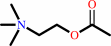 acetylcholine
|
+
|
H2O
|
=
|
 choline
|
+
|
 acetate
|
+
|
H(+)
|
|
|
|
|
|
|
|
|
|
|
|
|
Molecule diagrams generated from .mol files obtained from the
KEGG ftp site
|
|
|
|
|
|
|
|
|
|
|
|
|
|
 |
|
|
|
|
|
|
| |
|
|
| |
|
DOI no:
|
EMBO J
23:4394-4405
(2004)
|
|
PubMed id:
|
|
|
|
|
|
| |
|
The synaptic acetylcholinesterase tetramer assembles around a polyproline II helix.
|
|
H.Dvir,
M.Harel,
S.Bon,
W.Q.Liu,
M.Vidal,
C.Garbay,
J.L.Sussman,
J.Massoulié,
I.Silman.
|
|
|
|
|
| |
ABSTRACT
|
|
|
|
| |
|
|
Functional localization of acetylcholinesterase (AChE) in vertebrate muscle and
brain depends on interaction of the tryptophan amphiphilic tetramerization (WAT)
sequence, at the C-terminus of its major splice variant (T), with a proline-rich
attachment domain (PRAD), of the anchoring proteins, collagenous (ColQ) and
proline-rich membrane anchor. The crystal structure of the WAT/PRAD complex
reveals a novel supercoil structure in which four parallel WAT chains form a
left-handed superhelix around an antiparallel left-handed PRAD helix resembling
polyproline II. The WAT coiled coils possess a WWW motif making repetitive
hydrophobic stacking and hydrogen-bond interactions with the PRAD. The WAT
chains are related by an approximately 4-fold screw axis around the PRAD. Each
WAT makes similar but unique interactions, consistent with an asymmetric pattern
of disulfide linkages between the AChE tetramer subunits and ColQ. The P59Q
mutation in ColQ, which causes congenital endplate AChE deficiency, and is
located within the PRAD, disrupts crucial WAT-WAT and WAT-PRAD interactions. A
model is proposed for the synaptic AChE(T) tetramer.
|
|
|
|
|
|
| |
Selected figure(s)
|
|
|
|
| |
|
|

|
|

|
|
Figure 1.
Figure 1 Schematic representations of AChE tetramers. (A) Modes
of assembly of AChE subunits into tetramers. (B) Orientations of
the polypeptide chains and arrangement of disulfide bonds in the
[AChE[T]][4]ColQ complex deduced by site-directed mutagenesis.
|
|
Figure 7.
Figure 7 Stacking interactions between the WAT and PRAD helices.
Side view of the complex, with the superhelical axis running
vertically, and PRAD depicted as a stick model. Only the Trps of
WAT are shown, in space-filling format, with those of each WAT
chain colored individually. The Trp side chains form a spiral
staircase around the PRAD, fitting into grooves formed by the
extended left-handed PRAD helix.
|
|
|
|
|
|
| |
The above figures are
reprinted
from an Open Access publication published by Macmillan Publishers Ltd:
EMBO J
(2004,
23,
4394-4405)
copyright 2004.
|
|
| |
Figures were
selected
by an automated process.
|
|
|
|
|
|
|
|
|
|
|
|
|
|
|
|
 |
 |
 |
|
Literature references that cite this PDB file's key reference
|
|
|
| |
PubMed id
|
|
Reference
|
|
|
|
|
|
P.Anglade,
and
Y.Larabi-Godinot
(2010).
Historical landmarks in the histochemistry of the cholinergic synapse: Perspectives for future researches.
|
| |
Biomed Res,
31,
1.
|
|
|
|
|
|
|
R.Vijayan,
and
P.C.Biggin
(2010).
Conformational preferences of a 14-residue fibrillogenic peptide from acetylcholinesterase.
|
| |
Biochemistry,
49,
3678-3684.
|
|
|
|
|
|
|
A.A.Gorfe,
B.Lu,
Z.Yu,
and
J.A.McCammon
(2009).
Enzymatic activity versus structural dynamics: the case of acetylcholinesterase tetramer.
|
| |
Biophys J,
97,
897-905.
|
|
|
|
|
|
|
D.Liang,
J.P.Blouet,
F.Borrega,
S.Bon,
and
J.Massoulié
(2009).
Respective roles of the catalytic domains and C-terminal tail peptides in the oligomerization and secretory trafficking of human acetylcholinesterase and butyrylcholinesterase.
|
| |
FEBS J,
276,
94.
|
|
|
|
|
|
|
E.Podoly,
D.E.Shalev,
S.Shenhar-Tsarfaty,
E.R.Bennett,
E.Ben Assayag,
H.Wilgus,
O.Livnah,
and
H.Soreq
(2009).
The Butyrylcholinesterase K Variant Confers Structurally Derived Risks for Alzheimer Pathology{diamondsuit}.
|
| |
J Biol Chem,
284,
17170-17179.
|
|
|
|
|
|
|
K.W.Leung,
H.Q.Xie,
V.P.Chen,
M.K.Mok,
G.K.Chu,
R.C.Choi,
and
K.W.Tsim
(2009).
Restricted localization of proline-rich membrane anchor (PRiMA) of globular form acetylcholinesterase at the neuromuscular junctions--contribution and expression from motor neurons.
|
| |
FEBS J,
276,
3031-3042.
|
|
|
|
|
|
|
Y.Pan,
J.L.Muzyka,
and
C.G.Zhan
(2009).
Model of human butyrylcholinesterase tetramer by homology modeling and dynamics simulation.
|
| |
J Phys Chem B,
113,
6543-6552.
|
|
|
|
|
|
|
A.A.Gorfe,
C.E.Chang,
I.Ivanov,
and
J.A.McCammon
(2008).
Dynamics of the acetylcholinesterase tetramer.
|
| |
Biophys J,
94,
1144-1154.
|
|
|
|
|
|
|
A.Frederick,
I.Tsigelny,
F.Cohenour,
C.Spiker,
E.Krejci,
A.Chatonnet,
S.Bourgoin,
G.Richards,
T.Allen,
M.H.Whitlock,
and
L.Pezzementi
(2008).
Acetylcholinesterase from the invertebrate Ciona intestinalis is capable of assembling into asymmetric forms when co-expressed with vertebrate collagenic tail peptide.
|
| |
FEBS J,
275,
1309-1322.
|
|
|
|
|
|
|
H.Noureddine,
S.Carvalho,
C.Schmitt,
J.Massoulié,
and
S.Bon
(2008).
Acetylcholinesterase associates differently with its anchoring proteins ColQ and PRiMA.
|
| |
J Biol Chem,
283,
20722-20732.
|
|
|
|
|
|
|
M.Guerra,
A.Dobbertin,
and
C.Legay
(2008).
Identification of cis-acting elements involved in acetylcholinesterase RNA alternative splicing.
|
| |
Mol Cell Neurosci,
38,
1.
|
|
|
|
|
|
|
C.Perry,
M.Pick,
E.Podoly,
A.Gilboa-Geffen,
G.Zimmerman,
E.H.Sklan,
Y.Ben-Shaul,
S.Diamant,
and
H.Soreq
(2007).
Acetylcholinesterase/C terminal binding protein interactions modify Ikaros functions, causing T lymphopenia.
|
| |
Leukemia,
21,
1472-1480.
|
|
|
|
|
|
|
H.Noureddine,
C.Schmitt,
W.Liu,
C.Garbay,
J.Massoulié,
and
S.Bon
(2007).
Assembly of acetylcholinesterase tetramers by peptidic motifs from the proline-rich membrane anchor, PRiMA: competition between degradation and secretion pathways of heteromeric complexes.
|
| |
J Biol Chem,
282,
3487-3497.
|
|
|
|
|
|
|
H.Q.Xie,
R.C.Choi,
K.W.Leung,
N.L.Siow,
L.W.Kong,
F.T.Lau,
H.B.Peng,
and
K.W.Tsim
(2007).
Regulation of a transcript encoding the proline-rich membrane anchor of globular muscle acetylcholinesterase. The suppressive roles of myogenesis and innervating nerves.
|
| |
J Biol Chem,
282,
11765-11775.
|
|
|
|
|
|
|
L.Jean,
B.Thomas,
A.Tahiri-Alaoui,
M.Shaw,
and
D.J.Vaux
(2007).
Heterologous amyloid seeding: revisiting the role of acetylcholinesterase in Alzheimer's disease.
|
| |
PLoS ONE,
2,
e652.
|
|
|
|
|
|
|
M.N.Ngamelue,
K.Homma,
O.Lockridge,
and
O.A.Asojo
(2007).
Crystallization and X-ray structure of full-length recombinant human butyrylcholinesterase.
|
| |
Acta Crystallogr Sect F Struct Biol Cryst Commun,
63,
723-727.
|
|
|
PDB code:
|
|
|
|
|
|
|
|
S.Diamant,
E.Podoly,
A.Friedler,
H.Ligumsky,
O.Livnah,
and
H.Soreq
(2006).
Butyrylcholinesterase attenuates amyloid fibril formation in vitro.
|
| |
Proc Natl Acad Sci U S A,
103,
8628-8633.
|
|
|
|
|
|
|
D.Zhang,
and
J.A.McCammon
(2005).
The association of tetrameric acetylcholinesterase with ColQ tail: a block normal mode analysis.
|
| |
PLoS Comput Biol,
1,
e62.
|
|
|
|
|
|
|
D.Zhang,
J.Suen,
Y.Zhang,
Y.Song,
Z.Radic,
P.Taylor,
M.J.Holst,
C.Bajaj,
N.A.Baker,
and
J.A.McCammon
(2005).
Tetrameric mouse acetylcholinesterase: continuum diffusion rate calculations by solving the steady-state Smoluchowski equation using finite element methods.
|
| |
Biophys J,
88,
1659-1665.
|
|
|
|
|
|
|
M.E.Selkirk,
O.Lazari,
and
J.B.Matthews
(2005).
Functional genomics of nematode acetylcholinesterases.
|
| |
Parasitology,
131,
S3-18.
|
|
|
|
|
|
The most recent references are shown first.
Citation data come partly from CiteXplore and partly
from an automated harvesting procedure. Note that this is likely to be
only a partial list as not all journals are covered by
either method. However, we are continually building up the citation data
so more and more references will be included with time.
Where a reference describes a PDB structure, the PDB
code is
shown on the right.
|

| |


 Links
Links


