 |
PDBsum entry 1vso

|
|
|
|
|
|

|

|

|

|
|

|
|

|
|

|
|
|
 |

|

|
|
|
|
|
|
|
|
|
|
|
|
|
|
|
|
|
|
|
|
|
|
|
|
|
|
|
|
|
|
|
|
Membrane protein
|
PDB id
|
|
|
|
1vso
|
|
|
|
|
|
|
|
|
|
|
|
|
|
|

|

|

|
|
|
|
|
|
|
|
 |
Contents |
 |
|
|
|
|
|
|
|
|
|
|
|
|
* Residue conservation analysis
|
|
|
|
|
|
PDB id:
|
|
|
|
| Name: |
|
Membrane protein
|
|
|
Title:
|
|
Crystal structure of the ligand-binding core of iglur5 in complex with the antagonist (s)-atpo at 1.85 a resolution
|
|
Structure:
|
|
Glutamate receptor, ionotropic kainate 1. Chain: a. Synonym: glutamate receptor 5, glur-5, glur5. Engineered: yes
|
|
Source:
|
|
Rattus norvegicus. Norway rat. Organism_taxid: 10116. Gene: grik1, glur5. Expressed in: escherichia coli. Expression_system_taxid: 562.
|
|
Resolution:
|
|
|
1.85Å
|
R-factor:
|
0.202
|
R-free:
|
0.231
|
|
|
Authors:
|
|
H.Hald,P.Naur,M.Gajhede,J.S.Kastrup
|
Key ref:

|
|
H.Hald
et al.
(2007).
Partial Agonism and Antagonism of the Ionotropic Glutamate Receptor iGLuR5: STRUCTURES OF THE LIGAND-BINDING CORE IN COMPLEX WITH DOMOIC ACID AND 2-AMINO-3-[5-tert-BUTYL-3-(PHOSPHONOMETHOXY)-4-ISOXAZOLYL]PROPIONIC ACID.
J Biol Chem,
282,
25726-25736.
PubMed id:
DOI:

|
|
|
Date:
|
|
|
29-Mar-07
|
Release date:
|
03-Jul-07
|
|
|
|
|
|
|
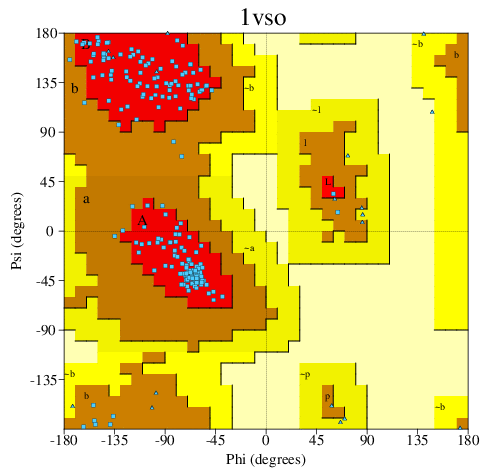
PROCHECK
|
|
|
|
|
|
Headers
|
|
|
|
References
|
|
|
|
|
|

|
|
P22756
(GRIK1_RAT) -
Glutamate receptor ionotropic, kainate 1 from Rattus norvegicus
|
|
|
|
Seq:
Struc:
|
|
|
|
949 a.a.
243 a.a.*
|
|

|

|

|
|
|
|
|
|
|
|
|
|
|
Key: |
 |
PfamA domain |
|
|
 |
Secondary structure |
|
 |
CATH domain |
|
|
*
PDB and UniProt seqs differ
at 1 residue position (black
cross)
|
|
|
|
|
|
|
|
|
|
|
|
|
|
|
|
|
 |
|
|
|
|
|
|
| |
|
DOI no:
|
J Biol Chem
282:25726-25736
(2007)
|
|
PubMed id:
|
|
|
|
|
|
| |
|
Partial Agonism and Antagonism of the Ionotropic Glutamate Receptor iGLuR5: STRUCTURES OF THE LIGAND-BINDING CORE IN COMPLEX WITH DOMOIC ACID AND 2-AMINO-3-[5-tert-BUTYL-3-(PHOSPHONOMETHOXY)-4-ISOXAZOLYL]PROPIONIC ACID.
|
|
H.Hald,
P.Naur,
D.S.Pickering,
D.Sprogøe,
U.Madsen,
D.B.Timmermann,
P.K.Ahring,
T.Liljefors,
A.Schousboe,
J.Egebjerg,
M.Gajhede,
J.S.Kastrup.
|
|
|
|
|
| |
ABSTRACT
|
|
|
|
| |
|
|
More than 50 structures have been reported on the ligand-binding core of the
ionotropic glutamate receptor iGluR2 that belongs to the
2-amino-3-(3-hydroxy-5-methyl-4-isoxazolyl)propionic acid-type of receptors. In
contrast, the ligand-binding core of the kainic acid-type receptor iGluR5 has
only been crystallized with three different ligands. Hence, additional
structures of iGluR5 are needed to broaden the understanding of the
ligand-binding properties of iGluR5, and the conformational changes leading to
channel opening and closing. Here, we present two structures of the
ligand-binding core of iGluR5; one as a complex with the partial agonist
(2S,3S,4S)-3-carboxymethyl-4-[(1Z,3E,5R)-5-carboxy-1-methyl-hexa-1,3-dienyl]-pyrrolidine-2-carboxylic
acid (domoic acid) and one as a complex with the antagonist
(S)-2-amino-3-[5-tert-butyl-3-(phosphonomethoxy)-4-isoxazolyl]propionic acid
((S)-ATPO). In agreement with the partial agonist activity of domoic acid, the
ligand-binding core of the iGluR5 complex is stabilized by domoic acid in a
conformation that is 11 degrees more open than the conformation observed in the
full agonist (S)-glutamic acid complex. This is primarily caused by the
5-carboxy-1-methyl-hexa-1,3-dienyl moiety of domoic acid and residues
Val(685)-Thr(690) of iGluR5. An even larger domain opening of 28 degrees is
introduced upon binding of the antagonist (S)-ATPO. It appears that the span of
domain opening is much larger in the ligand-binding core of iGluR5 (30 degrees )
compared with what has been observed in iGluR2 (19 degrees ). Similarly, much
larger variation in the distances between transmembrane linker residues in the
two protomers comprising the dimer is observed in iGluR5 as compared with iGluR2.
|
|
|
|
|
|
| |
Selected figure(s)
|
|
|
|
| |
|
|

|
|

|
|
Figure 1.
FIGURE 1. Chemical structures of domoic acid, kainic acid,
(S)-ATPO, UBP302, and UBP310. The atom numbering of domoic acid
is shown in italics and is according to Nanao et al. (46) (PDB
entry code 1YAE). The numbering of (S)-ATPO is according to
Hogner et al. (14) (PDB entry code 1N0T). See abbreviations for
compound names.
|
|
Figure 4.
FIGURE 4. Two-dimensional ligand-receptor interaction plots
of iGluR5-S1S2 in complex with domoic acid (A) and (S)-ATPO (B).
iGluR5-S1S2 polar residues are shown as purple circles, acidic
residues as purple/red, basic residues as purple/blue, and
hydrophobic residues in green. Contacts from ligand to receptor
side chains as calculated by the program MOE are shown as green
arrows and from ligand to receptor backbone as blue arrows.
Water molecules in contact with ligands are shown as white
circles and their contacts as yellow lines. The extent of ligand
and receptor exposure is shown as blue spheres differing in size.
|
|
|
|
|
|
| |
The above figures are
reprinted
by permission from the ASBMB:
J Biol Chem
(2007,
282,
25726-25736)
copyright 2007.
|
|
| |
Figures were
selected
by an automated process.
|
|
|
|
|
|
|
|
|
|
|
|
|
|
|
|
 |
 |
 |
|
Literature references that cite this PDB file's key reference
|
|
|
| |
PubMed id
|
|
Reference
|
|
|
|
|
|
G.M.Alushin,
D.Jane,
and
M.L.Mayer
(2011).
Binding site and ligand flexibility revealed by high resolution crystal structures of GluK1 competitive antagonists.
|
| |
Neuropharmacology,
60,
126-134.
|
|
|
PDB codes:
|
|
|
|
|
|
|
|
M.L.Mayer
(2011).
Glutamate receptor ion channels: where do all the calories go?
|
| |
Nat Struct Mol Biol,
18,
253-254.
|
|
|
|
|
|
|
A.H.Ahmed,
and
R.E.Oswald
(2010).
Piracetam defines a new binding site for allosteric modulators of alpha-amino-3-hydroxy-5-methyl-4-isoxazole-propionic acid (AMPA) receptors.
|
| |
J Med Chem,
53,
2197-2203.
|
|
|
PDB codes:
|
|
|
|
|
|
|
|
I.Nogueira,
A.Lobo-da-Cunha,
A.Afonso,
S.Rivera,
J.Azevedo,
R.Monteiro,
R.Cervantes,
A.Gago-Martinez,
and
V.Vasconcelos
(2010).
Toxic effects of domoic acid in the seabream Sparus aurata.
|
| |
Mar Drugs,
8,
2721-2732.
|
|
|
|
|
|
|
P.A.Postila,
G.T.Swanson,
and
O.T.Pentikäinen
(2010).
Exploring kainate receptor pharmacology using molecular dynamics simulations.
|
| |
Neuropharmacology,
58,
515-527.
|
|
|
|
|
|
|
A.H.Ahmed,
Q.Wang,
H.Sondermann,
and
R.E.Oswald
(2009).
Structure of the S1S2 glutamate binding domain of GLuR3.
|
| |
Proteins,
75,
628-637.
|
|
|
PDB codes:
|
|
|
|
|
|
|
|
D.R.Artis,
J.J.Lin,
C.Zhang,
W.Wang,
U.Mehra,
M.Perreault,
D.Erbe,
H.I.Krupka,
B.P.England,
J.Arnold,
A.N.Plotnikov,
A.Marimuthu,
H.Nguyen,
S.Will,
M.Signaevsky,
J.Kral,
J.Cantwell,
C.Settachatgull,
D.S.Yan,
D.Fong,
A.Oh,
S.Shi,
P.Womack,
B.Powell,
G.Habets,
B.L.West,
K.Y.Zhang,
M.V.Milburn,
G.P.Vlasuk,
K.P.Hirth,
K.Nolop,
G.Bollag,
P.N.Ibrahim,
and
J.F.Tobin
(2009).
Scaffold-based discovery of indeglitazar, a PPAR pan-active anti-diabetic agent.
|
| |
Proc Natl Acad Sci U S A,
106,
262-267.
|
|
|
PDB codes:
|
|
|
|
|
|
|
|
L.Bunch,
and
P.Krogsgaard-Larsen
(2009).
Subtype selective kainic acid receptor agonists: discovery and approaches to rational design.
|
| |
Med Res Rev,
29,
3.
|
|
|
|
|
|
|
M.Du,
A.Rambhadran,
and
V.Jayaraman
(2009).
Vibrational spectroscopic investigation of the ligand binding domain of kainate receptors.
|
| |
Protein Sci,
18,
1585-1591.
|
|
|
|
|
|
|
M.Du,
A.Rambhadran,
and
V.Jayaraman
(2008).
Luminescence resonance energy transfer investigation of conformational changes in the ligand binding domain of a kainate receptor.
|
| |
J Biol Chem,
283,
27074-27078.
|
|
|
|
|
|
|
O.M.Pulido
(2008).
Domoic acid toxicologic pathology: a review.
|
| |
Mar Drugs,
6,
180-219.
|
|
|
|
|
|
The most recent references are shown first.
Citation data come partly from CiteXplore and partly
from an automated harvesting procedure. Note that this is likely to be
only a partial list as not all journals are covered by
either method. However, we are continually building up the citation data
so more and more references will be included with time.
Where a reference describes a PDB structure, the PDB
codes are
shown on the right.
|
|


 Links
Links



