
|
|
|
|
|
 |
Contents |
 |
|
|
|
|
|
|
|
|
|
|
|
 237 a.a.
|
|
|
|
|
|
|
|
|
|
|
 337 a.a.
|
|
|
|
|
|
|
|
|
|
|
 246 a.a.
|
|
|
|
|
|
|
|
|
|
|
 140 a.a.
|
|
|
|
|
|
|
|
|
|
|
 172 a.a.
|
|
|
|
|
|
|
|
|
|
|
 119 a.a.
|
|
|
|
|
|
|
|
|
|
|
 29 a.a.
|
|
|
|
|
|
|
|
|
|
|
 160 a.a.
|
|
|
|
|
|
|
|
|
|
|
 142 a.a.
|
|
|
|
|
|
|
|
|
|
|
 132 a.a.
|
|
|
|
|
|
|
|
|
|
|
 145 a.a.
|
|
|
|
|
|
|
|
|
|
|
 194 a.a.
|
|
|
|
|
|
|
|
|
|
|
 186 a.a.
|
|
|
|
|
|
|
|
|
|
|
 115 a.a.
|
|
|
|
|
|
|
|
|
|
|
 143 a.a.
|
|
|
|
|
|
|
|
|
|
|
 95 a.a.
|
|
|
|
|
|
|
|
|
|
|
 150 a.a.
|
|
|
|
|
|
|
|
|
|
|
 81 a.a.
|
|
|
|
|
|
|
|
|
|
|
 119 a.a.
|
|
|
|
|
|
|
|
|
|
|
 53 a.a.
|
|
|
|
|
|
|
|
|
|
|
 65 a.a.
|
|
|
|
|
|
|
|
|
|
|
 154 a.a.
|
|
|
|
|
|
|
|
|
|
|
 82 a.a.
|
|
|
|
|
|
|
|
|
|
|
 142 a.a.
|
|
|
|
|
|
|
|
|
|
|
 73 a.a.
|
|
|
|
|
|
|
|
|
|
|
 56 a.a.
|
|
|
|
|
|
|
|
|
|
|
 46 a.a.
|
|
|
|
|
|
|
|
|
|
|
 92 a.a.
|
|
|
|
|
|
|
|
|
|
|
 70 a.a.
|
|
|
|
|
|
|
|
|
|
|
|
|
|
 _SR
×114 _SR
×114
|
|
|
|
|
|
|
|
|
|
|
 _MG
×94 _MG
×94
|
|
|
|
|
|
|
|
|
|
|
 _NA
×75 _NA
×75
|
|
|
|
|
|
|
|
|
|
|
_CL
×22
|
|
|
|
|
|
|
|
|
|
|
 _CD
×5 _CD
×5
|
|
|
|
|
|
|
|
|
|
|
 __K
×2 __K
×2
|
|
|
|
|
|
|
|
|
* Residue conservation analysis
|
|
|
|
|
|
PDB id:
|
|
|
|
| Name: |
|
Ribosome
|
|
|
Title:
|
|
The structure of cc-hpmn and cca-phe-cap-bio bound to the large ribosomal subunit of haloarcula marismortui
|
|
Structure:
|
|
23s ribosomal RNA. Chain: 0. 5s ribosomal RNA. Chain: 9. 5'-r( Cp Cp (Ppu) (Lof))-3'. Chain: 4. Engineered: yes. 5'-r( Cp Cp Ap (Phe) (Aca) (Btn))-3'. Chain: 5.
|
|
Source:
|
|
Haloarcula marismortui. Organism_taxid: 2238. Synthetic: yes. Other_details: cytidine-cytidine-hydroxypuromycin oligomer. Other_details: cca-phe-caproic acid biotin oligomer. Organism_taxid: 2238
|
|
Biol. unit:
|
|
 32mer (from
)
32mer (from
)
|
|
Resolution:
|
|
|
2.40Å
|
R-factor:
|
0.212
|
R-free:
|
0.248
|
|
|
Authors:
|
|
T.M.Schmeing,T.A.Steitz
|
Key ref:

|
|
T.M.Schmeing
et al.
(2005).
An induced-fit mechanism to promote peptide bond formation and exclude hydrolysis of peptidyl-tRNA.
Nature,
438,
520-524.
PubMed id:
DOI:

|
|
|
Date:
|
|
|
16-Dec-04
|
Release date:
|
29-Nov-05
|
|
|
|
|
|
|
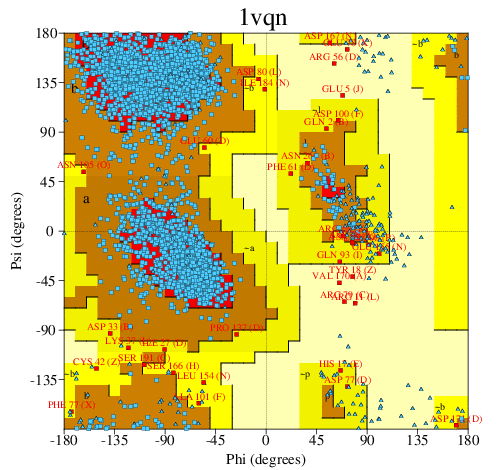
PROCHECK
|
|
|
|
|
|
Headers
|
|
|
|
References
|
|
|
|
|
|

|
|
P20276
(RL2_HALMA) -
Large ribosomal subunit protein uL2 from Haloarcula marismortui (strain ATCC 43049 / DSM 3752 / JCM 8966 / VKM B-1809)
|
|
|
|
Seq:
Struc:
|
|
|
|
240 a.a.
237 a.a.
|
|

|

|
|
|
|
|
|
|
|
|
|
|
|
|

|
|
P20279
(RL3_HALMA) -
Large ribosomal subunit protein uL3 from Haloarcula marismortui (strain ATCC 43049 / DSM 3752 / JCM 8966 / VKM B-1809)
|
|
|
|
Seq:
Struc:
|
|
|
|
338 a.a.
337 a.a.
|
|
|

|

|
|
|
|
|
|
|
|
|
|
|
|

|
|
P12735
(RL4_HALMA) -
Large ribosomal subunit protein uL4 from Haloarcula marismortui (strain ATCC 43049 / DSM 3752 / JCM 8966 / VKM B-1809)
|
|
|
|
Seq:
Struc:
|
|
|
|
246 a.a.
246 a.a.*
|
|
|

|
|
|
|
|
|
|
|
|
|
|
|
|

|
|
P14124
(RL5_HALMA) -
Large ribosomal subunit protein uL5 from Haloarcula marismortui (strain ATCC 43049 / DSM 3752 / JCM 8966 / VKM B-1809)
|
|
|
|
Seq:
Struc:
|
|
|
|
177 a.a.
140 a.a.
|
|
|

|
|
|
|
|
|
|
|
|
|
|
|
|

|
|
P14135
(RL6_HALMA) -
Large ribosomal subunit protein uL6 from Haloarcula marismortui (strain ATCC 43049 / DSM 3752 / JCM 8966 / VKM B-1809)
|
|
|
|
Seq:
Struc:
|
|
|
|
178 a.a.
172 a.a.
|
|
|

|
|
|
|
|
|
|
|
|
|
|
|
|

|
|
P12743
(RL7A_HALMA) -
Large ribosomal subunit protein eL8 from Haloarcula marismortui (strain ATCC 43049 / DSM 3752 / JCM 8966 / VKM B-1809)
|
|
|
|
Seq:
Struc:
|
|
|
|
120 a.a.
119 a.a.
|
|
|

|
|
|
|
|
|
|
|
|
|
|
|
|

|
|
P15825
(RL10_HALMA) -
Large ribosomal subunit protein uL10 from Haloarcula marismortui (strain ATCC 43049 / DSM 3752 / JCM 8966 / VKM B-1809)
|
|
|
|
Seq:
Struc:
|
|
|
|
348 a.a.
29 a.a.*
|
|
|

|

|
|
|
|
|
|
|
|
|
|
|
|

|
|
P60617
(RL10E_HALMA) -
Large ribosomal subunit protein uL16 from Haloarcula marismortui (strain ATCC 43049 / DSM 3752 / JCM 8966 / VKM B-1809)
|
|
|
|
Seq:
Struc:
|
|
|
|
177 a.a.
160 a.a.*
|
|
|

|
|
|
|
|
|
|
|
|
|
|
|
|

|
|
P29198
(RL13_HALMA) -
Large ribosomal subunit protein uL13 from Haloarcula marismortui (strain ATCC 43049 / DSM 3752 / JCM 8966 / VKM B-1809)
|
|
|
|
Seq:
Struc:
|
|
|
|
145 a.a.
142 a.a.
|
|
|

|
|
|
|
|
|
|
|
|
|
|
|
|

|
|
P22450
(RL14_HALMA) -
Large ribosomal subunit protein uL14 from Haloarcula marismortui (strain ATCC 43049 / DSM 3752 / JCM 8966 / VKM B-1809)
|
|
|
|
Seq:
Struc:
|
|
|
|
132 a.a.
132 a.a.*
|
|
|

|
|
|
|
|
|
|
|
|
|
|
|
|

|
|
P12737
(RL15_HALMA) -
Large ribosomal subunit protein uL15 from Haloarcula marismortui (strain ATCC 43049 / DSM 3752 / JCM 8966 / VKM B-1809)
|
|
|
|
Seq:
Struc:
|
|
|
|
165 a.a.
145 a.a.
|
|
|

|
|
|
|
|
|
|
|
|
|
|
|
|

|
|
P60618
(RL15E_HALMA) -
Large ribosomal subunit protein eL15 from Haloarcula marismortui (strain ATCC 43049 / DSM 3752 / JCM 8966 / VKM B-1809)
|
|
|
|
Seq:
Struc:
|
|
|
|
196 a.a.
194 a.a.*
|
|
|

|
|
|
|
|
|
|
|
|
|
|
|
|

|
|
P14123
(RL18_HALMA) -
Large ribosomal subunit protein uL18 from Haloarcula marismortui (strain ATCC 43049 / DSM 3752 / JCM 8966 / VKM B-1809)
|
|
|
|
Seq:
Struc:
|
|
|
|
187 a.a.
186 a.a.
|
|
|

|
|
|
|
|
|
|
|
|
|
|
|
|

|
|
P12733
(RL18E_HALMA) -
Large ribosomal subunit protein eL18 from Haloarcula marismortui (strain ATCC 43049 / DSM 3752 / JCM 8966 / VKM B-1809)
|
|
|
|
Seq:
Struc:
|
|
|
|
116 a.a.
115 a.a.
|
|
|

|
|
|
|
|
|
|
|
|
|
|
|
|

|
|
P14119
(RL19E_HALMA) -
Large ribosomal subunit protein eL19 from Haloarcula marismortui (strain ATCC 43049 / DSM 3752 / JCM 8966 / VKM B-1809)
|
|
|
|
Seq:
Struc:
|
|
|
|
149 a.a.
143 a.a.
|
|
|

|
|
|
|
|
|
|
|
|
|
|
|
|

|
|
P12734
(RL21_HALMA) -
Large ribosomal subunit protein eL21 from Haloarcula marismortui (strain ATCC 43049 / DSM 3752 / JCM 8966 / VKM B-1809)
|
|
|
|
Seq:
Struc:
|
|
|
|
96 a.a.
95 a.a.
|
|
|

|
|
|
|
|
|
|
|
|
|
|
|
|

|
|
P10970
(RL22_HALMA) -
Large ribosomal subunit protein uL22 from Haloarcula marismortui (strain ATCC 43049 / DSM 3752 / JCM 8966 / VKM B-1809)
|
|
|
|
Seq:
Struc:
|
|
|
|
155 a.a.
150 a.a.
|
|
|

|
|
|
|
|
|
|
|
|
|
|
|
|

|
|
P12732
(RL23_HALMA) -
Large ribosomal subunit protein uL23 from Haloarcula marismortui (strain ATCC 43049 / DSM 3752 / JCM 8966 / VKM B-1809)
|
|
|
|
Seq:
Struc:
|
|
|
|
85 a.a.
81 a.a.
|
|
|

|
|
|
|
|
|
|
|
|
|
|
|
|

|
|
P10972
(RL24_HALMA) -
Large ribosomal subunit protein uL24 from Haloarcula marismortui (strain ATCC 43049 / DSM 3752 / JCM 8966 / VKM B-1809)
|
|
|
|
Seq:
Struc:
|
|
|
|
120 a.a.
119 a.a.
|
|
|

|
|
|
|
|
|
|
|
|
|
|
|
|

|
|
P14116
(RL24E_HALMA) -
Large ribosomal subunit protein eL24 from Haloarcula marismortui (strain ATCC 43049 / DSM 3752 / JCM 8966 / VKM B-1809)
|
|
|
|
Seq:
Struc:
|
|
|
|
67 a.a.
53 a.a.
|
|
|

|
|
|
|
|
|
|
|
|
|
|
|
|

|
|
P10971
(RL29_HALMA) -
Large ribosomal subunit protein uL29 from Haloarcula marismortui (strain ATCC 43049 / DSM 3752 / JCM 8966 / VKM B-1809)
|
|
|
|
Seq:
Struc:
|
|
|
|
71 a.a.
65 a.a.
|
|
|

|
|
|
|
|
|
|
|
|
|
|
|
|

|
|
P14121
(RL30_HALMA) -
Large ribosomal subunit protein uL30 from Haloarcula marismortui (strain ATCC 43049 / DSM 3752 / JCM 8966 / VKM B-1809)
|
|
|
|
Seq:
Struc:
|
|
|
|
154 a.a.
154 a.a.
|
|
|

|
|
|
|
|
|
|
|
|
|
|
|
|

|
|
P18138
(RL31_HALMA) -
Large ribosomal subunit protein eL31 from Haloarcula marismortui (strain ATCC 43049 / DSM 3752 / JCM 8966 / VKM B-1809)
|
|
|
|
Seq:
Struc:
|
|
|
|
92 a.a.
82 a.a.
|
|
|

|
|
|
|
|
|
|
|
|
|
|
|
|

|
|
P12736
(RL32_HALMA) -
Large ribosomal subunit protein eL32 from Haloarcula marismortui (strain ATCC 43049 / DSM 3752 / JCM 8966 / VKM B-1809)
|
|
|
|
Seq:
Struc:
|
|
|
|
241 a.a.
142 a.a.
|
|
|

|
|
|
|
|
|
|
|
|
|
|
|
|

|
|
P60619
(RL37A_HALMA) -
Large ribosomal subunit protein eL43 from Haloarcula marismortui (strain ATCC 43049 / DSM 3752 / JCM 8966 / VKM B-1809)
|
|
|
|
Seq:
Struc:
|
|
|
|
92 a.a.
73 a.a.*
|
|
|

|
|
|
|
|
|
|
|
|
|
|
|
|

|
|
P32410
(RL37_HALMA) -
Large ribosomal subunit protein eL37 from Haloarcula marismortui (strain ATCC 43049 / DSM 3752 / JCM 8966 / VKM B-1809)
|
|
|
|
Seq:
Struc:
|
|
|
|
57 a.a.
56 a.a.
|
|
|

|
|
|
|
|
|
|
|
|
|
|
|
|

|
|
P22452
(RL39_HALMA) -
Large ribosomal subunit protein eL39 from Haloarcula marismortui (strain ATCC 43049 / DSM 3752 / JCM 8966 / VKM B-1809)
|
|
|
|
Seq:
Struc:
|
|
|
|
50 a.a.
46 a.a.
|
|
|

|
|
|
|
|
|
|
|
|
|
|
|
|
|
|
|
|
|
Enzyme class:
|
|
Chains A, B, C, D, E, F, G, H, J, K, L, M, N, O, P, Q, R, S, T, U, V, W, X, Y, Z, 1, 2, 3, I:
E.C.?
|
|
|
|
|
|
|
|
|
|
|
|
|
|
|
|
|
|
|
 |
|
|
|
|
|
|
| |
|
DOI no:
|
Nature
438:520-524
(2005)
|
|
PubMed id:
|
|
|
|
|
|
| |
|
An induced-fit mechanism to promote peptide bond formation and exclude hydrolysis of peptidyl-tRNA.
|
|
T.M.Schmeing,
K.S.Huang,
S.A.Strobel,
T.A.Steitz.
|
|
|
|
|
| |
ABSTRACT
|
|
|
|
| |
|
|
The large ribosomal subunit catalyses the reaction between the alpha-amino group
of the aminoacyl-tRNA bound to the A site and the ester carbon of the
peptidyl-tRNA bound to the P site, while preventing the nucleophilic attack of
water on the ester, which would lead to unprogrammed deacylation of the
peptidyl-tRNA. Here we describe three new structures of the large ribosomal
subunit of Haloarcula marismortui (Hma) complexed with peptidyl transferase
substrate analogues that reveal an induced-fit mechanism in which substrates and
active-site residues reposition to allow the peptidyl transferase reaction.
Proper binding of an aminoacyl-tRNA analogue to the A site induces specific
movements of 23S rRNA nucleotides 2618-2620 (Escherichia coli numbering
2583-2585) and 2541(2506), thereby reorienting the ester group of the
peptidyl-tRNA and making it accessible for attack. In the absence of the
appropriate A-site substrate, the peptidyl transferase centre positions the
ester link of the peptidyl-tRNA in a conformation that precludes the catalysed
nucleophilic attack by water. Protein release factors may also function, in
part, by inducing an active-site rearrangement similar to that produced by the
A-site aminoacyl-tRNA, allowing the carbonyl group and water to be positioned
for hydrolysis.
|
|
|
|
|
|
| |
Selected figure(s)
|
|
|
|
| |
|
|

|
|

|
|
Figure 2.
Figure 2: Steric exclusion of water results in protection of
peptidyl-tRNA from deacylation in the uninduced state. When
the peptidyl transferase centre is not in the induced state, as
occurs when ChPmn and CCApcb (green) are bound, the ribosome
(orange surface) occludes water from positions that could attack
the ester group. Theoretical water molecules (red spheres), are
shown aligned for attack at 105° to the plane of the ester
group, 2.8 Å away from the ester carbon. Steric clashes with
A2486(2451) and C2104(2063) block the position on one side,
whereas the uninduced conformation of U2620(2585) would block
the other side.
|
|
Figure 4.
Figure 4: Pre-attack conformation of the substrates. The
hydroxyl group representing the  -amino
group of the A-site substrate, CChPmn (purple) is in position to
attack the ester group of the P-site substrate CCApcb (green).
It is within hydrogen-bonding distance of N3 of A2486(2451) and
the 2' hydroxyl group of the P-site substrate. In this ground
state, the reactive groups are 3.7 Å apart. -amino
group of the A-site substrate, CChPmn (purple) is in position to
attack the ester group of the P-site substrate CCApcb (green).
It is within hydrogen-bonding distance of N3 of A2486(2451) and
the 2' hydroxyl group of the P-site substrate. In this ground
state, the reactive groups are 3.7 Å apart.
|
|
|
|
|
|
| |
The above figures are
reprinted
by permission from Macmillan Publishers Ltd:
Nature
(2005,
438,
520-524)
copyright 2005.
|
|
| |
Figures were
selected
by an automated process.
|
|
|
|
|
|
|
|
|
|
|
|
|
|
|
|
 |
 |
 |
|
Literature references that cite this PDB file's key reference
|
|
|
| |
PubMed id
|
|
Reference
|
|
|
|
|
|
D.N.Wilson,
and
R.Beckmann
(2011).
The ribosomal tunnel as a functional environment for nascent polypeptide folding and translational stalling.
|
| |
Curr Opin Struct Biol,
21,
274-282.
|
|
|
|
|
|
|
K.S.Krishnakumar,
B.Y.Michel,
N.Q.Nguyen-Trung,
B.Fenet,
and
P.Strazewski
(2011).
Intrinsic pK(a) values of 3'-N-α-l-aminoacyl-3'-aminodeoxyadenosines determined by pH dependent (1)H NMR in H(2)O.
|
| |
Chem Commun (Camb),
47,
3290-3292.
|
|
|
|
|
|
|
M.Johansson,
K.W.Ieong,
S.Trobro,
P.Strazewski,
J.Åqvist,
M.Y.Pavlov,
and
M.Ehrenberg
(2011).
pH-sensitivity of the ribosomal peptidyl transfer reaction dependent on the identity of the A-site aminoacyl-tRNA.
|
| |
Proc Natl Acad Sci U S A,
108,
79-84.
|
|
|
|
|
|
|
S.Bhushan,
T.Hoffmann,
B.Seidelt,
J.Frauenfeld,
T.Mielke,
O.Berninghausen,
D.N.Wilson,
and
R.Beckmann
(2011).
SecM-stalled ribosomes adopt an altered geometry at the peptidyl transferase center.
|
| |
PLoS Biol,
9,
e1000581.
|
|
|
|
|
|
|
A.Korostelev,
J.Zhu,
H.Asahara,
and
H.F.Noller
(2010).
Recognition of the amber UAG stop codon by release factor RF1.
|
| |
EMBO J,
29,
2577-2585.
|
|
|
PDB codes:
|
|
|
|
|
|
|
|
A.Meskauskas,
and
J.D.Dinman
(2010).
A molecular clamp ensures allosteric coordination of peptidyltransfer and ligand binding to the ribosomal A-site.
|
| |
Nucleic Acids Res,
38,
7800-7813.
|
|
|
|
|
|
|
G.Wallin,
and
J.Aqvist
(2010).
The transition state for peptide bond formation reveals the ribosome as a water trap.
|
| |
Proc Natl Acad Sci U S A,
107,
1888-1893.
|
|
|
|
|
|
|
H.Jin,
A.C.Kelley,
D.Loakes,
and
V.Ramakrishnan
(2010).
Structure of the 70S ribosome bound to release factor 2 and a substrate analog provides insights into catalysis of peptide release.
|
| |
Proc Natl Acad Sci U S A,
107,
8593-8598.
|
|
|
PDB codes:
|
|
|
|
|
|
|
|
J.A.Dunkle,
and
J.H.Cate
(2010).
Ribosome structure and dynamics during translocation and termination.
|
| |
Annu Rev Biophys,
39,
227-244.
|
|
|
|
|
|
|
L.Jenner,
N.Demeshkina,
G.Yusupova,
and
M.Yusupov
(2010).
Structural rearrangements of the ribosome at the tRNA proofreading step.
|
| |
Nat Struct Mol Biol,
17,
1072-1078.
|
|
|
|
|
|
|
M.A.Preston,
and
E.M.Phizicky
(2010).
The requirement for the highly conserved G-1 residue of Saccharomyces cerevisiae tRNAHis can be circumvented by overexpression of tRNAHis and its synthetase.
|
| |
RNA,
16,
1068-1077.
|
|
|
|
|
|
|
M.V.Rodnina,
and
W.Wintermeyer
(2010).
The ribosome goes Nobel.
|
| |
Trends Biochem Sci,
35,
1-5.
|
|
|
|
|
|
|
N.Vázquez-Laslop,
H.Ramu,
D.Klepacki,
K.Kannan,
and
A.S.Mankin
(2010).
The key function of a conserved and modified rRNA residue in the ribosomal response to the nascent peptide.
|
| |
EMBO J,
29,
3108-3117.
|
|
|
|
|
|
|
P.Khade,
and
S.Joseph
(2010).
Functional interactions by transfer RNAs in the ribosome.
|
| |
FEBS Lett,
584,
420-426.
|
|
|
|
|
|
|
R.E.Stanley,
G.Blaha,
R.L.Grodzicki,
M.D.Strickler,
and
T.A.Steitz
(2010).
The structures of the anti-tuberculosis antibiotics viomycin and capreomycin bound to the 70S ribosome.
|
| |
Nat Struct Mol Biol,
17,
289-293.
|
|
|
PDB codes:
|
|
|
|
|
|
|
|
R.Richter,
J.Rorbach,
A.Pajak,
P.M.Smith,
H.J.Wessels,
M.A.Huynen,
J.A.Smeitink,
R.N.Lightowlers,
and
Z.M.Chrzanowska-Lightowlers
(2010).
A functional peptidyl-tRNA hydrolase, ICT1, has been recruited into the human mitochondrial ribosome.
|
| |
EMBO J,
29,
1116-1125.
|
|
|
|
|
|
|
S.Bhushan,
H.Meyer,
A.L.Starosta,
T.Becker,
T.Mielke,
O.Berninghausen,
M.Sattler,
D.N.Wilson,
and
R.Beckmann
(2010).
Structural basis for translational stalling by human cytomegalovirus and fungal arginine attenuator peptide.
|
| |
Mol Cell,
40,
138-146.
|
|
|
PDB code:
|
|
|
|
|
|
|
|
S.Bhushan,
M.Gartmann,
M.Halic,
J.P.Armache,
A.Jarasch,
T.Mielke,
O.Berninghausen,
D.N.Wilson,
and
R.Beckmann
(2010).
alpha-Helical nascent polypeptide chains visualized within distinct regions of the ribosomal exit tunnel.
|
| |
Nat Struct Mol Biol,
17,
313-317.
|
|
|
|
|
|
|
T.Auerbach,
I.Mermershtain,
C.Davidovich,
A.Bashan,
M.Belousoff,
I.Wekselman,
E.Zimmerman,
L.Xiong,
D.Klepacki,
K.Arakawa,
H.Kinashi,
A.S.Mankin,
and
A.Yonath
(2010).
The structure of ribosome-lankacidin complex reveals ribosomal sites for synergistic antibiotics.
|
| |
Proc Natl Acad Sci U S A,
107,
1983-1988.
|
|
|
PDB code:
|
|
|
|
|
|
|
|
X.Agirrezabala,
and
J.Frank
(2010).
From DNA to proteins via the ribosome: structural insights into the workings of the translation machinery.
|
| |
Hum Genomics,
4,
226-237.
|
|
|
|
|
|
|
A.Yonath
(2009).
Large facilities and the evolving ribosome, the cellular machine for genetic-code translation.
|
| |
J R Soc Interface,
6,
S575-S585.
|
|
|
|
|
|
|
B.Hetrick,
K.Lee,
and
S.Joseph
(2009).
Kinetics of stop codon recognition by release factor 1.
|
| |
Biochemistry,
48,
11178-11184.
|
|
|
|
|
|
|
B.Seidelt,
C.A.Innis,
D.N.Wilson,
M.Gartmann,
J.P.Armache,
E.Villa,
L.G.Trabuco,
T.Becker,
T.Mielke,
K.Schulten,
T.A.Steitz,
and
R.Beckmann
(2009).
Structural insight into nascent polypeptide chain-mediated translational stalling.
|
| |
Science,
326,
1412-1415.
|
|
|
PDB codes:
|
|
|
|
|
|
|
|
D.N.Wilson
(2009).
The A-Z of bacterial translation inhibitors.
|
| |
Crit Rev Biochem Mol Biol,
44,
393-433.
|
|
|
|
|
|
|
G.Gürel,
G.Blaha,
T.A.Steitz,
and
P.B.Moore
(2009).
Structures of triacetyloleandomycin and mycalamide A bind to the large ribosomal subunit of Haloarcula marismortui.
|
| |
Antimicrob Agents Chemother,
53,
5010-5014.
|
|
|
PDB codes:
|
|
|
|
|
|
|
|
K.S.Long,
J.Poehlsgaard,
L.H.Hansen,
S.N.Hobbie,
E.C.Böttger,
and
B.Vester
(2009).
Single 23S rRNA mutations at the ribosomal peptidyl transferase centre confer resistance to valnemulin and other antibiotics in Mycobacterium smegmatis by perturbation of the drug binding pocket.
|
| |
Mol Microbiol,
71,
1218-1227.
|
|
|
|
|
|
|
M.Simonović,
and
T.A.Steitz
(2009).
A structural view on the mechanism of the ribosome-catalyzed peptide bond formation.
|
| |
Biochim Biophys Acta,
1789,
612-623.
|
|
|
|
|
|
|
M.de la Peña,
D.Dufour,
and
J.Gallego
(2009).
Three-way RNA junctions with remote tertiary contacts: a recurrent and highly versatile fold.
|
| |
RNA,
15,
1949-1964.
|
|
|
|
|
|
|
R.C.Spitale,
and
J.E.Wedekind
(2009).
Exploring ribozyme conformational changes with X-ray crystallography.
|
| |
Methods,
49,
87.
|
|
|
|
|
|
|
R.M.Voorhees,
A.Weixlbaumer,
D.Loakes,
A.C.Kelley,
and
V.Ramakrishnan
(2009).
Insights into substrate stabilization from snapshots of the peptidyl transferase center of the intact 70S ribosome.
|
| |
Nat Struct Mol Biol,
16,
528-533.
|
|
|
PDB codes:
|
|
|
|
|
|
|
|
R.Yang,
L.R.Cruz-Vera,
and
C.Yanofsky
(2009).
23S rRNA nucleotides in the peptidyl transferase center are essential for tryptophanase operon induction.
|
| |
J Bacteriol,
191,
3445-3450.
|
|
|
|
|
|
|
T.Dale,
R.P.Fahlman,
M.Olejniczak,
and
O.C.Uhlenbeck
(2009).
Specificity of the ribosomal A site for aminoacyl-tRNAs.
|
| |
Nucleic Acids Res,
37,
1202-1210.
|
|
|
|
|
|
|
T.M.Schmeing,
and
V.Ramakrishnan
(2009).
What recent ribosome structures have revealed about the mechanism of translation.
|
| |
Nature,
461,
1234-1242.
|
|
|
|
|
|
|
X.Agirrezabala,
and
J.Frank
(2009).
Elongation in translation as a dynamic interaction among the ribosome, tRNA, and elongation factors EF-G and EF-Tu.
|
| |
Q Rev Biophys,
42,
159-200.
|
|
|
|
|
|
|
A.Korostelev,
D.N.Ermolenko,
and
H.F.Noller
(2008).
Structural dynamics of the ribosome.
|
| |
Curr Opin Chem Biol,
12,
674-683.
|
|
|
|
|
|
|
A.Meskauskas,
and
J.D.Dinman
(2008).
Ribosomal protein L3 functions as a 'rocker switch' to aid in coordinating of large subunit-associated functions in eukaryotes and Archaea.
|
| |
Nucleic Acids Res,
36,
6175-6186.
|
|
|
|
|
|
|
A.Weixlbaumer,
H.Jin,
C.Neubauer,
R.M.Voorhees,
S.Petry,
A.C.Kelley,
and
V.Ramakrishnan
(2008).
Insights into translational termination from the structure of RF2 bound to the ribosome.
|
| |
Science,
322,
953-956.
|
|
|
PDB codes:
|
|
|
|
|
|
|
|
D.A.Kingery,
E.Pfund,
R.M.Voorhees,
K.Okuda,
I.Wohlgemuth,
D.E.Kitchen,
M.V.Rodnina,
and
S.A.Strobel
(2008).
An uncharged amine in the transition state of the ribosomal peptidyl transfer reaction.
|
| |
Chem Biol,
15,
493-500.
|
|
|
|
|
|
|
D.N.Wilson,
F.Schluenzen,
J.M.Harms,
A.L.Starosta,
S.R.Connell,
and
P.Fucini
(2008).
The oxazolidinone antibiotics perturb the ribosomal peptidyl-transferase center and effect tRNA positioning.
|
| |
Proc Natl Acad Sci U S A,
105,
13339-13344.
|
|
|
PDB code:
|
|
|
|
|
|
|
|
E.M.Youngman,
M.E.McDonald,
and
R.Green
(2008).
Peptide release on the ribosome: mechanism and implications for translational control.
|
| |
Annu Rev Microbiol,
62,
353-373.
|
|
|
|
|
|
|
G.Blaha,
G.Gürel,
S.J.Schroeder,
P.B.Moore,
and
T.A.Steitz
(2008).
Mutations outside the anisomycin-binding site can make ribosomes drug-resistant.
|
| |
J Mol Biol,
379,
505-519.
|
|
|
PDB codes:
|
|
|
|
|
|
|
|
I.Wohlgemuth,
S.Brenner,
M.Beringer,
and
M.V.Rodnina
(2008).
Modulation of the rate of peptidyl transfer on the ribosome by the nature of substrates.
|
| |
J Biol Chem,
283,
32229-32235.
|
|
|
|
|
|
|
K.A.Johnson
(2008).
Role of induced fit in enzyme specificity: a molecular forward/reverse switch.
|
| |
J Biol Chem,
283,
26297-26301.
|
|
|
|
|
|
|
M.Beringer
(2008).
Modulating the activity of the peptidyl transferase center of the ribosome.
|
| |
RNA,
14,
795-801.
|
|
|
|
|
|
|
M.Johansson,
E.Bouakaz,
M.Lovmar,
and
M.Ehrenberg
(2008).
The kinetics of ribosomal peptidyl transfer revisited.
|
| |
Mol Cell,
30,
589-598.
|
|
|
|
|
|
|
M.Laurberg,
H.Asahara,
A.Korostelev,
J.Zhu,
S.Trakhanov,
and
H.F.Noller
(2008).
Structural basis for translation termination on the 70S ribosome.
|
| |
Nature,
454,
852-857.
|
|
|
PDB codes:
|
|
|
|
|
|
|
|
M.Simonović,
and
T.A.Steitz
(2008).
Cross-crystal averaging reveals that the structure of the peptidyl-transferase center is the same in the 70S ribosome and the 50S subunit.
|
| |
Proc Natl Acad Sci U S A,
105,
500-505.
|
|
|
|
|
|
|
M.Simonović,
and
T.A.Steitz
(2008).
Peptidyl-CCA deacylation on the ribosome promoted by induced fit and the O3'-hydroxyl group of A76 of the unacylated A-site tRNA.
|
| |
RNA,
14,
2372-2378.
|
|
|
PDB codes:
|
|
|
|
|
|
|
|
P.Chandramouli,
M.Topf,
J.F.Ménétret,
N.Eswar,
J.J.Cannone,
R.R.Gutell,
A.Sali,
and
C.W.Akey
(2008).
Structure of the mammalian 80S ribosome at 8.7 A resolution.
|
| |
Structure,
16,
535-548.
|
|
|
PDB codes:
|
|
|
|
|
|
|
|
R.Rakauskaite,
and
J.D.Dinman
(2008).
rRNA mutants in the yeast peptidyltransferase center reveal allosteric information networks and mechanisms of drug resistance.
|
| |
Nucleic Acids Res,
36,
1497-1507.
|
|
|
|
|
|
|
S.Petry,
A.Weixlbaumer,
and
V.Ramakrishnan
(2008).
The termination of translation.
|
| |
Curr Opin Struct Biol,
18,
70-77.
|
|
|
|
|
|
|
T.A.Steitz
(2008).
A structural understanding of the dynamic ribosome machine.
|
| |
Nat Rev Mol Cell Biol,
9,
242-253.
|
|
|
|
|
|
|
T.A.Steitz
(2008).
Structural insights into the functions of the large ribosomal subunit, a major antibiotic target.
|
| |
Keio J Med,
57,
1.
|
|
|
|
|
|
|
A.Korostelev,
and
H.F.Noller
(2007).
Analysis of structural dynamics in the ribosome by TLS crystallographic refinement.
|
| |
J Mol Biol,
373,
1058-1070.
|
|
|
|
|
|
|
A.Korostelev,
and
H.F.Noller
(2007).
The ribosome in focus: new structures bring new insights.
|
| |
Trends Biochem Sci,
32,
434-441.
|
|
|
|
|
|
|
A.Meskauskas,
and
J.D.Dinman
(2007).
Ribosomal protein L3: gatekeeper to the A site.
|
| |
Mol Cell,
25,
877-888.
|
|
|
|
|
|
|
A.V.Manuilov,
S.S.Hixson,
and
R.A.Zimmermann
(2007).
New photoreactive tRNA derivatives for probing the peptidyl transferase center of the ribosome.
|
| |
RNA,
13,
793-800.
|
|
|
|
|
|
|
C.Davidovich,
A.Bashan,
T.Auerbach-Nevo,
R.D.Yaggie,
R.R.Gontarek,
and
A.Yonath
(2007).
Induced-fit tightens pleuromutilins binding to ribosomes and remote interactions enable their selectivity.
|
| |
Proc Natl Acad Sci U S A,
104,
4291-4296.
|
|
|
PDB codes:
|
|
|
|
|
|
|
|
D.Pan,
S.V.Kirillov,
and
B.S.Cooperman
(2007).
Kinetically competent intermediates in the translocation step of protein synthesis.
|
| |
Mol Cell,
25,
519-529.
|
|
|
|
|
|
|
E.M.Youngman,
S.L.He,
L.J.Nikstad,
and
R.Green
(2007).
Stop codon recognition by release factors induces structural rearrangement of the ribosomal decoding center that is productive for peptide release.
|
| |
Mol Cell,
28,
533-543.
|
|
|
|
|
|
|
G.Zoldák,
L.Redecke,
D.I.Svergun,
P.V.Konarev,
C.S.Voertler,
H.Dobbek,
E.Sedlák,
and
M.Sprinzl
(2007).
Release factors 2 from Escherichia coli and Thermus thermophilus: structural, spectroscopic and microcalorimetric studies.
|
| |
Nucleic Acids Res,
35,
1343-1353.
|
|
|
PDB code:
|
|
|
|
|
|
|
|
H.R.Soleimanpour-Lichaei,
I.Kühl,
M.Gaisne,
J.F.Passos,
M.Wydro,
J.Rorbach,
R.Temperley,
N.Bonnefoy,
W.Tate,
R.Lightowlers,
and
Z.Chrzanowska-Lightowlers
(2007).
mtRF1a is a human mitochondrial translation release factor decoding the major termination codons UAA and UAG.
|
| |
Mol Cell,
27,
745-757.
|
|
|
|
|
|
|
J.B.Munro,
R.B.Altman,
N.O'Connor,
and
S.C.Blanchard
(2007).
Identification of two distinct hybrid state intermediates on the ribosome.
|
| |
Mol Cell,
25,
505-517.
|
|
|
|
|
|
|
J.F.Atkins,
N.M.Wills,
G.Loughran,
C.Y.Wu,
K.Parsawar,
M.D.Ryan,
C.H.Wang,
and
C.C.Nelson
(2007).
A case for "StopGo": reprogramming translation to augment codon meaning of GGN by promoting unconventional termination (Stop) after addition of glycine and then allowing continued translation (Go).
|
| |
RNA,
13,
803-810.
|
|
|
|
|
|
|
J.J.Shaw,
and
R.Green
(2007).
Two distinct components of release factor function uncovered by nucleophile partitioning analysis.
|
| |
Mol Cell,
28,
458-467.
|
|
|
|
|
|
|
J.Ling,
S.S.Yadavalli,
and
M.Ibba
(2007).
Phenylalanyl-tRNA synthetase editing defects result in efficient mistranslation of phenylalanine codons as tyrosine.
|
| |
RNA,
13,
1881-1886.
|
|
|
|
|
|
|
J.S.Weinger,
and
S.A.Strobel
(2007).
Exploring the mechanism of protein synthesis with modified substrates and novel intermediate mimics.
|
| |
Blood Cells Mol Dis,
38,
110-116.
|
|
|
|
|
|
|
L.R.Cruz-Vera,
A.New,
C.Squires,
and
C.Yanofsky
(2007).
Ribosomal features essential for tna operon induction: tryptophan binding at the peptidyl transferase center.
|
| |
J Bacteriol,
189,
3140-3146.
|
|
|
|
|
|
|
M.Amort,
B.Wotzel,
K.Bakowska-Zywicka,
M.D.Erlacher,
R.Micura,
and
N.Polacek
(2007).
An intact ribose moiety at A2602 of 23S rRNA is key to trigger peptidyl-tRNA hydrolysis during translation termination.
|
| |
Nucleic Acids Res,
35,
5130-5140.
|
|
|
|
|
|
|
M.Beringer,
and
M.V.Rodnina
(2007).
Importance of tRNA interactions with 23S rRNA for peptide bond formation on the ribosome: studies with substrate analogs.
|
| |
Biol Chem,
388,
687-691.
|
|
|
|
|
|
|
M.Beringer,
and
M.V.Rodnina
(2007).
The ribosomal peptidyl transferase.
|
| |
Mol Cell,
26,
311-321.
|
|
|
|
|
|
|
M.V.Rodnina,
M.Beringer,
and
W.Wintermeyer
(2007).
How ribosomes make peptide bonds.
|
| |
Trends Biochem Sci,
32,
20-26.
|
|
|
|
|
|
|
S.J.Schroeder,
G.Blaha,
J.Tirado-Rives,
T.A.Steitz,
and
P.B.Moore
(2007).
The structures of antibiotics bound to the E site region of the 50 S ribosomal subunit of Haloarcula marismortui: 13-deoxytedanolide and girodazole.
|
| |
J Mol Biol,
367,
1471-1479.
|
|
|
PDB codes:
|
|
|
|
|
|
|
|
S.J.Schroeder,
G.Blaha,
and
P.B.Moore
(2007).
Negamycin binds to the wall of the nascent chain exit tunnel of the 50S ribosomal subunit.
|
| |
Antimicrob Agents Chemother,
51,
4462-4465.
|
|
|
PDB code:
|
|
|
|
|
|
|
|
V.Berk,
and
J.H.Cate
(2007).
Insights into protein biosynthesis from structures of bacterial ribosomes.
|
| |
Curr Opin Struct Biol,
17,
302-309.
|
|
|
|
|
|
|
A.Korostelev,
S.Trakhanov,
M.Laurberg,
and
H.F.Noller
(2006).
Crystal structure of a 70S ribosome-tRNA complex reveals functional interactions and rearrangements.
|
| |
Cell,
126,
1065-1077.
|
|
|
PDB codes:
|
|
|
|
|
|
|
|
E.M.Youngman,
L.Cochella,
J.L.Brunelle,
S.He,
and
R.Green
(2006).
Two distinct conformations of the conserved RNA-rich decoding center of the small ribosomal subunit are recognized by tRNAs and release factors.
|
| |
Cold Spring Harb Symp Quant Biol,
71,
545-549.
|
|
|
|
|
|
|
I.Wohlgemuth,
M.Beringer,
and
M.V.Rodnina
(2006).
Rapid peptide bond formation on isolated 50S ribosomal subunits.
|
| |
EMBO Rep,
7,
699-703.
|
|
|
|
|
|
|
J.S.Weinger,
and
S.A.Strobel
(2006).
Participation of the tRNA A76 hydroxyl groups throughout translation.
|
| |
Biochemistry,
45,
5939-5948.
|
|
|
|
|
|
|
M.Selmer,
C.M.Dunham,
F.V.Murphy,
A.Weixlbaumer,
S.Petry,
A.C.Kelley,
J.R.Weir,
and
V.Ramakrishnan
(2006).
Structure of the 70S ribosome complexed with mRNA and tRNA.
|
| |
Science,
313,
1935-1942.
|
|
|
PDB codes:
|
|
|
|
|
|
|
|
M.Sprinzl
(2006).
Chemistry of aminoacylation and peptide bond formation on the 3'terminus of tRNA.
|
| |
J Biosci,
31,
489-496.
|
|
|
|
|
|
|
N.S.Sato,
N.Hirabayashi,
I.Agmon,
A.Yonath,
and
T.Suzuki
(2006).
Comprehensive genetic selection revealed essential bases in the peptidyl-transferase center.
|
| |
Proc Natl Acad Sci U S A,
103,
15386-15391.
|
|
|
|
|
|
|
P.Bieling,
M.Beringer,
S.Adio,
and
M.V.Rodnina
(2006).
Peptide bond formation does not involve acid-base catalysis by ribosomal residues.
|
| |
Nat Struct Mol Biol,
13,
423-428.
|
|
|
|
|
|
The most recent references are shown first.
Citation data come partly from CiteXplore and partly
from an automated harvesting procedure. Note that this is likely to be
only a partial list as not all journals are covered by
either method. However, we are continually building up the citation data
so more and more references will be included with time.
Where a reference describes a PDB structure, the PDB
codes are
shown on the right.
|

| |


 Links
Links


