
|
|
|
|
|
 |
Contents |
 |
|
|
|
|
|
|
|
|
|
|
|
 237 a.a.
|
|
|
|
|
|
|
|
|
|
|
 337 a.a.
|
|
|
|
|
|
|
|
|
|
|
 246 a.a.
|
|
|
|
|
|
|
|
|
|
|
 140 a.a.
|
|
|
|
|
|
|
|
|
|
|
 172 a.a.
|
|
|
|
|
|
|
|
|
|
|
 119 a.a.
|
|
|
|
|
|
|
|
|
|
|
 29 a.a.
|
|
|
|
|
|
|
|
|
|
|
 160 a.a.
|
|
|
|
|
|
|
|
|
|
|
 142 a.a.
|
|
|
|
|
|
|
|
|
|
|
 132 a.a.
|
|
|
|
|
|
|
|
|
|
|
 145 a.a.
|
|
|
|
|
|
|
|
|
|
|
 194 a.a.
|
|
|
|
|
|
|
|
|
|
|
 186 a.a.
|
|
|
|
|
|
|
|
|
|
|
 115 a.a.
|
|
|
|
|
|
|
|
|
|
|
 143 a.a.
|
|
|
|
|
|
|
|
|
|
|
 95 a.a.
|
|
|
|
|
|
|
|
|
|
|
 150 a.a.
|
|
|
|
|
|
|
|
|
|
|
 81 a.a.
|
|
|
|
|
|
|
|
|
|
|
 119 a.a.
|
|
|
|
|
|
|
|
|
|
|
 53 a.a.
|
|
|
|
|
|
|
|
|
|
|
 65 a.a.
|
|
|
|
|
|
|
|
|
|
|
 154 a.a.
|
|
|
|
|
|
|
|
|
|
|
 82 a.a.
|
|
|
|
|
|
|
|
|
|
|
 142 a.a.
|
|
|
|
|
|
|
|
|
|
|
 73 a.a.
|
|
|
|
|
|
|
|
|
|
|
 56 a.a.
|
|
|
|
|
|
|
|
|
|
|
 46 a.a.
|
|
|
|
|
|
|
|
|
|
|
 92 a.a.
|
|
|
|
|
|
|
|
|
|
|
 70 a.a.
|
|
|
|
|
|
|
|
|
|
|
|
|
|
 _CL
×22 _CL
×22
|
|
|
|
|
|
|
|
|
|
|
 _NA
×86 _NA
×86
|
|
|
|
|
|
|
|
|
|
|
_MG
×117
|
|
|
|
|
|
|
|
|
|
|
 _CD
×5 _CD
×5
|
|
|
|
|
|
|
|
|
|
|
 __K
×3 __K
×3
|
|
|
|
|
|
|
|
|
* Residue conservation analysis
|
|
|
|
|
|
PDB id:
|
|
|
|
| Name: |
|
Ribosome
|
|
|
Title:
|
|
The structure of the transition state analogue "daa" bound to the large ribosomal subunit of haloarcula marismortui
|
|
Structure:
|
|
23s ribosomal RNA. Chain: 0. 5s ribosomal RNA. Chain: 9. 5'-r( Cp Cp (5Aa)p (2Op)p (Po2)p (Da)p C C)-3'). Chain: 4. Engineered: yes. 50s ribosomal protein l2p. Chain: a.
|
|
Source:
|
|
Haloarcula marismortui. Organism_taxid: 2238. Synthetic: yes. Other_details: synthetic oligo c-c-hydroxyalanylpuromycin-po2-a-c-c. Organism_taxid: 2238
|
|
Biol. unit:
|
|
32mer (from
)
|
|
Resolution:
|
|
|
2.70Å
|
R-factor:
|
0.190
|
R-free:
|
0.230
|
|
|
Authors:
|
|
T.M.Schmeing,T.A.Steitz
|
Key ref:

|
|
T.M.Schmeing
et al.
(2005).
Structural insights into the roles of water and the 2' hydroxyl of the P site tRNA in the peptidyl transferase reaction.
Mol Cell,
20,
437-448.
PubMed id:
DOI:

|
|
|
Date:
|
|
|
16-Dec-04
|
Release date:
|
29-Nov-05
|
|
|
|
|
|
|
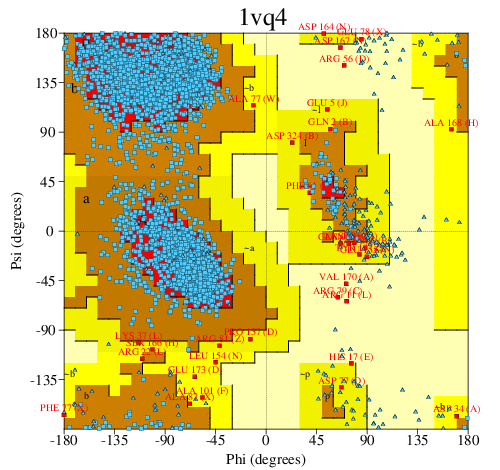
PROCHECK
|
|
|
|
|
|
Headers
|
|
|
|
References
|
|
|
|
|
|

|
|
P20276
(RL2_HALMA) -
Large ribosomal subunit protein uL2 from Haloarcula marismortui (strain ATCC 43049 / DSM 3752 / JCM 8966 / VKM B-1809)
|
|
|
|
Seq:
Struc:
|
|
|
|
240 a.a.
237 a.a.
|
|

|

|
|
|
|
|
|
|
|
|
|
|
|
|

|
|
P20279
(RL3_HALMA) -
Large ribosomal subunit protein uL3 from Haloarcula marismortui (strain ATCC 43049 / DSM 3752 / JCM 8966 / VKM B-1809)
|
|
|
|
Seq:
Struc:
|
|
|
|
338 a.a.
337 a.a.
|
|
|

|

|
|
|
|
|
|
|
|
|
|
|
|

|
|
P12735
(RL4_HALMA) -
Large ribosomal subunit protein uL4 from Haloarcula marismortui (strain ATCC 43049 / DSM 3752 / JCM 8966 / VKM B-1809)
|
|
|
|
Seq:
Struc:
|
|
|
|
246 a.a.
246 a.a.*
|
|
|

|
|
|
|
|
|
|
|
|
|
|
|
|

|
|
P14124
(RL5_HALMA) -
Large ribosomal subunit protein uL5 from Haloarcula marismortui (strain ATCC 43049 / DSM 3752 / JCM 8966 / VKM B-1809)
|
|
|
|
Seq:
Struc:
|
|
|
|
177 a.a.
140 a.a.
|
|
|

|
|
|
|
|
|
|
|
|
|
|
|
|

|
|
P14135
(RL6_HALMA) -
Large ribosomal subunit protein uL6 from Haloarcula marismortui (strain ATCC 43049 / DSM 3752 / JCM 8966 / VKM B-1809)
|
|
|
|
Seq:
Struc:
|
|
|
|
178 a.a.
172 a.a.
|
|
|

|
|
|
|
|
|
|
|
|
|
|
|
|

|
|
P12743
(RL7A_HALMA) -
Large ribosomal subunit protein eL8 from Haloarcula marismortui (strain ATCC 43049 / DSM 3752 / JCM 8966 / VKM B-1809)
|
|
|
|
Seq:
Struc:
|
|
|
|
120 a.a.
119 a.a.
|
|
|

|
|
|
|
|
|
|
|
|
|
|
|
|

|
|
P15825
(RL10_HALMA) -
Large ribosomal subunit protein uL10 from Haloarcula marismortui (strain ATCC 43049 / DSM 3752 / JCM 8966 / VKM B-1809)
|
|
|
|
Seq:
Struc:
|
|
|
|
348 a.a.
29 a.a.*
|
|
|

|

|
|
|
|
|
|
|
|
|
|
|
|

|
|
P60617
(RL10E_HALMA) -
Large ribosomal subunit protein uL16 from Haloarcula marismortui (strain ATCC 43049 / DSM 3752 / JCM 8966 / VKM B-1809)
|
|
|
|
Seq:
Struc:
|
|
|
|
177 a.a.
160 a.a.*
|
|
|

|
|
|
|
|
|
|
|
|
|
|
|
|

|
|
P29198
(RL13_HALMA) -
Large ribosomal subunit protein uL13 from Haloarcula marismortui (strain ATCC 43049 / DSM 3752 / JCM 8966 / VKM B-1809)
|
|
|
|
Seq:
Struc:
|
|
|
|
145 a.a.
142 a.a.
|
|
|
|
|
|
|
|
|
|
|
|
|
|
|
|

|
|
P22450
(RL14_HALMA) -
Large ribosomal subunit protein uL14 from Haloarcula marismortui (strain ATCC 43049 / DSM 3752 / JCM 8966 / VKM B-1809)
|
|
|
|
Seq:
Struc:
|
|
|
|
132 a.a.
132 a.a.*
|
|
|

|
|
|
|
|
|
|
|
|
|
|
|
|

|
|
P12737
(RL15_HALMA) -
Large ribosomal subunit protein uL15 from Haloarcula marismortui (strain ATCC 43049 / DSM 3752 / JCM 8966 / VKM B-1809)
|
|
|
|
Seq:
Struc:
|
|
|
|
165 a.a.
145 a.a.
|
|
|

|
|
|
|
|
|
|
|
|
|
|
|
|

|
|
P60618
(RL15E_HALMA) -
Large ribosomal subunit protein eL15 from Haloarcula marismortui (strain ATCC 43049 / DSM 3752 / JCM 8966 / VKM B-1809)
|
|
|
|
Seq:
Struc:
|
|
|
|
196 a.a.
194 a.a.*
|
|
|

|
|
|
|
|
|
|
|
|
|
|
|
|

|
|
P14123
(RL18_HALMA) -
Large ribosomal subunit protein uL18 from Haloarcula marismortui (strain ATCC 43049 / DSM 3752 / JCM 8966 / VKM B-1809)
|
|
|
|
Seq:
Struc:
|
|
|
|
187 a.a.
186 a.a.
|
|
|

|
|
|
|
|
|
|
|
|
|
|
|
|

|
|
P12733
(RL18E_HALMA) -
Large ribosomal subunit protein eL18 from Haloarcula marismortui (strain ATCC 43049 / DSM 3752 / JCM 8966 / VKM B-1809)
|
|
|
|
Seq:
Struc:
|
|
|
|
116 a.a.
115 a.a.
|
|
|

|
|
|
|
|
|
|
|
|
|
|
|
|

|
|
P14119
(RL19E_HALMA) -
Large ribosomal subunit protein eL19 from Haloarcula marismortui (strain ATCC 43049 / DSM 3752 / JCM 8966 / VKM B-1809)
|
|
|
|
Seq:
Struc:
|
|
|
|
149 a.a.
143 a.a.
|
|
|
|
|
|
|
|
|
|
|
|
|
|
|
|

|
|
P12734
(RL21_HALMA) -
Large ribosomal subunit protein eL21 from Haloarcula marismortui (strain ATCC 43049 / DSM 3752 / JCM 8966 / VKM B-1809)
|
|
|
|
Seq:
Struc:
|
|
|
|
96 a.a.
95 a.a.
|
|
|

|
|
|
|
|
|
|
|
|
|
|
|
|

|
|
P10970
(RL22_HALMA) -
Large ribosomal subunit protein uL22 from Haloarcula marismortui (strain ATCC 43049 / DSM 3752 / JCM 8966 / VKM B-1809)
|
|
|
|
Seq:
Struc:
|
|
|
|
155 a.a.
150 a.a.
|
|
|
|
|
|
|
|
|
|
|
|
|
|
|
|

|
|
P12732
(RL23_HALMA) -
Large ribosomal subunit protein uL23 from Haloarcula marismortui (strain ATCC 43049 / DSM 3752 / JCM 8966 / VKM B-1809)
|
|
|
|
Seq:
Struc:
|
|
|
|
85 a.a.
81 a.a.
|
|
|

|
|
|
|
|
|
|
|
|
|
|
|
|

|
|
P10972
(RL24_HALMA) -
Large ribosomal subunit protein uL24 from Haloarcula marismortui (strain ATCC 43049 / DSM 3752 / JCM 8966 / VKM B-1809)
|
|
|
|
Seq:
Struc:
|
|
|
|
120 a.a.
119 a.a.
|
|
|

|
|
|
|
|
|
|
|
|
|
|
|
|

|
|
P14116
(RL24E_HALMA) -
Large ribosomal subunit protein eL24 from Haloarcula marismortui (strain ATCC 43049 / DSM 3752 / JCM 8966 / VKM B-1809)
|
|
|
|
Seq:
Struc:
|
|
|
|
67 a.a.
53 a.a.
|
|
|

|
|
|
|
|
|
|
|
|
|
|
|
|

|
|
P10971
(RL29_HALMA) -
Large ribosomal subunit protein uL29 from Haloarcula marismortui (strain ATCC 43049 / DSM 3752 / JCM 8966 / VKM B-1809)
|
|
|
|
Seq:
Struc:
|
|
|
|
71 a.a.
65 a.a.
|
|
|

|
|
|
|
|
|
|
|
|
|
|
|
|

|
|
P14121
(RL30_HALMA) -
Large ribosomal subunit protein uL30 from Haloarcula marismortui (strain ATCC 43049 / DSM 3752 / JCM 8966 / VKM B-1809)
|
|
|
|
Seq:
Struc:
|
|
|
|
154 a.a.
154 a.a.
|
|
|

|
|
|
|
|
|
|
|
|
|
|
|
|

|
|
P18138
(RL31_HALMA) -
Large ribosomal subunit protein eL31 from Haloarcula marismortui (strain ATCC 43049 / DSM 3752 / JCM 8966 / VKM B-1809)
|
|
|
|
Seq:
Struc:
|
|
|
|
92 a.a.
82 a.a.
|
|
|

|
|
|
|
|
|
|
|
|
|
|
|
|

|
|
P12736
(RL32_HALMA) -
Large ribosomal subunit protein eL32 from Haloarcula marismortui (strain ATCC 43049 / DSM 3752 / JCM 8966 / VKM B-1809)
|
|
|
|
Seq:
Struc:
|
|
|
|
241 a.a.
142 a.a.
|
|
|

|
|
|
|
|
|
|
|
|
|
|
|
|

|
|
P60619
(RL37A_HALMA) -
Large ribosomal subunit protein eL43 from Haloarcula marismortui (strain ATCC 43049 / DSM 3752 / JCM 8966 / VKM B-1809)
|
|
|
|
Seq:
Struc:
|
|
|
|
92 a.a.
73 a.a.*
|
|
|

|
|
|
|
|
|
|
|
|
|
|
|
|

|
|
P32410
(RL37_HALMA) -
Large ribosomal subunit protein eL37 from Haloarcula marismortui (strain ATCC 43049 / DSM 3752 / JCM 8966 / VKM B-1809)
|
|
|
|
Seq:
Struc:
|
|
|
|
57 a.a.
56 a.a.
|
|
|

|
|
|
|
|
|
|
|
|
|
|
|
|

|
|
P22452
(RL39_HALMA) -
Large ribosomal subunit protein eL39 from Haloarcula marismortui (strain ATCC 43049 / DSM 3752 / JCM 8966 / VKM B-1809)
|
|
|
|
Seq:
Struc:
|
|
|
|
50 a.a.
46 a.a.
|
|
|

|
|
|
|
|
|
|
|
|
|
|
|
|
|
|
|
|
|
Enzyme class:
|
|
Chains A, B, C, D, E, F, G, H, J, K, L, M, N, O, P, Q, R, S, T, U, V, W, X, Y, Z, 1, 2, 3, I:
E.C.?
|
|
|
|
|
|
|
|
|
|
|
|
|
|
|
|
|
|
|
 |
|
|
|
|
|
|
| |
|
DOI no:
|
Mol Cell
20:437-448
(2005)
|
|
PubMed id:
|
|
|
|
|
|
| |
|
Structural insights into the roles of water and the 2' hydroxyl of the P site tRNA in the peptidyl transferase reaction.
|
|
T.M.Schmeing,
K.S.Huang,
D.E.Kitchen,
S.A.Strobel,
T.A.Steitz.
|
|
|
|
|
| |
ABSTRACT
|
|
|
|
| |
|
|
Peptide bond formation is catalyzed at the peptidyl transferase center (PTC) of
the large ribosomal subunit. Crystal structures of the large ribosomal subunit
of Haloarcula marismortui (Hma) complexed with several analogs that represent
either the substrates or the transition state intermediate of the peptidyl
transferase reaction show that this reaction proceeds through a tetrahedral
intermediate with S chirality. The oxyanion of the tetrahedral intermediate
interacts with a water molecule that is positioned by nucleotides A2637 (E. coli
numbering, 2602) and (methyl)U2619(2584). There are no Mg2+ ions or monovalent
metal ions observed in the PTC that could directly promote catalysis. The A76 2'
hydroxyl of the peptidyl-tRNA is hydrogen bonded to the alpha-amino group and
could facilitate peptide bond formation by substrate positioning and by acting
as a proton shuttle between the alpha-amino group and the A76 3' hydroxyl of the
peptidyl-tRNA.
|
|
|
|
|
|
| |
Selected figure(s)
|
|
|
|
| |
|
|

|
|

|
|
Figure 1.
Figure 1. Unbiased F[o] − F[c] Electron Density Maps for
Some of the Complexes of the 50S Subunit Bound with Peptidyl
Transferase Ligands, All Contoured at 3 σ
|
|
Figure 6.
Figure 6. The Reaction Pathway for Peptide Bond Formation
|
|
|
|
|
|
| |
The above figures are
reprinted
by permission from Cell Press:
Mol Cell
(2005,
20,
437-448)
copyright 2005.
|
|
| |
Figures were
selected
by an automated process.
|
|
|
|
|
|
|
|
|
|
|
|
|
|
|
|
 |
 |
 |
|
Literature references that cite this PDB file's key reference
|
|
|
| |
PubMed id
|
|
Reference
|
|
|
|
|
|
H.J.Kang,
and
E.N.Baker
(2011).
Intramolecular isopeptide bonds: protein crosslinks built for stress?
|
| |
Trends Biochem Sci,
36,
229-237.
|
|
|
|
|
|
|
H.Ramu,
N.Vázquez-Laslop,
D.Klepacki,
Q.Dai,
J.Piccirilli,
R.Micura,
and
A.S.Mankin
(2011).
Nascent peptide in the ribosome exit tunnel affects functional properties of the A-site of the peptidyl transferase center.
|
| |
Mol Cell,
41,
321-330.
|
|
|
|
|
|
|
K.S.Krishnakumar,
B.Y.Michel,
N.Q.Nguyen-Trung,
B.Fenet,
and
P.Strazewski
(2011).
Intrinsic pK(a) values of 3'-N-α-l-aminoacyl-3'-aminodeoxyadenosines determined by pH dependent (1)H NMR in H(2)O.
|
| |
Chem Commun (Camb),
47,
3290-3292.
|
|
|
|
|
|
|
M.Johansson,
K.W.Ieong,
S.Trobro,
P.Strazewski,
J.Åqvist,
M.Y.Pavlov,
and
M.Ehrenberg
(2011).
pH-sensitivity of the ribosomal peptidyl transfer reaction dependent on the identity of the A-site aminoacyl-tRNA.
|
| |
Proc Natl Acad Sci U S A,
108,
79-84.
|
|
|
|
|
|
|
S.Bhushan,
T.Hoffmann,
B.Seidelt,
J.Frauenfeld,
T.Mielke,
O.Berninghausen,
D.N.Wilson,
and
R.Beckmann
(2011).
SecM-stalled ribosomes adopt an altered geometry at the peptidyl transferase center.
|
| |
PLoS Biol,
9,
e1000581.
|
|
|
|
|
|
|
S.Kuhlenkoetter,
W.Wintermeyer,
and
M.V.Rodnina
(2011).
Different substrate-dependent transition states in the active site of the ribosome.
|
| |
Nature,
476,
351-354.
|
|
|
|
|
|
|
A.Chirkova,
M.D.Erlacher,
N.Clementi,
M.Zywicki,
M.Aigner,
and
N.Polacek
(2010).
The role of the universally conserved A2450-C2063 base pair in the ribosomal peptidyl transferase center.
|
| |
Nucleic Acids Res,
38,
4844-4855.
|
|
|
|
|
|
|
D.A.Hiller,
M.Zhong,
V.Singh,
and
S.A.Strobel
(2010).
Transition states of uncatalyzed hydrolysis and aminolysis reactions of a ribosomal P-site substrate determined by kinetic isotope effects.
|
| |
Biochemistry,
49,
3868-3878.
|
|
|
|
|
|
|
D.B.Johnson,
and
L.Wang
(2010).
Imprints of the genetic code in the ribosome.
|
| |
Proc Natl Acad Sci U S A,
107,
8298-8303.
|
|
|
|
|
|
|
G.Wallin,
and
J.Aqvist
(2010).
The transition state for peptide bond formation reveals the ribosome as a water trap.
|
| |
Proc Natl Acad Sci U S A,
107,
1888-1893.
|
|
|
|
|
|
|
H.Jin,
A.C.Kelley,
D.Loakes,
and
V.Ramakrishnan
(2010).
Structure of the 70S ribosome bound to release factor 2 and a substrate analog provides insights into catalysis of peptide release.
|
| |
Proc Natl Acad Sci U S A,
107,
8593-8598.
|
|
|
PDB codes:
|
|
|
|
|
|
|
|
M.Ehrenberg
(2010).
Protein synthesis: Translocation in slow motion.
|
| |
Nature,
466,
325-326.
|
|
|
|
|
|
|
M.V.Rodnina,
and
W.Wintermeyer
(2010).
The ribosome goes Nobel.
|
| |
Trends Biochem Sci,
35,
1-5.
|
|
|
|
|
|
|
N.B.Ulyanov,
and
T.L.James
(2010).
RNA structural motifs that entail hydrogen bonds involving sugar-phosphate backbone atoms of RNA.
|
| |
New J Chem,
34,
910-917.
|
|
|
|
|
|
|
R.E.Watts,
and
A.C.Forster
(2010).
Chemical models of peptide formation in translation.
|
| |
Biochemistry,
49,
2177-2185.
|
|
|
|
|
|
|
S.Bhushan,
H.Meyer,
A.L.Starosta,
T.Becker,
T.Mielke,
O.Berninghausen,
M.Sattler,
D.N.Wilson,
and
R.Beckmann
(2010).
Structural basis for translational stalling by human cytomegalovirus and fungal arginine attenuator peptide.
|
| |
Mol Cell,
40,
138-146.
|
|
|
PDB code:
|
|
|
|
|
|
|
|
S.Bhushan,
M.Gartmann,
M.Halic,
J.P.Armache,
A.Jarasch,
T.Mielke,
O.Berninghausen,
D.N.Wilson,
and
R.Beckmann
(2010).
alpha-Helical nascent polypeptide chains visualized within distinct regions of the ribosomal exit tunnel.
|
| |
Nat Struct Mol Biol,
17,
313-317.
|
|
|
|
|
|
|
X.Ge,
and
B.Roux
(2010).
Calculation of the standard binding free energy of sparsomycin to the ribosomal peptidyl-transferase P-site using molecular dynamics simulations with restraining potentials.
|
| |
J Mol Recognit,
23,
128-141.
|
|
|
|
|
|
|
A.Yonath
(2009).
Large facilities and the evolving ribosome, the cellular machine for genetic-code translation.
|
| |
J R Soc Interface,
6,
S575-S585.
|
|
|
|
|
|
|
B.Seidelt,
C.A.Innis,
D.N.Wilson,
M.Gartmann,
J.P.Armache,
E.Villa,
L.G.Trabuco,
T.Becker,
T.Mielke,
K.Schulten,
T.A.Steitz,
and
R.Beckmann
(2009).
Structural insight into nascent polypeptide chain-mediated translational stalling.
|
| |
Science,
326,
1412-1415.
|
|
|
PDB codes:
|
|
|
|
|
|
|
|
D.N.Wilson
(2009).
The A-Z of bacterial translation inhibitors.
|
| |
Crit Rev Biochem Mol Biol,
44,
393-433.
|
|
|
|
|
|
|
E.Zimmerman,
and
A.Yonath
(2009).
Biological implications of the ribosome's stunning stereochemistry.
|
| |
Chembiochem,
10,
63-72.
|
|
|
|
|
|
|
G.Gürel,
G.Blaha,
P.B.Moore,
and
T.A.Steitz
(2009).
U2504 determines the species specificity of the A-site cleft antibiotics: the structures of tiamulin, homoharringtonine, and bruceantin bound to the ribosome.
|
| |
J Mol Biol,
389,
146-156.
|
|
|
PDB codes:
|
|
|
|
|
|
|
|
G.Gürel,
G.Blaha,
T.A.Steitz,
and
P.B.Moore
(2009).
Structures of triacetyloleandomycin and mycalamide A bind to the large ribosomal subunit of Haloarcula marismortui.
|
| |
Antimicrob Agents Chemother,
53,
5010-5014.
|
|
|
PDB codes:
|
|
|
|
|
|
|
|
M.Simonović,
and
T.A.Steitz
(2009).
A structural view on the mechanism of the ribosome-catalyzed peptide bond formation.
|
| |
Biochim Biophys Acta,
1789,
612-623.
|
|
|
|
|
|
|
R.M.Voorhees,
A.Weixlbaumer,
D.Loakes,
A.C.Kelley,
and
V.Ramakrishnan
(2009).
Insights into substrate stabilization from snapshots of the peptidyl transferase center of the intact 70S ribosome.
|
| |
Nat Struct Mol Biol,
16,
528-533.
|
|
|
PDB codes:
|
|
|
|
|
|
|
|
T.M.Schmeing,
and
V.Ramakrishnan
(2009).
What recent ribosome structures have revealed about the mechanism of translation.
|
| |
Nature,
461,
1234-1242.
|
|
|
|
|
|
|
W.K.Olson,
M.Esguerra,
Y.Xin,
and
X.J.Lu
(2009).
New information content in RNA base pairing deduced from quantitative analysis of high-resolution structures.
|
| |
Methods,
47,
177-186.
|
|
|
|
|
|
|
X.Agirrezabala,
and
J.Frank
(2009).
Elongation in translation as a dynamic interaction among the ribosome, tRNA, and elongation factors EF-G and EF-Tu.
|
| |
Q Rev Biophys,
42,
159-200.
|
|
|
|
|
|
|
A.Bashan,
and
A.Yonath
(2008).
The linkage between ribosomal crystallography, metal ions, heteropolytungstates and functional flexibility.
|
| |
J Mol Struct,
890,
289-294.
|
|
|
|
|
|
|
A.Minajigi,
and
C.S.Francklyn
(2008).
RNA-assisted catalysis in a protein enzyme: The 2'-hydroxyl of tRNA(Thr) A76 promotes aminoacylation by threonyl-tRNA synthetase.
|
| |
Proc Natl Acad Sci U S A,
105,
17748-17753.
|
|
|
|
|
|
|
D.A.Kingery,
E.Pfund,
R.M.Voorhees,
K.Okuda,
I.Wohlgemuth,
D.E.Kitchen,
M.V.Rodnina,
and
S.A.Strobel
(2008).
An uncharged amine in the transition state of the ribosomal peptidyl transfer reaction.
|
| |
Chem Biol,
15,
493-500.
|
|
|
|
|
|
|
E.M.Youngman,
M.E.McDonald,
and
R.Green
(2008).
Peptide release on the ribosome: mechanism and implications for translational control.
|
| |
Annu Rev Microbiol,
62,
353-373.
|
|
|
|
|
|
|
I.Wohlgemuth,
S.Brenner,
M.Beringer,
and
M.V.Rodnina
(2008).
Modulation of the rate of peptidyl transfer on the ribosome by the nature of substrates.
|
| |
J Biol Chem,
283,
32229-32235.
|
|
|
|
|
|
|
J.L.Brunelle,
J.J.Shaw,
E.M.Youngman,
and
R.Green
(2008).
Peptide release on the ribosome depends critically on the 2' OH of the peptidyl-tRNA substrate.
|
| |
RNA,
14,
1526-1531.
|
|
|
|
|
|
|
K.S.Huang,
N.Carrasco,
E.Pfund,
and
S.A.Strobel
(2008).
Transition state chirality and role of the vicinal hydroxyl in the ribosomal peptidyl transferase reaction.
|
| |
Biochemistry,
47,
8822-8827.
|
|
|
|
|
|
|
M.Beringer
(2008).
Modulating the activity of the peptidyl transferase center of the ribosome.
|
| |
RNA,
14,
795-801.
|
|
|
|
|
|
|
M.Johansson,
E.Bouakaz,
M.Lovmar,
and
M.Ehrenberg
(2008).
The kinetics of ribosomal peptidyl transfer revisited.
|
| |
Mol Cell,
30,
589-598.
|
|
|
|
|
|
|
M.Laurberg,
H.Asahara,
A.Korostelev,
J.Zhu,
S.Trakhanov,
and
H.F.Noller
(2008).
Structural basis for translation termination on the 70S ribosome.
|
| |
Nature,
454,
852-857.
|
|
|
PDB codes:
|
|
|
|
|
|
|
|
M.Simonović,
and
T.A.Steitz
(2008).
Cross-crystal averaging reveals that the structure of the peptidyl-transferase center is the same in the 70S ribosome and the 50S subunit.
|
| |
Proc Natl Acad Sci U S A,
105,
500-505.
|
|
|
|
|
|
|
M.Simonović,
and
T.A.Steitz
(2008).
Peptidyl-CCA deacylation on the ribosome promoted by induced fit and the O3'-hydroxyl group of A76 of the unacylated A-site tRNA.
|
| |
RNA,
14,
2372-2378.
|
|
|
PDB codes:
|
|
|
|
|
|
|
|
T.A.Steitz
(2008).
A structural understanding of the dynamic ribosome machine.
|
| |
Nat Rev Mol Cell Biol,
9,
242-253.
|
|
|
|
|
|
|
T.A.Steitz
(2008).
Structural insights into the functions of the large ribosomal subunit, a major antibiotic target.
|
| |
Keio J Med,
57,
1.
|
|
|
|
|
|
|
A.T.Torelli,
J.Krucinska,
and
J.E.Wedekind
(2007).
A comparison of vanadate to a 2'-5' linkage at the active site of a small ribozyme suggests a role for water in transition-state stabilization.
|
| |
RNA,
13,
1052-1070.
|
|
|
PDB codes:
|
|
|
|
|
|
|
|
A.V.Manuilov,
S.S.Hixson,
and
R.A.Zimmermann
(2007).
New photoreactive tRNA derivatives for probing the peptidyl transferase center of the ribosome.
|
| |
RNA,
13,
793-800.
|
|
|
|
|
|
|
E.S.Poole,
D.J.Young,
M.E.Askarian-Amiri,
D.J.Scarlett,
and
W.P.Tate
(2007).
Accommodating the bacterial decoding release factor as an alien protein among the RNAs at the active site of the ribosome.
|
| |
Cell Res,
17,
591-607.
|
|
|
|
|
|
|
H.Tjong,
and
H.X.Zhou
(2007).
DISPLAR: an accurate method for predicting DNA-binding sites on protein surfaces.
|
| |
Nucleic Acids Res,
35,
1465-1477.
|
|
|
|
|
|
|
J.F.Atkins,
N.M.Wills,
G.Loughran,
C.Y.Wu,
K.Parsawar,
M.D.Ryan,
C.H.Wang,
and
C.C.Nelson
(2007).
A case for "StopGo": reprogramming translation to augment codon meaning of GGN by promoting unconventional termination (Stop) after addition of glycine and then allowing continued translation (Go).
|
| |
RNA,
13,
803-810.
|
|
|
|
|
|
|
J.J.Shaw,
and
R.Green
(2007).
Two distinct components of release factor function uncovered by nucleophile partitioning analysis.
|
| |
Mol Cell,
28,
458-467.
|
|
|
|
|
|
|
J.S.Weinger,
and
S.A.Strobel
(2007).
Exploring the mechanism of protein synthesis with modified substrates and novel intermediate mimics.
|
| |
Blood Cells Mol Dis,
38,
110-116.
|
|
|
|
|
|
|
K.Watanabe,
Y.Toh,
K.Suto,
Y.Shimizu,
N.Oka,
T.Wada,
and
K.Tomita
(2007).
Protein-based peptide-bond formation by aminoacyl-tRNA protein transferase.
|
| |
Nature,
449,
867-871.
|
|
|
PDB codes:
|
|
|
|
|
|
|
|
M.Amort,
B.Wotzel,
K.Bakowska-Zywicka,
M.D.Erlacher,
R.Micura,
and
N.Polacek
(2007).
An intact ribose moiety at A2602 of 23S rRNA is key to trigger peptidyl-tRNA hydrolysis during translation termination.
|
| |
Nucleic Acids Res,
35,
5130-5140.
|
|
|
|
|
|
|
M.Beringer,
and
M.V.Rodnina
(2007).
Importance of tRNA interactions with 23S rRNA for peptide bond formation on the ribosome: studies with substrate analogs.
|
| |
Biol Chem,
388,
687-691.
|
|
|
|
|
|
|
M.Beringer,
and
M.V.Rodnina
(2007).
The ribosomal peptidyl transferase.
|
| |
Mol Cell,
26,
311-321.
|
|
|
|
|
|
|
M.V.Rodnina,
M.Beringer,
and
W.Wintermeyer
(2007).
How ribosomes make peptide bonds.
|
| |
Trends Biochem Sci,
32,
20-26.
|
|
|
|
|
|
|
N.G.Walter
(2007).
Ribozyme catalysis revisited: is water involved?
|
| |
Mol Cell,
28,
923-929.
|
|
|
|
|
|
|
S.A.Strobel,
and
J.C.Cochrane
(2007).
RNA catalysis: ribozymes, ribosomes, and riboswitches.
|
| |
Curr Opin Chem Biol,
11,
636-643.
|
|
|
|
|
|
|
V.Berk,
and
J.H.Cate
(2007).
Insights into protein biosynthesis from structures of bacterial ribosomes.
|
| |
Curr Opin Struct Biol,
17,
302-309.
|
|
|
|
|
|
|
A.Korostelev,
S.Trakhanov,
M.Laurberg,
and
H.F.Noller
(2006).
Crystal structure of a 70S ribosome-tRNA complex reveals functional interactions and rearrangements.
|
| |
Cell,
126,
1065-1077.
|
|
|
PDB codes:
|
|
|
|
|
|
|
|
I.Wohlgemuth,
M.Beringer,
and
M.V.Rodnina
(2006).
Rapid peptide bond formation on isolated 50S ribosomal subunits.
|
| |
EMBO Rep,
7,
699-703.
|
|
|
|
|
|
|
J.S.Weinger,
and
S.A.Strobel
(2006).
Participation of the tRNA A76 hydroxyl groups throughout translation.
|
| |
Biochemistry,
45,
5939-5948.
|
|
|
|
|
|
|
J.Salter,
J.Krucinska,
S.Alam,
V.Grum-Tokars,
and
J.E.Wedekind
(2006).
Water in the active site of an all-RNA hairpin ribozyme and effects of Gua8 base variants on the geometry of phosphoryl transfer.
|
| |
Biochemistry,
45,
686-700.
|
|
|
PDB codes:
|
|
|
|
|
|
|
|
P.Bieling,
M.Beringer,
S.Adio,
and
M.V.Rodnina
(2006).
Peptide bond formation does not involve acid-base catalysis by ribosomal residues.
|
| |
Nat Struct Mol Biol,
13,
423-428.
|
|
|
|
|
|
The most recent references are shown first.
Citation data come partly from CiteXplore and partly
from an automated harvesting procedure. Note that this is likely to be
only a partial list as not all journals are covered by
either method. However, we are continually building up the citation data
so more and more references will be included with time.
Where a reference describes a PDB structure, the PDB
codes are
shown on the right.
|

| |


 Links
Links





