
|
|
|
|
|
 |
Contents |
 |
|
|
|
|
|
|
|
|
|
|
|
 96 a.a.
|
|
|
|
|
|
|
|
|
|
|
 90 a.a.
|
|
|
|
|
|
|
|
|
|
|
 20 a.a.
|
|
|
|
|
|
|
|
|
|
|
 18 a.a.
|
|
|
|
|
|
|
|
|
* Residue conservation analysis
|
|
|
|
|
|
PDB id:
|
|
|
|
| Name: |
|
Growth factor/growth factor inhibitor
|
|
|
Title:
|
|
Complex between vegf and a receptor blocking peptide
|
|
Structure:
|
|
Protein (vascular endothelial growth factor). Chain: v, w. Fragment: receptor binding domain. Synonym: vegf, vascular permeability factor, vpf. Engineered: yes. Protein (peptide v108). Chain: x, y. Fragment: receptor blocking peptide. Engineered: yes
|
|
Source:
|
|
Homo sapiens. Human. Organism_taxid: 9606. Expressed in: escherichia coli. Expression_system_taxid: 562. Synthetic: yes. Other_details: this sequence is chemically synthesized
|
|
Biol. unit:
|
|
Tetramer (from
)
|
|
Resolution:
|
|
|
1.90Å
|
R-factor:
|
0.190
|
R-free:
|
0.270
|
|
|
Authors:
|
|
C.Wiesmann,H.W.Christinger,A.G.Cochran,B.C.Cunningham, W.J.Fairbrother,C.J.Keenan,G.Meng,A.M.De Vos
|
Key ref:

|
|
C.Wiesmann
et al.
(1998).
Crystal structure of the complex between VEGF and a receptor-blocking peptide.
Biochemistry,
37,
17765-17772.
PubMed id:
DOI:
|
|
|
Date:
|
|
|
09-Oct-98
|
Release date:
|
23-Feb-99
|
|
|
|
|
|
|
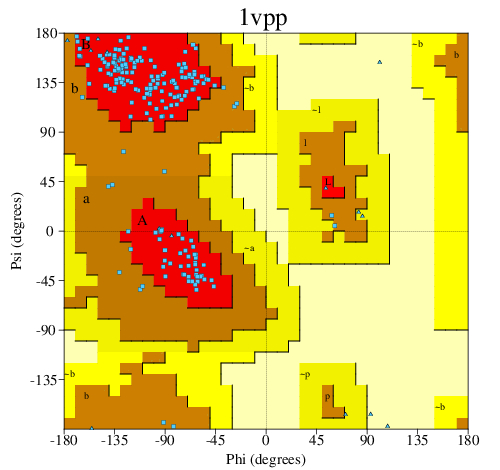
PROCHECK
|
|
|
|
|
|
Headers
|
|
|
|
References
|
|
|
|
|
|

|
|
P15692
(VEGFA_HUMAN) -
Vascular endothelial growth factor A, long form from Homo sapiens
|
|
|
|
Seq:
Struc:
|
|
|
|
395 a.a.
96 a.a.
|
|

|

|

|
|
|
|
|
|
|
|
|
|
|
|

|
|
P15692
(VEGFA_HUMAN) -
Vascular endothelial growth factor A, long form from Homo sapiens
|
|
|
|
Seq:
Struc:
|
|
|
|
395 a.a.
90 a.a.
|
|
|

|

|
|
|
|
|
|
|
|
|
|
|
|
|
|
|
|
|
|
|
|
|
 |
|
|
|
|
|
|
| |
|
DOI no:
|
Biochemistry
37:17765-17772
(1998)
|
|
PubMed id:
|
|
|
|
|
|
| |
|
Crystal structure of the complex between VEGF and a receptor-blocking peptide.
|
|
C.Wiesmann,
H.W.Christinger,
A.G.Cochran,
B.C.Cunningham,
W.J.Fairbrother,
C.J.Keenan,
G.Meng,
A.M.de Vos.
|
|
|
|
|
| |
ABSTRACT
|
|
|
|
| |
|
|
Vascular endothelial growth factor (VEGF) is a specific and potent angiogenic
factor and, therefore, a prime therapeutic target for the development of
antagonists for the treatment of cancer. As a first step toward this goal, phage
display was used to generate peptides that bind to the receptor-binding domain
(residues 8-109) of VEGF and compete with receptor [Fairbrother, W. J.,
Christinger, H. W., Cochran, A. G., Fuh, G., Keenan, C. J., Quan, C., Shriver,
S. K., Tom, J. Y. K., Wells, J. A., and Cunningham, B. C. (1999) Biochemistry
38, 17754-17764]. The crystal structure of VEGF in complex with one of these
peptides was solved and refined to a resolution of 1.9 A. The 20-mer peptide is
unstructured in solution and adopts a largely extended conformation when bound
to VEGF. Residues 3-8 form a beta-strand which pairs with strand beta6 of VEGF
via six hydrogen bonds. The C-terminal four residues of the peptide point away
from the growth factor, consistent with NMR data indicating that these residues
are flexible in the complex in solution. In contrast, shortening the N-terminus
of the peptide leads to decreased binding affinities. Truncation studies show
that the peptide can be reduced to 14 residues with only moderate effect on
binding affinity. However, because of the extended conformation and the scarcity
of specific side-chain interactions with VEGF, the peptide is not a promising
lead for small-molecule development. The interface between the peptide and VEGF
contains a subset of the residues recognized by a neutralizing Fab fragment and
overlaps partially with the binding site for the Flt-1 receptor. The location of
the peptide-binding site and the hydrophilic character of the interactions with
VEGF resemble more the binding mode of the Fab fragment than that of the
receptor.
|
|
|
|
|
|
|
|
|
|
|
|
|
|
|
|
|
|
 |
 |
 |
|
Literature references that cite this PDB file's key reference
|
|
|
| |
PubMed id
|
|
Reference
|
|
|
|
|
|
L.Li,
B.P.Orner,
T.Huang,
A.P.Hinck,
and
L.L.Kiessling
(2010).
Peptide ligands that use a novel binding site to target both TGF-β receptors.
|
| |
Mol Biosyst,
6,
2392-2402.
|
|
|
|
|
|
|
A.S.Potty,
K.Kourentzi,
H.Fang,
G.W.Jackson,
X.Zhang,
G.B.Legge,
and
R.C.Willson
(2009).
Biophysical characterization of DNA aptamer interactions with vascular endothelial growth factor.
|
| |
Biopolymers,
91,
145-156.
|
|
|
|
|
|
|
E.Vivès,
J.Schmidt,
and
A.Pèlegrin
(2008).
Cell-penetrating and cell-targeting peptides in drug delivery.
|
| |
Biochim Biophys Acta,
1786,
126-138.
|
|
|
|
|
|
|
J.H.Lee,
F.Jucker,
and
A.Pardi
(2008).
Imino proton exchange rates imply an induced-fit binding mechanism for the VEGF165-targeting aptamer, Macugen.
|
| |
FEBS Lett,
582,
1835-1839.
|
|
|
|
|
|
|
G.Fuh,
P.Wu,
W.C.Liang,
M.Ultsch,
C.V.Lee,
B.Moffat,
and
C.Wiesmann
(2006).
Structure-function studies of two synthetic anti-vascular endothelial growth factor Fabs and comparison with the Avastin Fab.
|
| |
J Biol Chem,
281,
6625-6631.
|
|
|
PDB codes:
|
|
|
|
|
|
|
|
L.D.D'Andrea,
A.Del Gatto,
C.Pedone,
and
E.Benedetti
(2006).
Peptide-based molecules in angiogenesis.
|
| |
Chem Biol Drug Des,
67,
115-126.
|
|
|
|
|
|
|
S.Cébe-Suarez,
A.Zehnder-Fjällman,
and
K.Ballmer-Hofer
(2006).
The role of VEGF receptors in angiogenesis; complex partnerships.
|
| |
Cell Mol Life Sci,
63,
601-615.
|
|
|
|
|
|
|
L.D.D'Andrea,
G.Iaccarino,
R.Fattorusso,
D.Sorriento,
C.Carannante,
D.Capasso,
B.Trimarco,
and
C.Pedone
(2005).
Targeting angiogenesis: structural characterization and biological properties of a de novo engineered VEGF mimicking peptide.
|
| |
Proc Natl Acad Sci U S A,
102,
14215-14220.
|
|
|
|
|
|
|
L.Gardiner,
B.J.Coyle,
W.C.Chan,
and
P.Soultanas
(2005).
Discovery of antagonist peptides against bacterial helicase-primase interaction in B. stearothermophilus by reverse yeast three-hybrid.
|
| |
Chem Biol,
12,
595-604.
|
|
|
|
|
|
|
A.C.Anderson
(2003).
The process of structure-based drug design.
|
| |
Chem Biol,
10,
787-797.
|
|
|
|
|
|
|
A.Kiba,
N.Yabana,
and
M.Shibuya
(2003).
A set of loop-1 and -3 structures in the novel vascular endothelial growth factor (VEGF) family member, VEGF-ENZ-7, is essential for the activation of VEGFR-2 signaling.
|
| |
J Biol Chem,
278,
13453-13461.
|
|
|
|
|
|
|
S.S.Sidhu,
W.J.Fairbrother,
and
K.Deshayes
(2003).
Exploring protein-protein interactions with phage display.
|
| |
Chembiochem,
4,
14-25.
|
|
|
|
|
|
|
T.P.Boesen,
B.Soni,
T.W.Schwartz,
and
T.Halkier
(2002).
Single-chain vascular endothelial growth factor variant with antagonist activity.
|
| |
J Biol Chem,
277,
40335-40341.
|
|
|
|
|
|
|
Y.A.Muller,
C.Heiring,
R.Misselwitz,
K.Welfle,
and
H.Welfle
(2002).
The cystine knot promotes folding and not thermodynamic stability in vascular endothelial growth factor.
|
| |
J Biol Chem,
277,
43410-43416.
|
|
|
PDB codes:
|
|
|
|
|
|
|
|
D.J.Christensen,
E.B.Gottlin,
R.E.Benson,
and
P.T.Hamilton
(2001).
Phage display for target-based antibacterial drug discovery.
|
| |
Drug Discov Today,
6,
721-727.
|
|
|
|
|
|
|
A.G.Cochran
(2000).
Antagonists of protein-protein interactions.
|
| |
Chem Biol,
7,
R85-R94.
|
|
|
|
|
|
|
M.C.Deller,
and
E.Yvonne Jones
(2000).
Cell surface receptors.
|
| |
Curr Opin Struct Biol,
10,
213-219.
|
|
|
|
|
|
|
R.W.Roberts,
and
W.W.Ja
(1999).
In vitro selection of nucleic acids and proteins: What are we learning?
|
| |
Curr Opin Struct Biol,
9,
521-529.
|
|
|
|
|
|
The most recent references are shown first.
Citation data come partly from CiteXplore and partly
from an automated harvesting procedure. Note that this is likely to be
only a partial list as not all journals are covered by
either method. However, we are continually building up the citation data
so more and more references will be included with time.
Where a reference describes a PDB structure, the PDB
codes are
shown on the right.
|

| |


 Links
Links


