|
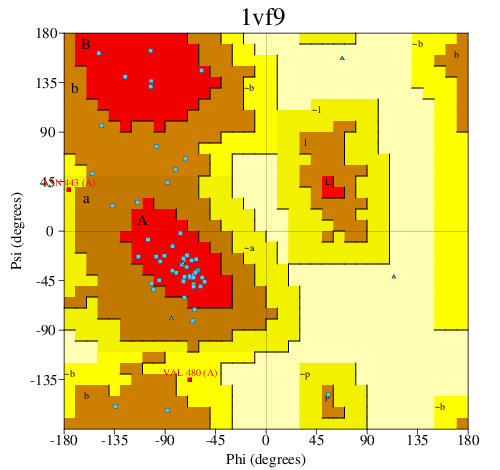
PDBsum entry 1vf9

|
|
|
|
|
|

|

|

|

|
|

|
|

|
|

|
|
|
 |

|

|
|
|
|
|
|
|
|
|
|
|
|
|
|
|
|
|
|
|
|
|
|
|
|
|
|
|
|
|
|
|
|
DNA binding protein
|
PDB id
|
|
|
|
1vf9
|
|
|
|
|
|
|
|
|
|
|
|
|
|
|

|

|

|
|
|
|
|
|
|
|
 |
Contents |
 |
|
|
|
|
|
|
|
|
* Residue conservation analysis
|
|
|
|
|
|
|
|
|
|
|
|
|
|
|
 |
|
|
|
|
|
|
| |
|
DOI no:
|
Protein Sci
14:119-130
(2005)
|
|
PubMed id:
|
|
|
|
|
|
| |
|
Comparison between TRF2 and TRF1 of their telomeric DNA-bound structures and DNA-binding activities.
|
|
S.Hanaoka,
A.Nagadoi,
Y.Nishimura.
|
|
|
|
|
| |
ABSTRACT
|
|
|
|
| |
|
|
Mammalian telomeres consist of long tandem arrays of double-stranded telomeric
TTAGGG repeats packaged by the telomeric DNA-binding proteins TRF1 and TRF2.
Both contain a similar C-terminal Myb domain that mediates sequence-specific
binding to telomeric DNA. In a DNA complex of TRF1, only the single Myb-like
domain consisting of three helices can bind specifically to double-stranded
telomeric DNA. TRF2 also binds to double-stranded telomeric DNA. Although the
DNA binding mode of TRF2 is likely identical to that of TRF1, TRF2 plays an
important role in the t-loop formation that protects the ends of telomeres.
Here, to clarify the details of the double-stranded telomeric DNA-binding modes
of TRF1 and TRF2, we determined the solution structure of the DNA-binding domain
of human TRF2 bound to telomeric DNA; it consists of three helices, and like
TRF1, the third helix recognizes TAGGG sequence in the major groove of DNA with
the N-terminal arm locating in the minor groove. However, small but significant
differences are observed; in contrast to the minor groove recognition of TRF1,
in which an arginine residue recognizes the TT sequence, a lysine residue of
TRF2 interacts with the TT part. We examined the telomeric DNA-binding
activities of both DNA-binding domains of TRF1 and TRF2 and found that TRF1
binds more strongly than TRF2. Based on the structural differences of both
domains, we created several mutants of the DNA-binding domain of TRF2 with
stronger binding activities compared to the wild-type TRF2.
|
|
|
|
|
|
| |
Selected figure(s)
|
|
|
|
| |
|
|

|
|

|
|
Figure 4.
Figure 4. Comparison of DNA recognition modes between hTRF1
and hTRF2. (A) DNA recognition of the DNA-binding domain of
hTRF2. The red circle indicates hydrophobic contact containing
methyl groups of Ala484, Val485, and T3. Black broken lines
indicate hydrophilic contacts between Asp489 and C7', C8'. (B)
The interaction modes of Ser404/Ser417, Ala471/Ala484, and the
phosphate group of T3. Black broken lines indicate hydrophilic
contacts. (C) The interaction modes in the minor groove of DNA.
Sidechains of Arg380 of hTRF1 and Lys447 of hTRF2, and DNA are
shown. In hTRF1, the average distances over 20 structures
between NH1 of Arg380 and O2 of T9, NH2 of Arg380 and O2 of T9,
NH1 of Arg380 and N3 of A6', and NH2 of Arg380 and N3 of A6' are
shown. In hTRF2, the average distances over 20 structures
between NZ of Lys447 and O2 of T9, and NZ of Lys447 and N3 of
A6' are shown. (D) The number of hydrogen bonds in the
determined structures of the hTRF1 complex and the hTRF2
complex, respectively. The criteria of the hydrogen bonds were
set as N-H o o D (O or N): N o o D distance < 3.5 Å; N-H-D angle
> 90°.
|
|
Figure 5.
Figure 5. NMR titration experiments of the wild-type,
K447R, A471S, A484S, R496K, DM (A471S/A484S), and QM
(K447R/A471S/A484S/R496K) to the telomeric double-stranded DNA
with the sequence GT-TAGGGTTAGGG.
|
|
|
|
|
|
| |
The above figures are
reprinted
by permission from the Protein Society:
Protein Sci
(2005,
14,
119-130)
copyright 2005.
|
|
| |
Figures were
selected
by an automated process.
|
|
|
|
|
|
|
|
|
|
|
|
|
|
|
|
 |
 |
 |
|
Literature references that cite this PDB file's key reference
|
|
|
| |
PubMed id
|
|
Reference
|
|
|
|
|
|
J.Nandakumar,
and
T.R.Cech
(2013).
Finding the end: recruitment of telomerase to telomeres.
|
| |
Nat Rev Mol Cell Biol,
14,
69-82.
|
|
|
|
|
|
|
D.Jain,
and
J.P.Cooper
(2010).
Telomeric strategies: means to an end.
|
| |
Annu Rev Genet,
44,
243-269.
|
|
|
|
|
|
|
G.J.Nora,
N.A.Buncher,
and
P.L.Opresko
(2010).
Telomeric protein TRF2 protects Holliday junctions with telomeric arms from displacement by the Werner syndrome helicase.
|
| |
Nucleic Acids Res,
38,
3984-3998.
|
|
|
|
|
|
|
I.Ourliac-Garnier,
A.Poulet,
R.Charif,
S.Amiard,
F.Magdinier,
K.Rezaï,
E.Gilson,
M.J.Giraud-Panis,
and
S.Bombard
(2010).
Platination of telomeric DNA by cisplatin disrupts recognition by TRF2 and TRF1.
|
| |
J Biol Inorg Chem,
15,
641-654.
|
|
|
|
|
|
|
P.Cysewski,
and
P.Czeleń
(2010).
Structural and energetic consequences of oxidation of d(ApGpGpGpTpT) telomere repeat unit in complex with TRF1 protein.
|
| |
J Mol Model,
16,
1797-1807.
|
|
|
|
|
|
|
A.M.Baker,
Q.Fu,
W.Hayward,
S.M.Lindsay,
and
T.M.Fletcher
(2009).
The Myb/SANT domain of the telomere-binding protein TRF2 alters chromatin structure.
|
| |
Nucleic Acids Res,
37,
5019-5031.
|
|
|
|
|
|
|
G.De Boeck,
R.G.Forsyth,
M.Praet,
and
P.C.Hogendoorn
(2009).
Telomere-associated proteins: cross-talk between telomere maintenance and telomere-lengthening mechanisms.
|
| |
J Pathol,
217,
327-344.
|
|
|
|
|
|
|
J.Sarthy,
N.S.Bae,
J.Scrafford,
and
P.Baumann
(2009).
Human RAP1 inhibits non-homologous end joining at telomeres.
|
| |
EMBO J,
28,
3390-3399.
|
|
|
|
|
|
|
M.Wan,
J.Qin,
Z.Songyang,
and
D.Liu
(2009).
OB fold-containing protein 1 (OBFC1), a human homolog of yeast Stn1, associates with TPP1 and is implicated in telomere length regulation.
|
| |
J Biol Chem,
284,
26725-26731.
|
|
|
|
|
|
|
N.A.Demarse,
S.Ponnusamy,
E.K.Spicer,
E.Apohan,
J.E.Baatz,
B.Ogretmen,
and
C.Davies
(2009).
Direct binding of glyceraldehyde 3-phosphate dehydrogenase to telomeric DNA protects telomeres against chemotherapy-induced rapid degradation.
|
| |
J Mol Biol,
394,
789-803.
|
|
|
|
|
|
|
A.Konishi,
and
T.de Lange
(2008).
Cell cycle control of telomere protection and NHEJ revealed by a ts mutation in the DNA-binding domain of TRF2.
|
| |
Genes Dev,
22,
1221-1230.
|
|
|
|
|
|
|
E.R.Ko,
D.Ko,
C.Chen,
and
J.S.Lipsick
(2008).
A conserved acidic patch in the Myb domain is required for activation of an endogenous target gene and for chromatin binding.
|
| |
Mol Cancer,
7,
77.
|
|
|
|
|
|
|
W.Palm,
and
T.de Lange
(2008).
How shelterin protects mammalian telomeres.
|
| |
Annu Rev Genet,
42,
301-334.
|
|
|
|
|
|
|
M.Matulić,
M.Sopta,
and
I.Rubelj
(2007).
Telomere dynamics: the means to an end.
|
| |
Cell Prolif,
40,
462-474.
|
|
|
|
|
|
|
P.Cysewski,
and
P.Czeleń
(2007).
Theoretical analysis of the effects of guanine oxidative damage on the properties of B-DNA telomere fragments.
|
| |
J Mol Model,
13,
739-750.
|
|
|
|
|
|
|
H.Tahara,
K.Shin-Ya,
H.Seimiya,
H.Yamada,
T.Tsuruo,
and
T.Ide
(2006).
G-Quadruplex stabilization by telomestatin induces TRF2 protein dissociation from telomeres and anaphase bridge formation accompanied by loss of the 3' telomeric overhang in cancer cells.
|
| |
Oncogene,
25,
1955-1966.
|
|
|
|
|
|
|
R.L.Rich,
and
D.G.Myszka
(2006).
Survey of the year 2005 commercial optical biosensor literature.
|
| |
J Mol Recognit,
19,
478-534.
|
|
|
|
|
|
|
S.Akashi,
K.Suzuki,
A.Arai,
N.Yamada,
E.Suzuki,
K.Hirayama,
S.Nakamura,
and
Y.Nishimura
(2006).
Top-down analysis of basic proteins by microchip capillary electrophoresis mass spectrometry.
|
| |
Rapid Commun Mass Spectrom,
20,
1932-1938.
|
|
|
|
|
|
|
B.Li,
A.Espinal,
and
G.A.Cross
(2005).
Trypanosome telomeres are protected by a homologue of mammalian TRF2.
|
| |
Mol Cell Biol,
25,
5011-5021.
|
|
|
|
|
|
The most recent references are shown first.
Citation data come partly from CiteXplore and partly
from an automated harvesting procedure. Note that this is likely to be
only a partial list as not all journals are covered by
either method. However, we are continually building up the citation data
so more and more references will be included with time.
|
|


 Links
Links