
|
|
|
|
|
 |
Contents |
 |
|
|
|
|
|
|
|
|
|
|
|
 269 a.a.
|
|
|
|
|
|
|
|
|
|
|
 250 a.a.
|
|
|
|
|
|
|
|
|
|
|
 237 a.a.
|
|
|
|
|
|
|
|
|
|
|
 25 a.a.
|
|
|
|
|
|
|
|
|
|
|
 39 a.a.
|
|
|
|
|
|
|
|
|
|
|
* Residue conservation analysis
|
|
|
|
|
|
PDB id:
|
|
|
|
| Name: |
|
Virus/receptor
|
|
|
Title:
|
|
Human rhinovirus 2 bound to a fragment of its cellular receptor protein
|
|
Structure:
|
|
Coat protein vp1. Chain: 1. Synonym: p1d. Coat protein vp2. Chain: 2. Synonym: p1b. Coat protein vp3. Chain: 3. Synonym: p1c.
|
|
Source:
|
|
Human rhinovirus 2. Organism_taxid: 12130. Strain: serotype 2. Homo sapiens. Human. Organism_taxid: 9606. Expressed in: escherichia coli. Expression_system_taxid: 562.
|
|
Resolution:
|
|
|
3.60Å
|
R-factor:
|
0.285
|
R-free:
|
0.295
|
|
|
Authors:
|
|
N.Verdaguer,I.Fita,M.Reithmayer,R.Moser,D.Blaas
|
Key ref:

|
|
N.Verdaguer
et al.
(2004).
X-ray structure of a minor group human rhinovirus bound to a fragment of its cellular receptor protein.
Nat Struct Mol Biol,
11,
429-434.
PubMed id:
DOI:

|
|
|
Date:
|
|
|
03-Feb-04
|
Release date:
|
04-May-04
|
|
|
|
|
|
|
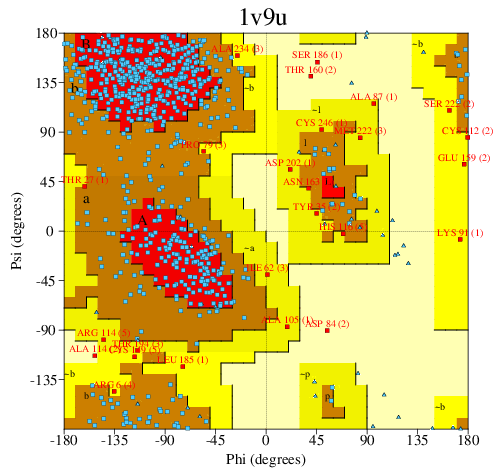
PROCHECK
|
|
|
|
|
|
Headers
|
|
|
|
References
|
|
|
|
|
|

|
|
P04936
(POLG_HRV2) -
Genome polyprotein from Human rhinovirus 2
|
|
|
|
Seq:
Struc:
|
|
|
|
2150 a.a.
269 a.a.
|
|

|

|
|
|
|
|
|
|
|
|
|
|
|
|

|
|
P04936
(POLG_HRV2) -
Genome polyprotein from Human rhinovirus 2
|
|
|
|
Seq:
Struc:
|
|
|
|
2150 a.a.
250 a.a.
|
|
|

|
|
|
|
|
|
|
|
|
|
|
|
|

|
|
P04936
(POLG_HRV2) -
Genome polyprotein from Human rhinovirus 2
|
|
|
|
Seq:
Struc:
|
|
|
|
2150 a.a.
237 a.a.
|
|
|

|
|
|
|
|
|
|
|
|
|
|
|
|
|
|
|
|
|
Enzyme class 1:
|
|
Chains 1, 2, 3, 4:
E.C.2.7.7.48
- RNA-directed Rna polymerase.
|
|
|
|
|
|
|
Reaction:
|
|
RNA(n) + a ribonucleoside 5'-triphosphate = RNA(n+1) + diphosphate
|
|
|
|
|
|
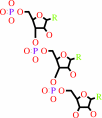 RNA(n)
|
+
|
ribonucleoside 5'-triphosphate
|
=
|
RNA(n+1)
|
+
|
 diphosphate
|
|
|
|
|
|
|
|
|
|
Enzyme class 2:
|
|
Chains 1, 2, 3, 4:
E.C.3.4.22.28
- picornain 3C.
|
|
|
|
|
|
|
Reaction:
|
|
Selective cleavage of Gln-|-Gly bond in the poliovirus polyprotein. In other picornavirus reactions Glu may be substituted for Gln, and Ser or Thr for Gly.
|
|
|
|
|
|
Enzyme class 3:
|
|
Chains 1, 2, 3, 4:
E.C.3.4.22.29
- picornain 2A.
|
|
|
|
|
|
|
Reaction:
|
|
Selective cleavage of Tyr-|-Gly bond in the picornavirus polyprotein. In other picornavirus reactions Glu may be substituted for Gln, and Ser or Thr for Gly.
|
|
|
|
|
|
Enzyme class 4:
|
|
Chains 1, 2, 3, 4:
E.C.3.6.1.15
- nucleoside-triphosphate phosphatase.
|
|
|
|
|
|
|
Reaction:
|
|
a ribonucleoside 5'-triphosphate + H2O = a ribonucleoside 5'-diphosphate + phosphate + H+
|
|
|
|
|
|
ribonucleoside 5'-triphosphate
|
+
|
H2O
|
=
|
ribonucleoside 5'-diphosphate
|
+
|
 phosphate
|
+
|
H(+)
|
|
|
|
|
|
|
|
|
|
|
|
|
Note, where more than one E.C. class is given (as above), each may
correspond to a different protein domain or, in the case of polyprotein
precursors, to a different mature protein.
|
|
|
|
Molecule diagrams generated from .mol files obtained from the
KEGG ftp site
|
|
|
|
|
|
|
|
|
|
|
|
|
|
 |
|
|
|
|
|
|
| |
|
|
| |
|
DOI no:
|
Nat Struct Mol Biol
11:429-434
(2004)
|
|
PubMed id:
|
|
|
|
|
|
| |
|
X-ray structure of a minor group human rhinovirus bound to a fragment of its cellular receptor protein.
|
|
N.Verdaguer,
I.Fita,
M.Reithmayer,
R.Moser,
D.Blaas.
|
|
|
|
|
| |
ABSTRACT
|
|
|
|
| |
|
|
Although many viral receptors have been identified, the ways in which they
interact with their cognate viruses are not understood at the molecular level.
We have determined the X-ray structure of a complex between calcium-containing
modules of the very low-density lipoprotein receptor and the minor group human
rhinovirus HRV2. The receptor binds close to the icosahedral five-fold vertex,
with only one module per virus protomer. The binding face of this module is
defined by acidic calcium-chelating residues and, in particular, by an exposed
tryptophan that is highly conserved. The attachment site on the virus involves
only residues from VP1, particularly a lysine strictly conserved in all minor
group HRVs. The disposition of the attached ligand-binding repeats around the
five-fold axis, together with the proximity of the N- and C-terminal ends of
adjacent modules, suggests that more than one repeat in a single receptor
molecule might attach simultaneously.
|
|
|
|
|
|
| |
Selected figure(s)
|
|
|
|
| |
|
|

|
|

|
|
Figure 1.
Figure 1. Scheme of the modular organization of members of the
LDLR family. LDLR and VLDLR have seven and eight N-terminal
ligand binding repeats, L1 -L7 and V1 -V8, respectively. Three
epidermal growth factor precursor-like regions (A -C) flank a
six-bladed  -propeller
( )
with YWTD motifs. The adjacent domain (GLYCO) carries O-linked
oligosaccharides. The receptors are anchored in the membrane via
a single transmembrane domain (TM). The intracellular C termini
carry NPXY clathrin-localization signals. -propeller
( )
with YWTD motifs. The adjacent domain (GLYCO) carries O-linked
oligosaccharides. The receptors are anchored in the membrane via
a single transmembrane domain (TM). The intracellular C termini
carry NPXY clathrin-localization signals.
|
|
Figure 2.
Figure 2. Three-dimensional structure of the V23 -HRV2 complex.
(a) Stereo view of the 3.5 Å -averaged electron density of V3
bound to HRV2. The region corresponds to residues from His13 to
Glu36 of the V3 receptor. The V3 model is also shown in
ball-and-stick representation. The Ca^2+ ion in the center of
the acidic cluster is green. Residues involved directly in
interactions with HRV2 are labeled. (b) Orthogonal views of an
HRV2-V3 pentamer subunit. HRV2 proteins are shown as
space-filling model colored in the standard viral protein color
code (VP1, blue, VP2, green and VP3, red) in the reference
protomer and light blue in the others. The five V3 receptors are
shown as worms in yellow.
|
|
|
|
|
|
| |
The above figures are
reprinted
by permission from Macmillan Publishers Ltd:
Nat Struct Mol Biol
(2004,
11,
429-434)
copyright 2004.
|
|
| |
Figures were
selected
by an automated process.
|
|
|
|
|
|
|
|
|
|
|
|
|
|
|
|
 |
 |
 |
|
Literature references that cite this PDB file's key reference
|
|
|
| |
PubMed id
|
|
Reference
|
|
|
|
|
|
A.Janner
(2011).
Form, symmetry and packing of biomacromolecules. III. Antigenic, receptor and contact binding sites in picornaviruses.
|
| |
Acta Crystallogr A,
67,
174-189.
|
|
|
|
|
|
|
J.M.Rollinger,
and
M.Schmidtke
(2011).
The human rhinovirus: human-pathological impact, mechanisms of antirhinoviral agents, and strategies for their discovery.
|
| |
Med Res Rev,
31,
42-92.
|
|
|
|
|
|
|
Y.A.Bochkov,
A.C.Palmenberg,
W.M.Lee,
J.A.Rathe,
S.P.Amineva,
X.Sun,
T.R.Pasic,
N.N.Jarjour,
S.B.Liggett,
and
J.E.Gern
(2011).
Molecular modeling, organ culture and reverse genetics for a newly identified human rhinovirus C.
|
| |
Nat Med,
17,
627-632.
|
|
|
|
|
|
|
K.E.Arden,
and
I.M.Mackay
(2010).
Newly identified human rhinoviruses: molecular methods heat up the cold viruses.
|
| |
Rev Med Virol,
20,
156-176.
|
|
|
|
|
|
|
M.Guttman,
J.H.Prieto,
J.E.Croy,
and
E.A.Komives
(2010).
Decoding of lipoprotein-receptor interactions: properties of ligand binding modules governing interactions with apolipoprotein E.
|
| |
Biochemistry,
49,
1207-1216.
|
|
|
|
|
|
|
M.Guttman,
J.H.Prieto,
T.M.Handel,
P.J.Domaille,
and
E.A.Komives
(2010).
Structure of the minimal interface between ApoE and LRP.
|
| |
J Mol Biol,
398,
306-319.
|
|
|
PDB codes:
|
|
|
|
|
|
|
|
N.Yasui,
T.Nogi,
and
J.Takagi
(2010).
Structural basis for specific recognition of reelin by its receptors.
|
| |
Structure,
18,
320-331.
|
|
|
PDB code:
|
|
|
|
|
|
|
|
R.Fuchs,
and
D.Blaas
(2010).
Uncoating of human rhinoviruses.
|
| |
Rev Med Virol,
20,
281-297.
|
|
|
|
|
|
|
D.Beglov,
C.J.Lee,
A.De Biasio,
D.Kozakov,
R.Brenke,
S.Vajda,
and
N.Beglova
(2009).
Structural insights into recognition of beta2-glycoprotein I by the lipoprotein receptors.
|
| |
Proteins,
77,
940-949.
|
|
|
|
|
|
|
K.Sakai,
O.Tiebel,
M.C.Ljungberg,
M.Sullivan,
H.J.Lee,
T.Terashima,
R.Li,
K.Kobayashi,
H.C.Lu,
L.Chan,
and
K.Oka
(2009).
A neuronal VLDLR variant lacking the third complement-type repeat exhibits high capacity binding of apoE containing lipoproteins.
|
| |
Brain Res,
1276,
11-21.
|
|
|
|
|
|
|
L.Kremser,
D.Blaas,
and
E.Kenndler
(2009).
Virus analysis using electromigration techniques.
|
| |
Electrophoresis,
30,
133-140.
|
|
|
|
|
|
|
S.Blomqvist,
C.Savolainen-Kopra,
A.Paananen,
T.Hovi,
and
M.Roivainen
(2009).
Molecular characterization of human rhinovirus field strains isolated during surveillance of enteroviruses.
|
| |
J Gen Virol,
90,
1371-1381.
|
|
|
|
|
|
|
T.Konecsni,
U.Berka,
A.Pickl-Herk,
G.Bilek,
A.G.Khan,
L.Gajdzig,
R.Fuchs,
and
D.Blaas
(2009).
Low pH-triggered beta-propeller switch of the low-density lipoprotein receptor assists rhinovirus infection.
|
| |
J Virol,
83,
10922-10930.
|
|
|
|
|
|
|
T.Stehle,
and
J.M.Casasnovas
(2009).
Specificity switching in virus-receptor complexes.
|
| |
Curr Opin Struct Biol,
19,
181-188.
|
|
|
|
|
|
|
V.U.Weiss,
G.Bilek,
A.Pickl-Herk,
D.Blaas,
and
E.Kenndler
(2009).
Mimicking virus attachment to host cells employing liposomes: analysis by chip electrophoresis.
|
| |
Electrophoresis,
30,
2123-2128.
|
|
|
|
|
|
|
N.M.Ananyeva,
Y.M.Makogonenko,
A.G.Sarafanov,
I.V.Pechik,
N.Gorlatova,
K.P.Radtke,
M.Shima,
and
E.L.Saenko
(2008).
Interaction of coagulation factor VIII with members of the low-density lipoprotein receptor family follows common mechanism and involves consensus residues within the A2 binding site 484-509.
|
| |
Blood Coagul Fibrinolysis,
19,
543-555.
|
|
|
|
|
|
|
S.Venkataraman,
S.P.Reddy,
J.Loo,
N.Idamakanti,
P.L.Hallenbeck,
and
V.S.Reddy
(2008).
Structure of Seneca Valley Virus-001: an oncolytic picornavirus representing a new genus.
|
| |
Structure,
16,
1555-1561.
|
|
|
PDB code:
|
|
|
|
|
|
|
|
A.G.Khan,
J.Pichler,
A.Rosemann,
and
D.Blaas
(2007).
Human rhinovirus type 54 infection via heparan sulfate is less efficient and strictly dependent on low endosomal pH.
|
| |
J Virol,
81,
4625-4632.
|
|
|
|
|
|
|
L.Kremser,
G.Bilek,
D.Blaas,
and
E.Kenndler
(2007).
Capillary electrophoresis of viruses, subviral particles and virus complexes.
|
| |
J Sep Sci,
30,
1704-1713.
|
|
|
|
|
|
|
N.Yasui,
T.Nogi,
T.Kitao,
Y.Nakano,
M.Hattori,
and
J.Takagi
(2007).
Structure of a receptor-binding fragment of reelin and mutational analysis reveal a recognition mechanism similar to endocytic receptors.
|
| |
Proc Natl Acad Sci U S A,
104,
9988-9993.
|
|
|
PDB code:
|
|
|
|
|
|
|
|
S.C.Blacklow
(2007).
Versatility in ligand recognition by LDL receptor family proteins: advances and frontiers.
|
| |
Curr Opin Struct Biol,
17,
419-426.
|
|
|
|
|
|
|
S.Hafenstein,
L.M.Palermo,
V.A.Kostyuchenko,
C.Xiao,
M.C.Morais,
C.D.Nelson,
V.D.Bowman,
A.J.Battisti,
P.R.Chipman,
C.R.Parrish,
and
M.G.Rossmann
(2007).
Asymmetric binding of transferrin receptor to parvovirus capsids.
|
| |
Proc Natl Acad Sci U S A,
104,
6585-6589.
|
|
|
PDB code:
|
|
|
|
|
|
|
|
V.Kolivoska,
V.U.Weiss,
L.Kremser,
B.Gas,
D.Blaas,
and
E.Kenndler
(2007).
Electrophoresis on a microfluidic chip for analysis of fluorescence-labeled human rhinovirus.
|
| |
Electrophoresis,
28,
4734-4740.
|
|
|
|
|
|
|
E.A.Hewat,
and
D.Blaas
(2006).
Nonneutralizing human rhinovirus serotype 2-specific monoclonal antibody 2G2 attaches to the region that undergoes the most dramatic changes upon release of the viral RNA.
|
| |
J Virol,
80,
12398-12401.
|
|
|
|
|
|
|
E.Pokidysheva,
Y.Zhang,
A.J.Battisti,
C.M.Bator-Kelly,
P.R.Chipman,
C.Xiao,
G.G.Gregorio,
W.A.Hendrickson,
R.J.Kuhn,
and
M.G.Rossmann
(2006).
Cryo-EM reconstruction of dengue virus in complex with the carbohydrate recognition domain of DC-SIGN.
|
| |
Cell,
124,
485-493.
|
|
|
PDB code:
|
|
|
|
|
|
|
|
K.Pääkkönen,
H.Tossavainen,
P.Permi,
H.Rakkolainen,
H.Rauvala,
E.Raulo,
I.Kilpeläinen,
and
P.Güntert
(2006).
Solution structures of the first and fourth TSR domains of F-spondin.
|
| |
Proteins,
64,
665-672.
|
|
|
PDB codes:
|
|
|
|
|
|
|
|
S.Contreras-Alcantara,
J.A.Godby,
and
S.E.Delos
(2006).
The single ligand-binding repeat of Tva, a low density lipoprotein receptor-related protein, contains two ligand-binding surfaces.
|
| |
J Biol Chem,
281,
22827-22838.
|
|
|
|
|
|
|
S.Skeldal,
J.V.Larsen,
K.E.Pedersen,
H.H.Petersen,
R.Egelund,
A.Christensen,
J.K.Jensen,
J.Gliemann,
and
P.A.Andreasen
(2006).
Binding areas of urokinase-type plasminogen activator-plasminogen activator inhibitor-1 complex for endocytosis receptors of the low-density lipoprotein receptor family, determined by site-directed mutagenesis.
|
| |
FEBS J,
273,
5143-5159.
|
|
|
|
|
|
|
W.E.Royer,
H.Sharma,
K.Strand,
J.E.Knapp,
and
B.Bhyravbhatla
(2006).
Lumbricus erythrocruorin at 3.5 A resolution: architecture of a megadalton respiratory complex.
|
| |
Structure,
14,
1167-1177.
|
|
|
PDB code:
|
|
|
|
|
|
|
|
C.Abad-Zapatero,
and
M.G.Replacement
(2005).
Homage to Prof. M.G. Replacement: a celebration of structural biology at Purdue University.
|
| |
Structure,
13,
845-848.
|
|
|
|
|
|
|
F.Kienberger,
C.Rankl,
V.Pastushenko,
R.Zhu,
D.Blaas,
and
P.Hinterdorfer
(2005).
Visualization of single receptor molecules bound to human rhinovirus under physiological conditions.
|
| |
Structure,
13,
1247-1253.
|
|
|
|
|
|
|
H.Jeon,
and
S.C.Blacklow
(2005).
Structure and physiologic function of the low-density lipoprotein receptor.
|
| |
Annu Rev Biochem,
74,
535-562.
|
|
|
|
|
|
|
M.Vlasak,
I.Goesler,
and
D.Blaas
(2005).
Human rhinovirus type 89 variants use heparan sulfate proteoglycan for cell attachment.
|
| |
J Virol,
79,
5963-5970.
|
|
|
|
|
|
|
M.Vlasak,
M.Roivainen,
M.Reithmayer,
I.Goesler,
P.Laine,
L.Snyers,
T.Hovi,
and
D.Blaas
(2005).
The minor receptor group of human rhinovirus (HRV) includes HRV23 and HRV25, but the presence of a lysine in the VP1 HI loop is not sufficient for receptor binding.
|
| |
J Virol,
79,
7389-7395.
|
|
|
|
|
|
|
N.Beglova,
and
S.C.Blacklow
(2005).
The LDL receptor: how acid pulls the trigger.
|
| |
Trends Biochem Sci,
30,
309-317.
|
|
|
|
|
|
|
S.Clejan,
E.Mandrea,
I.V.Pandrea,
J.Dufour,
S.Japa,
and
R.S.Veazey
(2005).
Immune responses induced by intranasal imiquimod and implications for therapeutics in rhinovirus infections.
|
| |
J Cell Mol Med,
9,
457-461.
|
|
|
|
|
|
|
S.E.Delos,
J.A.Godby,
and
J.M.White
(2005).
Receptor-induced conformational changes in the SU subunit of the avian sarcoma/leukosis virus A envelope protein: implications for fusion activation.
|
| |
J Virol,
79,
3488-3499.
|
|
|
|
|
|
|
S.Nizet,
J.Wruss,
N.Landstetter,
L.Snyers,
and
D.Blaas
(2005).
A mutation in the first ligand-binding repeat of the human very-low-density lipoprotein receptor results in high-affinity binding of the single V1 module to human rhinovirus 2.
|
| |
J Virol,
79,
14730-14736.
|
|
|
|
|
|
|
B.Herdy,
L.Snyers,
M.Reithmayer,
P.Hinterdorfer,
and
D.Blaas
(2004).
Identification of the human rhinovirus serotype 1A binding site on the murine low-density lipoprotein receptor by using human-mouse receptor chimeras.
|
| |
J Virol,
78,
6766-6774.
|
|
|
|
|
|
|
C.Xiao,
T.J.Tuthill,
C.M.Bator Kelly,
L.J.Challinor,
P.R.Chipman,
R.A.Killington,
D.J.Rowlands,
A.Craig,
and
M.G.Rossmann
(2004).
Discrimination among rhinovirus serotypes for a variant ICAM-1 receptor molecule.
|
| |
J Virol,
78,
10034-10044.
|
|
|
|
|
|
The most recent references are shown first.
Citation data come partly from CiteXplore and partly
from an automated harvesting procedure. Note that this is likely to be
only a partial list as not all journals are covered by
either method. However, we are continually building up the citation data
so more and more references will be included with time.
Where a reference describes a PDB structure, the PDB
codes are
shown on the right.
|

| |


 Links
Links


