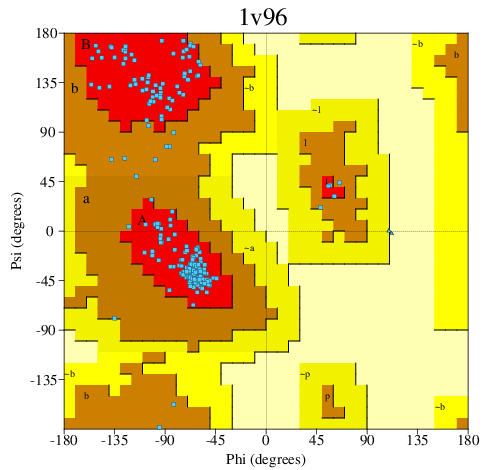
|
PDBsum entry 1v96

|
|
|
|
|
|

|

|

|

|
|

|
|

|
|

|
|

|
|
|
 |

|

|
|
|
|
|
|
|
|
|
|
|
|
|
|
|
|
|
|
|
|
|
|
|
|
|
|
|
|
|
|
|
|
|
Structural genomics, unknown function
|
PDB id
|
|
|
|
1v96
|
|
|
|
|
|
|
|
|
|
|
|
|
|
|

|

|

|
|
|
|
|
|
|
|
 |
Contents |
 |
|
|
|
|
|
|
|
|
|
|
|
|
* Residue conservation analysis
|
|
|
|
|
|
|
|
|
|
|
|
|
|
|
 |
|
|
|
|
|
|
| |
|
DOI no:
|
Acta Crystallogr Sect F Struct Biol Cryst Commun
61:463-468
(2005)
|
|
PubMed id:
|
|
|
|
|
|
| |
|
Structure of PIN-domain protein PH0500 from Pyrococcus horikoshii.
|
|
J.Jeyakanthan,
E.Inagaki,
C.Kuroishi,
T.H.Tahirov.
|
|
|
|
|
| |
ABSTRACT
|
|
|
|
| |
|
|
The Pyrococcus horikoshii OT3 protein PH0500 is highly conserved within the
Pyrococcus genus of hyperthermophilic archaea and shows low amino-acid sequence
similarity with a family of PIN-domain proteins. The protein has been expressed,
purified and crystallized in two crystal forms: PH0500-I and PH0500-II. The
structure was determined at 2.0 A by the multiple anomalous dispersion method
using a selenomethionyl derivative of crystal form PH0500-I (PH0500-I-Se). The
structure of PH0500-I has been refined at 1.75 A resolution to an R factor of
20.9% and the structure of PH0500-II has been refined at 2.0 A resolution to an
R factor of 23.4%. In both crystal forms as well as in solution the molecule
appears to be a dimer. Searches of the databases for protein-fold similarities
confirmed that the PH0500 protein is a PIN-domain protein with possible
exonuclease activity and involvement in DNA or RNA editing.
|
|
|
|
|
|
| |
Selected figure(s)
|
|
|
|
| |
|
|

|
|

|
|
Figure 3.
The overall view of (a) PH0500 and (b) AF0591 dimers and (c)
PAE2754 tetramers. Subunits are represented by ribbons and have
different colours. The figures were prepared using MOLSCRIPT
(Kraulis, 1991[triangle]) and RASTER3D (Merritt & Murphy,
1994[triangle]). Acta Crystallogr Sect F Struct Biol Cryst
Commun. 2005 May 1; 61(Pt 5): 463–468. Published online 2005
April 26. doi: 10.1107/S1744309105012406. Copyright [copyright]
International Union of Crystallography 2005
|
|
Figure 4.
The surface representation of the PH0500 dimer. View (a) is
as in Fig. 3 [triangle]
Figure 3- (a)
and the view (b) is in the opposite direction to (a). The
positively and the negatively charged surface regions are in
blue and red, respectively. The figures were prepared using
GRASP (Nichols et al., 1991[triangle]). Acta Crystallogr Sect F
Struct Biol Cryst Commun. 2005 May 1; 61(Pt 5): 463–468.
Published online 2005 April 26. doi: 10.1107/S1744309105012406.
Copyright [copyright] International Union of Crystallography
2005 (a)
and the view (b) is in the opposite direction to (a). The
positively and the negatively charged surface regions are in
blue and red, respectively. The figures were prepared using
GRASP (Nichols et al., 1991[triangle]). Acta Crystallogr Sect F
Struct Biol Cryst Commun. 2005 May 1; 61(Pt 5): 463–468.
Published online 2005 April 26. doi: 10.1107/S1744309105012406.
Copyright [copyright] International Union of Crystallography
2005
|
|
|
|
|
|
| |
The above figures are
reprinted
from an Open Access publication published by the IUCr:
Acta Crystallogr Sect F Struct Biol Cryst Commun
(2005,
61,
463-468)
copyright 2005.
|
|
| |
Figures were
selected
by an automated process.
|
|
|
|
|
|
|
|
|
|
|
|
|
|
|
|
 |
 |
 |
|
Literature references that cite this PDB file's key reference
|
|
|
| |
PubMed id
|
|
Reference
|
|
|
|
|
|
A.C.Lamanna,
and
K.Karbstein
(2009).
Nob1 binds the single-stranded cleavage site D at the 3'-end of 18S rRNA with its PIN domain.
|
| |
Proc Natl Acad Sci U S A,
106,
14259-14264.
|
|
|
|
|
|
The most recent references are shown first.
Citation data come partly from CiteXplore and partly
from an automated harvesting procedure. Note that this is likely to be
only a partial list as not all journals are covered by
either method. However, we are continually building up the citation data
so more and more references will be included with time.
|
|


 Links
Links