
|
|
|
|
|
 |
Contents |
 |
|
|
|
|
|
|
|
|
|
|
|

 212 a.a.
|
|
|
|
|
|
|
|
|
|
|

 217 a.a.
|
|
|
|
|
|
|
|
|
|
|

 145 a.a.
|
|
|
|
|
|
|
|
|
* Residue conservation analysis
|
|
|
|
|
|
PDB id:
|
|
|
|
| Name: |
|
Immune system/cytokine
|
|
|
Title:
|
|
Human thrombopoietin functional domain complexed to neutralizing antibody tn1 fab
|
|
Structure:
|
|
Monoclonal tn1 fab light chain. Chain: l, m. Fragment: fab light chain. Engineered: yes. Monoclonal tn1 fab heavy chain. Chain: h, i. Fragment: fab heavy chain. Engineered: yes. Thrombopoietin.
|
|
Source:
|
|
Mus musculus. House mouse. Organism_taxid: 10090. Expressed in: mus musculus. Expression_system_taxid: 10090. Expression_system_cell_line: hybridoma. Homo sapiens. Human. Organism_taxid: 9606.
|
|
Biol. unit:
|
|
Hexamer (from
)
|
|
Resolution:
|
|
|
2.51Å
|
R-factor:
|
0.232
|
R-free:
|
0.316
|
|
|
Authors:
|
|
M.D.Feese,T.Tamada,Y.Kato,Y.Maeda,M.Hirose,Y.Matsukura,H.Shigematsu, T.Kato,H.Miyazaki,R.Kuroki
|
Key ref:

|
|
M.D.Feese
et al.
(2004).
Structure of the receptor-binding domain of human thrombopoietin determined by complexation with a neutralizing antibody fragment.
Proc Natl Acad Sci U S A,
101,
1816-1821.
PubMed id:
DOI:

|
|
|
Date:
|
|
|
18-Dec-03
|
Release date:
|
02-Mar-04
|
|
|
|
|
|
|
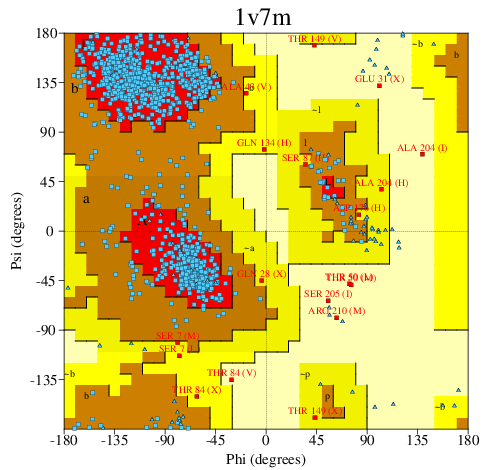
PROCHECK
|
|
|
|
|
|
Headers
|
|
|
|
References
|
|
|
|
|
|

|
|
No UniProt id for this chain
|
|
|
|
|
|
|
|
|
|
|
|
|
|
|
|
|
|
|
|
|
|
|
|
|
 |
|
|
|
|
|
|
| |
|
DOI no:
|
Proc Natl Acad Sci U S A
101:1816-1821
(2004)
|
|
PubMed id:
|
|
|
|
|
|
| |
|
Structure of the receptor-binding domain of human thrombopoietin determined by complexation with a neutralizing antibody fragment.
|
|
M.D.Feese,
T.Tamada,
Y.Kato,
Y.Maeda,
M.Hirose,
Y.Matsukura,
H.Shigematsu,
T.Muto,
A.Matsumoto,
H.Watarai,
K.Ogami,
T.Tahara,
T.Kato,
H.Miyazaki,
R.Kuroki.
|
|
|
|
|
| |
ABSTRACT
|
|
|
|
| |
|
|
The cytokine thrombopoietin (TPO), the ligand for the hematopoietic receptor
c-Mpl, acts as a primary regulator of megakaryocytopoiesis and platelet
production. We have determined the crystal structure of the receptor-binding
domain of human TPO (hTPO(163)) to a 2.5-A resolution by complexation with a
neutralizing Fab fragment. The backbone structure of hTPO(163) has an
antiparallel four-helix bundle fold. The neutralizing Fab mainly recognizes the
C-D crossover loop containing the species invariant residue Q111. Titration
calorimetric experiments show that hTPO(163) interacts with soluble c-Mpl
containing the extracellular cytokine receptor homology domains with 1:2
stoichiometry with the binding constants of 3.3 x 10(9) M(-1) and 1.1 x 10(6)
M(-1). The presence of the neutralizing Fab did not inhibit binding of hTPO(163)
to soluble c-Mpl fragments, but the lower-affinity binding disappeared. Together
with prior genetic data, these define the structure-function relationships in
TPO and the activation scheme of c-Mpl.
|
|
|
|
|
|
| |
Selected figure(s)
|
|
|
|
| |
|
|

|
|

|
|
Figure 3.
Fig. 3. hTPO[163]-TN1-Fab complex. The C  traces
for the heavy and light chains of the variable domains of the
TN1-Fab are shown in green and blue. Only residues that interact
with hTPO[163] are shown. hTPO[163] is shown in the
Corey-Pauling-Koltun molecular model (CPK) with residues that
interact with the TN1-Fab highlighted as individually colored
CPK atoms. Regions of hTPO[163] that do not interact with the
TN1-Fab are shown as solid orange CPK. traces
for the heavy and light chains of the variable domains of the
TN1-Fab are shown in green and blue. Only residues that interact
with hTPO[163] are shown. hTPO[163] is shown in the
Corey-Pauling-Koltun molecular model (CPK) with residues that
interact with the TN1-Fab highlighted as individually colored
CPK atoms. Regions of hTPO[163] that do not interact with the
TN1-Fab are shown as solid orange CPK.
|
|
Figure 5.
Fig. 5. Determinants of specificity of TPO for c-Mpl.
Residues that are invariant within the TPO family but not
conserved in the EPO family are proposed to confer specificity
to the TPO-c-Mpl interaction. These residues fall into two
distinct clusters corresponding to the proposed high-affinity
(blue) and low-affinity (green) receptor interaction sites.
Residues that are invariant in the TPO/EPO family are shown in
black.
|
|
|
|
| |
Figures were
selected
by an automated process.
|
|
|
|
|
|
|
|
|
|
|
|
|
|
|
|
 |
 |
 |
|
Literature references that cite this PDB file's key reference
|
|
|
| |
PubMed id
|
|
Reference
|
|
|
|
|
|
T.Wang,
Z.Wang,
and
R.Yang
(2011).
Thrombopoietic growth factors in the treatment of immune thrombocytopenic purpura.
|
| |
Crit Rev Oncol Hematol,
77,
172-183.
|
|
|
|
|
|
|
R.Stasi,
J.Bosworth,
E.Rhodes,
M.S.Shannon,
F.Willis,
and
E.C.Gordon-Smith
(2010).
Thrombopoietic agents.
|
| |
Blood Rev,
24,
179-190.
|
|
|
|
|
|
|
D.J.Kuter
(2009).
Thrombopoietin and thrombopoietin mimetics in the treatment of thrombocytopenia.
|
| |
Annu Rev Med,
60,
193-206.
|
|
|
|
|
|
|
E.Honjo,
T.Tamada,
M.Adachi,
R.Kuroki,
A.Meher,
and
M.Blaber
(2008).
Mutagenesis of the crystal contact of acidic fibroblast growth factor.
|
| |
J Synchrotron Radiat,
15,
285-287.
|
|
|
|
|
|
|
D.J.Kuter
(2007).
New thrombopoietic growth factors.
|
| |
Blood,
109,
4607-4616.
|
|
|
|
|
|
|
H.Yamada,
T.Tamada,
M.Kosaka,
K.Miyata,
S.Fujiki,
M.Tano,
M.Moriya,
M.Yamanishi,
E.Honjo,
H.Tada,
T.Ino,
H.Yamaguchi,
J.Futami,
M.Seno,
T.Nomoto,
T.Hirata,
M.Yoshimura,
and
R.Kuroki
(2007).
'Crystal lattice engineering,' an approach to engineer protein crystal contacts by creating intermolecular symmetry: crystallization and structure determination of a mutant human RNase 1 with a hydrophobic interface of leucines.
|
| |
Protein Sci,
16,
1389-1397.
|
|
|
PDB codes:
|
|
|
|
|
|
|
|
N.H.Afdhal,
and
J.G.McHutchison
(2007).
Review article: pharmacological approaches for the treatment of thrombocytopenia in patients with chronic liver disease and hepatitis C infection.
|
| |
Aliment Pharmacol Ther,
26,
29-39.
|
|
|
|
|
|
|
S.Krause,
H.U.Schmoldt,
A.Wentzel,
M.Ballmaier,
K.Friedrich,
and
H.Kolmar
(2007).
Grafting of thrombopoietin-mimetic peptides into cystine knot miniproteins yields high-affinity thrombopoietin antagonists and agonists.
|
| |
FEBS J,
274,
86-95.
|
|
|
|
|
|
|
N.K.Lim,
J.H.Kim,
S.Y.Kim,
H.J.Kang,
K.S.Kim,
S.Lee,
H.J.Hong,
and
K.S.Inn
(2006).
Monoclonal anti-thrombopoietin antibodies generated by genetic immunization.
|
| |
Hybridoma (Larchmt),
25,
75-79.
|
|
|
|
|
|
|
S.Frederickson,
M.W.Renshaw,
B.Lin,
L.M.Smith,
P.Calveley,
J.P.Springhorn,
K.Johnson,
Y.Wang,
X.Su,
Y.Shen,
and
K.S.Bowdish
(2006).
A rationally designed agonist antibody fragment that functionally mimics thrombopoietin.
|
| |
Proc Natl Acad Sci U S A,
103,
14307-14312.
|
|
|
|
|
|
|
H.Takedatsu,
K.Yoshimoto,
T.Okamura,
H.Miyazaki,
T.Kuwaki,
M.Sata,
and
K.Itoh
(2005).
Determination of thrombopoietin-derived peptides recognized by both cellular and humoral immunities in healthy donors and patients with thrombocytopenia.
|
| |
Stem Cells,
23,
975-982.
|
|
|
|
|
|
The most recent references are shown first.
Citation data come partly from CiteXplore and partly
from an automated harvesting procedure. Note that this is likely to be
only a partial list as not all journals are covered by
either method. However, we are continually building up the citation data
so more and more references will be included with time.
Where a reference describes a PDB structure, the PDB
codes are
shown on the right.
|
 |
|


 Links
Links


