 |
PDBsum entry 1v2z

|
|
|
|
|
|

|

|

|

|
|

|
|

|
|
|
 |

|

|
|
|
|
|
|
|
|
|
|
|
|
|
|
|
|
|
|
|
|
|
|
|
|
|
|
|
|
|
|
|
Circadian clock protein
|
PDB id
|
|
|
|
1v2z
|
|
|
|
|
|
|
|
|
|
|
|
|
|
|

|

|

|
|
|
|
|
|
|
|
 |
Contents |
 |
|
|
|
|
|
|
|
|
|
|
* Residue conservation analysis
|
|
|
|
|
|
PDB id:
|
|
|
|
| Name: |
|
Circadian clock protein
|
|
|
Title:
|
|
Crystal structure of thE C-terminal domain of thermosynechococcus elongatus bp-1 kaia
|
|
Structure:
|
|
Circadian clock protein kaia homolog. Chain: a. Fragment: c-terminal domain. Engineered: yes
|
|
Source:
|
|
Thermosynechococcus elongatus. Organism_taxid: 197221. Strain: bp-1. Expressed in: escherichia coli bl21. Expression_system_taxid: 511693.
|
|
Resolution:
|
|
|
1.80Å
|
R-factor:
|
0.227
|
R-free:
|
0.264
|
|
|
Authors:
|
|
T.Uzumaki,M.Fujita,T.Nakatsu,F.Hayashi,H.Shibata,N.Itoh,H.Kato, M.Ishiura,Riken Structural Genomics/proteomics Initiative (Rsgi)
|
Key ref:

|
|
T.Uzumaki
et al.
(2004).
Crystal structure of the C-terminal clock-oscillator domain of the cyanobacterial KaiA protein.
Nat Struct Mol Biol,
11,
623-631.
PubMed id:
DOI:

|
|
|
Date:
|
|
|
20-Oct-03
|
Release date:
|
01-Jun-04
|
|
|
|
|
|
|
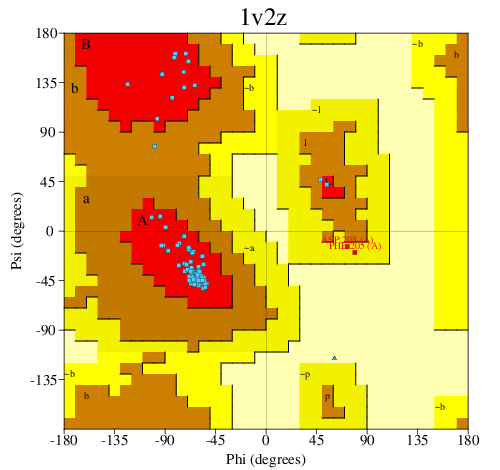
PROCHECK
|
|
|
|
|
|
Headers
|
|
|
|
References
|
|
|
|
|
|

|
|
Q79V62
(KAIA_THEEB) -
Circadian clock oscillator protein KaiA from Thermosynechococcus vestitus (strain NIES-2133 / IAM M-273 / BP-1)
|
|
|
|
Seq:
Struc:
|
|
|
|
283 a.a.
106 a.a.*
|
|

|

|

|
|
|
|
|
|
|
|
|
|
|
Key: |
 |
PfamA domain |
|
|
 |
Secondary structure |
|
 |
CATH domain |
|
|
*
PDB and UniProt seqs differ
at 1 residue position (black
cross)
|
|
|
|
|
|
|
|
|
|
|
|
|
|
|
|
|
 |
|
|
|
|
|
|
| |
|
DOI no:
|
Nat Struct Mol Biol
11:623-631
(2004)
|
|
PubMed id:
|
|
|
|
|
|
| |
|
Crystal structure of the C-terminal clock-oscillator domain of the cyanobacterial KaiA protein.
|
|
T.Uzumaki,
M.Fujita,
T.Nakatsu,
F.Hayashi,
H.Shibata,
N.Itoh,
H.Kato,
M.Ishiura.
|
|
|
|
|
| |
ABSTRACT
|
|
|
|
| |
|
|
KaiA, KaiB and KaiC constitute the circadian clock machinery in cyanobacteria,
and KaiA activates kaiBC expression whereas KaiC represses it. Here we show that
KaiA is composed of three functional domains, the N-terminal amplitude-amplifier
domain, the central period-adjuster domain and the C-terminal clock-oscillator
domain. The C-terminal domain is responsible for dimer formation, binding to
KaiC, enhancing KaiC phosphorylation and generating the circadian oscillations.
The X-ray crystal structure at a resolution of 1.8 A of the C-terminal
clock-oscillator domain of KaiA from the thermophilic cyanobacterium
Thermosynechococcus elongatus BP-1 shows that residue His270, located at the
center of a KaiA dimer concavity, is essential to KaiA function. KaiA binding to
KaiC probably occurs via the concave surface. On the basis of the structure, we
predict the structural roles of the residues that affect circadian oscillations.
|
|
|
|
|
|
| |
Selected figure(s)
|
|
|
|
| |
|
|

|
|

|
|
Figure 3.
Figure 3. Synechococcus KaiA dimerization assayed by gel
filtration chromatography. Full-length (a), N- and central
domains (b), C-terminal domain (c), central and C-terminal
domains (d) and N- and C-terminal domains (e).
|
|
Figure 6.
Figure 6. Overview of the structure of T. elongatus KaiA(174
-283) (the C-terminal clock-oscillator domain). (a) C  backbone
of a KaiA(174 -283) subunit. h1 (residues 174 -181), red; h2
(186 -203), orange; h3 (211 -225), pink; h4 (229 -247), green;
h5 (255 -258), blue; h6 (260 -277), cyan. (b) A hydrophobic core
formed by Phe177, Phe178, Phe223, Phe224 and Tyr275 connecting
h1, h3 and h6. The helices are colored as described above. The
residues are in ball-and-stick representation (black, carbon;
red, oxygen; yellow, sulfur). (c) A hydrophobic core formed by
Tyr197, Tyr204, Phe205, Phe218, Met240, Phe243, Leu257, Tyr260
and Leu264. (d) C backbone
of a dimer. Yellow, A-chain; purple, B-chain. The eight residues
(Arg179, Asp226, Ile227, Val229, Asp259, Arg261, Glu273 and
Arg276) involved in dimer formation are indicated in
ball-and-stick, as are the functionally essential residue
(His270) and its neighboring residues (Asp266 and Tyr204).
Carbon, black; nitrogen, blue; oxygen, red. Green dotted lines,
hydrogen bonds involved in dimer formation; cyan dotted lines,
hydrogen bonds connecting His270, Asp266 and Tyr204, linearly
arrayed. (e) Space-filling representation of a dimer. The 23
residues conserved in the 11 strains are green, except for
His270, which is red. (f) View of e from a different angle.
Figures of molecular models were prepared with MolScript34 and
Raster3D^35. backbone
of a KaiA(174 -283) subunit. h1 (residues 174 -181), red; h2
(186 -203), orange; h3 (211 -225), pink; h4 (229 -247), green;
h5 (255 -258), blue; h6 (260 -277), cyan. (b) A hydrophobic core
formed by Phe177, Phe178, Phe223, Phe224 and Tyr275 connecting
h1, h3 and h6. The helices are colored as described above. The
residues are in ball-and-stick representation (black, carbon;
red, oxygen; yellow, sulfur). (c) A hydrophobic core formed by
Tyr197, Tyr204, Phe205, Phe218, Met240, Phe243, Leu257, Tyr260
and Leu264. (d) C backbone
of a dimer. Yellow, A-chain; purple, B-chain. The eight residues
(Arg179, Asp226, Ile227, Val229, Asp259, Arg261, Glu273 and
Arg276) involved in dimer formation are indicated in
ball-and-stick, as are the functionally essential residue
(His270) and its neighboring residues (Asp266 and Tyr204).
Carbon, black; nitrogen, blue; oxygen, red. Green dotted lines,
hydrogen bonds involved in dimer formation; cyan dotted lines,
hydrogen bonds connecting His270, Asp266 and Tyr204, linearly
arrayed. (e) Space-filling representation of a dimer. The 23
residues conserved in the 11 strains are green, except for
His270, which is red. (f) View of e from a different angle.
Figures of molecular models were prepared with MolScript34 and
Raster3D^35.
|
|
|
|
|
|
| |
The above figures are
reprinted
by permission from Macmillan Publishers Ltd:
Nat Struct Mol Biol
(2004,
11,
623-631)
copyright 2004.
|
|
| |
Figures were
selected
by an automated process.
|
|
|
|
|
|
|
|
|
|
|
|
|
|
|
|
 |
 |
 |
|
Literature references that cite this PDB file's key reference
|
|
|
| |
PubMed id
|
|
Reference
|
|
|
|
|
|
C.Brettschneider,
R.J.Rose,
S.Hertel,
I.M.Axmann,
A.J.Heck,
and
M.Kollmann
(2010).
A sequestration feedback determines dynamics and temperature entrainment of the KaiABC circadian clock.
|
| |
Mol Syst Biol,
6,
389.
|
|
|
|
|
|
|
S.Kurosawa,
R.Murakami,
K.Onai,
M.Morishita,
D.Hasegawa,
R.Iwase,
T.Uzumaki,
F.Hayashi,
T.Kitajima-Ihara,
S.Sakata,
M.Murakami,
T.Kouyama,
and
M.Ishiura
(2009).
Functionally important structural elements of the cyanobacterial clock-related protein Pex.
|
| |
Genes Cells,
14,
1.
|
|
|
PDB codes:
|
|
|
|
|
|
|
|
K.Eguchi,
M.Yoda,
T.P.Terada,
and
M.Sasai
(2008).
Mechanism of robust circadian oscillation of KaiC phosphorylation in vitro.
|
| |
Biophys J,
95,
1773-1784.
|
|
|
|
|
|
|
R.Murakami,
A.Miyake,
R.Iwase,
F.Hayashi,
T.Uzumaki,
and
M.Ishiura
(2008).
ATPase activity and its temperature compensation of the cyanobacterial clock protein KaiC.
|
| |
Genes Cells,
13,
387-395.
|
|
|
|
|
|
|
R.Pattanayek,
D.R.Williams,
S.Pattanayek,
T.Mori,
C.H.Johnson,
P.L.Stewart,
and
M.Egli
(2008).
Structural model of the circadian clock KaiB-KaiC complex and mechanism for modulation of KaiC phosphorylation.
|
| |
EMBO J,
27,
1767-1778.
|
|
|
PDB code:
|
|
|
|
|
|
|
|
S.Lee,
and
C.D.Poulter
(2008).
Cloning, solubilization, and characterization of squalene synthase from Thermosynechococcus elongatus BP-1.
|
| |
J Bacteriol,
190,
3808-3816.
|
|
|
|
|
|
|
Y.I.Kim,
G.Dong,
C.W.Carruthers,
S.S.Golden,
and
A.LiWang
(2008).
The day/night switch in KaiC, a central oscillator component of the circadian clock of cyanobacteria.
|
| |
Proc Natl Acad Sci U S A,
105,
12825-12830.
|
|
|
|
|
|
|
M.Yoda,
K.Eguchi,
T.P.Terada,
and
M.Sasai
(2007).
Monomer-shuffling and allosteric transition in KaiC circadian oscillation.
|
| |
PLoS ONE,
2,
e408.
|
|
|
|
|
|
|
S.Clodong,
U.Dühring,
L.Kronk,
A.Wilde,
I.Axmann,
H.Herzel,
and
M.Kollmann
(2007).
Functioning and robustness of a bacterial circadian clock.
|
| |
Mol Syst Biol,
3,
90.
|
|
|
|
|
|
|
S.S.Golden
(2007).
Integrating the circadian oscillator into the life of the cyanobacterial cell.
|
| |
Cold Spring Harb Symp Quant Biol,
72,
331-338.
|
|
|
|
|
|
|
T.Gao,
X.Zhang,
N.B.Ivleva,
S.S.Golden,
and
A.LiWang
(2007).
NMR structure of the pseudo-receiver domain of CikA.
|
| |
Protein Sci,
16,
465-475.
|
|
|
PDB code:
|
|
|
|
|
|
|
|
Y.Taniguchi,
M.Katayama,
R.Ito,
N.Takai,
T.Kondo,
and
T.Oyama
(2007).
labA: a novel gene required for negative feedback regulation of the cyanobacterial circadian clock protein KaiC.
|
| |
Genes Dev,
21,
60-70.
|
|
|
|
|
|
|
J.M.Yang,
and
C.H.Tung
(2006).
Protein structure database search and evolutionary classification.
|
| |
Nucleic Acids Res,
34,
3646-3659.
|
|
|
|
|
|
|
R.Pattanayek,
D.R.Williams,
S.Pattanayek,
Y.Xu,
T.Mori,
C.H.Johnson,
P.L.Stewart,
and
M.Egli
(2006).
Analysis of KaiA-KaiC protein interactions in the cyano-bacterial circadian clock using hybrid structural methods.
|
| |
EMBO J,
25,
2017-2028.
|
|
|
PDB code:
|
|
|
|
|
|
|
|
J.Wang
(2005).
Recent cyanobacterial Kai protein structures suggest a rotary clock.
|
| |
Structure,
13,
735-741.
|
|
|
|
|
|
|
K.Hitomi,
T.Oyama,
S.Han,
A.S.Arvai,
and
E.D.Getzoff
(2005).
Tetrameric architecture of the circadian clock protein KaiB. A novel interface for intermolecular interactions and its impact on the circadian rhythm.
|
| |
J Biol Chem,
280,
19127-19135.
|
|
|
PDB code:
|
|
|
|
|
|
|
|
S.Kutsuna,
Y.Nakahira,
M.Katayama,
M.Ishiura,
and
T.Kondo
(2005).
Transcriptional regulation of the circadian clock operon kaiBC by upstream regions in cyanobacteria.
|
| |
Mol Microbiol,
57,
1474-1484.
|
|
|
|
|
|
|
C.H.Johnson,
and
M.Egli
(2004).
Visualizing a biological clockwork's cogs.
|
| |
Nat Struct Mol Biol,
11,
584-585.
|
|
|
|
|
|
|
F.Hayashi,
N.Itoh,
T.Uzumaki,
R.Iwase,
Y.Tsuchiya,
H.Yamakawa,
M.Morishita,
K.Onai,
S.Itoh,
and
M.Ishiura
(2004).
Roles of two ATPase-motif-containing domains in cyanobacterial circadian clock protein KaiC.
|
| |
J Biol Chem,
279,
52331-52337.
|
|
|
|
|
|
|
K.Kucho,
Y.Tsuchiya,
Y.Okumoto,
M.Harada,
M.Yamada,
and
M.Ishiura
(2004).
Construction of unmodified oligonucleotide-based microarrays in the thermophilic cyanobacterium Thermosynechococcus elongatus BP-1: screening of the candidates for circadianly expressed genes.
|
| |
Genes Genet Syst,
79,
319-329.
|
|
|
|
|
|
|
Y.Xu,
T.Mori,
R.Pattanayek,
S.Pattanayek,
M.Egli,
and
C.H.Johnson
(2004).
Identification of key phosphorylation sites in the circadian clock protein KaiC by crystallographic and mutagenetic analyses.
|
| |
Proc Natl Acad Sci U S A,
101,
13933-13938.
|
|
|
PDB code:
|
|
|
|
|
|
|
The most recent references are shown first.
Citation data come partly from CiteXplore and partly
from an automated harvesting procedure. Note that this is likely to be
only a partial list as not all journals are covered by
either method. However, we are continually building up the citation data
so more and more references will be included with time.
Where a reference describes a PDB structure, the PDB
codes are
shown on the right.
|
|


 Links
Links


