 |
PDBsum entry 1ukh

|
|
|
|
|
 |
Contents |
 |
|
|
|
|
|
|
|
|
|
|
|
|
* Residue conservation analysis
|
|
|
|
|
|
PDB id:
|
|
|
|
| Name: |
|
Transferase
|
|
|
Title:
|
|
Structural basis for the selective inhibition of jnk1 by the scaffolding protein jip1 and sp600125
|
|
Structure:
|
|
Mitogen-activated protein kinase 8 isoform 4. Chain: a. Fragment: residues 1-369. Synonym: jnk1. Engineered: yes. 11-mer peptide from c-jun-amino-terminal kinase interacting protein 1. Chain: b. Synonym: jip1.
|
|
Source:
|
|
Homo sapiens. Human. Organism_taxid: 9606. Expressed in: escherichia coli. Expression_system_taxid: 562. Synthetic: yes. Other_details: this sequence occurs peptide synthesis
|
|
Biol. unit:
|
|
 Dimer (from
)
Dimer (from
)
|
|
Resolution:
|
|
|
2.35Å
|
R-factor:
|
0.226
|
R-free:
|
0.245
|
|
|
Authors:
|
|
Y.-S.Heo,Y.K.Kim,B.-J.Sung,H.S.Lee,J.I.Lee,C.I.Seo,S.-Y.Park,J.H.Kim, Y.-L.Hyun,Y.H.Jeon,S.Ro,T.G.Lee,J.M.Cho,K.Y.Hwang,C.-H.Yang
|
Key ref:

|
|
Y.S.Heo
et al.
(2004).
Structural basis for the selective inhibition of JNK1 by the scaffolding protein JIP1 and SP600125.
EMBO J,
23,
2185-2195.
PubMed id:
DOI:

|
|
|
Date:
|
|
|
23-Aug-03
|
Release date:
|
30-Aug-04
|
|
|
|
|
|
|
PROCHECK
|

|
|
|
|
|
Headers
|
|
|
|
References
|
|
|
|
|
|

|
|
P45983
(MK08_HUMAN) -
Mitogen-activated protein kinase 8 from Homo sapiens
|
|
|
|
Seq:
Struc:
|
|
|
|
427 a.a.
321 a.a.*
|
|

|

|

|
|
|
|
|
|
|
|
|
|
|
Key: |
 |
PfamA domain |
|
|
 |
Secondary structure |
|
 |
CATH domain |
|
|
*
PDB and UniProt seqs differ
at 8 residue positions (black
crosses)
|
|
|
|
|
|
|
|
|
|
|
|
|
Enzyme class:
|
|
E.C.2.7.11.24
- mitogen-activated protein kinase.
|
|
|
|
|
|
|
Reaction:
|
|
|
1.
|
L-seryl-[protein] + ATP = O-phospho-L-seryl-[protein] + ADP + H+
|
|
2.
|
L-threonyl-[protein] + ATP = O-phospho-L-threonyl-[protein] + ADP + H+
|
|
|
|
|
|
|
L-seryl-[protein]
|
+
|
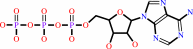 ATP
ATP
|
=
|
O-phospho-L-seryl-[protein]
|
+
|
 ADP
ADP
|
+
|
H(+)
|
|
|
|
|
|
|
L-threonyl-[protein]
|
+
|
ATP
|
=
|
O-phospho-L-threonyl-[protein]
|
+
|
ADP
|
+
|
H(+)
|
|
|
|
|
|
|
|
|
|
|
|
|
Molecule diagrams generated from .mol files obtained from the
KEGG ftp site
|
|
|
|
|
|
|
|
|
|
|
|
|
|
 |
|
|
|
|
|
|
| |
|
|
| |
|
DOI no:
|
EMBO J
23:2185-2195
(2004)
|
|
PubMed id:
|
|
|
|
|
|
| |
|
Structural basis for the selective inhibition of JNK1 by the scaffolding protein JIP1 and SP600125.
|
|
Y.S.Heo,
S.K.Kim,
C.I.Seo,
Y.K.Kim,
B.J.Sung,
H.S.Lee,
J.I.Lee,
S.Y.Park,
J.H.Kim,
K.Y.Hwang,
Y.L.Hyun,
Y.H.Jeon,
S.Ro,
J.M.Cho,
T.G.Lee,
C.H.Yang.
|
|
|
|
|
| |
ABSTRACT
|
|
|
|
| |
|
|
The c-jun N-terminal kinase (JNK) signaling pathway is regulated by
JNK-interacting protein-1 (JIP1), which is a scaffolding protein assembling the
components of the JNK cascade. Overexpression of JIP1 deactivates the JNK
pathway selectively by cytoplasmic retention of JNK and thereby inhibits gene
expression mediated by JNK, which occurs in the nucleus. Here, we report the
crystal structure of human JNK1 complexed with pepJIP1, the peptide fragment of
JIP1, revealing its selectivity for JNK1 over other MAPKs and the allosteric
inhibition mechanism. The van der Waals contacts by the three residues (Pro157,
Leu160, and Leu162) of pepJIP1 and the hydrogen bonding between Glu329 of JNK1
and Arg156 of pepJIP1 are critical for the selective binding. Binding of the
peptide also induces a hinge motion between the N- and C-terminal domains of
JNK1 and distorts the ATP-binding cleft, reducing the affinity of the kinase for
ATP. In addition, we also determined the ternary complex structure of
pepJIP1-bound JNK1 complexed with SP600125, an ATP-competitive inhibitor of JNK,
providing the basis for the JNK specificity of the compound.
|
|
|
|
|
|
| |
Selected figure(s)
|
|
|
|
| |
|
|

|
|

|
|
Figure 4.
Figure 4 Distortion of the ATP-binding site caused by
interdomain rearrangement upon pepJIP1 binding. (A) Structural
comparison between JNK3 (green) and pepJIP1-bound JNK1 (violet)
when the C-terminal domains of the kinases are superimposed. The
conformational differences of the N-terminal domains can be
easily distinguished when the conventional view of kinases is
rotated by 45° along the horizontal axis. The yellow circle
indicates the interaction between the  1
helix and the phosphorylation loop in JNK3, but not existing in
JNK1 complexed with pepJIP1. (B) Comparison of ATP-binding sites
between the JNK1 -pepJIP1 (violet) and JNK3 -AMPPNP (green)
complexes. The AMPPNP bound in JNK3 is shown in a ball-and-stick
model. The residues of JNK3 involved in the hydrogen bonding
with AMPPNP are labeled. The side chains of the residues in the
glycine-rich loop including E75 and A74 of JNK3 are omitted for
clarity because the backbone amide groups only are involved in
the hydrogen bonds with the phosphate groups of AMPPNP. (C) The
structural comparison of the residues crucial for the catalytic
activity between the JNK1 -pepJIP1 (violet) and JNK3 -AMPPNP
(green) complexes. The residues in JNK1 and JNK3 are labeled red
and black, respectively. In (B, C), hydrogen bonds are indicated
by dashed lines. 1
helix and the phosphorylation loop in JNK3, but not existing in
JNK1 complexed with pepJIP1. (B) Comparison of ATP-binding sites
between the JNK1 -pepJIP1 (violet) and JNK3 -AMPPNP (green)
complexes. The AMPPNP bound in JNK3 is shown in a ball-and-stick
model. The residues of JNK3 involved in the hydrogen bonding
with AMPPNP are labeled. The side chains of the residues in the
glycine-rich loop including E75 and A74 of JNK3 are omitted for
clarity because the backbone amide groups only are involved in
the hydrogen bonds with the phosphate groups of AMPPNP. (C) The
structural comparison of the residues crucial for the catalytic
activity between the JNK1 -pepJIP1 (violet) and JNK3 -AMPPNP
(green) complexes. The residues in JNK1 and JNK3 are labeled red
and black, respectively. In (B, C), hydrogen bonds are indicated
by dashed lines.
|
|
Figure 5.
Figure 5 The inhibited phosphorylation of MBP, the docking
site-independent substrate, due to the reduced ATP binding
affinity to JNK1 by pepJIP1 binding. (A, B) The binding
affinities of ATP to JNK1 were measured by ITC when pepJIP1 was
unbound (A) and bound (B) to JNK1. (C) Dose-dependent inhibition
of the kinase activity of JNK1 by pepJIP1 using MBP as
substrates. The mutated pepJIP1 used for control experiment has
the sequence of RPKAATTANAF.
|
|
|
|
|
|
| |
The above figures are
reprinted
from an Open Access publication published by Macmillan Publishers Ltd:
EMBO J
(2004,
23,
2185-2195)
copyright 2004.
|
|
| |
Figures were
selected
by an automated process.
|
|
|
|
|
|
|
|
|
|
|
|
|
|
|
|
 |
 |
 |
|
Literature references that cite this PDB file's key reference
|
|
|
| |
PubMed id
|
|
Reference
|
|
|
|
|
|
A.F.Thévenin,
C.L.Zony,
B.J.Bahnson,
and
R.F.Colman
(2011).
GSTpi modulates JNK activity through a direct interaction with JNK substrate, ATF2.
|
| |
Protein Sci,
20,
834-848.
|
|
|
|
|
|
|
K.R.Ngoei,
B.Catimel,
N.Church,
D.S.Lio,
C.Dogovski,
M.A.Perugini,
P.M.Watt,
H.C.Cheng,
D.C.Ng,
and
M.A.Bogoyevitch
(2011).
Characterization of a novel JNK (c-Jun N-terminal kinase) inhibitory peptide.
|
| |
Biochem J,
434,
399-413.
|
|
|
|
|
|
|
S.K.De,
E.Barile,
V.Chen,
J.L.Stebbins,
J.F.Cellitti,
T.Machleidt,
C.B.Carlson,
L.Yang,
R.Dahl,
and
M.Pellecchia
(2011).
Design, synthesis, and structure-activity relationship studies of thiophene-3-carboxamide derivatives as dual inhibitors of the c-Jun N-terminal kinase.
|
| |
Bioorg Med Chem,
19,
2582-2588.
|
|
|
|
|
|
|
S.Lee,
M.Warthaka,
C.Yan,
T.S.Kaoud,
A.Piserchio,
R.Ghose,
P.Ren,
and
K.N.Dalby
(2011).
A model of a MAPK•substrate complex in an active conformation: a computational and experimental approach.
|
| |
PLoS One,
6,
e18594.
|
|
|
|
|
|
|
S.Mehan,
H.Meena,
D.Sharma,
and
R.Sankhla
(2011).
JNK: A Stress-Activated Protein Kinase Therapeutic Strategies and Involvement in Alzheimer's and Various Neurodegenerative Abnormalities.
|
| |
J Mol Neurosci,
43,
376-390.
|
|
|
|
|
|
|
S.R.Boston,
R.Deshmukh,
S.Strome,
U.D.Priyakumar,
A.D.MacKerell,
and
P.Shapiro
(2011).
Characterization of ERK docking domain inhibitors that induce apoptosis by targeting Rsk-1 and caspase-9.
|
| |
BMC Cancer,
11,
7.
|
|
|
|
|
|
|
C.Li,
J.I.Macdonald,
T.Hryciw,
and
S.O.Meakin
(2010).
Nerve growth factor activation of the TrkA receptor induces cell death, by macropinocytosis, in medulloblastoma Daoy cells.
|
| |
J Neurochem,
112,
882-899.
|
|
|
|
|
|
|
R.Akella,
X.Min,
Q.Wu,
K.H.Gardner,
and
E.J.Goldsmith
(2010).
The third conformation of p38α MAP kinase observed in phosphorylated p38α and in solution.
|
| |
Structure,
18,
1571-1578.
|
|
|
PDB code:
|
|
|
|
|
|
|
|
S.K.De,
V.Chen,
J.L.Stebbins,
L.H.Chen,
J.F.Cellitti,
T.Machleidt,
E.Barile,
M.Riel-Mehan,
R.Dahl,
L.Yang,
A.Emdadi,
R.Murphy,
and
M.Pellecchia
(2010).
Synthesis and optimization of thiadiazole derivatives as a novel class of substrate competitive c-Jun N-terminal kinase inhibitors.
|
| |
Bioorg Med Chem,
18,
590-596.
|
|
|
|
|
|
|
T.M.Lindstrom,
and
W.H.Robinson
(2010).
A multitude of kinases--which are the best targets in treating rheumatoid arthritis?
|
| |
Rheum Dis Clin North Am,
36,
367-383.
|
|
|
|
|
|
|
A.J.Bardwell,
E.Frankson,
and
L.Bardwell
(2009).
Selectivity of docking sites in MAPK kinases.
|
| |
J Biol Chem,
284,
13165-13173.
|
|
|
|
|
|
|
A.W.Truman,
K.Y.Kim,
and
D.E.Levin
(2009).
Mechanism of Mpk1 mitogen-activated protein kinase binding to the Swi4 transcription factor and its regulation by a novel caffeine-induced phosphorylation.
|
| |
Mol Cell Biol,
29,
6449-6461.
|
|
|
|
|
|
|
F.Chen,
K.Beezhold,
and
V.Castranova
(2009).
JNK1, a potential therapeutic target for hepatocellular carcinoma.
|
| |
Biochim Biophys Acta,
1796,
242-251.
|
|
|
|
|
|
|
M.C.Balasu,
L.N.Spiridon,
S.Miron,
C.T.Craescu,
A.J.Scheidig,
A.J.Petrescu,
and
S.E.Szedlacsek
(2009).
Interface analysis of the complex between ERK2 and PTP-SL.
|
| |
PLoS ONE,
4,
e5432.
|
|
|
|
|
|
|
M.Gaestel,
A.Kotlyarov,
and
M.Kracht
(2009).
Targeting innate immunity protein kinase signalling in inflammation.
|
| |
Nat Rev Drug Discov,
8,
480-499.
|
|
|
|
|
|
|
M.R.Arkin,
and
A.Whitty
(2009).
The road less traveled: modulating signal transduction enzymes by inhibiting their protein-protein interactions.
|
| |
Curr Opin Chem Biol,
13,
284-290.
|
|
|
|
|
|
|
R.L.Zemans,
and
P.G.Arndt
(2009).
Tec kinases regulate actin assembly and cytokine expression in LPS-stimulated human neutrophils via JNK activation.
|
| |
Cell Immunol,
258,
90-97.
|
|
|
|
|
|
|
S.K.De,
J.L.Stebbins,
L.H.Chen,
M.Riel-Mehan,
T.Machleidt,
R.Dahl,
H.Yuan,
A.Emdadi,
E.Barile,
V.Chen,
R.Murphy,
and
M.Pellecchia
(2009).
Design, synthesis, and structure-activity relationship of substrate competitive, selective, and in vivo active triazole and thiadiazole inhibitors of the c-Jun N-terminal kinase.
|
| |
J Med Chem,
52,
1943-1952.
|
|
|
|
|
|
|
S.K.De,
L.H.Chen,
J.L.Stebbins,
T.Machleidt,
M.Riel-Mehan,
R.Dahl,
V.Chen,
H.Yuan,
E.Barile,
A.Emdadi,
R.Murphy,
and
M.Pellecchia
(2009).
Discovery of 2-(5-nitrothiazol-2-ylthio)benzo[d]thiazoles as novel c-Jun N-terminal kinase inhibitors.
|
| |
Bioorg Med Chem,
17,
2712-2717.
|
|
|
|
|
|
|
T.Chen,
N.Kablaoui,
J.Little,
S.Timofeevski,
W.R.Tschantz,
P.Chen,
J.Feng,
M.Charlton,
R.Stanton,
and
P.Bauer
(2009).
Identification of small-molecule inhibitors of the JIP-JNK interaction.
|
| |
Biochem J,
420,
283-294.
|
|
|
|
|
|
|
T.Kamenecka,
J.Habel,
D.Duckett,
W.Chen,
Y.Y.Ling,
B.Frackowiak,
R.Jiang,
Y.Shin,
X.Song,
and
P.Lograsso
(2009).
Structure-Activity Relationships and X-ray Structures Describing the Selectivity of Aminopyrazole Inhibitors for c-Jun N-terminal Kinase 3 (JNK3) over p38.
|
| |
J Biol Chem,
284,
12853-12861.
|
|
|
PDB codes:
|
|
|
|
|
|
|
|
X.Min,
R.Akella,
H.He,
J.M.Humphreys,
S.E.Tsutakawa,
S.J.Lee,
J.A.Tainer,
M.H.Cobb,
and
E.J.Goldsmith
(2009).
The structure of the MAP2K MEK6 reveals an autoinhibitory dimer.
|
| |
Structure,
17,
96.
|
|
|
PDB code:
|
|
|
|
|
|
|
|
C.Guo,
and
A.J.Whitmarsh
(2008).
The beta-arrestin-2 scaffold protein promotes c-Jun N-terminal kinase-3 activation by binding to its nonconserved N terminus.
|
| |
J Biol Chem,
283,
15903-15911.
|
|
|
|
|
|
|
D.Dávila,
and
I.Torres-Aleman
(2008).
Neuronal death by oxidative stress involves activation of FOXO3 through a two-arm pathway that activates stress kinases and attenuates insulin-like growth factor I signaling.
|
| |
Mol Biol Cell,
19,
2014-2025.
|
|
|
|
|
|
|
D.L.Sheridan,
Y.Kong,
S.A.Parker,
K.N.Dalby,
and
B.E.Turk
(2008).
Substrate discrimination among mitogen-activated protein kinases through distinct docking sequence motifs.
|
| |
J Biol Chem,
283,
19511-19520.
|
|
|
|
|
|
|
J.L.Stebbins,
S.K.De,
T.Machleidt,
B.Becattini,
J.Vazquez,
C.Kuntzen,
L.H.Chen,
J.F.Cellitti,
M.Riel-Mehan,
A.Emdadi,
G.Solinas,
M.Karin,
and
M.Pellecchia
(2008).
Identification of a new JNK inhibitor targeting the JNK-JIP interaction site.
|
| |
Proc Natl Acad Sci U S A,
105,
16809-16813.
|
|
|
|
|
|
|
J.Vazquez,
S.K.De,
L.H.Chen,
M.Riel-Mehan,
A.Emdadi,
J.Cellitti,
J.L.Stebbins,
M.F.Rega,
and
M.Pellecchia
(2008).
Development of paramagnetic probes for molecular recognition studies in protein kinases.
|
| |
J Med Chem,
51,
3460-3465.
|
|
|
|
|
|
|
J.Yamauchi,
Y.Miyamoto,
J.R.Chan,
and
A.Tanoue
(2008).
ErbB2 directly activates the exchange factor Dock7 to promote Schwann cell migration.
|
| |
J Cell Biol,
181,
351-365.
|
|
|
|
|
|
|
M.L.Chu,
L.M.Chavas,
K.T.Douglas,
P.A.Eyers,
and
L.Tabernero
(2008).
Crystal structure of the catalytic domain of the mitotic checkpoint kinase Mps1 in complex with SP600125.
|
| |
J Biol Chem,
283,
21495-21500.
|
|
|
PDB codes:
|
|
|
|
|
|
|
|
R.Akella,
T.M.Moon,
and
E.J.Goldsmith
(2008).
Unique MAP Kinase binding sites.
|
| |
Biochim Biophys Acta,
1784,
48-55.
|
|
|
|
|
|
|
S.Galli,
V.G.Antico Arciuch,
C.Poderoso,
D.P.Converso,
Q.Zhou,
E.Bal de Kier Joffé,
E.Cadenas,
J.Boczkowski,
M.C.Carreras,
and
J.J.Poderoso
(2008).
Tumor cell phenotype is sustained by selective MAPK oxidation in mitochondria.
|
| |
PLoS ONE,
3,
e2379.
|
|
|
|
|
|
|
Y.Murakami,
K.Tatebayashi,
and
H.Saito
(2008).
Two adjacent docking sites in the yeast Hog1 mitogen-activated protein (MAP) kinase differentially interact with the Pbs2 MAP kinase kinase and the Ptp2 protein tyrosine phosphatase.
|
| |
Mol Cell Biol,
28,
2481-2494.
|
|
|
|
|
|
|
A.G.Turjanski,
J.P.Vaqué,
and
J.S.Gutkind
(2007).
MAP kinases and the control of nuclear events.
|
| |
Oncogene,
26,
3240-3253.
|
|
|
|
|
|
|
A.White,
C.A.Pargellis,
J.M.Studts,
B.G.Werneburg,
and
B.T.Farmer
(2007).
Molecular basis of MAPK-activated protein kinase 2:p38 assembly.
|
| |
Proc Natl Acad Sci U S A,
104,
6353-6358.
|
|
|
PDB code:
|
|
|
|
|
|
|
|
C.R.Weston,
and
R.J.Davis
(2007).
The JNK signal transduction pathway.
|
| |
Curr Opin Cell Biol,
19,
142-149.
|
|
|
|
|
|
|
G.Bunkoczi,
E.Salah,
P.Filippakopoulos,
O.Fedorov,
S.Müller,
F.Sobott,
S.A.Parker,
H.Zhang,
W.Min,
B.E.Turk,
and
S.Knapp
(2007).
Structural and functional characterization of the human protein kinase ASK1.
|
| |
Structure,
15,
1215-1226.
|
|
|
PDB code:
|
|
|
|
|
|
|
|
H.J.Zapata,
M.Nakatsugawa,
and
J.F.Moffat
(2007).
Varicella-zoster virus infection of human fibroblast cells activates the c-Jun N-terminal kinase pathway.
|
| |
J Virol,
81,
977-990.
|
|
|
|
|
|
|
J.A.Ubersax,
and
J.E.Ferrell
(2007).
Mechanisms of specificity in protein phosphorylation.
|
| |
Nat Rev Mol Cell Biol,
8,
530-541.
|
|
|
|
|
|
|
M.Raman,
W.Chen,
and
M.H.Cobb
(2007).
Differential regulation and properties of MAPKs.
|
| |
Oncogene,
26,
3100-3112.
|
|
|
|
|
|
|
O.Abramczyk,
M.A.Rainey,
R.Barnes,
L.Martin,
and
K.N.Dalby
(2007).
Expanding the repertoire of an ERK2 recruitment site: cysteine footprinting identifies the D-recruitment site as a mediator of Ets-1 binding.
|
| |
Biochemistry,
46,
9174-9186.
|
|
|
|
|
|
|
Y.Zhu,
H.Li,
C.Long,
L.Hu,
H.Xu,
L.Liu,
S.Chen,
D.C.Wang,
and
F.Shao
(2007).
Structural insights into the enzymatic mechanism of the pathogenic MAPK phosphothreonine lyase.
|
| |
Mol Cell,
28,
899-913.
|
|
|
PDB codes:
|
|
|
|
|
|
|
|
A.Reményi,
M.C.Good,
and
W.A.Lim
(2006).
Docking interactions in protein kinase and phosphatase networks.
|
| |
Curr Opin Struct Biol,
16,
676-685.
|
|
|
|
|
|
|
B.Zhou,
J.Zhang,
S.Liu,
S.Reddy,
F.Wang,
and
Z.Y.Zhang
(2006).
Mapping ERK2-MKP3 binding interfaces by hydrogen/deuterium exchange mass spectrometry.
|
| |
J Biol Chem,
281,
38834-38844.
|
|
|
|
|
|
|
D.T.Ho,
A.J.Bardwell,
S.Grewal,
C.Iverson,
and
L.Bardwell
(2006).
Interacting JNK-docking sites in MKK7 promote binding and activation of JNK mitogen-activated protein kinases.
|
| |
J Biol Chem,
281,
13169-13179.
|
|
|
|
|
|
|
H.Zhou,
M.Zheng,
J.Chen,
C.Xie,
A.R.Kolatkar,
T.Zarubin,
Z.Ye,
R.Akella,
S.Lin,
E.J.Goldsmith,
and
J.Han
(2006).
Determinants that control the specific interactions between TAB1 and p38alpha.
|
| |
Mol Cell Biol,
26,
3824-3834.
|
|
|
|
|
|
|
L.Bardwell,
and
K.Shah
(2006).
Analysis of mitogen-activated protein kinase activation and interactions with regulators and substrates.
|
| |
Methods,
40,
213-223.
|
|
|
|
|
|
|
L.Bardwell
(2006).
Mechanisms of MAPK signalling specificity.
|
| |
Biochem Soc Trans,
34,
837-841.
|
|
|
|
|
|
|
M.A.Bogoyevitch,
and
B.Kobe
(2006).
Uses for JNK: the many and varied substrates of the c-Jun N-terminal kinases.
|
| |
Microbiol Mol Biol Rev,
70,
1061-1095.
|
|
|
|
|
|
|
O.Kristensen,
S.Guenat,
I.Dar,
N.Allaman-Pillet,
A.Abderrahmani,
M.Ferdaoussi,
R.Roduit,
F.Maurer,
J.S.Beckmann,
J.S.Kastrup,
M.Gajhede,
and
C.Bonny
(2006).
A unique set of SH3-SH3 interactions controls IB1 homodimerization.
|
| |
EMBO J,
25,
785-797.
|
|
|
PDB codes:
|
|
|
|
|
|
|
|
R.P.Bhattacharyya,
A.Reményi,
B.J.Yeh,
and
W.A.Lim
(2006).
Domains, motifs, and scaffolds: the role of modular interactions in the evolution and wiring of cell signaling circuits.
|
| |
Annu Rev Biochem,
75,
655-680.
|
|
|
|
|
|
|
S.Liu,
J.P.Sun,
B.Zhou,
and
Z.Y.Zhang
(2006).
Structural basis of docking interactions between ERK2 and MAP kinase phosphatase 3.
|
| |
Proc Natl Acad Sci U S A,
103,
5326-5331.
|
|
|
PDB code:
|
|
|
|
|
|
|
|
T.Zhou,
L.Sun,
J.Humphreys,
and
E.J.Goldsmith
(2006).
Docking interactions induce exposure of activation loop in the MAP kinase ERK2.
|
| |
Structure,
14,
1011-1019.
|
|
|
PDB code:
|
|
|
|
|
|
|
|
X.Shi-Wen,
F.Rodríguez-Pascual,
S.Lamas,
A.Holmes,
S.Howat,
J.D.Pearson,
M.R.Dashwood,
R.M.du Bois,
C.P.Denton,
C.M.Black,
D.J.Abraham,
and
A.Leask
(2006).
Constitutive ALK5-independent c-Jun N-terminal kinase activation contributes to endothelin-1 overexpression in pulmonary fibrosis: evidence of an autocrine endothelin loop operating through the endothelin A and B receptors.
|
| |
Mol Cell Biol,
26,
5518-5527.
|
|
|
|
|
|
|
Z.Shi,
K.A.Resing,
and
N.G.Ahn
(2006).
Networks for the allosteric control of protein kinases.
|
| |
Curr Opin Struct Biol,
16,
686-692.
|
|
|
|
|
|
|
A.Reményi,
M.C.Good,
R.P.Bhattacharyya,
and
W.A.Lim
(2005).
The role of docking interactions in mediating signaling input, output, and discrimination in the yeast MAPK network.
|
| |
Mol Cell,
20,
951-962.
|
|
|
PDB codes:
|
|
|
|
|
|
|
|
C.Tárrega,
P.Ríos,
R.Cejudo-Marín,
C.Blanco-Aparicio,
L.van den Berk,
J.Schepens,
W.Hendriks,
L.Tabernero,
and
R.Pulido
(2005).
ERK2 shows a restrictive and locally selective mechanism of recognition by its tyrosine phosphatase inactivators not shared by its activator MEK1.
|
| |
J Biol Chem,
280,
37885-37894.
|
|
|
|
|
|
|
D.M.Molina,
S.Grewal,
and
L.Bardwell
(2005).
Characterization of an ERK-binding domain in microphthalmia-associated transcription factor and differential inhibition of ERK2-mediated substrate phosphorylation.
|
| |
J Biol Chem,
280,
42051-42060.
|
|
|
|
|
|
|
D.Shin,
Y.S.Heo,
K.J.Lee,
C.M.Kim,
J.M.Yoon,
J.I.Lee,
Y.L.Hyun,
Y.H.Jeon,
T.G.Lee,
J.M.Cho,
and
S.Ro
(2005).
Structural chemoproteomics and drug discovery.
|
| |
Biopolymers,
80,
258-263.
|
|
|
|
|
|
|
M.A.Bogoyevitch
(2005).
Therapeutic promise of JNK ATP-noncompetitive inhibitors.
|
| |
Trends Mol Med,
11,
232-239.
|
|
|
|
|
|
|
M.Schmidt,
Y.Budirahardja,
R.Klompmaker,
and
R.H.Medema
(2005).
Ablation of the spindle assembly checkpoint by a compound targeting Mps1.
|
| |
EMBO Rep,
6,
866-872.
|
|
|
|
|
|
|
P.López-Bergami,
H.Habelhah,
A.Bhoumik,
W.Zhang,
L.H.Wang,
and
Z.Ronai
(2005).
RACK1 mediates activation of JNK by protein kinase C [corrected].
|
| |
Mol Cell,
19,
309-320.
|
|
|
|
|
|
|
L.Resnick,
and
M.Fennell
(2004).
Targeting JNK3 for the treatment of neurodegenerative disorders.
|
| |
Drug Discov Today,
9,
932-939.
|
|
|
|
|
|
|
R.K.Barr,
I.Boehm,
P.V.Attwood,
P.M.Watt,
and
M.A.Bogoyevitch
(2004).
The critical features and the mechanism of inhibition of a kinase interaction motif-based peptide inhibitor of JNK.
|
| |
J Biol Chem,
279,
36327-36338.
|
|
|
|
|
|
|
R.K.Barr,
R.M.Hopkins,
P.M.Watt,
and
M.A.Bogoyevitch
(2004).
Reverse two-hybrid screening identifies residues of JNK required for interaction with the kinase interaction motif of JNK-interacting protein-1.
|
| |
J Biol Chem,
279,
43178-43189.
|
|
|
|
|
|
|
R.Ricci,
G.Sumara,
I.Sumara,
I.Rozenberg,
M.Kurrer,
A.Akhmedov,
M.Hersberger,
U.Eriksson,
F.R.Eberli,
B.Becher,
J.Borén,
M.Chen,
M.I.Cybulsky,
K.J.Moore,
M.W.Freeman,
E.F.Wagner,
C.M.Matter,
and
T.F.Lüscher
(2004).
Requirement of JNK2 for scavenger receptor A-mediated foam cell formation in atherogenesis.
|
| |
Science,
306,
1558-1561.
|
|
|
|
|
|
The most recent references are shown first.
Citation data come partly from CiteXplore and partly
from an automated harvesting procedure. Note that this is likely to be
only a partial list as not all journals are covered by
either method. However, we are continually building up the citation data
so more and more references will be included with time.
Where a reference describes a PDB structure, the PDB
code is
shown on the right.
|
|


 Links
Links


