 |
PDBsum entry 1svk

|
|
|
|
|
|

|

|

|

|
|

|
|

|
|

|
|

|
|

|
|
|
 |

|

|
|
|
|
|
|
|
|
|
|
|
|
|
|
|
|
|
|
|
|
|
|
|
|
|
|
|
|
|
|
|
|
|
|
Hydrolase, signaling protein
|
PDB id
|
|
|
|
1svk
|
|
|
|
|
|
|
|
|
|
|
|
|
|
|

|

|

|
|
|
|
|
|
|
|
 |
Contents |
 |
|
|
|
|
|
|
|
|
|
|
|
|
|
|
* Residue conservation analysis
|
|
|
|
|
|
PDB id:
|
|
|
|
| Name: |
|
Hydrolase, signaling protein
|
|
|
Title:
|
|
Structure of the k180p mutant of gi alpha subunit bound to alf4 and gdp
|
|
Structure:
|
|
Guanine nucleotide-binding protein g(i), alpha-1 subunit. Chain: a. Synonym: adenylate cyclase-inhibiting g alpha protein. Engineered: yes. Mutation: yes
|
|
Source:
|
|
Rattus norvegicus. Norway rat. Organism_taxid: 10116. Gene: gnai1, gnai-1. Expressed in: escherichia coli. Expression_system_taxid: 562.
|
|
Resolution:
|
|
|
2.00Å
|
R-factor:
|
0.197
|
R-free:
|
0.239
|
|
|
Authors:
|
|
C.J.Thomas,X.Du,P.Li,Y.Wang,E.M.Ross,S.R.Sprang
|
Key ref:

|
|
C.J.Thomas
et al.
(2004).
Uncoupling conformational change from GTP hydrolysis in a heterotrimeric G protein alpha-subunit.
Proc Natl Acad Sci U S A,
101,
7560-7565.
PubMed id:
DOI:

|
|
|
Date:
|
|
|
29-Mar-04
|
Release date:
|
01-Jun-04
|
|
|
|
|
|
|
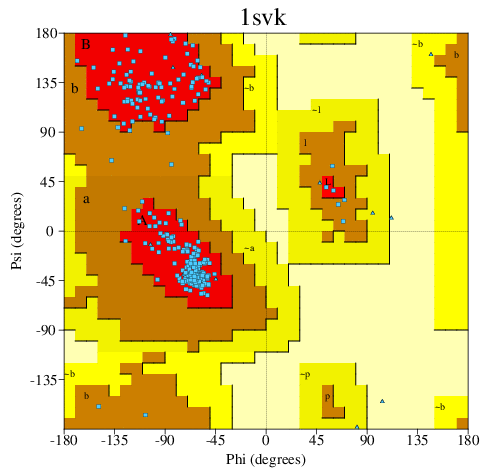
PROCHECK
|
|
|
|
|
|
Headers
|
|
|
|
References
|
|
|
|
|
|

|
|
P10824
(GNAI1_RAT) -
Guanine nucleotide-binding protein G(i) subunit alpha-1 from Rattus norvegicus
|
|
|
|
Seq:
Struc:
|
|
|
|
354 a.a.
313 a.a.*
|
|

|

|
|
|
|
|
|
|
|
|
|
|
|
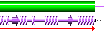
Key: |
 |
PfamA domain |
|
|
 |
Secondary structure |
|
 |
CATH domain |
|
|
*
PDB and UniProt seqs differ
at 1 residue position (black
cross)
|
|
|
|
|
|
|
|
|
|
|
|
|
Enzyme class:
|
|
E.C.3.6.1.46
- Transferred entry: 3.6.5.1.
|
|
|
|
|
|
|
Reaction:
|
|
GTP + H2O = GDP + phosphate
|
|
|
|
|
|
|
|
|
|
|
|
|
|
|
|
|
|
 |
|
|
|
|
|
|
| |
|
DOI no:
|
Proc Natl Acad Sci U S A
101:7560-7565
(2004)
|
|
PubMed id:
|
|
|
|
|
|
| |
|
Uncoupling conformational change from GTP hydrolysis in a heterotrimeric G protein alpha-subunit.
|
|
C.J.Thomas,
X.Du,
P.Li,
Y.Wang,
E.M.Ross,
S.R.Sprang.
|
|
|
|
|
| |
ABSTRACT
|
|
|
|
| |
|
|
Heterotrimeric G protein alpha (G alpha) subunits possess intrinsic GTPase
activity that leads to functional deactivation with a rate constant of
approximately 2 min(-1) at 30 degrees C. GTP hydrolysis causes conformational
changes in three regions of G alpha, including Switch I and Switch II. Mutation
of G202-->A in Switch II of G alpha(i1) accelerates the rates of both GTP
hydrolysis and conformational change, which is measured by the loss of
fluorescence from Trp-211 in Switch II. Mutation of K180-->P in Switch I
increases the rate of conformational change but decreases the GTPase rate, which
causes transient but substantial accumulation of a low-fluorescence G
alpha(i1).GTP species. Isothermal titration calorimetric analysis of the binding
of (G202A)G alpha(i1) and (K180P)G alpha(i1) to the GTPase-activating protein
RGS4 indicates that the G202A mutation stabilizes the pretransition state-like
conformation of G alpha(i1) that is mimicked by the complex of G alpha(i1) with
GDP and magnesium fluoroaluminate, whereas the K180P mutation destabilizes this
state. The crystal structures of (K180P)G alpha(i1) bound to a slowly
hydrolyzable GTP analog, and the GDP.magnesium fluoroaluminate complex provide
evidence that the Mg(2+) binding site is destabilized and that Switch I is
torsionally restrained by the K180P mutation. The data are consistent with a
catalytic mechanism for G alpha in which major conformational transitions in
Switch I and Switch II are obligate events that precede the bond-breaking step
in GTP hydrolysis. In (K180P)G alpha(i1), the two events are decoupled
kinetically, whereas in the native protein they are concerted.
|
|
|
|
|
|
| |
Selected figure(s)
|
|
|
|
| |
|
|

|
|

|
|
Figure 2.
Fig. 2. Catalytic sites of G  [i1]·
GDP·Mg2+·AlF[4]^- complexes. Atoms are rendered as
follows: carbon, gold; nitrogen, cyan; oxygen, red; fluorine,
yellow; aluminum, gray; and phosphorus, green. Mg2+ is shown as
a blue sphere; and [i1]·
GDP·Mg2+·AlF[4]^- complexes. Atoms are rendered as
follows: carbon, gold; nitrogen, cyan; oxygen, red; fluorine,
yellow; aluminum, gray; and phosphorus, green. Mg2+ is shown as
a blue sphere; and  phosphate oxygen atoms
are shown. Metal-coordination interactions are indicated by gray
dashed lines, and hydrogen bonds are indicated by red dashed
lines. (A) Wild-type G [i1]. (B) For (K180P)G
[i1], major (a,
occupancy, phosphate oxygen atoms
are shown. Metal-coordination interactions are indicated by gray
dashed lines, and hydrogen bonds are indicated by red dashed
lines. (A) Wild-type G [i1]. (B) For (K180P)G
[i1], major (a,
occupancy,  0.25) and minor (b,
occupancy, 0.75) conformations of
Ser-47 are shown. 0.25) and minor (b,
occupancy, 0.75) conformations of
Ser-47 are shown.
|
|
Figure 3.
Fig. 3. Difference-distance analysis of wild type and
(K180P)G [i1] in complexes with
GppNHp·Mg2+ and GDP·Mg2+·AlF[4.] Changes in
contacts between C in residues 165-207 in
G [i1] (rows) and
residues 35-76 and 140-226 in (K180P)G [i1] (columns) for the
GNP-bound complexes (Left), and the AlF-bound complexes (Center)
are shown. In Right, the elements from the AlF matrix are
subtracted from the corresponding elements in the GNP matrix.
Values are  -weighted and
color-coded according to direction and magnitude (red, negative;
blue, positive). Contour values range from ± to 0.
Matrix elements corresponding to residue pairs separated by >10
Å were set at 0. The dark line represents self-vectors (i
= j). -weighted and
color-coded according to direction and magnitude (red, negative;
blue, positive). Contour values range from ± to 0.
Matrix elements corresponding to residue pairs separated by >10
Å were set at 0. The dark line represents self-vectors (i
= j).
|
|
|
|
| |
Figures were
selected
by an automated process.
|
|
|
|
|
|
|
|
|
|
|
|
|
|
|
|
 |
 |
 |
|
Literature references that cite this PDB file's key reference
|
|
|
| |
PubMed id
|
|
Reference
|
|
|
|
|
|
F.D.Ivey,
F.X.Taglia,
F.Yang,
M.M.Lander,
D.A.Kelly,
and
C.S.Hoffman
(2010).
Activated alleles of the Schizosaccharomyces pombe gpa2+ Galpha gene identify residues involved in GDP-GTP exchange.
|
| |
Eukaryot Cell,
9,
626-633.
|
|
|
|
|
|
|
N.A.Lambert,
C.A.Johnston,
S.D.Cappell,
S.Kuravi,
A.J.Kimple,
F.S.Willard,
and
D.P.Siderovski
(2010).
Regulators of G-protein signaling accelerate GPCR signaling kinetics and govern sensitivity solely by accelerating GTPase activity.
|
| |
Proc Natl Acad Sci U S A,
107,
7066-7071.
|
|
|
|
|
|
|
K.Khafizov
(2009).
GoLoco motif proteins binding to Galpha(i1): insights from molecular simulations.
|
| |
J Mol Model,
15,
1491-1499.
|
|
|
|
|
|
|
Z.Chen,
W.D.Singer,
S.M.Danesh,
P.C.Sternweis,
and
S.R.Sprang
(2008).
Recognition of the activated states of Galpha13 by the rgRGS domain of PDZRhoGEF.
|
| |
Structure,
16,
1532-1543.
|
|
|
PDB codes:
|
|
|
|
|
|
|
The most recent references are shown first.
Citation data come partly from CiteXplore and partly
from an automated harvesting procedure. Note that this is likely to be
only a partial list as not all journals are covered by
either method. However, we are continually building up the citation data
so more and more references will be included with time.
Where a reference describes a PDB structure, the PDB
codes are
shown on the right.
|
|


 Links
Links


