 |
PDBsum entry 1shx

|
|
|
|
|
|

|

|

|

|
|

|
|

|
|

|
|

|
|
|
 |

|

|
|
|
|
|
|
|
|
|
|
|
|
|
|
|
|
|
|
|
|
|
|
|
|
|
|
|
|
|
|
|
|
|
Hormone/growth factor
|
PDB id
|
|
|
|
1shx
|
|
|
|
|
|
|
|
|
|
|
|
|
|
|

|

|

|
|
|
|
|
|
|
|
 |
Contents |
 |
|
|
|
|
|
|
|
|
|
|
|
|
* Residue conservation analysis
|
|
|
|
|
|
PDB id:
|
|
|
|
| Name: |
|
Hormone/growth factor
|
|
|
Title:
|
|
Ephrin a5 ligand structure
|
|
Structure:
|
|
Ephrin-a5. Chain: a, b. Synonym: eph-related receptor tyrosine kinase ligand 7, lerk-7, al-1. Engineered: yes
|
|
Source:
|
|
Mus musculus. House mouse. Organism_taxid: 10090. Gene: efna5, eplg7, lerk7, epl7. Expressed in: homo sapiens. Expression_system_taxid: 9606. Expression_system_cell_line: hek293. Expression_system_organ: kidney
|
|
Resolution:
|
|
|
2.10Å
|
R-factor:
|
0.224
|
R-free:
|
0.278
|
|
|
Authors:
|
|
J.P.Himanen,W.A.Barton,D.B.Nikolov,P.D.Jeffrey
|
|
Key ref:
|
|
B.Day
et al.
(2005).
Three distinct molecular surfaces in ephrin-A5 are essential for a functional interaction with EphA3.
J Biol Chem,
280,
26526-26532.
PubMed id:
|
|
|
Date:
|
|
|
26-Feb-04
|
Release date:
|
19-Apr-05
|
|
|
|
|
|
|
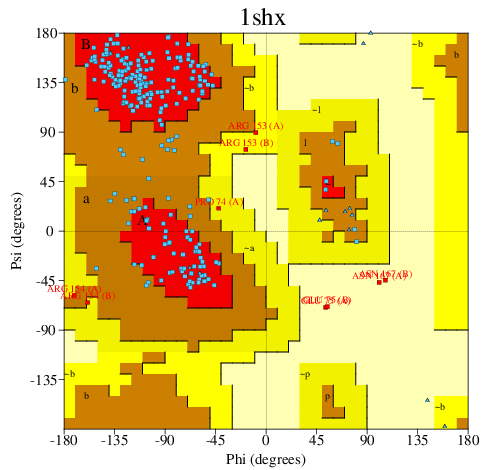
PROCHECK
|
|
|
|
|
|
Headers
|
|
|
|
References
|
|
|
|
|
|

|
|
O08543
(EFNA5_MOUSE) -
Ephrin-A5 from Mus musculus
|
|
|
|
Seq:
Struc:
|
|
|
|
228 a.a.
138 a.a.
|
|

|

|
|
|
|
|
|
|
|
|
|
|
|
Key: |
 |
PfamA domain |
|
|
 |
Secondary structure |
|
 |
CATH domain |
|
|
|
|
|
|
|
|
|
|
|
|
|
|
|
|
|
 |
|
|
|
|
|
|
| |
|
|
J Biol Chem
280:26526-26532
(2005)
|
|
PubMed id:
|
|
|
|
|
|
| |
|
Three distinct molecular surfaces in ephrin-A5 are essential for a functional interaction with EphA3.
|
|
B.Day,
C.To,
J.P.Himanen,
F.M.Smith,
D.B.Nikolov,
A.W.Boyd,
M.Lackmann.
|
|
|
|
|
| |
ABSTRACT
|
|
|
|
| |
|
|
Eph receptor tyrosine kinases (Ephs) function as molecular relays that interact
with cell surface-bound ephrin ligands to direct the position of migrating
cells. Structural studies revealed that, through two distinct contact surfaces
on opposite sites of each protein, Eph and ephrin binding domains assemble into
symmetric, circular heterotetramers. However, Eph signal initiation requires the
assembly of higher order oligomers, suggesting additional points of contact. By
screening a random library of EphA3 binding-compromised ephrin-A5 mutants, we
have now determined ephrin-A5 residues that are essential for the assembly of
high affinity EphA3 signaling complexes. In addition to the two interfaces
predicted from the crystal structure of the homologous EphB2.ephrin-B2 complex,
we identified a cluster of 10 residues on the ephrin-A5 E alpha-helix, the E-F
loop, the underlying H beta-strand, as well as the nearby B-C loop, which define
a distinct third surface required for oligomerization and activation of EphA3
signaling. Together with a corresponding third surface region identified
recently outside of the minimal ephrin binding domain of EphA3, our findings
provide experimental evidence for the essential contribution of three distinct
protein-interaction interfaces to assemble functional EphA3 signaling complexes.
|
|
|
|
|
|
|
|
|
|
|
|
|
|
|
|
|
|
 |
 |
 |
|
Literature references that cite this PDB file's key reference
|
|
|
| |
PubMed id
|
|
Reference
|
|
|
|
|
|
K.Salaita,
P.M.Nair,
R.S.Petit,
R.M.Neve,
D.Das,
J.W.Gray,
and
J.T.Groves
(2010).
Restriction of receptor movement alters cellular response: physical force sensing by EphA2.
|
| |
Science,
327,
1380-1385.
|
|
|
|
|
|
|
T.A.Bowden,
A.R.Aricescu,
J.E.Nettleship,
C.Siebold,
N.Rahman-Huq,
R.J.Owens,
D.I.Stuart,
and
E.Y.Jones
(2009).
Structural plasticity of eph receptor A4 facilitates cross-class ephrin signaling.
|
| |
Structure,
17,
1386-1397.
|
|
|
PDB codes:
|
|
|
|
|
|
|
|
T.L.Davis,
J.R.Walker,
A.Allali-Hassani,
S.A.Parker,
B.E.Turk,
and
S.Dhe-Paganon
(2009).
Structural recognition of an optimized substrate for the ephrin family of receptor tyrosine kinases.
|
| |
FEBS J,
276,
4395-4404.
|
|
|
|
|
|
|
S.H.Wimmer-Kleikamp,
E.Nievergall,
K.Gegenbauer,
S.Adikari,
M.Mansour,
T.Yeadon,
A.W.Boyd,
N.R.Patani,
and
M.Lackmann
(2008).
Elevated protein tyrosine phosphatase activity provokes Eph/ephrin-facilitated adhesion of pre-B leukemia cells.
|
| |
Blood,
112,
721-732.
|
|
|
|
|
|
|
J.P.Himanen,
N.Saha,
and
D.B.Nikolov
(2007).
Cell-cell signaling via Eph receptors and ephrins.
|
| |
Curr Opin Cell Biol,
19,
534-542.
|
|
|
|
|
|
|
K.B.Pabbisetty,
X.Yue,
C.Li,
J.P.Himanen,
R.Zhou,
D.B.Nikolov,
and
L.Hu
(2007).
Kinetic analysis of the binding of monomeric and dimeric ephrins to Eph receptors: correlation to function in a growth cone collapse assay.
|
| |
Protein Sci,
16,
355-361.
|
|
|
|
|
|
|
R.L.Rich,
and
D.G.Myszka
(2006).
Survey of the year 2005 commercial optical biosensor literature.
|
| |
J Mol Recognit,
19,
478-534.
|
|
|
|
|
|
The most recent references are shown first.
Citation data come partly from CiteXplore and partly
from an automated harvesting procedure. Note that this is likely to be
only a partial list as not all journals are covered by
either method. However, we are continually building up the citation data
so more and more references will be included with time.
Where a reference describes a PDB structure, the PDB
codes are
shown on the right.
|
|


 Links
Links


