 |
PDBsum entry 1ryh

|
|
|
|
|
 |
Contents |
 |
|
|
|
|
|
|
|
|
|
|
|
|
|
|
* Residue conservation analysis
|
|
|
|
|
|
|
|
|
|
|
Enzyme class:
|
|
E.C.3.6.5.2
- small monomeric GTPase.
|
|
|
|
|
|
|
Reaction:
|
|
GTP + H2O = GDP + phosphate + H+
|
|
|
|
|
|
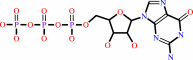 GTP
GTP
|
+
|
H2O
|
=
|
GDP
Bound ligand (Het Group name = )
matches with 81.82% similarity
|
+
|
 phosphate
|
+
|
H(+)
|
|
|
|
|
|
|
|
|
|
|
|
|
Molecule diagrams generated from .mol files obtained from the
KEGG ftp site
|
|
|
|
|
|
|
|
|
|
|
|
|
|
 |
|
|
|
|
|
|
| |
|
|
| |
|
DOI no:
|
J Biol Chem
279:4743-4749
(2004)
|
|
PubMed id:
|
|
|
|
|
|
| |
|
Alternative splicing of Rac1 generates Rac1b, a self-activating GTPase.
|
|
D.Fiegen,
L.C.Haeusler,
L.Blumenstein,
U.Herbrand,
R.Dvorsky,
I.R.Vetter,
M.R.Ahmadian.
|
|
|
|
|
| |
ABSTRACT
|
|
|
|
| |
|
|
Rac1b was recently identified in malignant colorectal tumors as an alternative
splice variant of Rac1 containing a 19-amino acid insertion next to the switch
II region. The structures of Rac1b in the GDP- and the GppNHp-bound forms,
determined at a resolution of 1.75 A, reveal that the insertion induces an open
switch I conformation and a highly mobile switch II. As a consequence, Rac1b has
an accelerated GEF-independent GDP/GTP exchange and an impaired GTP hydrolysis,
which is restored partially by GTPase-activating proteins. Interestingly, Rac1b
is able to bind the GTPase-binding domain of PAK but not full-length PAK in a
GTP-dependent manner, suggesting that the insertion does not completely abolish
effector interaction. The presented study provides insights into the structural
and biochemical mechanism of a self-activating GTPase.
|
|
|
|
|
|
| |
Selected figure(s)
|
|
|
|
| |
|
|

|
|

|
|
Figure 3.
FIG. 3. Quantitative measurement of the PAK-GBD interaction
with Rac1 (A) and Rac1b (B). Dissociation of mantGppNHp from
Rac1b was inhibited by increasing concentration of the PAK-GBD
(2-50 µM). The observed rate constants were plotted
against the concentration of the PAK-GBD to obtain equilibrium
dissociation constants of 0.49 µM for Rac1 and 3.55
µM for Rac1b.
|
|
Figure 4.
FIG. 4. Comparison of the Rac1b structures with Rac1.
Ribbon representation of Rac1b·GDP (purple) and
Rac1b·GppNHp (red) were superimposed on the structure of
Rac1·GppNHp (brown) (17). The switch II region of Rac1 is
highlighted in orange. The nucleotide (GppNHp of Rac1b) and the
Mg2+ ion are shown as ball-and-stick.
|
|
|
|
|
|
| |
The above figures are
reprinted
by permission from the ASBMB:
J Biol Chem
(2004,
279,
4743-4749)
copyright 2004.
|
|
| |
Figures were
selected
by an automated process.
|
|
|
|
|
|
|
|
|
|
|
|
|
|
|
|
 |
 |
 |
|
Literature references that cite this PDB file's key reference
|
|
|
| |
PubMed id
|
|
Reference
|
|
|
|
|
|
H.Hegyi,
L.Kalmar,
T.Horvath,
and
P.Tompa
(2011).
Verification of alternative splicing variants based on domain integrity, truncation length and intrinsic protein disorder.
|
| |
Nucleic Acids Res,
39,
1208-1219.
|
|
|
|
|
|
|
J.Bourgine,
A.Garat,
D.Allorge,
A.Crunelle-Thibaut,
J.M.Lo-Guidice,
J.F.Colombel,
F.Broly,
and
I.Billaut-Laden
(2011).
Evidence for a functional genetic polymorphism of the Rho-GTPase Rac1. Implication in azathioprine response?
|
| |
Pharmacogenet Genomics,
21,
313-324.
|
|
|
|
|
|
|
E.S.Radisky,
and
D.C.Radisky
(2010).
Matrix metalloproteinase-induced epithelial-mesenchymal transition in breast cancer.
|
| |
J Mammary Gland Biol Neoplasia,
15,
201-212.
|
|
|
|
|
|
|
M.Parri,
and
P.Chiarugi
(2010).
Rac and Rho GTPases in cancer cell motility control.
|
| |
Cell Commun Signal,
8,
23.
|
|
|
|
|
|
|
T.Kamai,
H.Shirataki,
K.Nakanishi,
N.Furuya,
T.Kambara,
H.Abe,
T.Oyama,
and
K.Yoshida
(2010).
Increased Rac1 activity and Pak1 overexpression are associated with lymphovascular invasion and lymph node metastasis of upper urinary tract cancer.
|
| |
BMC Cancer,
10,
164.
|
|
|
|
|
|
|
P.Barros,
P.Jordan,
and
P.Matos
(2009).
Rac1 signaling modulates BCL-6-mediated repression of gene transcription.
|
| |
Mol Cell Biol,
29,
4156-4166.
|
|
|
|
|
|
|
V.Gonçalves,
P.Matos,
and
P.Jordan
(2009).
Antagonistic SR proteins regulate alternative splicing of tumor-related Rac1b downstream of the PI3-kinase and Wnt pathways.
|
| |
Hum Mol Genet,
18,
3696-3707.
|
|
|
|
|
|
|
A.K.Dunker,
C.J.Oldfield,
J.Meng,
P.Romero,
J.Y.Yang,
J.W.Chen,
V.Vacic,
Z.Obradovic,
and
V.N.Uversky
(2008).
The unfoldomics decade: an update on intrinsically disordered proteins.
|
| |
BMC Genomics,
9,
S1.
|
|
|
|
|
|
|
C.J.Oldfield,
J.Meng,
J.Y.Yang,
M.Q.Yang,
V.N.Uversky,
and
A.K.Dunker
(2008).
Flexible nets: disorder and induced fit in the associations of p53 and 14-3-3 with their partners.
|
| |
BMC Genomics,
9,
S1.
|
|
|
|
|
|
|
P.Matos,
C.Oliveira,
S.Velho,
V.Gonçalves,
L.T.da Costa,
M.P.Moyer,
R.Seruca,
and
P.Jordan
(2008).
B-Raf(V600E) cooperates with alternative spliced Rac1b to sustain colorectal cancer cell survival.
|
| |
Gastroenterology,
135,
899-906.
|
|
|
|
|
|
|
D.C.Radisky,
P.A.Kenny,
and
M.J.Bissell
(2007).
Fibrosis and cancer: do myofibroblasts come also from epithelial cells via EMT?
|
| |
J Cell Biochem,
101,
830-839.
|
|
|
|
|
|
|
K.Gotthardt,
and
M.R.Ahmadian
(2007).
Asef is a Cdc42-specific guanine nucleotide exchange factor.
|
| |
Biol Chem,
388,
67-71.
|
|
|
|
|
|
|
C.A.Wells,
A.M.Chalk,
A.Forrest,
D.Taylor,
N.Waddell,
K.Schroder,
S.R.Himes,
G.Faulkner,
S.Lo,
T.Kasukawa,
H.Kawaji,
C.Kai,
J.Kawai,
S.Katayama,
P.Carninci,
Y.Hayashizaki,
D.A.Hume,
and
S.M.Grimmond
(2006).
Alternate transcription of the Toll-like receptor signaling cascade.
|
| |
Genome Biol,
7,
R10.
|
|
|
|
|
|
|
P.J.Gardina,
T.A.Clark,
B.Shimada,
M.K.Staples,
Q.Yang,
J.Veitch,
A.Schweitzer,
T.Awad,
C.Sugnet,
S.Dee,
C.Davies,
A.Williams,
and
Y.Turpaz
(2006).
Alternative splicing and differential gene expression in colon cancer detected by a whole genome exon array.
|
| |
BMC Genomics,
7,
325.
|
|
|
|
|
|
|
P.R.Romero,
S.Zaidi,
Y.Y.Fang,
V.N.Uversky,
P.Radivojac,
C.J.Oldfield,
M.S.Cortese,
M.Sickmeier,
T.LeGall,
Z.Obradovic,
and
A.K.Dunker
(2006).
Alternative splicing in concert with protein intrinsic disorder enables increased functional diversity in multicellular organisms.
|
| |
Proc Natl Acad Sci U S A,
103,
8390-8395.
|
|
|
|
|
|
|
R.Kumar,
A.E.Gururaj,
and
C.J.Barnes
(2006).
p21-activated kinases in cancer.
|
| |
Nat Rev Cancer,
6,
459-471.
|
|
|
|
|
|
|
U.Herbrand,
and
M.R.Ahmadian
(2006).
p190-RhoGAP as an integral component of the Tiam1/Rac1-induced downregulation of Rho.
|
| |
Biol Chem,
387,
311-317.
|
|
|
|
|
|
|
A.Eberth,
R.Dvorsky,
C.F.Becker,
A.Beste,
R.S.Goody,
and
M.R.Ahmadian
(2005).
Monitoring the real-time kinetics of the hydrolysis reaction of guanine nucleotide-binding proteins.
|
| |
Biol Chem,
386,
1105-1114.
|
|
|
|
|
|
|
D.C.Radisky,
D.D.Levy,
L.E.Littlepage,
H.Liu,
C.M.Nelson,
J.E.Fata,
D.Leake,
E.L.Godden,
D.G.Albertson,
M.A.Nieto,
Z.Werb,
and
M.J.Bissell
(2005).
Rac1b and reactive oxygen species mediate MMP-3-induced EMT and genomic instability.
|
| |
Nature,
436,
123-127.
|
|
|
|
|
|
|
L.Hemsath,
R.Dvorsky,
D.Fiegen,
M.F.Carlier,
and
M.R.Ahmadian
(2005).
An electrostatic steering mechanism of Cdc42 recognition by Wiskott-Aldrich syndrome proteins.
|
| |
Mol Cell,
20,
313-324.
|
|
|
PDB code:
|
|
|
|
|
|
|
|
M.J.Bissell,
P.A.Kenny,
and
D.C.Radisky
(2005).
Microenvironmental regulators of tissue structure and function also regulate tumor induction and progression: the role of extracellular matrix and its degrading enzymes.
|
| |
Cold Spring Harb Symp Quant Biol,
70,
343-356.
|
|
|
|
|
|
The most recent references are shown first.
Citation data come partly from CiteXplore and partly
from an automated harvesting procedure. Note that this is likely to be
only a partial list as not all journals are covered by
either method. However, we are continually building up the citation data
so more and more references will be included with time.
Where a reference describes a PDB structure, the PDB
code is
shown on the right.
|
|


 Links
Links


