
|
|
|
|
|
 |
Contents |
 |
|
|
|
|
|
|
|
|
* Residue conservation analysis
|
|
|
|
|
|
|
|
|
|
Enzyme class:
|
|
Chain A:
E.C.2.7.10.2
- non-specific protein-tyrosine kinase.
|
|
|
|
|
|
|
Reaction:
|
|
L-tyrosyl-[protein] + ATP = O-phospho-L-tyrosyl-[protein] + ADP + H+
|
|
|
|
|
|
L-tyrosyl-[protein]
|
+
|
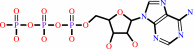 ATP
ATP
|
=
|
O-phospho-L-tyrosyl-[protein]
|
+
|
 ADP
ADP
|
+
|
H(+)
|
|
|
|
|
|
|
|
|
|
|
|
|
Molecule diagrams generated from .mol files obtained from the
KEGG ftp site
|
|
|
|
|
|
|
|
|
|
|
|
|
|
 |
|
|
|
|
|
|
| |
|
|
| |
|
DOI no:
|
Proc Natl Acad Sci U S A
92:12408-12415
(1995)
|
|
PubMed id:
|
|
|
|
|
|
| |
|
Specific interactions outside the proline-rich core of two classes of Src homology 3 ligands.
|
|
S.Feng,
C.Kasahara,
R.J.Rickles,
S.L.Schreiber.
|
|
|
|
|
| |
ABSTRACT
|
|
|
|
| |
|
|
Two dodecapeptides belonging to distinct classes of Src homology 3 (SH3) ligands
and selected from biased phage display libraries were used to investigate
interactions between a specificity pocket in the Src SH3 domain and ligant
residues flanking the proline-rich core. The solution structures of c-Src SH3
complexed with these peptides were solved by NMR. In addition to proline-rich,
polyproline type II helix-forming core, the class I and II ligands each
possesses a flanking sequence that occupies a large pocket between the RT and
n-Src loops of the SH3 domain. Structural and mutational analyses illustrate how
the two classes of SH3 ligands exploit a specificity pocket on the receptor
differently to increase binding affinity and specificity.
|
|
|
|
|
|
|
|
|
|
|
|
|
|
|
|
|
|
 |
 |
 |
|
Literature references that cite this PDB file's key reference
|
|
|
| |
PubMed id
|
|
Reference
|
|
|
|
|
|
J.Tanaka,
H.Yanagawa,
and
N.Doi
(2011).
Comparison of the frequency of functional SH3 domains with different limited sets of amino acids using mRNA display.
|
| |
PLoS One,
6,
e18034.
|
|
|
|
|
|
|
Z.B.Hill,
B.G.Perera,
and
D.J.Maly
(2011).
Bivalent inhibitors of the tyrosine kinases ABL and SRC: determinants of potency and selectivity.
|
| |
Mol Biosyst,
7,
447-456.
|
|
|
|
|
|
|
M.Y.Kim,
E.J.Ann,
J.S.Mo,
F.Dajas-Bailador,
M.S.Seo,
J.A.Hong,
J.Jung,
Y.H.Choi,
J.H.Yoon,
S.M.Kim,
E.J.Choi,
H.S.Hoe,
A.J.Whitmarsh,
and
H.S.Park
(2010).
JIP1 binding to RBP-Jk mediates cross-talk between the Notch1 and JIP1-JNK signaling pathway.
|
| |
Cell Death Differ,
17,
1728-1738.
|
|
|
|
|
|
|
S.Hoffmann,
S.A.Funke,
K.Wiesehan,
S.Moedder,
J.M.Glück,
S.Feuerstein,
M.Gerdts,
J.Mötter,
and
D.Willbold
(2010).
Competitively selected protein ligands pay their increase in specificity by a decrease in affinity.
|
| |
Mol Biosyst,
6,
116-123.
|
|
|
|
|
|
|
Z.Zhang,
A.F.Kolodziej,
J.Qi,
S.A.Nair,
X.Wang,
A.W.Case,
M.T.Greenfield,
P.B.Graham,
T.J.McMurry,
and
P.Caravan
(2010).
Effect of Peptide-Chelate Architecture on Metabolic Stability of Peptide-based MRI Contrast Agents.
|
| |
New J Chem,
2010,
611-616.
|
|
|
|
|
|
|
A.Leal,
K.Huehne,
F.Bauer,
H.Sticht,
P.Berger,
U.Suter,
B.Morera,
G.Del Valle,
J.R.Lupski,
A.Ekici,
F.Pasutto,
S.Endele,
R.Barrantes,
C.Berghoff,
M.Berghoff,
B.Neundörfer,
D.Heuss,
T.Dorn,
P.Young,
L.Santolin,
T.Uhlmann,
M.Meisterernst,
M.Sereda,
G.M.Zu Horste,
K.A.Nave,
A.Reis,
and
B.Rautenstrauss
(2009).
Identification of the variant Ala335Val of MED25 as responsible for CMT2B2: molecular data, functional studies of the SH3 recognition motif and correlation between wild-type MED25 and PMP22 RNA levels in CMT1A animal models.
|
| |
Neurogenetics,
10,
275-287.
|
|
|
|
|
|
|
K.L.Singleton,
K.T.Roybal,
Y.Sun,
G.Fu,
N.R.Gascoigne,
N.S.van Oers,
and
C.Wülfing
(2009).
Spatiotemporal patterning during T cell activation is highly diverse.
|
| |
Sci Signal,
2,
ra15.
|
|
|
|
|
|
|
P.Fernando,
J.S.Sandoz,
W.Ding,
Y.de Repentigny,
S.Brunette,
J.F.Kelly,
R.Kothary,
and
L.A.Megeney
(2009).
Bin1 SRC homology 3 domain acts as a scaffold for myofiber sarcomere assembly.
|
| |
J Biol Chem,
284,
27674-27686.
|
|
|
|
|
|
|
R.Tiwari,
and
K.Parang
(2009).
Protein conjugates of SH3-domain ligands and ATP-competitive inhibitors as bivalent inhibitors of protein kinases.
|
| |
Chembiochem,
10,
2445-2448.
|
|
|
|
|
|
|
T.Hou,
Z.Xu,
W.Zhang,
W.A.McLaughlin,
D.A.Case,
Y.Xu,
and
W.Wang
(2009).
Characterization of domain-peptide interaction interface: a generic structure-based model to decipher the binding specificity of SH3 domains.
|
| |
Mol Cell Proteomics,
8,
639-649.
|
|
|
|
|
|
|
R.A.Robinson,
X.Lu,
E.Y.Jones,
and
C.Siebold
(2008).
Biochemical and structural studies of ASPP proteins reveal differential binding to p53, p63, and p73.
|
| |
Structure,
16,
259-268.
|
|
|
PDB code:
|
|
|
|
|
|
|
|
S.A.Solheim,
E.Petsalaki,
A.J.Stokka,
R.B.Russell,
K.Taskén,
and
T.Berge
(2008).
Interactions between the Fyn SH3-domain and adaptor protein Cbp/PAG derived ligands, effects on kinase activity and affinity.
|
| |
FEBS J,
275,
4863-4874.
|
|
|
|
|
|
|
D.Adolph,
N.Flach,
K.Mueller,
D.H.Ostareck,
and
A.Ostareck-Lederer
(2007).
Deciphering the cross talk between hnRNP K and c-Src: the c-Src activation domain in hnRNP K is distinct from a second interaction site.
|
| |
Mol Cell Biol,
27,
1758-1770.
|
|
|
|
|
|
|
D.Tobi,
and
I.Bahar
(2007).
Recruitment of rare 3-grams at functional sites: is this a mechanism for increasing enzyme specificity?
|
| |
BMC Bioinformatics,
8,
226.
|
|
|
|
|
|
|
R.Tonikian,
Y.Zhang,
C.Boone,
and
S.S.Sidhu
(2007).
Identifying specificity profiles for peptide recognition modules from phage-displayed peptide libraries.
|
| |
Nat Protoc,
2,
1368-1386.
|
|
|
|
|
|
|
A.Zarrine-Afsar,
A.Mittermaier,
L.E.Kay,
and
A.R.Davidson
(2006).
Protein stabilization by specific binding of guanidinium to a functional arginine-binding surface on an SH3 domain.
|
| |
Protein Sci,
15,
162-170.
|
|
|
|
|
|
|
X.Li,
Y.Chen,
Y.Liu,
J.Gao,
F.Gao,
M.Bartlam,
J.Y.Wu,
and
Z.Rao
(2006).
Structural basis of Robo proline-rich motif recognition by the srGAP1 Src homology 3 domain in the Slit-Robo signaling pathway.
|
| |
J Biol Chem,
281,
28430-28437.
|
|
|
PDB code:
|
|
|
|
|
|
|
|
F.Bauer,
K.Schweimer,
H.Meiselbach,
S.Hoffmann,
P.Rösch,
and
H.Sticht
(2005).
Structural characterization of Lyn-SH3 domain in complex with a herpesviral protein reveals an extended recognition motif that enhances binding affinity.
|
| |
Protein Sci,
14,
2487-2498.
|
|
|
PDB code:
|
|
|
|
|
|
|
|
M.H.Schmidt,
I.Dikic,
and
O.Bögler
(2005).
Src phosphorylation of Alix/AIP1 modulates its interaction with binding partners and antagonizes its activities.
|
| |
J Biol Chem,
280,
3414-3425.
|
|
|
|
|
|
|
A.Sharma,
I.Sharma,
D.Kogkasuriyachai,
and
N.Kumar
(2003).
Structure of a gametocyte protein essential for sexual development in Plasmodium falciparum.
|
| |
Nat Struct Biol,
10,
197-203.
|
|
|
PDB code:
|
|
|
|
|
|
|
|
F.Santamaria,
Z.Wu,
C.Boulègue,
G.Pál,
and
W.Lu
(2003).
Reexamination of the recognition preference of the specificity pocket of the Abl SH3 domain.
|
| |
J Mol Recognit,
16,
131-138.
|
|
|
|
|
|
|
Q.Liu,
D.Berry,
P.Nash,
T.Pawson,
C.J.McGlade,
and
S.S.Li
(2003).
Structural basis for specific binding of the Gads SH3 domain to an RxxK motif-containing SLP-76 peptide: a novel mode of peptide recognition.
|
| |
Mol Cell,
11,
471-481.
|
|
|
PDB code:
|
|
|
|
|
|
|
|
A.Laederach,
K.W.Cradic,
K.N.Brazin,
J.Zamoon,
D.B.Fulton,
X.Y.Huang,
and
A.H.Andreotti
(2002).
Competing modes of self-association in the regulatory domains of Bruton's tyrosine kinase: intramolecular contact versus asymmetric homodimerization.
|
| |
Protein Sci,
11,
36-45.
|
|
|
|
|
|
|
K.Kami,
R.Takeya,
H.Sumimoto,
and
D.Kohda
(2002).
Diverse recognition of non-PxxP peptide ligands by the SH3 domains from p67(phox), Grb2 and Pex13p.
|
| |
EMBO J,
21,
4268-4276.
|
|
|
PDB code:
|
|
|
|
|
|
|
|
K.Schweimer,
S.Hoffmann,
F.Bauer,
U.Friedrich,
C.Kardinal,
S.M.Feller,
B.Biesinger,
and
H.Sticht
(2002).
Structural investigation of the binding of a herpesviral protein to the SH3 domain of tyrosine kinase Lck.
|
| |
Biochemistry,
41,
5120-5130.
|
|
|
PDB codes:
|
|
|
|
|
|
|
|
M.P.Okoh,
and
M.Vihinen
(2002).
Interaction between Btk TH and SH3 domain.
|
| |
Biopolymers,
63,
325-334.
|
|
|
|
|
|
|
M.N.Nitabach,
D.A.Llamas,
R.C.Araneda,
J.L.Intile,
I.J.Thompson,
Y.I.Zhou,
and
T.C.Holmes
(2001).
A mechanism for combinatorial regulation of electrical activity: Potassium channel subunits capable of functioning as Src homology 3-dependent adaptors.
|
| |
Proc Natl Acad Sci U S A,
98,
705-710.
|
|
|
|
|
|
|
M.Vidal,
V.Gigoux,
and
C.Garbay
(2001).
SH2 and SH3 domains as targets for anti-proliferative agents.
|
| |
Crit Rev Oncol Hematol,
40,
175-186.
|
|
|
|
|
|
|
J.J.Derry,
S.Richard,
H.Valderrama Carvajal,
X.Ye,
V.Vasioukhin,
A.W.Cochrane,
T.Chen,
and
A.L.Tyner
(2000).
Sik (BRK) phosphorylates Sam68 in the nucleus and negatively regulates its RNA binding ability.
|
| |
Mol Cell Biol,
20,
6114-6126.
|
|
|
|
|
|
|
N.Okishio,
M.Nagai,
R.Fukuda,
S.Nagatomo,
and
T.Kitagawa
(2000).
Interactions of phosphatidylinositol 3-kinase Src homology 3 domain with its ligand peptide studied by absorption, circular dichroism, and UV resonance raman spectroscopies.
|
| |
Biopolymers,
57,
208-217.
|
|
|
|
|
|
|
P.Wu,
J.Leinonen,
E.Koivunen,
H.Lankinen,
and
U.H.Stenman
(2000).
Identification of novel prostate-specific antigen-binding peptides modulating its enzyme activity.
|
| |
Eur J Biochem,
267,
6212-6220.
|
|
|
|
|
|
|
F.J.King,
E.Hu,
D.F.Harris,
P.Sarraf,
B.M.Spiegelman,
and
T.M.Roberts
(1999).
DEF-1, a novel Src SH3 binding protein that promotes adipogenesis in fibroblastic cell lines.
|
| |
Mol Cell Biol,
19,
2330-2337.
|
|
|
|
|
|
|
J.C.Albrecht,
U.Friedrich,
C.Kardinal,
J.Koehn,
B.Fleckenstein,
S.M.Feller,
and
B.Biesinger
(1999).
Herpesvirus ateles gene product Tio interacts with nonreceptor protein tyrosine kinases.
|
| |
J Virol,
73,
4631-4639.
|
|
|
|
|
|
|
M.Niethammer,
J.G.Valtschanoff,
T.M.Kapoor,
D.W.Allison,
R.J.Weinberg,
A.M.Craig,
and
M.Sheng
(1998).
CRIPT, a novel postsynaptic protein that binds to the third PDZ domain of PSD-95/SAP90.
|
| |
Neuron,
20,
693-707.
|
|
|
|
|
|
|
S.Suetsugu,
H.Miki,
and
T.Takenawa
(1998).
The essential role of profilin in the assembly of actin for microspike formation.
|
| |
EMBO J,
17,
6516-6526.
|
|
|
|
|
|
|
Y.A.Puius,
N.M.Mahoney,
and
S.C.Almo
(1998).
The modular structure of actin-regulatory proteins.
|
| |
Curr Opin Cell Biol,
10,
23-34.
|
|
|
|
|
|
|
D.C.Dalgarno,
M.C.Botfield,
and
R.J.Rickles
(1997).
SH3 domains and drug design: ligands, structure, and biological function.
|
| |
Biopolymers,
43,
383-400.
|
|
|
|
|
|
|
H.Linn,
K.S.Ermekova,
S.Rentschler,
A.B.Sparks,
B.K.Kay,
and
M.Sudol
(1997).
Using molecular repertoires to identify high-affinity peptide ligands of the WW domain of human and mouse YAP.
|
| |
Biol Chem,
378,
531-537.
|
|
|
|
|
|
|
H.V.Patel,
S.R.Tzeng,
C.Y.Liao,
S.H.Chen,
and
J.W.Cheng
(1997).
SH3 domain of Bruton's tyrosine kinase can bind to proline-rich peptides of TH domain of the kinase and p120cbl.
|
| |
Proteins,
29,
545-552.
|
|
|
|
|
|
|
J.B.Bolen,
and
J.S.Brugge
(1997).
Leukocyte protein tyrosine kinases: potential targets for drug discovery.
|
| |
Annu Rev Immunol,
15,
371-404.
|
|
|
|
|
|
|
J.Kuriyan,
and
D.Cowburn
(1997).
Modular peptide recognition domains in eukaryotic signaling.
|
| |
Annu Rev Biophys Biomol Struct,
26,
259-288.
|
|
|
|
|
|
|
R.M.Scaife,
and
R.L.Margolis
(1997).
The role of the PH domain and SH3 binding domains in dynamin function.
|
| |
Cell Signal,
9,
395-401.
|
|
|
|
|
|
|
S.Spencer,
D.Dowbenko,
J.Cheng,
W.Li,
J.Brush,
S.Utzig,
V.Simanis,
and
L.A.Lasky
(1997).
PSTPIP: a tyrosine phosphorylated cleavage furrow-associated protein that is a substrate for a PEST tyrosine phosphatase.
|
| |
J Cell Biol,
138,
845-860.
|
|
|
|
|
|
|
T.Scherf,
M.Balass,
S.Fuchs,
E.Katchalski-Katzir,
and
J.Anglister
(1997).
Three-dimensional solution structure of the complex of alpha-bungarotoxin with a library-derived peptide.
|
| |
Proc Natl Acad Sci U S A,
94,
6059-6064.
|
|
|
PDB codes:
|
|
|
|
|
|
|
|
J.F.Cloutier,
and
A.Veillette
(1996).
Association of inhibitory tyrosine protein kinase p50csk with protein tyrosine phosphatase PEP in T cells and other hemopoietic cells.
|
| |
EMBO J,
15,
4909-4918.
|
|
|
|
|
|
The most recent references are shown first.
Citation data come partly from CiteXplore and partly
from an automated harvesting procedure. Note that this is likely to be
only a partial list as not all journals are covered by
either method. However, we are continually building up the citation data
so more and more references will be included with time.
Where a reference describes a PDB structure, the PDB
code is
shown on the right.
|
 |


 Links
Links





