 |
PDBsum entry 1o0c

|
|
|
|
|
 |
Contents |
 |
|
|
|
|
|
|
|
|
|
|
|
|
|
|
* Residue conservation analysis
|
|
|
|
|
|
|
|
|
|
|
Enzyme class:
|
|
E.C.6.1.1.18
- glutamine--tRNA ligase.
|
|
|
|
|
|
|
Reaction:
|
|
tRNA(Gln) + L-glutamine + ATP = L-glutaminyl-tRNA(Gln) + AMP + diphosphate
|
|
|
|
|
|
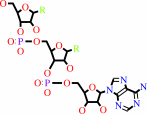 tRNA(Gln)
|
+
|
L-glutamine
Bound ligand (Het Group name = )
matches with 81.82% similarity
|
+
|
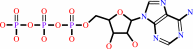 ATP
ATP
|
=
|
L-glutaminyl-tRNA(Gln)
Bound ligand (Het Group name = )
corresponds exactly
|
+
|
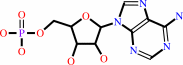 AMP
AMP
|
+
|
 diphosphate
|
|
|
|
|
|
|
|
|
|
|
|
|
Molecule diagrams generated from .mol files obtained from the
KEGG ftp site
|
|
|
|
|
|
|
|
|
|
|
|
|
|
 |
|
|
|
|
|
|
| |
|
|
| |
|
DOI no:
|
J Mol Biol
328:395-408
(2003)
|
|
PubMed id:
|
|
|
|
|
|
| |
|
Amino acid discrimination by a class I aminoacyl-tRNA synthetase specified by negative determinants.
|
|
T.L.Bullock,
N.Uter,
T.A.Nissan,
J.J.Perona.
|
|
|
|
|
| |
ABSTRACT
|
|
|
|
| |
|
|
The 2.5 A crystal structure of Escherichia coli glutaminyl-tRNA synthetase in a
quaternary complex with tRNA(Gln), an ATP analog and glutamate reveals that the
non-cognate amino acid adopts a distinct binding mode within the active site
cleft. In contrast to the binding of cognate glutamine, one oxygen of the
charged glutamate carboxylate group makes a direct ion-pair interaction with the
strictly conserved Arg30 residue located in the first half of the dinucleotide
fold domain. The nucleophilic alpha-carboxylate moiety of glutamate is
mispositioned with respect to both the ATP alpha-phosphate and terminal tRNA
ribose groups, suggesting that a component of amino acid discrimination resides
at the catalytic step of the reaction. Further, the other side-chain carboxylate
oxygen of glutamate is found in a position identical to that previously proposed
to be occupied by the NH(2) group of the cognate glutamine substrate. At this
position, the glutamate oxygen accepts hydrogen bonds from the hydroxyl moiety
of Tyr211 and a water molecule. These findings demonstrate that amino acid
specificity by GlnRS cannot arise from hydrogen bonds donated by the cognate
glutamine amide to these same moieties, as previously suggested. Instead, Arg30
functions as a negative determinant to drive binding of non-cognate glutamate
into a non-productive orientation. The poorly differentiated cognate amino
acid-binding site in GlnRS may be a consequence of the late emergence of this
enzyme from the eukaryotic lineage of glutamyl-tRNA synthetases.
|
|
|
|
|
|
| |
Selected figure(s)
|
|
|
|
| |
|
|

|
|

|
|
Figure 3.
Figure 3. (A) Schematic drawing of a proposed network of
hydrogen bonds in the amino acid-binding pocket of GlnRS when
substrate glutamine is bound. Arrowheads point toward the
hydrogen bond acceptor of each pair, and numerals indicate the
distance in Å units between the two electronegative atoms
of the pair, as estimated from this 2.3 Å crystal
structure. The closest approach of Arg30 to the glutamine
substrate is 4 Å. MC indicates main-chain. The
donor-acceptor pairings and directions of the hydrogen bonds in
this model are identical to those proposed by Rath et al.10
based on the structure of GlnRS bound to the QSI analog (except
that WAT4 was not considered in that analysis). The
correspondence between the nomenclature of the water molecules
is: WAT1 corresponds to WAT1050 of Rath et al.10 WAT2
corresponds to WAT1052, WAT3 corresponds to WAT1136, and WAT4
corresponds to WAT1081. (B) Schematic drawing of a proposed
network of hydrogen bonds in the amino acid-binding pocket of
GlnRS when non-cognate glutamate is bound. Glu makes two
additional hydrogen bonds with Arg30 and WAT1. Differences in
proposed hydrogen-bonding structure to accommodate the acceptor
oxygen atoms of Glu are (i) bifurcation of the Og hydrogen of
Ser227. This hydrogen lies 2.3 Å from WAT1 and 2.6 Å
from the Asp219 carboxylate and is thus well-positioned to
bifurcate; in the structure bound to Glu, the hydrogen in the
refined coordinates rotates toward WAT1, which is itself
re-oriented to donate a proton to the substrate as depicted.
(ii) One proton of WAT3 is now bifurcated between the Asp212
carboxylate and Asn236 main-chain acceptors (bottom). Rotation
of this water by graphics modeling shows that one proton can be
oriented midway between the two acceptors at 2.6 Å
distance from each, while the second proton then points in-line
toward WAT2. This orients the two acceptor positions generally
toward WAT4.
|
|
Figure 4.
Figure 4. Time-course for glutamylation of E. coli
tRNA[2]^Gln by GlnRS. The inset shows a thin-layer
chromatography plate in which misacylated Glu-AMP is formed to
approximately 50% aminoacylation levels (see Materials and
Methods for details). The % aminoacylation on the ordinate is
derived from the ratio of intensities of the spots corresponding
to Glu-AMP and AMP (right).
|
|
|
|
|
|
| |
The above figures are
reprinted
by permission from Elsevier:
J Mol Biol
(2003,
328,
395-408)
copyright 2003.
|
|
| |
Figures were
selected
by an automated process.
|
|
|
|
|
|
|
|
|
|
|
|
|
|
|
|
 |
 |
 |
|
Literature references that cite this PDB file's key reference
|
|
|
| |
PubMed id
|
|
Reference
|
|
|
|
|
|
A.Palencia,
T.Crépin,
M.T.Vu,
T.L.Lincecum,
S.A.Martinis,
and
S.Cusack
(2012).
Structural dynamics of the aminoacylation and proofreading functional cycle of bacterial leucyl-tRNA synthetase.
|
| |
Nat Struct Mol Biol,
19,
677-684.
|
|
|
PDB codes:
|
|
|
|
|
|
|
|
A.Rodríguez-Hernández,
and
J.J.Perona
(2011).
Heat maps for intramolecular communication in an RNP enzyme encoding glutamine.
|
| |
Structure,
19,
386-396.
|
|
|
|
|
|
|
M.G.Gagnon,
Y.I.Boutorine,
and
S.V.Steinberg
(2010).
Recurrent RNA motifs as probes for studying RNA-protein interactions in the ribosome.
|
| |
Nucleic Acids Res,
38,
3441-3453.
|
|
|
|
|
|
|
O.Nureki,
P.O'Donoghue,
N.Watanabe,
A.Ohmori,
H.Oshikane,
Y.Araiso,
K.Sheppard,
D.Söll,
and
R.Ishitani
(2010).
Structure of an archaeal non-discriminating glutamyl-tRNA synthetase: a missing link in the evolution of Gln-tRNAGln formation.
|
| |
Nucleic Acids Res,
38,
7286-7297.
|
|
|
PDB code:
|
|
|
|
|
|
|
|
E.M.Corigliano,
and
J.J.Perona
(2009).
Architectural underpinnings of the genetic code for glutamine.
|
| |
Biochemistry,
48,
676-687.
|
|
|
|
|
|
|
W.Tsuchiya,
and
T.Hasegawa
(2009).
Molecular recognition of tryptophan tRNA by tryptophanyl-tRNA synthetase from Aeropyrum pernix K1.
|
| |
J Biochem,
145,
635-641.
|
|
|
|
|
|
|
C.S.Francklyn
(2008).
DNA polymerases and aminoacyl-tRNA synthetases: shared mechanisms for ensuring the fidelity of gene expression.
|
| |
Biochemistry,
47,
11695-11703.
|
|
|
|
|
|
|
K.Sheppard,
P.M.Akochy,
and
D.Söll
(2008).
Assays for transfer RNA-dependent amino acid biosynthesis.
|
| |
Methods,
44,
139-145.
|
|
|
|
|
|
|
R.L.Sherrer,
J.M.Ho,
and
D.Söll
(2008).
Divergence of selenocysteine tRNA recognition by archaeal and eukaryotic O-phosphoseryl-tRNASec kinase.
|
| |
Nucleic Acids Res,
36,
1871-1880.
|
|
|
|
|
|
|
R.L.Sherrer,
P.O'Donoghue,
and
D.Söll
(2008).
Characterization and evolutionary history of an archaeal kinase involved in selenocysteinyl-tRNA formation.
|
| |
Nucleic Acids Res,
36,
1247-1259.
|
|
|
|
|
|
|
S.I.Hauenstein,
and
J.J.Perona
(2008).
Redundant synthesis of cysteinyl-tRNACys in Methanosarcina mazei.
|
| |
J Biol Chem,
283,
22007-22017.
|
|
|
|
|
|
|
S.I.Hauenstein,
Y.M.Hou,
and
J.J.Perona
(2008).
The homotetrameric phosphoseryl-tRNA synthetase from Methanosarcina mazei exhibits half-of-the-sites activity.
|
| |
J Biol Chem,
283,
21997-22006.
|
|
|
|
|
|
|
S.Ledoux,
and
O.C.Uhlenbeck
(2008).
[3'-32P]-labeling tRNA with nucleotidyltransferase for assaying aminoacylation and peptide bond formation.
|
| |
Methods,
44,
74-80.
|
|
|
|
|
|
|
T.L.Bullock,
A.Rodríguez-Hernández,
E.M.Corigliano,
and
J.J.Perona
(2008).
A rationally engineered misacylating aminoacyl-tRNA synthetase.
|
| |
Proc Natl Acad Sci U S A,
105,
7428-7433.
|
|
|
PDB codes:
|
|
|
|
|
|
|
|
Y.Araiso,
S.Palioura,
R.Ishitani,
R.L.Sherrer,
P.O'Donoghue,
J.Yuan,
H.Oshikane,
N.Domae,
J.Defranco,
D.Söll,
and
O.Nureki
(2008).
Structural insights into RNA-dependent eukaryal and archaeal selenocysteine formation.
|
| |
Nucleic Acids Res,
36,
1187-1199.
|
|
|
PDB code:
|
|
|
|
|
|
|
|
A.Ambrogelly,
S.Gundllapalli,
S.Herring,
C.Polycarpo,
C.Frauer,
and
D.Söll
(2007).
Pyrrolysine is not hardwired for cotranslational insertion at UAG codons.
|
| |
Proc Natl Acad Sci U S A,
104,
3141-3146.
|
|
|
|
|
|
|
I.A.Vasil'eva,
and
N.A.Moor
(2007).
Interaction of aminoacyl-tRNA synthetases with tRNA: general principles and distinguishing characteristics of the high-molecular-weight substrate recognition.
|
| |
Biochemistry (Mosc),
72,
247-263.
|
|
|
|
|
|
|
K.Sheppard,
P.M.Akochy,
J.C.Salazar,
and
D.Söll
(2007).
The Helicobacter pylori amidotransferase GatCAB is equally efficient in glutamine-dependent transamidation of Asp-tRNAAsn and Glu-tRNAGln.
|
| |
J Biol Chem,
282,
11866-11873.
|
|
|
|
|
|
|
M.Deniziak,
C.Sauter,
H.D.Becker,
C.A.Paulus,
R.Giegé,
and
D.Kern
(2007).
Deinococcus glutaminyl-tRNA synthetase is a chimer between proteins from an ancient and the modern pathways of aminoacyl-tRNA formation.
|
| |
Nucleic Acids Res,
35,
1421-1431.
|
|
|
PDB code:
|
|
|
|
|
|
|
|
M.Kapustina,
V.Weinreb,
L.Li,
B.Kuhlman,
and
C.W.Carter
(2007).
A conformational transition state accompanies tryptophan activation by B. stearothermophilus tryptophanyl-tRNA synthetase.
|
| |
Structure,
15,
1272-1284.
|
|
|
|
|
|
|
R.Sathyapriya,
and
S.Vishveshwara
(2007).
Structure networks of E. coli glutaminyl-tRNA synthetase: effects of ligand binding.
|
| |
Proteins,
68,
541-550.
|
|
|
|
|
|
|
S.Herring,
A.Ambrogelly,
C.R.Polycarpo,
and
D.Söll
(2007).
Recognition of pyrrolysine tRNA by the Desulfitobacterium hafniense pyrrolysyl-tRNA synthetase.
|
| |
Nucleic Acids Res,
35,
1270-1278.
|
|
|
|
|
|
|
T.F.Chou,
and
C.R.Wagner
(2007).
Lysyl-tRNA synthetase-generated lysyl-adenylate is a substrate for histidine triad nucleotide binding proteins.
|
| |
J Biol Chem,
282,
4719-4727.
|
|
|
|
|
|
|
N.T.Uter,
and
J.J.Perona
(2006).
Active-site assembly in glutaminyl-tRNA synthetase by tRNA-mediated induced fit.
|
| |
Biochemistry,
45,
6858-6865.
|
|
|
|
|
|
|
S.Hati,
B.Ziervogel,
J.Sternjohn,
F.C.Wong,
M.C.Nagan,
A.E.Rosen,
P.G.Siliciano,
J.W.Chihade,
and
K.Musier-Forsyth
(2006).
Pre-transfer editing by class II prolyl-tRNA synthetase: role of aminoacylation active site in "selective release" of noncognate amino acids.
|
| |
J Biol Chem,
281,
27862-27872.
|
|
|
|
|
|
|
I.Gruic-Sovulj,
N.Uter,
T.Bullock,
and
J.J.Perona
(2005).
tRNA-dependent aminoacyl-adenylate hydrolysis by a nonediting class I aminoacyl-tRNA synthetase.
|
| |
J Biol Chem,
280,
23978-23986.
|
|
|
PDB code:
|
|
|
|
|
|
|
|
N.T.Uter,
I.Gruic-Sovulj,
and
J.J.Perona
(2005).
Amino acid-dependent transfer RNA affinity in a class I aminoacyl-tRNA synthetase.
|
| |
J Biol Chem,
280,
23966-23977.
|
|
|
|
|
|
|
M.A.Deniziak,
C.Sauter,
H.D.Becker,
R.Giegé,
and
D.Kern
(2004).
Crystallization and preliminary X-ray characterization of the atypical glutaminyl-tRNA synthetase from Deinococcus radiodurans.
|
| |
Acta Crystallogr D Biol Crystallogr,
60,
2361-2363.
|
|
|
|
|
|
|
N.T.Uter,
and
J.J.Perona
(2004).
Long-range intramolecular signaling in a tRNA synthetase complex revealed by pre-steady-state kinetics.
|
| |
Proc Natl Acad Sci U S A,
101,
14396-14401.
|
|
|
|
|
|
|
S.Hauenstein,
C.M.Zhang,
Y.M.Hou,
and
J.J.Perona
(2004).
Shape-selective RNA recognition by cysteinyl-tRNA synthetase.
|
| |
Nat Struct Mol Biol,
11,
1134-1141.
|
|
|
PDB code:
|
|
|
|
|
|
|
The most recent references are shown first.
Citation data come partly from CiteXplore and partly
from an automated harvesting procedure. Note that this is likely to be
only a partial list as not all journals are covered by
either method. However, we are continually building up the citation data
so more and more references will be included with time.
Where a reference describes a PDB structure, the PDB
codes are
shown on the right.
|
|


 Links
Links


