 |
PDBsum entry 1npm

|
|
|
|
|
|

|

|

|

|
|

|
|

|
|

|
|

|
|
|
 |

|

|
|
|
|
|
|
|
|
|
|
|
|
|
|
|
|
|
|
|
|
|
|
|
|
|
|
|
|
|
|
|
|
|
Serine proteinase
|
PDB id
|
|
|
|
1npm
|
|
|
|
|
|
|
|
|
|
|
|
|
|
|

|

|

|
|
|
|
|
|
|
|
 |
Contents |
 |
|
|
|
|
|
|
|
|
|
|
|
|
* Residue conservation analysis
|
|
|
|
|
|
PDB id:
|
|
|
|
| Name: |
|
Serine proteinase
|
|
|
Title:
|
|
Neuropsin, a serine protease expressed in the limbic system of mouse brain
|
|
Structure:
|
|
Neuropsin. Chain: a, b. Engineered: yes
|
|
Source:
|
|
Mus musculus. House mouse. Organism_taxid: 10090. Cell_line: high5. Organ: hippocampus. Expressed in: spodoptera frugiperda. Expression_system_taxid: 7108. Expression_system_cell_line: high5.
|
|
Resolution:
|
|
|
2.10Å
|
R-factor:
|
0.186
|
R-free:
|
0.227
|
|
|
Authors:
|
|
T.Kishi,M.Kato,T.Shimizu,K.Kato,K.Matsumoto,S.Yoshida,S.Shiosaka, T.Hakoshima
|
Key ref:

|
|
T.Kishi
et al.
(1999).
Crystal structure of neuropsin, a hippocampal protease involved in kindling epileptogenesis.
J Biol Chem,
274,
4220-4224.
PubMed id:
DOI:

|
|
|
Date:
|
|
|
07-Jan-98
|
Release date:
|
23-Mar-99
|
|
|
|
|
|
|
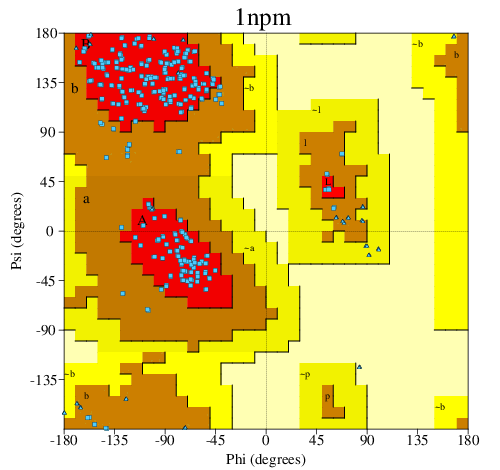
PROCHECK
|
|
|
|
|
|
Headers
|
|
|
|
References
|
|
|
|
|
|

|
|
Q61955
(KLK8_MOUSE) -
Kallikrein-8 from Mus musculus
|
|
|
|
Seq:
Struc:
|
|
|
|
260 a.a.
223 a.a.
|
|

|

|
|
|
|
|
|
|
|
|
|
|
|
Key: |
 |
PfamA domain |
|
|
 |
Secondary structure |
|
 |
CATH domain |
|
|
|
|
|
|
|
|
|
|
|
|
|
|
|
|
|
 |
|
|
|
|
|
|
| |
|
DOI no:
|
J Biol Chem
274:4220-4224
(1999)
|
|
PubMed id:
|
|
|
|
|
|
| |
|
Crystal structure of neuropsin, a hippocampal protease involved in kindling epileptogenesis.
|
|
T.Kishi,
M.Kato,
T.Shimizu,
K.Kato,
K.Matsumoto,
S.Yoshida,
S.Shiosaka,
T.Hakoshima.
|
|
|
|
|
| |
ABSTRACT
|
|
|
|
| |
|
|
Neuropsin is a novel serine protease, the expression of which is highly
localized in the limbic areas of the mouse brain and which is suggested to be
involved in kindling epileptogenesis and hippocampal plasticity. The 2.1-A
resolution crystal structure of neuropsin provides the first three-dimensional
view of one of the serine proteases highly expressed in the nervous system, and
reveals a serine protease fold that exhibits chimeric features between trypsin
and nerve growth factor-gamma (NGFgamma), a member of the kallikrein family.
Neuropsin possesses an N-glycosylated "kallikrein loop" but forms six
disulfide bonds corresponding to those of trypsin. The ordered kallikrein loop
projects proline toward the active site to restrict smaller residues or proline
at the P2 position of substrates. Loop F, which participates in forming the
S3/S4 sites, is similar to trypsin rather than NGFgamma. The unique
conformations of loops G and H form an S1 pocket specific for both arginine and
lysine. These characteristic loop structures forming the substrate-binding site
suggest the novel substrate specificity of neuropsin and give a clue to the
design of its specific inhibitors.
|
|
|
|
|
|
| |
Selected figure(s)
|
|
|
|
| |
|
|

|
|

|
|
Figure 1.
Fig. 1. Overall structure of neuropsin. a, ribbon
representation of neuropsin. Seven-stranded  -sheets (the
top and bottom halves) are sandwiched with the catalytic triad
at the cleft of the -sandwich.
The surface loops (A-H) forming the substrate-binding site are
colored with labels. Six disulfide bonds are shown by bridges in
white, and the disulfide bond (SS3), which is conserved in
trypsin but not in kallikrein, was labeled. Loop D is the
kallikrein loop that has an N-glycosylated Asn95 with one
visible GlcNAc residue. The side chains of the catalytic triad,
Asp189 at the S1-specific pocket, Lys175 at the S3/4 site,
Glu149 and Asp218 at the rim of the S1 pocket, and Leu40 and
Ile^41 at the S1' site, are also shown with stick
representations with one-letter amino acid labels. b, molecular
surfaces of neuropsin viewed from nearly the same direction of
panel a. Surface electrostatic potentials calculated and
rendered using GRASP (negative potentials are in red and
positive in blue). The S1-S4 and S1' sites and characteristic
surface residues are labeled. -sheets (the
top and bottom halves) are sandwiched with the catalytic triad
at the cleft of the -sandwich.
The surface loops (A-H) forming the substrate-binding site are
colored with labels. Six disulfide bonds are shown by bridges in
white, and the disulfide bond (SS3), which is conserved in
trypsin but not in kallikrein, was labeled. Loop D is the
kallikrein loop that has an N-glycosylated Asn95 with one
visible GlcNAc residue. The side chains of the catalytic triad,
Asp189 at the S1-specific pocket, Lys175 at the S3/4 site,
Glu149 and Asp218 at the rim of the S1 pocket, and Leu40 and
Ile^41 at the S1' site, are also shown with stick
representations with one-letter amino acid labels. b, molecular
surfaces of neuropsin viewed from nearly the same direction of
panel a. Surface electrostatic potentials calculated and
rendered using GRASP (negative potentials are in red and
positive in blue). The S1-S4 and S1' sites and characteristic
surface residues are labeled.
|
|
Figure 4.
Fig. 4. Comparison of the surface loops forming the S2
site between neuropsin (colored) and  -thrombin
(gray). The C[ -thrombin
(gray). The C[  ]-carbon
atom tracings of loops of neuropsin, colored as in Fig. 1a, are
superimposed on -thrombin
complexed with D-Phe-Pro-Arg-chloromethylketone (green). The van
der Waals surfaces of the inhibitor peptide and P95D are shown
with dot-surface representations. Labels are as in Fig. 3. ]-carbon
atom tracings of loops of neuropsin, colored as in Fig. 1a, are
superimposed on -thrombin
complexed with D-Phe-Pro-Arg-chloromethylketone (green). The van
der Waals surfaces of the inhibitor peptide and P95D are shown
with dot-surface representations. Labels are as in Fig. 3.
|
|
|
|
|
|
| |
The above figures are
reprinted
by permission from the ASBMB:
J Biol Chem
(1999,
274,
4220-4224)
copyright 1999.
|
|
| |
Figures were
selected
by an automated process.
|
|
|
|
|
|
|
|
|
|
|
|
|
|
|
|
 |
 |
 |
|
Literature references that cite this PDB file's key reference
|
|
|
| |
PubMed id
|
|
Reference
|
|
|
|
|
|
P.Goettig,
V.Magdolen,
and
H.Brandstetter
(2010).
Natural and synthetic inhibitors of kallikrein-related peptidases (KLKs).
|
| |
Biochimie,
92,
1546-1567.
|
|
|
|
|
|
|
J.A.Clements
(2008).
Reflections on the tissue kallikrein and kallikrein-related peptidase family - from mice to men - what have we learnt in the last two decades?
|
| |
Biol Chem,
389,
1447-1454.
|
|
|
|
|
|
|
C.A.Borgoño,
J.A.Gavigan,
J.Alves,
B.Bowles,
J.L.Harris,
G.Sotiropoulou,
and
E.P.Diamandis
(2007).
Defining the extended substrate specificity of kallikrein 1-related peptidases.
|
| |
Biol Chem,
388,
1215-1225.
|
|
|
|
|
|
|
S.I.Blaber,
H.Yoon,
I.A.Scarisbrick,
M.A.Juliano,
and
M.Blaber
(2007).
The autolytic regulation of human kallikrein-related peptidase 6.
|
| |
Biochemistry,
46,
5209-5217.
|
|
|
|
|
|
|
Z.X.Lu,
J.Peng,
and
B.Su
(2007).
A human-specific mutation leads to the origin of a novel splice form of neuropsin (KLK8), a gene involved in learning and memory.
|
| |
Hum Mutat,
28,
978-984.
|
|
|
|
|
|
|
T.Kishi,
S.M.Cloutier,
C.Kündig,
D.Deperthes,
and
E.P.Diamandis
(2006).
Activation and enzymatic characterization of recombinant human kallikrein 8.
|
| |
Biol Chem,
387,
723-731.
|
|
|
|
|
|
|
G.Laxmikanthan,
S.I.Blaber,
M.J.Bernett,
I.A.Scarisbrick,
M.A.Juliano,
and
M.Blaber
(2005).
1.70 A X-ray structure of human apo kallikrein 1: structural changes upon peptide inhibitor/substrate binding.
|
| |
Proteins,
58,
802-814.
|
|
|
PDB code:
|
|
|
|
|
|
|
|
O.Guvench,
D.J.Price,
and
C.L.Brooks
(2005).
Receptor rigidity and ligand mobility in trypsin-ligand complexes.
|
| |
Proteins,
58,
407-417.
|
|
|
|
|
|
|
A.Bahi,
F.Boyer,
C.Gumy,
T.Kafri,
and
J.L.Dreyer
(2004).
In vivo gene delivery of urokinase-type plasminogen activator with regulatable lentivirus induces behavioural changes in chronic cocaine administration.
|
| |
Eur J Neurosci,
20,
3473-3488.
|
|
|
|
|
|
|
T.Nakamura,
S.Mitsui,
A.Okui,
T.Miki,
and
N.Yamaguchi
(2003).
Molecular cloning and expression of a variant form of hippostasin/KLK11 in prostate.
|
| |
Prostate,
54,
299-305.
|
|
|
|
|
|
|
B.A.Citron,
I.V.Smirnova,
P.M.Arnold,
and
B.W.Festoff
(2000).
Upregulation of neurotoxic serine proteases, prothrombin, and protease-activated receptor 1 early after spinal cord injury.
|
| |
J Neurotrauma,
17,
1191-1203.
|
|
|
|
|
|
The most recent references are shown first.
Citation data come partly from CiteXplore and partly
from an automated harvesting procedure. Note that this is likely to be
only a partial list as not all journals are covered by
either method. However, we are continually building up the citation data
so more and more references will be included with time.
Where a reference describes a PDB structure, the PDB
code is
shown on the right.
|
|


 Links
Links


