
|
|
|
|
|
 |
Contents |
 |
|
|
|
|
|
|
|
|
|
|
* Residue conservation analysis
|
|
|
|
|
|
PDB id:
|
|
|
|
| Name: |
|
Cell cycle
|
|
|
Title:
|
|
Structure of rb tumor suppressor bound to the transactivation domain of e2f-2
|
|
Structure:
|
|
Retinoblastoma pocket. Chain: a, b. Fragment: residues 380-785. Engineered: yes. Transcription factor e2f2. Chain: c, d, e. Fragment: residues 410-427. Synonym: e2f-2. Engineered: yes
|
|
Source:
|
|
Homo sapiens. Human. Organism_taxid: 9606. Expressed in: escherichia coli. Expression_system_taxid: 562. Synthetic: yes. Other_details: the peptide was chemically synthesized. The sequence of the peptide is naturally found in homo sapiens (human).
|
|
Biol. unit:
|
|
 Pentamer (from
)
Pentamer (from
)
|
|
Resolution:
|
|
|
2.20Å
|
R-factor:
|
0.222
|
R-free:
|
0.282
|
|
|
Authors:
|
|
C.Lee,J.H.Chang,H.S.Lee,Y.Cho
|
|
Key ref:
|
|
C.Lee
et al.
(2002).
Structural basis for the recognition of the E2F transactivation domain by the retinoblastoma tumor suppressor.
Genes Dev,
16,
3199-3212.
PubMed id:
|
|
|
Date:
|
|
|
31-Oct-02
|
Release date:
|
07-Jan-03
|
|
|
|
|
|
|
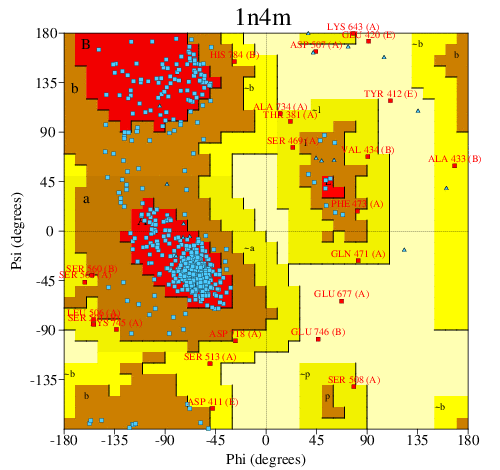
PROCHECK
|
|
|
|
|
|
Headers
|
|
|
|
References
|
|
|
|
|
|

|
|
P06400
(RB_HUMAN) -
Retinoblastoma-associated protein from Homo sapiens
|
|
|
|
Seq:
Struc:
|
|
|
|
928 a.a.
345 a.a.*
|
|

|

|

|
|
|
|
|
|
|
|
|
|
|
|
|
|
|
|
|
Enzyme class:
|
|
Chains A, B, C, D, E:
E.C.?
|
|
|
|
|
|
|
|
|
|
|
|
|
|
|
|
|
|
|
 |
|
|
|
|
|
|
| |
|
|
Genes Dev
16:3199-3212
(2002)
|
|
PubMed id:
|
|
|
|
|
|
| |
|
Structural basis for the recognition of the E2F transactivation domain by the retinoblastoma tumor suppressor.
|
|
C.Lee,
J.H.Chang,
H.S.Lee,
Y.Cho.
|
|
|
|
|
| |
ABSTRACT
|
|
|
|
| |
|
|
Repression of E2F transcription activity by the retinoblastoma (Rb) tumor
suppressor through its interaction with the transactivation domain of the E2F
transcription factor is one of the central features of G1/S arrest in the
mammalian cell cycle. Deregulation of the Rb-E2F interaction results in
hyperproliferation, lack of differentiation, and apoptosis, and can lead to
cancer. The 2.2-A crystal structure of the Rb pocket complexed with an
18-residue transactivation-domain peptide of E2F-2 reveals that the
boomerang-shaped peptide binds to the highly conserved interface between the
A-box and the B-box of the Rb pocket in a bipartite manner. The N-terminal
segment of the E2F-2 peptide in an extended beta-strand-like structure interacts
with helices from the conserved groove at the A-B interface, whereas the
C-terminal segment, which contains one 3(10) helix, binds to a groove mainly
formed by A-box helices. The flexibility in the middle of the E2F-2 peptide is
essential for the tight association of E2F to the Rb pocket. The binding of Rb
to the E2F-2 peptide conceals several conserved residues that are crucial for
transcription activation of E2F. We provide the structural basis for the
Rb-mediated repression of E2F transcription activity without the requirement of
histone-modifying enzymes.
|
|
|
|
|
|
|
|
|
|
|
|
|
|
|
|
|
|
 |
 |
 |
|
Literature references that cite this PDB file's key reference
|
|
|
| |
PubMed id
|
|
Reference
|
|
|
|
|
|
E.R.Balog,
J.R.Burke,
G.L.Hura,
and
S.M.Rubin
(2011).
Crystal structure of the unliganded retinoblastoma protein pocket domain.
|
| |
Proteins,
79,
2010-2014.
|
|
|
PDB code:
|
|
|
|
|
|
|
|
M.J.Cecchini,
and
F.A.Dick
(2011).
The biochemical basis of CDK phosphorylation-independent regulation of E2F1 by the retinoblastoma protein.
|
| |
Biochem J,
434,
297-308.
|
|
|
|
|
|
|
R.B.Delston,
K.A.Matatall,
Y.Sun,
M.D.Onken,
and
J.W.Harbour
(2011).
p38 phosphorylates Rb on Ser567 by a novel, cell cycle-independent mechanism that triggers Rb-Hdm2 interaction and apoptosis.
|
| |
Oncogene,
30,
588-599.
|
|
|
|
|
|
|
Y.C.Kim,
S.Y.Kim,
J.M.Mellado-Gil,
H.Yadav,
W.Neidermyer,
A.K.Kamaraju,
and
S.G.Rane
(2011).
RB regulates pancreas development by stabilizing Pdx1.
|
| |
EMBO J,
30,
1563-1576.
|
|
|
|
|
|
|
L.B.Chemes,
I.E.Sánchez,
C.Smal,
and
G.de Prat-Gay
(2010).
Targeting mechanism of the retinoblastoma tumor suppressor by a prototypical viral oncoprotein. Structural modularity, intrinsic disorder and phosphorylation of human papillomavirus E7.
|
| |
FEBS J,
277,
973-988.
|
|
|
|
|
|
|
P.Acharya,
N.Raj,
M.S.Buckley,
L.Zhang,
S.Duperon,
G.Williams,
R.W.Henry,
and
D.N.Arnosti
(2010).
Paradoxical instability-activity relationship defines a novel regulatory pathway for retinoblastoma proteins.
|
| |
Mol Biol Cell,
21,
3890-3901.
|
|
|
|
|
|
|
D.Gerber,
S.J.Maerkl,
and
S.R.Quake
(2009).
An in vitro microfluidic approach to generating protein-interaction networks.
|
| |
Nat Methods,
6,
71-74.
|
|
|
|
|
|
|
H.Wang,
L.B.Carey,
Y.Cai,
H.Wijnen,
and
B.Futcher
(2009).
Recruitment of Cln3 cyclin to promoters controls cell cycle entry via histone deacetylase and other targets.
|
| |
PLoS Biol,
7,
e1000189.
|
|
|
|
|
|
|
J.C.Ferreon,
M.A.Martinez-Yamout,
H.J.Dyson,
and
P.E.Wright
(2009).
Structural basis for subversion of cellular control mechanisms by the adenoviral E1A oncoprotein.
|
| |
Proc Natl Acad Sci U S A,
106,
13260-13265.
|
|
|
PDB code:
|
|
|
|
|
|
|
|
J.Cheng,
J.A.DeCaprio,
M.M.Fluck,
and
B.S.Schaffhausen
(2009).
Cellular transformation by Simian Virus 40 and Murine Polyoma Virus T antigens.
|
| |
Semin Cancer Biol,
19,
218-228.
|
|
|
|
|
|
|
M.R.Tallack,
J.R.Keys,
P.O.Humbert,
and
A.C.Perkins
(2009).
EKLF/KLF1 controls cell cycle entry via direct regulation of E2f2.
|
| |
J Biol Chem,
284,
20966-20974.
|
|
|
|
|
|
|
M.DeRan,
M.Pulvino,
E.Greene,
C.Su,
and
J.Zhao
(2008).
Transcriptional activation of histone genes requires NPAT-dependent recruitment of TRRAP-Tip60 complex to histone promoters during the G1/S phase transition.
|
| |
Mol Cell Biol,
28,
435-447.
|
|
|
|
|
|
|
T.Tonini,
G.D'Andrilli,
A.Fucito,
L.Gaspa,
and
L.Bagella
(2008).
Importance of Ezh2 polycomb protein in tumorigenesis process interfering with the pathway of growth suppressive key elements.
|
| |
J Cell Physiol,
214,
295-300.
|
|
|
|
|
|
|
F.A.Dick
(2007).
Structure-function analysis of the retinoblastoma tumor suppressor protein - is the whole a sum of its parts?
|
| |
Cell Div,
2,
26.
|
|
|
|
|
|
|
H.L.Borges,
I.C.Hunton,
and
J.Y.Wang
(2007).
Reduction of apoptosis in Rb-deficient embryos via Abl knockout.
|
| |
Oncogene,
26,
3868-3877.
|
|
|
|
|
|
|
M.Hassler,
S.Singh,
W.W.Yue,
M.Luczynski,
R.Lakbir,
F.Sanchez-Sanchez,
T.Bader,
L.H.Pearl,
and
S.Mittnacht
(2007).
Crystal structure of the retinoblastoma protein N domain provides insight into tumor suppression, ligand interaction, and holoprotein architecture.
|
| |
Mol Cell,
28,
371-385.
|
|
|
PDB code:
|
|
|
|
|
|
|
|
S.Tyagi,
A.L.Chabes,
J.Wysocka,
and
W.Herr
(2007).
E2F activation of S phase promoters via association with HCF-1 and the MLL family of histone H3K4 methyltransferases.
|
| |
Mol Cell,
27,
107-119.
|
|
|
|
|
|
|
X.Liu,
and
R.Marmorstein
(2007).
Structure of the retinoblastoma protein bound to adenovirus E1A reveals the molecular basis for viral oncoprotein inactivation of a tumor suppressor.
|
| |
Genes Dev,
21,
2711-2716.
|
|
|
PDB code:
|
|
|
|
|
|
|
|
Y.Inoue,
M.Kitagawa,
and
Y.Taya
(2007).
Phosphorylation of pRB at Ser612 by Chk1/2 leads to a complex between pRB and E2F-1 after DNA damage.
|
| |
EMBO J,
26,
2083-2093.
|
|
|
|
|
|
|
Y.Nakamura,
K.Nakano,
T.Umehara,
M.Kimura,
Y.Hayashizaki,
A.Tanaka,
M.Horikoshi,
B.Padmanabhan,
and
S.Yokoyama
(2007).
Structure of the oncoprotein gankyrin in complex with S6 ATPase of the 26S proteasome.
|
| |
Structure,
15,
179-189.
|
|
|
PDB codes:
|
|
|
|
|
|
|
|
A.Felsani,
A.M.Mileo,
and
M.G.Paggi
(2006).
Retinoblastoma family proteins as key targets of the small DNA virus oncoproteins.
|
| |
Oncogene,
25,
5277-5285.
|
|
|
|
|
|
|
J.W.Harbour
(2006).
Eye cancer: unique insights into oncogenesis: the Cogan Lecture.
|
| |
Invest Ophthalmol Vis Sci,
47,
1736-1745.
|
|
|
|
|
|
|
A.Ledl,
D.Schmidt,
and
S.Müller
(2005).
Viral oncoproteins E1A and E7 and cellular LxCxE proteins repress SUMO modification of the retinoblastoma tumor suppressor.
|
| |
Oncogene,
24,
3810-3818.
|
|
|
|
|
|
|
D.X.Nguyen,
and
D.J.McCance
(2005).
Role of the retinoblastoma tumor suppressor protein in cellular differentiation.
|
| |
J Cell Biochem,
94,
870-879.
|
|
|
|
|
|
|
R.Halaban
(2005).
Rb/E2F: a two-edged sword in the melanocytic system.
|
| |
Cancer Metastasis Rev,
24,
339-356.
|
|
|
|
|
|
|
S.M.Rubin,
A.L.Gall,
N.Zheng,
and
N.P.Pavletich
(2005).
Structure of the Rb C-terminal domain bound to E2F1-DP1: a mechanism for phosphorylation-induced E2F release.
|
| |
Cell,
123,
1093-1106.
|
|
|
PDB code:
|
|
|
|
|
|
|
|
V.Neduva,
R.Linding,
I.Su-Angrand,
A.Stark,
F.de Masi,
T.J.Gibson,
J.Lewis,
L.Serrano,
and
R.B.Russell
(2005).
Systematic discovery of new recognition peptides mediating protein interaction networks.
|
| |
PLoS Biol,
3,
e405.
|
|
|
|
|
|
|
P.W.Lewis,
E.L.Beall,
T.C.Fleischer,
D.Georlette,
A.J.Link,
and
M.R.Botchan
(2004).
Identification of a Drosophila Myb-E2F2/RBF transcriptional repressor complex.
|
| |
Genes Dev,
18,
2929-2940.
|
|
|
|
|
|
|
F.A.Dick,
and
N.Dyson
(2003).
pRB contains an E2F1-specific binding domain that allows E2F1-induced apoptosis to be regulated separately from other E2F activities.
|
| |
Mol Cell,
12,
639-649.
|
|
|
|
|
|
|
K.Munger
(2003).
Clefts, grooves, and (small) pockets: the structure of the retinoblastoma tumor suppressor in complex with its cellular target E2F unveiled.
|
| |
Proc Natl Acad Sci U S A,
100,
2165-2167.
|
|
|
|
|
|
|
R.L.Rich,
and
D.G.Myszka
(2003).
A survey of the year 2002 commercial optical biosensor literature.
|
| |
J Mol Recognit,
16,
351-382.
|
|
|
|
|
|
The most recent references are shown first.
Citation data come partly from CiteXplore and partly
from an automated harvesting procedure. Note that this is likely to be
only a partial list as not all journals are covered by
either method. However, we are continually building up the citation data
so more and more references will be included with time.
Where a reference describes a PDB structure, the PDB
code is
shown on the right.
|
 |
|


 Links
Links


