|
PDBsum entry 1mw2

|
|
|
|
|
 |
Contents |
 |
|
|
|
|
|
|
|
|
|
|
|
|
* Residue conservation analysis
|
|
|
|
|
|
|
|
|
|
|
Enzyme class:
|
|
E.C.2.4.1.4
- amylosucrase.
|
|
|
|
|
|
|
Reaction:
|
|
[(1->4)-alpha-D-glucosyl](n) + sucrose = [(1->4)-alpha-D-glucosyl](n+1) + D-fructose
|
|
|
|
|
|
[(1->4)-alpha-D-glucosyl](n)
|
+
|
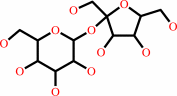 sucrose
|
=
|
[(1->4)-alpha-D-glucosyl](n+1)
|
+
|
D-fructose
Bound ligand (Het Group name = )
corresponds exactly
|
|
|
|
|
|
|
|
|
|
|
|
|
Molecule diagrams generated from .mol files obtained from the
KEGG ftp site
|
|
|
|
|
|
|
|
|
|
|
|
|
|
 |
|
|
|
|
|
|
| |
|
|
| |
|
DOI no:
|
J Biol Chem
277:47741-47747
(2002)
|
|
PubMed id:
|
|
|
|
|
|
| |
|
Oligosaccharide and sucrose complexes of amylosucrase. Structural implications for the polymerase activity.
|
|
L.K.Skov,
O.Mirza,
D.Sprogøe,
I.Dar,
M.Remaud-Simeon,
C.Albenne,
P.Monsan,
M.Gajhede.
|
|
|
|
|
| |
ABSTRACT
|
|
|
|
| |
|
|
The glucosyltransferase amylosucrase is structurally quite similar to the
hydrolase alpha-amylase. How this switch in functionality is achieved is an
important and fundamental question. The inactive E328Q amylosucrase variant has
been co-crystallized with maltoheptaose, and the structure was determined by
x-ray crystallography to 2.2 A resolution, revealing a maltoheptaose binding
site in the B'-domain somewhat distant from the active site. Additional soaking
of these crystals with maltoheptaose resulted in replacement of Tris in the
active site with maltoheptaose, allowing the mapping of the -1 to +5 binding
subsites. Crystals of amylosucrase were soaked with sucrose at different
concentrations. The structures at approximately 2.1 A resolution revealed three
new binding sites of different affinity. The highest affinity binding site is
close to the active site but is not in the previously identified substrate
access channel. Allosteric regulation seems necessary to facilitate access from
this binding site. The structures show the pivotal role of the B'-domain in the
transferase reaction. Based on these observations, an extension of the hydrolase
reaction mechanism valid for this enzyme can be proposed. In this mechanism, the
glycogen-like polymer is bound in the widest access channel to the active site.
The polymer binding introduces structural changes that allow sucrose to migrate
from its binding site into the active site and displace the polymer.
|
|
|
|
|
|
| |
Selected figure(s)
|
|
|
|
| |
|
|

|
|

|
|
Figure 1.
Fig. 1. Stereo picture illustrating the various sucrose-
and oligosaccharide binding sites on amylosucrase. The three
oligosacchararide binding sites are labeled OB1, OB2, and OB3.
Sucrose at the surface site is colored magenta and labeled SB2.
The B'-domain is colored yellow.
|
|
Figure 5.
Fig. 5. Schematic representation of the interactions at
the AS·sucrose binding site (SB2).
|
|
|
|
|
|
| |
The above figures are
reprinted
by permission from the ASBMB:
J Biol Chem
(2002,
277,
47741-47747)
copyright 2002.
|
|
| |
Figures were
selected
by an automated process.
|
|
|
|
|
|
|
|
|
|
|
|
|
|
|
|
 |
 |
 |
|
Literature references that cite this PDB file's key reference
|
|
|
| |
PubMed id
|
|
Reference
|
|
|
|
|
|
J.Schneider,
C.Fricke,
H.Overwin,
and
B.Hofer
(2011).
High level expression of a recombinant amylosucrase gene and selected properties of the enzyme.
|
| |
Appl Microbiol Biotechnol,
89,
1821-1829.
|
|
|
|
|
|
|
E.Champion,
M.Remaud-Simeon,
L.K.Skov,
J.S.Kastrup,
M.Gajhede,
and
O.Mirza
(2009).
The apo structure of sucrose hydrolase from Xanthomonas campestris pv. campestris shows an open active-site groove.
|
| |
Acta Crystallogr D Biol Crystallogr,
65,
1309-1314.
|
|
|
PDB code:
|
|
|
|
|
|
|
|
J.Schneider,
C.Fricke,
H.Overwin,
B.Hofmann,
and
B.Hofer
(2009).
Generation of amylosucrase variants that terminate catalysis of acceptor elongation at the di- or trisaccharide stage.
|
| |
Appl Environ Microbiol,
75,
7453-7460.
|
|
|
|
|
|
|
S.Emond,
S.Mondeil,
K.Jaziri,
I.André,
P.Monsan,
M.Remaud-Siméon,
and
G.Potocki-Véronèse
(2008).
Cloning, purification and characterization of a thermostable amylosucrase from Deinococcus geothermalis.
|
| |
FEMS Microbiol Lett,
285,
25-32.
|
|
|
|
|
|
|
C.Albenne,
L.K.Skov,
V.Tran,
M.Gajhede,
P.Monsan,
M.Remaud-Siméon,
and
G.André-Leroux
(2007).
Towards the molecular understanding of glycogen elongation by amylosucrase.
|
| |
Proteins,
66,
118-126.
|
|
|
|
|
|
|
S.Bozonnet,
M.T.Jensen,
M.M.Nielsen,
N.Aghajari,
M.H.Jensen,
B.Kramhøft,
M.Willemoës,
S.Tranier,
R.Haser,
and
B.Svensson
(2007).
The 'pair of sugar tongs' site on the non-catalytic domain C of barley alpha-amylase participates in substrate binding and activity.
|
| |
FEBS J,
274,
5055-5067.
|
|
|
PDB codes:
|
|
|
|
|
|
|
|
B.A.van der Veen,
L.K.Skov,
G.Potocki-Véronèse,
M.Gajhede,
P.Monsan,
and
M.Remaud-Simeon
(2006).
Increased amylosucrase activity and specificity, and identification of regions important for activity, specificity and stability through molecular evolution.
|
| |
FEBS J,
273,
673-681.
|
|
|
|
|
|
|
S.A.van Hijum,
S.Kralj,
L.K.Ozimek,
L.Dijkhuizen,
and
I.G.van Geel-Schutten
(2006).
Structure-function relationships of glucansucrase and fructansucrase enzymes from lactic acid bacteria.
|
| |
Microbiol Mol Biol Rev,
70,
157-176.
|
|
|
|
|
|
|
J.Allouch,
W.Helbert,
B.Henrissat,
and
M.Czjzek
(2004).
Parallel substrate binding sites in a beta-agarase suggest a novel mode of action on double-helical agarose.
|
| |
Structure,
12,
623-632.
|
|
|
PDB code:
|
|
|
|
|
|
|
|
J.Cortés,
T.Siméon,
M.Remaud-Siméon,
and
V.Tran
(2004).
Geometric algorithms for the conformational analysis of long protein loops.
|
| |
J Comput Chem,
25,
956-967.
|
|
|
|
|
|
The most recent references are shown first.
Citation data come partly from CiteXplore and partly
from an automated harvesting procedure. Note that this is likely to be
only a partial list as not all journals are covered by
either method. However, we are continually building up the citation data
so more and more references will be included with time.
Where a reference describes a PDB structure, the PDB
code is
shown on the right.
|
|


 Links
Links