 |
PDBsum entry 1mlv

|
|
|
|
|
 |
Contents |
 |
|
|
|
|
|
|
|
|
|
|
|
|
* Residue conservation analysis
|
|
|
|
|
|
PDB id:
|
|
|
|
| Name: |
|
Transferase
|
|
|
Title:
|
|
Structure and catalytic mechanism of a set domain protein methyltransferase
|
|
Structure:
|
|
Ribulose-1,5 biphosphate carboxylase/oxygenase large subunit n-methyltransferase. Chain: a, b, c. Fragment: residues 46-482. Synonym: [ribulose-biphosphate-carboxylase]-lysine n- methyltransferase, rubisco methyltransferase, rubisco lsmt, rbcmt. Engineered: yes
|
|
Source:
|
|
Pisum sativum. Pea. Organism_taxid: 3888. Expressed in: escherichia coli bl21(de3). Expression_system_taxid: 469008.
|
|
Biol. unit:
|
|
 Hexamer (from
)
Hexamer (from
)
|
|
Resolution:
|
|
|
2.60Å
|
R-factor:
|
0.232
|
R-free:
|
0.277
|
|
|
Authors:
|
|
R.C.Trievel,B.M.Beach,L.M.A.Dirk,R.L.Houtz,J.H.Hurley
|
Key ref:

|
|
R.C.Trievel
et al.
(2002).
Structure and catalytic mechanism of a SET domain protein methyltransferase.
Cell,
111,
91.
PubMed id:
DOI:

|
|
|
Date:
|
|
|
30-Aug-02
|
Release date:
|
30-Oct-02
|
|
|
|
|
|
|
PROCHECK
|

|
|
|
|
|
Headers
|
|
|
|
References
|
|
|
|
|
|

|
|
Q43088
(RBCMT_PEA) -
Ribulose-1,5 bisphosphate carboxylase/oxygenase large subunit N-methyltransferase, chloroplastic from Pisum sativum
|
|
|
|
Seq:
Struc:
|
|
|
|
489 a.a.
424 a.a.*
|
|

|

|

|
|
|
|
|
|
|
|
|
|
|
Key: |
 |
PfamA domain |
|
|
 |
Secondary structure |
|
 |
CATH domain |
|
|
*
PDB and UniProt seqs differ
at 3 residue positions (black
crosses)
|
|
|
|
|
|
|
|
|
|
|
|
|
Enzyme class 1:
|
|
E.C.2.1.1.127
- [ribulose-bisphosphate carboxylase]-lysine N-methyltransferase.
|
|
|
|
|
|
|
Reaction:
|
|
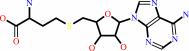
L-lysyl-[ribulose-1,5-bisphosphate carboxylase] + 3 S-adenosyl-L- methionine = N6,N6,N6-trimethyl-L-lysyl-[ribulose-1,5-bisphosphate carboxylase] + 3 S-adenosyl-L-homocysteine + 3 H+
|
|
|
|
|
|
L-lysyl-[ribulose-1,5-bisphosphate carboxylase]
|
+
|
 3
×
S-adenosyl-L- methionine
3
×
S-adenosyl-L- methionine
|
=
|
N(6),N(6),N(6)-trimethyl-L-lysyl-[ribulose-1,5-bisphosphate carboxylase]
|
+
|
 3
×
S-adenosyl-L-homocysteine
3
×
S-adenosyl-L-homocysteine
|
+
|
3
×
H(+)
Bound ligand (Het Group name = )
corresponds exactly
|
|
|
|
|
|
|
|
|
|
Enzyme class 2:
|
|
E.C.2.1.1.259
- [fructose-bisphosphate aldolase]-lysine N-methyltransferase.
|
|
|
|
|
|
|
Reaction:
|
|
[fructose-bisphosphate aldolase]-L-lysine + 3 S-adenosyl-L-methionine = [fructose-bisphosphate aldolase]-N6,N6,N6-trimethyl-L-lysine + 3 S-adenosyl-L-homocysteine + 3 H+
|
|
|
|
|
|
[fructose-bisphosphate aldolase]-L-lysine
|
+
|
3
×
S-adenosyl-L-methionine
|
=
|
[fructose-bisphosphate aldolase]-N(6),N(6),N(6)-trimethyl-L-lysine
|
+
|
3
×
S-adenosyl-L-homocysteine
|
+
|
3
×
H(+)
Bound ligand (Het Group name = )
corresponds exactly
|
|
|
|
|
|
|
|
|
|
|
|
|
Note, where more than one E.C. class is given (as above), each may
correspond to a different protein domain or, in the case of polyprotein
precursors, to a different mature protein.
|
|
|
|
Molecule diagrams generated from .mol files obtained from the
KEGG ftp site
|
|
|
|
|
|
|
|
|
|
|
|
|
|
 |
|
|
|
|
|
|
| |
|
|
| |
|
DOI no:
|
Cell
111:91
(2002)
|
|
PubMed id:
|
|
|
|
|
|
| |
|
Structure and catalytic mechanism of a SET domain protein methyltransferase.
|
|
R.C.Trievel,
B.M.Beach,
L.M.Dirk,
R.L.Houtz,
J.H.Hurley.
|
|
|
|
|
| |
ABSTRACT
|
|
|
|
| |
|
|
Protein lysine methylation by SET domain enzymes regulates chromatin structure,
gene silencing, transcriptional activation, plant metabolism, and other
processes. The 2.6 A resolution structure of Rubisco large subunit
methyltransferase in a pseudo-bisubstrate complex with S-adenosylhomocysteine
and a HEPES ion reveals an all-beta architecture for the SET domain embedded
within a larger alpha-helical enzyme fold. Conserved regions of the SET domain
bind S-adenosylmethionine and substrate lysine at two sites connected by a pore.
We propose that methyl transfer is catalyzed by a conserved Tyr at a narrow pore
connecting the sites. The cofactor enters by a "back door" on the
opposite side of the enzyme from substrate, promoting highly specific protein
recognition and allowing addition of multiple methyl groups.
|
|
|
|
|
|
| |
Selected figure(s)
|
|
|
|
| |
|
|

|
|

|
|
Figure 1.
Figure 1. Structure of LSMT and the SET Domain
|
|
Figure 4.
Figure 4. Ligand Binding Sites
|
|
|
|
|
|
| |
The above figures are
reprinted
by permission from Cell Press:
Cell
(2002,
111,
91-0)
copyright 2002.
|
|
| |
Figures were
selected
by the author.
|
|
|
|
|
|
|
|
|
|
|
|
|
|
|
|
 |
 |
 |
|
Literature references that cite this PDB file's key reference
|
|
|
| |
PubMed id
|
|
Reference
|
|
|
|
|
|
A.M.Quinn,
A.Allali-Hassani,
M.Vedadi,
and
A.Simeonov
(2010).
A chemiluminescence-based method for identification of histone lysine methyltransferase inhibitors.
|
| |
Mol Biosyst,
6,
782-788.
|
|
|
|
|
|
|
B.M.Zee,
R.S.Levin,
B.Xu,
G.LeRoy,
N.S.Wingreen,
and
B.A.Garcia
(2010).
In vivo residue-specific histone methylation dynamics.
|
| |
J Biol Chem,
285,
3341-3350.
|
|
|
|
|
|
|
F.Pontvianne,
T.Blevins,
and
C.S.Pikaard
(2010).
Arabidopsis Histone Lysine Methyltransferases.
|
| |
Adv Bot Res,
53,
1.
|
|
|
|
|
|
|
H.Wei,
and
M.M.Zhou
(2010).
Dimerization of a viral SET protein endows its function.
|
| |
Proc Natl Acad Sci U S A,
107,
18433-18438.
|
|
|
PDB codes:
|
|
|
|
|
|
|
|
T.Sahr,
T.Adam,
C.Fizames,
C.Maurel,
and
V.Santoni
(2010).
O-carboxyl- and N-methyltransferases active on plant aquaporins.
|
| |
Plant Cell Physiol,
51,
2092-2104.
|
|
|
|
|
|
|
A.Patel,
V.Dharmarajan,
V.E.Vought,
and
M.S.Cosgrove
(2009).
On the mechanism of multiple lysine methylation by the human mixed lineage leukemia protein-1 (MLL1) core complex.
|
| |
J Biol Chem,
284,
24242-24256.
|
|
|
|
|
|
|
H.Zheng,
S.Wang,
and
Y.Zhang
(2009).
Increasing the time step with mass scaling in Born-Oppenheimer ab initio QM/MM molecular dynamics simulations.
|
| |
J Comput Chem,
30,
2706-2711.
|
|
|
|
|
|
|
P.Seale,
S.Kajimura,
and
B.M.Spiegelman
(2009).
Transcriptional control of brown adipocyte development and physiological function--of mice and men.
|
| |
Genes Dev,
23,
788-797.
|
|
|
|
|
|
|
R.K.McGinty,
M.Köhn,
C.Chatterjee,
K.P.Chiang,
M.R.Pratt,
and
T.W.Muir
(2009).
Structure-activity analysis of semisynthetic nucleosomes: mechanistic insights into the stimulation of Dot1L by ubiquitylated histone H2B.
|
| |
ACS Chem Biol,
4,
958-968.
|
|
|
|
|
|
|
S.Raunser,
R.Magnani,
Z.Huang,
R.L.Houtz,
R.C.Trievel,
P.A.Penczek,
and
T.Walz
(2009).
Rubisco in complex with Rubisco large subunit methyltransferase.
|
| |
Proc Natl Acad Sci U S A,
106,
3160-3165.
|
|
|
|
|
|
|
Y.Jacob,
and
S.D.Michaels
(2009).
H3K27me1 is E(z) in animals, but not in plants.
|
| |
Epigenetics,
4,
366-369.
|
|
|
|
|
|
|
E.Kraft,
M.Bostick,
S.E.Jacobsen,
and
J.Callis
(2008).
ORTH/VIM proteins that regulate DNA methylation are functional ubiquitin E3 ligases.
|
| |
Plant J,
56,
704-715.
|
|
|
|
|
|
|
J.F.Couture,
L.M.Dirk,
J.S.Brunzelle,
R.L.Houtz,
and
R.C.Trievel
(2008).
Structural origins for the product specificity of SET domain protein methyltransferases.
|
| |
Proc Natl Acad Sci U S A,
105,
20659-20664.
|
|
|
PDB codes:
|
|
|
|
|
|
|
|
P.Hu,
S.Wang,
and
Y.Zhang
(2008).
How do SET-domain protein lysine methyltransferases achieve the methylation state specificity? Revisited by Ab initio QM/MM molecular dynamics simulations.
|
| |
J Am Chem Soc,
130,
3806-3813.
|
|
|
|
|
|
|
S.Kajimura,
P.Seale,
T.Tomaru,
H.Erdjument-Bromage,
M.P.Cooper,
J.L.Ruas,
S.Chin,
P.Tempst,
M.A.Lazar,
and
B.M.Spiegelman
(2008).
Regulation of the brown and white fat gene programs through a PRDM16/CtBP transcriptional complex.
|
| |
Genes Dev,
22,
1397-1409.
|
|
|
|
|
|
|
S.Kawamura,
E.Yoshigai,
S.Kuhara,
and
K.Tashiro
(2008).
smyd1 and smyd2 are expressed in muscle tissue in Xenopus laevis.
|
| |
Cytotechnology,
57,
161-168.
|
|
|
|
|
|
|
D.W.Ng,
T.Wang,
M.B.Chandrasekharan,
R.Aramayo,
S.Kertbundit,
and
T.C.Hall
(2007).
Plant SET domain-containing proteins: structure, function and regulation.
|
| |
Biochim Biophys Acta,
1769,
316-329.
|
|
|
|
|
|
|
H.B.Guo,
and
H.Guo
(2007).
Mechanism of histone methylation catalyzed by protein lysine methyltransferase SET7/9 and origin of product specificity.
|
| |
Proc Natl Acad Sci U S A,
104,
8797-8802.
|
|
|
|
|
|
|
K.L.Rice,
I.Hormaeche,
and
J.D.Licht
(2007).
Epigenetic regulation of normal and malignant hematopoiesis.
|
| |
Oncogene,
26,
6697-6714.
|
|
|
|
|
|
|
R.Magnani,
N.R.Nayak,
M.Mazarei,
L.M.Dirk,
and
R.L.Houtz
(2007).
Polypeptide substrate specificity of PsLSMT. A set domain protein methyltransferase.
|
| |
J Biol Chem,
282,
27857-27864.
|
|
|
|
|
|
|
S.Wang,
P.Hu,
and
Y.Zhang
(2007).
Ab initio quantum mechanical/molecular mechanical molecular dynamics simulation of enzyme catalysis: the case of histone lysine methyltransferase SET7/9.
|
| |
J Phys Chem B,
111,
3758-3764.
|
|
|
|
|
|
|
T.R.Porras-Yakushi,
J.P.Whitelegge,
and
S.Clarke
(2007).
Yeast ribosomal/cytochrome c SET domain methyltransferase subfamily: identification of Rpl23ab methylation sites and recognition motifs.
|
| |
J Biol Chem,
282,
12368-12376.
|
|
|
|
|
|
|
X.Cheng,
and
X.Zhang
(2007).
Structural dynamics of protein lysine methylation and demethylation.
|
| |
Mutat Res,
618,
102-115.
|
|
|
|
|
|
|
A.Ebert,
S.Lein,
G.Schotta,
and
G.Reuter
(2006).
Histone modification and the control of heterochromatic gene silencing in Drosophila.
|
| |
Chromosome Res,
14,
377-392.
|
|
|
|
|
|
|
C.Raynaud,
R.Sozzani,
N.Glab,
S.Domenichini,
C.Perennes,
R.Cella,
E.Kondorosi,
and
C.Bergounioux
(2006).
Two cell-cycle regulated SET-domain proteins interact with proliferating cell nuclear antigen (PCNA) in Arabidopsis.
|
| |
Plant J,
47,
395-407.
|
|
|
|
|
|
|
J.F.Couture,
E.Collazo,
G.Hauk,
and
R.C.Trievel
(2006).
Structural basis for the methylation site specificity of SET7/9.
|
| |
Nat Struct Mol Biol,
13,
140-146.
|
|
|
PDB code:
|
|
|
|
|
|
|
|
J.F.Couture,
G.Hauk,
M.J.Thompson,
G.M.Blackburn,
and
R.C.Trievel
(2006).
Catalytic roles for carbon-oxygen hydrogen bonding in SET domain lysine methyltransferases.
|
| |
J Biol Chem,
281,
19280-19287.
|
|
|
PDB codes:
|
|
|
|
|
|
|
|
J.Mis,
S.S.Ner,
and
T.A.Grigliatti
(2006).
Identification of three histone methyltransferases in Drosophila: dG9a is a suppressor of PEV and is required for gene silencing.
|
| |
Mol Genet Genomics,
275,
513-526.
|
|
|
|
|
|
|
B.Xiao,
C.Jing,
G.Kelly,
P.A.Walker,
F.W.Muskett,
T.A.Frenkiel,
S.R.Martin,
K.Sarma,
D.Reinberg,
S.J.Gamblin,
and
J.R.Wilson
(2005).
Specificity and mechanism of the histone methyltransferase Pr-Set7.
|
| |
Genes Dev,
19,
1444-1454.
|
|
|
PDB code:
|
|
|
|
|
|
|
|
H.Gowher,
X.Zhang,
X.Cheng,
and
A.Jeltsch
(2005).
Avidin plate assay system for enzymatic characterization of a histone lysine methyltransferase.
|
| |
Anal Biochem,
342,
287-291.
|
|
|
|
|
|
|
J.F.Couture,
E.Collazo,
J.S.Brunzelle,
and
R.C.Trievel
(2005).
Structural and functional analysis of SET8, a histone H4 Lys-20 methyltransferase.
|
| |
Genes Dev,
19,
1455-1465.
|
|
|
PDB code:
|
|
|
|
|
|
|
|
M.Biel,
V.Wascholowski,
and
A.Giannis
(2005).
Epigenetics--an epicenter of gene regulation: histones and histone-modifying enzymes.
|
| |
Angew Chem Int Ed Engl,
44,
3186-3216.
|
|
|
|
|
|
|
M.D.Shahbazian,
K.Zhang,
and
M.Grunstein
(2005).
Histone H2B ubiquitylation controls processive methylation but not monomethylation by Dot1 and Set1.
|
| |
Mol Cell,
19,
271-277.
|
|
|
|
|
|
|
P.Z.Kozbial,
and
A.R.Mushegian
(2005).
Natural history of S-adenosylmethionine-binding proteins.
|
| |
BMC Struct Biol,
5,
19.
|
|
|
|
|
|
|
S.C.Dillon,
X.Zhang,
R.C.Trievel,
and
X.Cheng
(2005).
The SET-domain protein superfamily: protein lysine methyltransferases.
|
| |
Genome Biol,
6,
227.
|
|
|
|
|
|
|
X.Cheng,
R.E.Collins,
and
X.Zhang
(2005).
Structural and sequence motifs of protein (histone) methylation enzymes.
|
| |
Annu Rev Biophys Biomol Struct,
34,
267-294.
|
|
|
|
|
|
|
Y.Yin,
C.Liu,
S.N.Tsai,
B.Zhou,
S.M.Ngai,
and
G.Zhu
(2005).
SET8 recognizes the sequence RHRK20VLRDN within the N terminus of histone H4 and mono-methylates lysine 20.
|
| |
J Biol Chem,
280,
30025-30031.
|
|
|
|
|
|
|
D.Patnaik,
H.G.Chin,
P.O.Estève,
J.Benner,
S.E.Jacobsen,
and
S.Pradhan
(2004).
Substrate specificity and kinetic mechanism of mammalian G9a histone H3 methyltransferase.
|
| |
J Biol Chem,
279,
53248-53258.
|
|
|
|
|
|
|
K.Sawada,
Z.Yang,
J.R.Horton,
R.E.Collins,
X.Zhang,
and
X.Cheng
(2004).
Structure of the conserved core of the yeast Dot1p, a nucleosomal histone H3 lysine 79 methyltransferase.
|
| |
J Biol Chem,
279,
43296-43306.
|
|
|
PDB code:
|
|
|
|
|
|
|
|
B.Xiao,
C.Jing,
J.R.Wilson,
P.A.Walker,
N.Vasisht,
G.Kelly,
S.Howell,
I.A.Taylor,
G.M.Blackburn,
and
S.J.Gamblin
(2003).
Structure and catalytic mechanism of the human histone methyltransferase SET7/9.
|
| |
Nature,
421,
652-656.
|
|
|
PDB code:
|
|
|
|
|
|
|
|
B.Xiao,
J.R.Wilson,
and
S.J.Gamblin
(2003).
SET domains and histone methylation.
|
| |
Curr Opin Struct Biol,
13,
699-705.
|
|
|
|
|
|
|
C.V.Smith,
and
J.C.Sacchettini
(2003).
Mycobacterium tuberculosis: a model system for structural genomics.
|
| |
Curr Opin Struct Biol,
13,
658-664.
|
|
|
|
|
|
|
H.L.Schubert,
R.M.Blumenthal,
and
X.Cheng
(2003).
Many paths to methyltransfer: a chronicle of convergence.
|
| |
Trends Biochem Sci,
28,
329-335.
|
|
|
|
|
|
|
J.Landry,
A.Sutton,
T.Hesman,
J.Min,
R.M.Xu,
M.Johnston,
and
R.Sternglanz
(2003).
Set2-catalyzed methylation of histone H3 represses basal expression of GAL4 in Saccharomyces cerevisiae.
|
| |
Mol Cell Biol,
23,
5972-5978.
|
|
|
|
|
|
|
J.M.Johnston,
V.L.Arcus,
C.J.Morton,
M.W.Parker,
and
E.N.Baker
(2003).
Crystal structure of a putative methyltransferase from Mycobacterium tuberculosis: misannotation of a genome clarified by protein structural analysis.
|
| |
J Bacteriol,
185,
4057-4065.
|
|
|
PDB code:
|
|
|
|
|
|
|
|
J.Min,
Q.Feng,
Z.Li,
Y.Zhang,
and
R.M.Xu
(2003).
Structure of the catalytic domain of human DOT1L, a non-SET domain nucleosomal histone methyltransferase.
|
| |
Cell,
112,
711-723.
|
|
|
PDB code:
|
|
|
|
|
|
|
|
K.L.Manzur,
A.Farooq,
L.Zeng,
O.Plotnikova,
A.W.Koch,
Sachchidanand,
and
M.M.Zhou
(2003).
A dimeric viral SET domain methyltransferase specific to Lys27 of histone H3.
|
| |
Nat Struct Biol,
10,
187-196.
|
|
|
PDB code:
|
|
|
|
|
|
|
|
K.Zhao,
X.Chai,
A.Clements,
and
R.Marmorstein
(2003).
Structure and autoregulation of the yeast Hst2 homolog of Sir2.
|
| |
Nat Struct Biol,
10,
864-871.
|
|
|
PDB code:
|
|
|
|
|
|
|
|
M.A.Kurowski,
J.M.Sasin,
M.Feder,
J.Debski,
and
J.M.Bujnicki
(2003).
Characterization of the cofactor-binding site in the SPOUT-fold methyltransferases by computational docking of S-adenosylmethionine to three crystal structures.
|
| |
BMC Bioinformatics,
4,
9.
|
|
|
|
|
|
|
M.Jaskelioff,
and
C.L.Peterson
(2003).
Chromatin and transcription: histones continue to make their marks.
|
| |
Nat Cell Biol,
5,
395-399.
|
|
|
|
|
|
|
R.C.Trievel,
E.M.Flynn,
R.L.Houtz,
and
J.H.Hurley
(2003).
Mechanism of multiple lysine methylation by the SET domain enzyme Rubisco LSMT.
|
| |
Nat Struct Biol,
10,
545-552.
|
|
|
PDB codes:
|
|
|
|
|
|
|
|
R.Marmorstein
(2003).
Structure of SET domain proteins: a new twist on histone methylation.
|
| |
Trends Biochem Sci,
28,
59-62.
|
|
|
|
|
|
|
T.Kwon,
J.H.Chang,
E.Kwak,
C.W.Lee,
A.Joachimiak,
Y.C.Kim,
J.Lee,
and
Y.Cho
(2003).
Mechanism of histone lysine methyl transfer revealed by the structure of SET7/9-AdoMet.
|
| |
EMBO J,
22,
292-303.
|
|
|
PDB codes:
|
|
|
|
|
|
|
|
X.Zhang,
Z.Yang,
S.I.Khan,
J.R.Horton,
H.Tamaru,
E.U.Selker,
and
X.Cheng
(2003).
Structural basis for the product specificity of histone lysine methyltransferases.
|
| |
Mol Cell,
12,
177-185.
|
|
|
PDB code:
|
|
|
|
|
|
|
|
R.N.Dutnall,
and
J.M.Denu
(2002).
Methyl magic and HAT tricks.
|
| |
Nat Struct Biol,
9,
888-891.
|
|
|
|
|
|
|
T.O.Yeates
(2002).
Structures of SET domain proteins: protein lysine methyltransferases make their mark.
|
| |
Cell,
111,
5-7.
|
|
|
|
|
|
The most recent references are shown first.
Citation data come partly from CiteXplore and partly
from an automated harvesting procedure. Note that this is likely to be
only a partial list as not all journals are covered by
either method. However, we are continually building up the citation data
so more and more references will be included with time.
Where a reference describes a PDB structure, the PDB
codes are
shown on the right.
|
|


 Links
Links


