 |
PDBsum entry 1l3c

|
|
|
|
|
|

|

|

|

|
|

|
|

|
|

|
|

|
|

|
|
|
 |

|

|
|
|
|
|
|
|
|
|
|
|
|
|
|
|
|
|
|
|
|
|
|
|
|
|
|
|
|
|
|
|
|
|
|
Transferase, lyase
|
PDB id
|
|
|
|
1l3c
|
|
|
|
|
|
|
|
|
|
|
|
|
|
|

|

|

|
|
|
|
|
|
|
|
 |
Contents |
 |
|
|
|
|
|
|
|
|
|
|
* Residue conservation analysis
|
|
|
|
|
|
PDB id:
|
|
|
|
| Name: |
|
Transferase, lyase
|
|
|
Title:
|
|
Mt0146, the precorrin-6y methyltransferase (cbit) homolog from m. Thermoautotrophicum, c2 spacegroup with short cell
|
|
Structure:
|
|
Precorrin-6y methyltransferase/putative decarboxylase. Chain: a, b, c, d. Synonym: mt0146, cbit, mth146. Engineered: yes
|
|
Source:
|
|
Methanothermobacter thermautotrophicus. Organism_taxid: 145262. Gene: mth146. Expressed in: escherichia coli. Expression_system_taxid: 562.
|
|
Biol. unit:
|
|
Tetramer (from
)
|
|
Resolution:
|
|
|
2.31Å
|
R-factor:
|
0.204
|
R-free:
|
0.254
|
|
|
Authors:
|
|
J.P.Keller,P.M.Smith,J.Benach,D.Christendat,G.Detitta,J.F.Hunt
|
Key ref:

|
|
J.P.Keller
et al.
(2002).
The crystal structure of MT0146/CbiT suggests that the putative precorrin-8w decarboxylase is a methyltransferase.
Structure,
10,
1475-1487.
PubMed id:
DOI:

|
|
|
Date:
|
|
|
26-Feb-02
|
Release date:
|
27-Nov-02
|
|
|
|
|
|
|
PROCHECK
|

|
|
|
|
|
Headers
|
|
|
|
References
|
|
|
|
|
|

|
|
O26249
(CBIT_METTH) -
Probable cobalt-precorrin-6B C(15)-methyltransferase (decarboxylating) from Methanothermobacter thermautotrophicus (strain ATCC 29096 / DSM 1053 / JCM 10044 / NBRC 100330 / Delta H)
|
|
|
|
Seq:
Struc:
|
|
|
|
192 a.a.
186 a.a.
|
|

|

|
|
|
|
|
|
|
|
|
|
|
|
Key: |
 |
PfamA domain |
|
|
 |
Secondary structure |
|
 |
CATH domain |
|
|
|
|
|
|
|
|
|
|
|
|
|
Enzyme class:
|
|
E.C.2.1.1.196
- cobalt-precorrin-6B (C(15))-methyltransferase [decarboxylating].
|
|
|
|
|
|
|
Reaction:
|
|
Co-precorrin-6B + S-adenosyl-L-methionine = Co-precorrin-7 + S-adenosyl- L-homocysteine + CO2
|
|
|
|
|
|
Co-precorrin-6B
|
+
|
 S-adenosyl-L-methionine
|
=
|
Co-precorrin-7
|
+
|
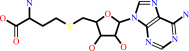 S-adenosyl- L-homocysteine
|
+
|
 CO2
CO2
|
|
|
|
|
|
|
|
|
|
|
|
|
Molecule diagrams generated from .mol files obtained from the
KEGG ftp site
|
|
|
|
|
|
|
|
|
|
|
|
|
|
 |
|
|
|
|
|
|
| |
|
|
| |
|
DOI no:
|
Structure
10:1475-1487
(2002)
|
|
PubMed id:
|
|
|
|
|
|
| |
|
The crystal structure of MT0146/CbiT suggests that the putative precorrin-8w decarboxylase is a methyltransferase.
|
|
J.P.Keller,
P.M.Smith,
J.Benach,
D.Christendat,
G.T.deTitta,
J.F.Hunt.
|
|
|
|
|
| |
ABSTRACT
|
|
|
|
| |
|
|
The CbiT and CbiE enzymes participate in the biosynthesis of vitamin B12. They
are fused together in some organisms to form a protein called CobL, which
catalyzes two methylations and one decarboxylation on a precorrin intermediate.
Because CbiE has sequence homology to canonical precorrin methyltransferases,
CbiT was hypothesized to catalyze the decarboxylation. We herein present the
crystal structure of MT0146, the CbiT homolog from Methanobacterium
thermoautotrophicum. The protein shows structural similarity to Rossmann-like
S-adenosyl-methionine-dependent methyltransferases, and our 1.9 A cocrystal
structure shows that it binds S-adenosyl-methionine in standard geometry near a
binding pocket that could accommodate a precorrin substrate. Therefore,
MT0146/CbiT probably functions as a precorrin methyltransferase and represents
the first enzyme identified with this activity that does not have the canonical
precorrin methyltransferase fold.
|
|
|
|
|
|
| |
Selected figure(s)
|
|
|
|
| |
|
|

|
|
Figure 4.
Figure 4. Structure of the Methyltransferase Active Site(A)
Stereo ribbon diagram showing the F[o] - F[c] difference density
(magenta) observed in the active site of the AdoHcy-bound
MT0146/CbiT crystal form with molecular replacement phases
calculated from the apo model. The electron density was
contoured at 3.5 s. The coordinates of the AdoHcy molecule shown
in ball and stick representation came from the structure of the
COMT homolog [12] on the basis of the structural alignment of
its methyltransferase fold to that of MT0146/CbiT by the program
DALI.(B) Stereo pair showing the binding contacts to the AdoHcy
molecule in the refined MT0146/CbiT complex structure.
|
|
|
|
|
|
| |
The above figure is
reprinted
by permission from Cell Press:
Structure
(2002,
10,
1475-1487)
copyright 2002.
|
|
| |
Figure was
selected
by an automated process.
|
|
|
|
|
|
|
|
|
|
|
|
|
|
|
|
 |
 |
 |
|
Literature references that cite this PDB file's key reference
|
|
|
| |
PubMed id
|
|
Reference
|
|
|
|
|
|
M.D.Miller,
L.Aravind,
C.Bakolitsa,
C.L.Rife,
D.Carlton,
P.Abdubek,
T.Astakhova,
H.L.Axelrod,
H.J.Chiu,
T.Clayton,
M.C.Deller,
L.Duan,
J.Feuerhelm,
J.C.Grant,
G.W.Han,
L.Jaroszewski,
K.K.Jin,
H.E.Klock,
M.W.Knuth,
P.Kozbial,
S.S.Krishna,
A.Kumar,
D.Marciano,
D.McMullan,
A.T.Morse,
E.Nigoghossian,
L.Okach,
R.Reyes,
H.van den Bedem,
D.Weekes,
Q.Xu,
K.O.Hodgson,
J.Wooley,
M.A.Elsliger,
A.M.Deacon,
A.Godzik,
S.A.Lesley,
and
I.A.Wilson
(2010).
Structure of the first representative of Pfam family PF04016 (DUF364) reveals enolase and Rossmann-like folds that combine to form a unique active site with a possible role in heavy-metal chelation.
|
| |
Acta Crystallogr Sect F Struct Biol Cryst Commun,
66,
1167-1173.
|
|
|
PDB code:
|
|
|
|
|
|
|
|
D.Bandyopadhyay,
J.Huan,
J.Prins,
J.Snoeyink,
W.Wang,
and
A.Tropsha
(2009).
Identification of family-specific residue packing motifs and their use for structure-based protein function prediction: I. Method development.
|
| |
J Comput Aided Mol Des,
23,
773-784.
|
|
|
|
|
|
|
R.Mazumder,
and
S.Vasudevan
(2008).
Structure-guided comparative analysis of proteins: principles, tools, and applications for predicting function.
|
| |
PLoS Comput Biol,
4,
e1000151.
|
|
|
|
|
|
|
N.Mirkovic,
Z.Li,
A.Parnassa,
and
D.Murray
(2007).
Strategies for high-throughput comparative modeling: applications to leverage analysis in structural genomics and protein family organization.
|
| |
Proteins,
66,
766-777.
|
|
|
|
|
|
|
W.A.Hendrickson
(2007).
Impact of structures from the protein structure initiative.
|
| |
Structure,
15,
1528-1529.
|
|
|
|
|
|
|
C.A.Roessner,
and
A.I.Scott
(2006).
Fine-tuning our knowledge of the anaerobic route to cobalamin (vitamin B12).
|
| |
J Bacteriol,
188,
7331-7334.
|
|
|
|
|
|
|
P.Z.Kozbial,
and
A.R.Mushegian
(2005).
Natural history of S-adenosylmethionine-binding proteins.
|
| |
BMC Struct Biol,
5,
19.
|
|
|
|
|
|
|
Y.Ofran,
M.Punta,
R.Schneider,
and
B.Rost
(2005).
Beyond annotation transfer by homology: novel protein-function prediction methods to assist drug discovery.
|
| |
Drug Discov Today,
10,
1475-1482.
|
|
|
|
|
|
|
A.F.Yakunin,
A.A.Yee,
A.Savchenko,
A.M.Edwards,
and
C.H.Arrowsmith
(2004).
Structural proteomics: a tool for genome annotation.
|
| |
Curr Opin Chem Biol,
8,
42-48.
|
|
|
|
|
|
|
M.Roovers,
J.Wouters,
J.M.Bujnicki,
C.Tricot,
V.Stalon,
H.Grosjean,
and
L.Droogmans
(2004).
A primordial RNA modification enzyme: the case of tRNA (m1A) methyltransferase.
|
| |
Nucleic Acids Res,
32,
465-476.
|
|
|
|
|
|
|
C.Zhang,
and
S.H.Kim
(2003).
Overview of structural genomics: from structure to function.
|
| |
Curr Opin Chem Biol,
7,
28-32.
|
|
|
|
|
|
|
H.L.Schubert,
R.M.Blumenthal,
and
X.Cheng
(2003).
Many paths to methyltransfer: a chronicle of convergence.
|
| |
Trends Biochem Sci,
28,
329-335.
|
|
|
|
|
|
|
K.Kinoshita,
and
H.Nakamura
(2003).
Protein informatics towards function identification.
|
| |
Curr Opin Struct Biol,
13,
396-400.
|
|
|
|
|
|
|
M.E.Stroupe,
H.K.Leech,
D.S.Daniels,
M.J.Warren,
and
E.D.Getzoff
(2003).
CysG structure reveals tetrapyrrole-binding features and novel regulation of siroheme biosynthesis.
|
| |
Nat Struct Biol,
10,
1064-1073.
|
|
|
PDB codes:
|
|
|
|
|
|
|
The most recent references are shown first.
Citation data come partly from CiteXplore and partly
from an automated harvesting procedure. Note that this is likely to be
only a partial list as not all journals are covered by
either method. However, we are continually building up the citation data
so more and more references will be included with time.
Where a reference describes a PDB structure, the PDB
code is
shown on the right.
|
|


 Links
Links


