 |
PDBsum entry 1kwp

|
|
|
|
|
 |
Contents |
 |
|
|
|
|
|
|
|
|
|
|
|
|
* Residue conservation analysis
|
|
|
|
|
|
PDB id:
|
|
|
|
| Name: |
|
Transferase
|
|
|
Title:
|
|
Crystal structure of mapkap2
|
|
Structure:
|
|
Map kinase activated protein kinase 2. Chain: a, b. Synonym: mapkap2. Engineered: yes
|
|
Source:
|
|
Homo sapiens. Human. Organism_taxid: 9606. Expressed in: escherichia coli. Expression_system_taxid: 562
|
|
Biol. unit:
|
|
Hexamer (from
)
|
|
Resolution:
|
|
|
2.80Å
|
R-factor:
|
0.233
|
R-free:
|
0.245
|
|
|
Authors:
|
|
W.Meng,L.L.Swenson,M.J.Fitzgibbon,K.Hayakawa,E.Ter Haar,A.E.Behrens, J.R.Fulghum,J.A.Lippke
|
Key ref:

|
|
W.Meng
et al.
(2002).
Structure of mitogen-activated protein kinase-activated protein (MAPKAP) kinase 2 suggests a bifunctional switch that couples kinase activation with nuclear export.
J Biol Chem,
277,
37401-37405.
PubMed id:
DOI:

|
|
|
Date:
|
|
|
30-Jan-02
|
Release date:
|
18-Sep-02
|
|
|
|
|
|
|
PROCHECK
|

|
|
|
|
|
Headers
|
|
|
|
References
|
|
|
|
|
|

|
|
P49137
(MAPK2_HUMAN) -
MAP kinase-activated protein kinase 2 from Homo sapiens
|
|
|
|
Seq:
Struc:
|
|
|
|
400 a.a.
319 a.a.
|
|

|

|

|
|
|
|
|
|
|
|
|
|
|
Key: |
 |
PfamA domain |
|
|
 |
Secondary structure |
|
 |
CATH domain |
|
|
|
|
|
|
|
|
|
|
|
|
|
Enzyme class:
|
|
E.C.2.7.11.1
- non-specific serine/threonine protein kinase.
|
|
|
|
|
|
|
Reaction:
|
|
|
1.
|
L-seryl-[protein] + ATP = O-phospho-L-seryl-[protein] + ADP + H+
|
|
2.
|
L-threonyl-[protein] + ATP = O-phospho-L-threonyl-[protein] + ADP + H+
|
|
|
|
|
|
|
L-seryl-[protein]
|
+
|
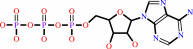 ATP
ATP
|
=
|
O-phospho-L-seryl-[protein]
|
+
|
 ADP
ADP
|
+
|
H(+)
|
|
|
|
|
|
|
L-threonyl-[protein]
|
+
|
ATP
|
=
|
O-phospho-L-threonyl-[protein]
|
+
|
ADP
|
+
|
H(+)
|
|
|
|
|
|
|
|
|
|
|
|
|
Molecule diagrams generated from .mol files obtained from the
KEGG ftp site
|
|
|
|
|
|
|
|
|
|
|
|
|
|
 |
|
|
|
|
|
|
| |
|
|
| |
|
DOI no:
|
J Biol Chem
277:37401-37405
(2002)
|
|
PubMed id:
|
|
|
|
|
|
| |
|
Structure of mitogen-activated protein kinase-activated protein (MAPKAP) kinase 2 suggests a bifunctional switch that couples kinase activation with nuclear export.
|
|
W.Meng,
L.L.Swenson,
M.J.Fitzgibbon,
K.Hayakawa,
E.Ter Haar,
A.E.Behrens,
J.R.Fulghum,
J.A.Lippke.
|
|
|
|
|
| |
ABSTRACT
|
|
|
|
| |
|
|
MAPK-activated protein kinase 2 (MAPKAPK2), one of several kinases directly
phosphorylated and activated by p38 MAPK, plays a central role in the
inflammatory response. The activated MAPKAPK2 phosphorylates its nuclear targets
CREB/ATF1, serum response factor, and E2A protein E47 and its cytoplasmic
targets HSP25/27, LSP-1, 5-lipoxygenase, glycogen synthase, and tyrosine
hydroxylase. The crystal structure of unphosphorylated MAPKAPK2, determined at
2.8 A resolution, includes the kinase domain and the C-terminal regulatory
domain. Although the protein is inactive, the kinase domain adopts an active
conformation with aspartate 366 mimicking the missing phosphorylated threonine
222 in the activation loop. The C-terminal regulatory domain forms a
helix-turn-helix plus a long strand. Phosphorylation of threonine 334, which is
located between the kinase domain and the C-terminal regulatory domain, may
serve as a switch for MAPKAPK2 nuclear import and export. Phosphorylated
MAPKAPK2 masks the nuclear localization signal at its C terminus by binding to
p38. It unmasks the nuclear export signal, which is part of the second
C-terminal helix packed along the surface of kinase domain C-lobe, and thereby
carries p38 to the cytoplasm.
|
|
|
|
|
|
| |
Selected figure(s)
|
|
|
|
| |
|
|

|
|

|
|
Figure 1.
Fig. 1. Ribbon diagram of the MAPKAPK2 structure. The
N-lobe of the kinase domain is colored light blue. The C-lobe of
the kinase domain is colored dark blue. The regulatory domain is
colored red. The key regulatory residue threonine 334 is
labeled. The dotted line indicates the missing part of
activation loop.
|
|
Figure 5.
Fig. 5. Interaction between the kinase domain C-lobe and
the C-terminal regulatory domain second helix of MAPKAPK2.
|
|
|
|
|
|
| |
The above figures are
reprinted
by permission from the ASBMB:
J Biol Chem
(2002,
277,
37401-37405)
copyright 2002.
|
|
| |
Figures were
selected
by an automated process.
|
|
|
|
|
|
|
|
|
|
|
|
|
|
|
|
 |
 |
 |
|
Literature references that cite this PDB file's key reference
|
|
|
| |
PubMed id
|
|
Reference
|
|
|
|
|
|
B.Petri,
J.Kaur,
E.M.Long,
H.Li,
S.A.Parsons,
S.Butz,
M.Phillipson,
D.Vestweber,
K.D.Patel,
S.M.Robbins,
and
P.Kubes
(2011).
Endothelial LSP1 is involved in endothelial dome formation, minimizing vascular permeability changes during neutrophil transmigration in vivo.
|
| |
Blood,
117,
942-952.
|
|
|
|
|
|
|
A.Fujino,
K.Fukushima,
N.Namiki,
T.Kosugi,
and
M.Takimoto-Kamimura
(2010).
Structural analysis of an MK2-inhibitor complex: insight into the regulation of the secondary structure of the Gly-rich loop by TEI-I01800.
|
| |
Acta Crystallogr D Biol Crystallogr,
66,
80-87.
|
|
|
PDB code:
|
|
|
|
|
|
|
|
H.C.Reinhardt,
P.Hasskamp,
I.Schmedding,
S.Morandell,
M.A.van Vugt,
X.Wang,
R.Linding,
S.E.Ong,
D.Weaver,
S.A.Carr,
and
M.B.Yaffe
(2010).
DNA damage activates a spatially distinct late cytoplasmic cell-cycle checkpoint network controlled by MK2-mediated RNA stabilization.
|
| |
Mol Cell,
40,
34-49.
|
|
|
|
|
|
|
R.Cheng,
B.Felicetti,
S.Palan,
I.Toogood-Johnson,
C.Scheich,
J.Barker,
M.Whittaker,
and
T.Hesterkamp
(2010).
High-resolution crystal structure of human Mapkap kinase 3 in complex with a high affinity ligand.
|
| |
Protein Sci,
19,
168-173.
|
|
|
PDB code:
|
|
|
|
|
|
|
|
B.A.Holloway,
S.Gomez de la Torre Canny,
Y.Ye,
D.C.Slusarski,
C.M.Freisinger,
R.Dosch,
M.M.Chou,
D.S.Wagner,
and
M.C.Mullins
(2009).
A novel role for MAPKAPK2 in morphogenesis during zebrafish development.
|
| |
PLoS Genet,
5,
e1000413.
|
|
|
|
|
|
|
B.Ward,
B.L.Seal,
C.M.Brophy,
and
A.Panitch
(2009).
Design of a bioactive cell-penetrating peptide: when a transduction domain does more than transduce.
|
| |
J Pept Sci,
15,
668-674.
|
|
|
|
|
|
|
M.A.Argiriadi,
S.Sousa,
D.Banach,
D.Marcotte,
T.Xiang,
M.J.Tomlinson,
M.Demers,
C.Harris,
S.Kwak,
J.Hardman,
M.Pietras,
L.Quinn,
J.DiMauro,
B.Ni,
J.Mankovich,
D.W.Borhani,
R.V.Talanian,
and
R.Sadhukhan
(2009).
Rational mutagenesis to support structure-based drug design: MAPKAP kinase 2 as a case study.
|
| |
BMC Struct Biol,
9,
16.
|
|
|
|
|
|
|
N.Flamand,
M.Luo,
M.Peters-Golden,
and
T.G.Brock
(2009).
Phosphorylation of serine 271 on 5-lipoxygenase and its role in nuclear export.
|
| |
J Biol Chem,
284,
306-313.
|
|
|
|
|
|
|
T.Yoshizawa,
D.Hammaker,
D.L.Boyle,
M.Corr,
R.Flavell,
R.Davis,
G.Schett,
and
G.S.Firestein
(2009).
Role of MAPK kinase 6 in arthritis: distinct mechanism of action in inflammation and cytokine expression.
|
| |
J Immunol,
183,
1360-1367.
|
|
|
|
|
|
|
A.C.Pike,
P.Rellos,
F.H.Niesen,
A.Turnbull,
A.W.Oliver,
S.A.Parker,
B.E.Turk,
L.H.Pearl,
and
S.Knapp
(2008).
Activation segment dimerization: a mechanism for kinase autophosphorylation of non-consensus sites.
|
| |
EMBO J,
27,
704-714.
|
|
|
PDB codes:
|
|
|
|
|
|
|
|
A.White,
C.A.Pargellis,
J.M.Studts,
B.G.Werneburg,
and
B.T.Farmer
(2007).
Molecular basis of MAPK-activated protein kinase 2:p38 assembly.
|
| |
Proc Natl Acad Sci U S A,
104,
6353-6358.
|
|
|
PDB code:
|
|
|
|
|
|
|
|
C.McCormick,
and
D.Ganem
(2006).
Phosphorylation and function of the kaposin B direct repeats of Kaposi's sarcoma-associated herpesvirus.
|
| |
J Virol,
80,
6165-6170.
|
|
|
|
|
|
|
G.A.Malawski,
R.C.Hillig,
F.Monteclaro,
U.Eberspaecher,
A.A.Schmitz,
K.Crusius,
M.Huber,
U.Egner,
P.Donner,
and
B.Müller-Tiemann
(2006).
Identifying protein construct variants with increased crystallization propensity--a case study.
|
| |
Protein Sci,
15,
2718-2728.
|
|
|
|
|
|
|
J.Sangerman,
M.S.Lee,
X.Yao,
E.Oteng,
C.H.Hsiao,
W.Li,
S.Zein,
S.F.Ofori-Acquah,
and
B.S.Pace
(2006).
Mechanism for fetal hemoglobin induction by histone deacetylase inhibitors involves gamma-globin activation by CREB1 and ATF-2.
|
| |
Blood,
108,
3590-3599.
|
|
|
|
|
|
|
K.Oda,
and
H.Kitano
(2006).
A comprehensive map of the toll-like receptor signaling network.
|
| |
Mol Syst Biol,
2,
2006.0015.
|
|
|
|
|
|
|
M.Gaestel
(2006).
MAPKAP kinases - MKs - two's company, three's a crowd.
|
| |
Nat Rev Mol Cell Biol,
7,
120-130.
|
|
|
|
|
|
|
S.Ross,
T.Chen,
V.Yu,
Y.Tudor,
D.Zhang,
L.Liu,
N.Tamayo,
C.Dominguez,
and
D.Powers
(2006).
High-content screening analysis of the p38 pathway: profiling of structurally related p38alpha kinase inhibitors using cell-based assays.
|
| |
Assay Drug Dev Technol,
4,
397-409.
|
|
|
|
|
|
|
A.Astolfi,
S.Rolla,
P.Nanni,
E.Quaglino,
C.De Giovanni,
M.Iezzi,
P.Musiani,
G.Forni,
P.L.Lollini,
F.Cavallo,
and
R.A.Calogero
(2005).
Immune prevention of mammary carcinogenesis in HER-2/neu transgenic mice: a microarray scenario.
|
| |
Cancer Immunol Immunother,
54,
599-610.
|
|
|
|
|
|
|
E.D.Scheeff,
and
P.E.Bourne
(2005).
Structural evolution of the protein kinase-like superfamily.
|
| |
PLoS Comput Biol,
1,
e49.
|
|
|
|
|
|
|
S.Spisani,
S.Falzarano,
S.Traniello,
M.Nalli,
and
R.Selvatici
(2005).
A 'pure' chemoattractant formylpeptide analogue triggers a specific signalling pathway in human neutrophil chemotaxis.
|
| |
FEBS J,
272,
883-891.
|
|
|
|
|
|
|
D.L.Almholt,
F.Loechel,
S.J.Nielsen,
C.Krog-Jensen,
R.Terry,
S.P.Bjørn,
H.C.Pedersen,
M.Praestegaard,
S.Møller,
M.Heide,
L.Pagliaro,
A.J.Mason,
S.Butcher,
and
S.W.Dahl
(2004).
Nuclear export inhibitors and kinase inhibitors identified using a MAPK-activated protein kinase 2 redistribution screen.
|
| |
Assay Drug Dev Technol,
2,
7.
|
|
|
|
|
|
|
L.Le Gallic,
L.Virgilio,
P.Cohen,
B.Biteau,
and
G.Mavrothalassitis
(2004).
ERF nuclear shuttling, a continuous monitor of Erk activity that links it to cell cycle progression.
|
| |
Mol Cell Biol,
24,
1206-1218.
|
|
|
|
|
|
|
P.P.Roux,
and
J.Blenis
(2004).
ERK and p38 MAPK-activated protein kinases: a family of protein kinases with diverse biological functions.
|
| |
Microbiol Mol Biol Rev,
68,
320-344.
|
|
|
|
|
|
|
G.C.Scheper,
J.L.Parra,
M.Wilson,
B.Van Kollenburg,
A.C.Vertegaal,
Z.G.Han,
and
C.G.Proud
(2003).
The N and C termini of the splice variants of the human mitogen-activated protein kinase-interacting kinase Mnk2 determine activity and localization.
|
| |
Mol Cell Biol,
23,
5692-5705.
|
|
|
|
|
|
The most recent references are shown first.
Citation data come partly from CiteXplore and partly
from an automated harvesting procedure. Note that this is likely to be
only a partial list as not all journals are covered by
either method. However, we are continually building up the citation data
so more and more references will be included with time.
Where a reference describes a PDB structure, the PDB
code is
shown on the right.
|
|


 Links
Links


