 |
PDBsum entry 1kd7

|
|
|
|
|
|

|

|

|

|
|

|
|

|
|

|
|
|
 |

|

|
|
|
|
|
|
|
|
|
|
|
|
|
|
|
|
|
|
|
|
|
|
|
|
|
|
|
|
|
|
|
|
Membrane protein
|
PDB id
|
|
|
|
1kd7
|
|
|
|
|
|
|
|
|
|
|
|
|
|
|

|

|

|
|
|
|
|
|
|
|
 |
Contents |
 |
|
|
|
|
|
|
|
|
* Residue conservation analysis
|
|
|
|
|
|
PDB id:
|
|
|
|
| Name: |
|
Membrane protein
|
|
|
Title:
|
|
Crystal structure of an extracellular domain fragment of human baff
|
|
Structure:
|
|
Tumor necrosis factor ligand superfamily member 13b. Chain: a, b, c, k, l, m. Fragment: extracellular domain fragment. Synonym: baff, tall-1, tnf-and-apol-related leukocyte expressed ligand 1. Engineered: yes
|
|
Source:
|
|
Homo sapiens. Human. Organism_taxid: 9606. Expressed in: pichia pastoris. Expression_system_taxid: 4922
|
|
Biol. unit:
|
|
 Hexamer (from
)
Hexamer (from
)
|
|
Resolution:
|
|
|
2.80Å
|
R-factor:
|
0.217
|
R-free:
|
0.250
|
|
|
Authors:
|
|
M.Karpusas,T.G.Cachero,F.Qian,A.Boriack-Sjodin,C.Mullen,K.Strauch,Y.- M.Hsu,S.L.Kalled
|
Key ref:

|
|
M.Karpusas
et al.
(2002).
Crystal structure of extracellular human BAFF, a TNF family member that stimulates B lymphocytes.
J Mol Biol,
315,
1145-1154.
PubMed id:
DOI:

|
|
|
Date:
|
|
|
12-Nov-01
|
Release date:
|
12-Nov-02
|
|
|
|
|
|
|
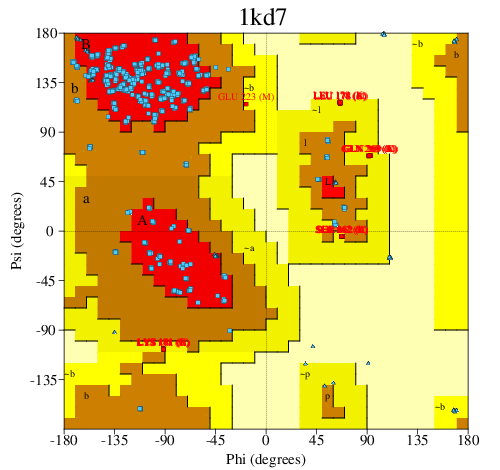
PROCHECK
|
|
|
|
|
|
Headers
|
|
|
|
References
|
|
|
|
|
|

|
|
Q9Y275
(TN13B_HUMAN) -
Tumor necrosis factor ligand superfamily member 13B from Homo sapiens
|
|
|
|
Seq:
Struc:
|
|
|
|
285 a.a.
144 a.a.
|
|

|

|

|
|
|
|
|
|
|
|
|
|
|
Key: |
 |
PfamA domain |
|
|
 |
Secondary structure |
|
 |
CATH domain |
|
|
|
|
|
|
|
|
|
|
|
|
|
|
|
|
|
 |
|
|
|
|
|
|
| |
|
DOI no:
|
J Mol Biol
315:1145-1154
(2002)
|
|
PubMed id:
|
|
|
|
|
|
| |
|
Crystal structure of extracellular human BAFF, a TNF family member that stimulates B lymphocytes.
|
|
M.Karpusas,
T.G.Cachero,
F.Qian,
A.Boriack-Sjodin,
C.Mullen,
K.Strauch,
Y.M.Hsu,
S.L.Kalled.
|
|
|
|
|
| |
ABSTRACT
|
|
|
|
| |
|
|
B cell activating factor (BAFF), a ligand belonging to the tumor necrosis factor
(TNF) family, plays a critical role in regulating survival and activation of
peripheral B cell populations and has been associated with autoimmune disease.
BAFF is known to interact with three receptors, BCMA, TACI and BAFF-R, that have
distant similarities with other receptors of the TNF family. We have determined
the crystal structure of the TNF-homologous domain of BAFF at 2.8 A resolution.
The structure reveals significant differences when compared to other TNF family
members, including an unusually long D-E loop that participates in the formation
of a deep, concave and negatively charged region in the putative receptor
binding site. The BAFF structure was further used to generate a homology model
of APRIL, a closely related TNF family ligand that also binds to BCMA and TACI,
but not BAFF-R. Analysis of the putative receptor binding sites of BAFF and
APRIL suggests that differences in the D-E loop structure and electrostatic
surface potentials may be important for determining binding specificities for
BCMA, TACI and BAFF-R.
|
|
|
|
|
|
| |
Selected figure(s)
|
|
|
|
| |
|
|

|
|

|
|
Figure 1.
Figure 1. Representative region of the final 2F[o] - F[c]
electron density map contoured at 1.0 s.
|
|
Figure 2.
Figure 2. Crystal structure of human BAFF. (a) BAFF trimer
in ribbon representation. Monomers are colored differently and
b-strands and N and C-terminal residues are labeled for the
green-colored monomer. Also shown in the ball-and-stick
representation are the disulfide bridge in red and the
glycosylation site Asn242 in turquoise. (b) Space-filling model
of BAFF viewed along the 3-fold axis from the top of the trimer.
The arrows point to the putative receptor binding sites. The
Figure was made with RIBBONS.[47]
|
|
|
|
|
|
| |
The above figures are
reprinted
by permission from Elsevier:
J Mol Biol
(2002,
315,
1145-1154)
copyright 2002.
|
|
| |
Figures were
selected
by an automated process.
|
|
|
|
|
|
|
|
|
|
|
|
|
|
|
|
 |
 |
 |
|
Literature references that cite this PDB file's key reference
|
|
|
| |
PubMed id
|
|
Reference
|
|
|
|
|
|
Z.Zhou,
X.Li,
J.Li,
C.Su,
L.Zhuang,
S.Luo,
and
L.Zhang
(2010).
Direct B-cell stimulation by peripheral blood monocyte-derived dendritic cells in idiopathic thrombocytopenic purpura patients.
|
| |
J Clin Immunol,
30,
814-822.
|
|
|
|
|
|
|
M.P.Cancro,
D.P.D'Cruz,
and
M.A.Khamashta
(2009).
The role of B lymphocyte stimulator (BLyS) in systemic lupus erythematosus.
|
| |
J Clin Invest,
119,
1066-1073.
|
|
|
|
|
|
|
A.Binard,
L.Le Pottier,
A.Saraux,
V.Devauchelle-Pensec,
J.O.Pers,
and
P.Youinou
(2008).
Does the BAFF dysregulation play a major role in the pathogenesis of systemic lupus erythematosus?
|
| |
J Autoimmun,
30,
63-67.
|
|
|
|
|
|
|
C.Bossen,
T.G.Cachero,
A.Tardivel,
K.Ingold,
L.Willen,
M.Dobles,
M.L.Scott,
A.Maquelin,
E.Belnoue,
C.A.Siegrist,
S.Chevrier,
H.Acha-Orbea,
H.Leung,
F.Mackay,
J.Tschopp,
and
P.Schneider
(2008).
TACI, unlike BAFF-R, is solely activated by oligomeric BAFF and APRIL to support survival of activated B cells and plasmablasts.
|
| |
Blood,
111,
1004-1012.
|
|
|
|
|
|
|
L.Le Pottier,
B.Bendaoud,
M.Dueymes,
C.Daridon,
P.Youinou,
Y.Shoenfeld,
and
J.O.Pers
(2007).
BAFF, a new target for intravenous immunoglobulin in autoimmunity and cancer.
|
| |
J Clin Immunol,
27,
257-265.
|
|
|
|
|
|
|
A.Buschiazzo,
M.Goytia,
F.Schaeffer,
W.Degrave,
W.Shepard,
C.Grégoire,
N.Chamond,
A.Cosson,
A.Berneman,
N.Coatnoan,
P.M.Alzari,
and
P.Minoprio
(2006).
Crystal structure, catalytic mechanism, and mitogenic properties of Trypanosoma cruzi proline racemase.
|
| |
Proc Natl Acad Sci U S A,
103,
1705-1710.
|
|
|
PDB codes:
|
|
|
|
|
|
|
|
D.M.Compaan,
and
S.G.Hymowitz
(2006).
The crystal structure of the costimulatory OX40-OX40L complex.
|
| |
Structure,
14,
1321-1330.
|
|
|
PDB codes:
|
|
|
|
|
|
|
|
Q.Shen,
S.X.Li,
F.H.Fu,
Q.S.Yuan,
and
Y.Gong
(2006).
Two observed regions in B lymphocyte stimulator important for its biological activity.
|
| |
Acta Biochim Biophys Sin (Shanghai),
38,
227-232.
|
|
|
|
|
|
|
S.G.Hymowitz,
D.R.Patel,
H.J.Wallweber,
S.Runyon,
M.Yan,
J.Yin,
S.K.Shriver,
N.C.Gordon,
B.Pan,
N.J.Skelton,
R.F.Kelley,
and
M.A.Starovasnik
(2005).
Structures of APRIL-receptor complexes: like BCMA, TACI employs only a single cysteine-rich domain for high affinity ligand binding.
|
| |
J Biol Chem,
280,
7218-7227.
|
|
|
PDB codes:
|
|
|
|
|
|
|
|
T.Matsushita,
and
S.Sato
(2005).
[The role of BAFF in autoimmune diseases]
|
| |
Nihon Rinsho Meneki Gakkai Kaishi,
28,
333-342.
|
|
|
|
|
|
|
B.P.O'Connor,
V.S.Raman,
L.D.Erickson,
W.J.Cook,
L.K.Weaver,
C.Ahonen,
L.L.Lin,
G.T.Mantchev,
R.J.Bram,
and
R.J.Noelle
(2004).
BCMA is essential for the survival of long-lived bone marrow plasma cells.
|
| |
J Exp Med,
199,
91-98.
|
|
|
|
|
|
|
G.Zhang
(2004).
Tumor necrosis factor family ligand-receptor binding.
|
| |
Curr Opin Struct Biol,
14,
154-160.
|
|
|
|
|
|
|
I.Mecklenbräuker,
S.L.Kalled,
M.Leitges,
F.Mackay,
and
A.Tarakhovsky
(2004).
Regulation of B-cell survival by BAFF-dependent PKCdelta-mediated nuclear signalling.
|
| |
Nature,
431,
456-461.
|
|
|
|
|
|
|
K.Koskela,
P.Nieminen,
P.Kohonen,
H.Salminen,
and
O.Lassila
(2004).
Chicken B-cell-activating factor: regulator of B-cell survival in the bursa of fabricius.
|
| |
Scand J Immunol,
59,
449-457.
|
|
|
|
|
|
|
M.P.Cancro
(2004).
The BLyS family of ligands and receptors: an archetype for niche-specific homeostatic regulation.
|
| |
Immunol Rev,
202,
237-249.
|
|
|
|
|
|
|
R.Lesley,
Y.Xu,
S.L.Kalled,
D.M.Hess,
S.R.Schwab,
H.B.Shu,
and
J.G.Cyster
(2004).
Reduced competitiveness of autoantigen-engaged B cells due to increased dependence on BAFF.
|
| |
Immunity,
20,
441-453.
|
|
|
|
|
|
|
W.Stohl
(2004).
Targeting B lymphocyte stimulator in systemic lupus erythematosus and other autoimmune rheumatic disorders.
|
| |
Expert Opin Ther Targets,
8,
177-189.
|
|
|
|
|
|
|
A.L.Gavin,
D.Aït-Azzouzene,
C.F.Ware,
and
D.Nemazee
(2003).
DeltaBAFF, an alternate splice isoform that regulates receptor binding and biopresentation of the B cell survival cytokine, BAFF.
|
| |
J Biol Chem,
278,
38220-38228.
|
|
|
|
|
|
|
F.Mackay,
and
C.Ambrose
(2003).
The TNF family members BAFF and APRIL: the growing complexity.
|
| |
Cytokine Growth Factor Rev,
14,
311-324.
|
|
|
|
|
|
|
F.Mackay,
P.Schneider,
P.Rennert,
and
J.Browning
(2003).
BAFF AND APRIL: a tutorial on B cell survival.
|
| |
Annu Rev Immunol,
21,
231-264.
|
|
|
|
|
|
|
H.M.Kim,
K.S.Yu,
M.E.Lee,
D.R.Shin,
Y.S.Kim,
S.G.Paik,
O.J.Yoo,
H.Lee,
and
J.O.Lee
(2003).
Crystal structure of the BAFF-BAFF-R complex and its implications for receptor activation.
|
| |
Nat Struct Biol,
10,
342-348.
|
|
|
PDB codes:
|
|
|
|
|
|
|
|
M.Pelletier,
J.S.Thompson,
F.Qian,
S.A.Bixler,
D.Gong,
T.Cachero,
K.Gilbride,
E.Day,
M.Zafari,
C.Benjamin,
L.Gorelik,
A.Whitty,
S.L.Kalled,
C.Ambrose,
and
Y.M.Hsu
(2003).
Comparison of soluble decoy IgG fusion proteins of BAFF-R and BCMA as antagonists for BAFF.
|
| |
J Biol Chem,
278,
33127-33133.
|
|
|
|
|
|
|
S.L.Kalled,
C.Ambrose,
and
Y.M.Hsu
(2003).
BAFF: B cell survival factor and emerging therapeutic target for autoimmune disorders.
|
| |
Expert Opin Ther Targets,
7,
115-123.
|
|
|
|
|
|
|
Y.Liu,
X.Hong,
J.Kappler,
L.Jiang,
R.Zhang,
L.Xu,
C.H.Pan,
W.E.Martin,
R.C.Murphy,
H.B.Shu,
S.Dai,
and
G.Zhang
(2003).
Ligand-receptor binding revealed by the TNF family member TALL-1.
|
| |
Nature,
423,
49-56.
|
|
|
PDB codes:
|
|
|
|
|
|
|
|
F.Mackay,
and
J.L.Browning
(2002).
BAFF: a fundamental survival factor for B cells.
|
| |
Nat Rev Immunol,
2,
465-475.
|
|
|
|
|
|
|
W.Stohl
(2002).
Systemic lupus erythematosus: a blissless disease of too much BLyS (B lymphocyte stimulator) protein.
|
| |
Curr Opin Rheumatol,
14,
522-528.
|
|
|
|
|
|
The most recent references are shown first.
Citation data come partly from CiteXplore and partly
from an automated harvesting procedure. Note that this is likely to be
only a partial list as not all journals are covered by
either method. However, we are continually building up the citation data
so more and more references will be included with time.
Where a reference describes a PDB structure, the PDB
codes are
shown on the right.
|
|


 Links
Links


