
|
|
|
|
|
 |
Contents |
 |
|
|
|
|
|
|
|
|
|
|
|
|
* Residue conservation analysis
|
|
|
|
|
|
PDB id:
|
|
|
|
| Name: |
|
Signaling protein
|
|
|
Title:
|
|
Crystal structure of ras-bry2rbd complex
|
|
Structure:
|
|
Transforming protein p21/h-ras-1. Chain: a. Fragment: gtp-binding/catalytic domain, residues 1-166. Engineered: yes. Protein kinase byr2. Chain: b. Fragment: ras binding domain (rbd), residues 71-180. Engineered: yes
|
|
Source:
|
|
Homo sapiens. Human. Organism_taxid: 9606. Gene: hras or hras1. Expressed in: escherichia coli. Expression_system_taxid: 562. Schizosaccharomyces pombe. Fission yeast. Organism_taxid: 4896.
|
|
Biol. unit:
|
|
 Tetramer (from
)
Tetramer (from
)
|
|
Resolution:
|
|
|
3.00Å
|
R-factor:
|
0.235
|
R-free:
|
0.305
|
|
|
Authors:
|
|
K.Scheffzek,P.Gruenewald,S.Wohlgemuth,W.Kabsch,H.Tu,M.Wigler, A.Wittinghofer,C.Herrmann
|
Key ref:

|
|
K.Scheffzek
et al.
(2001).
The Ras-Byr2RBD complex: structural basis for Ras effector recognition in yeast.
Structure,
9,
1043-1050.
PubMed id:
DOI:

|
|
|
Date:
|
|
|
25-Oct-01
|
Release date:
|
13-Mar-02
|
|
|
|
|
|
|
PROCHECK
|

|
|
|
|
|
Headers
|
|
|
|
References
|
|
|
|
|
|
|
|
|
|
|
|
Enzyme class 2:
|
|
Chain A:
E.C.3.6.5.2
- small monomeric GTPase.
|
|
|
|
|
|
|
Reaction:
|
|
GTP + H2O = GDP + phosphate + H+
|
|
|
|
|
|
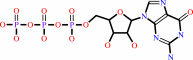 GTP
GTP
|
+
|
H2O
|
=
|
GDP
Bound ligand (Het Group name = )
matches with 81.82% similarity
|
+
|
 phosphate
|
+
|
H(+)
|
|
|
|
|
|
|
|
|
|
Enzyme class 3:
|
|
Chain B:
E.C.2.7.11.25
- mitogen-activated protein kinase kinase kinase.
|
|
|
|
|
|
|
Reaction:
|
|
|
1.
|
L-seryl-[protein] + ATP = O-phospho-L-seryl-[protein] + ADP + H+
|
|
2.
|
L-threonyl-[protein] + ATP = O-phospho-L-threonyl-[protein] + ADP + H+
|
|
|
|
|
|
|
L-seryl-[protein]
|
+
|
 ATP
ATP
|
=
|
O-phospho-L-seryl-[protein]
Bound ligand (Het Group name = )
matches with 78.79% similarity
|
+
|
 ADP
ADP
|
+
|
H(+)
|
|
|
|
|
|
|
L-threonyl-[protein]
|
+
|
ATP
|
=
|
O-phospho-L-threonyl-[protein]
Bound ligand (Het Group name = )
matches with 78.79% similarity
|
+
|
ADP
|
+
|
H(+)
|
|
|
|
|
|
|
|
|
|
|
|
|
Note, where more than one E.C. class is given (as above), each may
correspond to a different protein domain or, in the case of polyprotein
precursors, to a different mature protein.
|
|
|
|
Molecule diagrams generated from .mol files obtained from the
KEGG ftp site
|
|
|
|
|
|
|
|
|
|
|
|
|
|
 |
|
|
|
|
|
|
| |
|
|
| |
|
DOI no:
|
Structure
9:1043-1050
(2001)
|
|
PubMed id:
|
|
|
|
|
|
| |
|
The Ras-Byr2RBD complex: structural basis for Ras effector recognition in yeast.
|
|
K.Scheffzek,
P.Grünewald,
S.Wohlgemuth,
W.Kabsch,
H.Tu,
M.Wigler,
A.Wittinghofer,
C.Herrmann.
|
|
|
|
|
| |
ABSTRACT
|
|
|
|
| |
|
|
BACKGROUND: The small GTP binding protein Ras has important roles in cellular
growth and differentiation. Mutant Ras is permanently active and contributes to
cancer development. In its activated form, Ras interacts with effector proteins,
frequently initiating a kinase cascade. In the lower eukaryotic
Schizosaccharomyces pombe, Byr2 kinase represents a Ras target that in terms of
signal-transduction hierarchy can be considered a homolog of mammalian
Raf-kinase. The activation mechanism of protein kinases by Ras is not
understood, and there is no detailed structural information about Ras binding
domains (RBDs) in nonmammalian organisms. RESULTS: The crystal structure of the
Ras-Byr2RBD complex at 3 A resolution shows a complex architecture similar to
that observed in mammalian homologous systems, with an interprotein beta sheet
stabilized by predominantly polar interactions between the interacting
components. The C-terminal half of the Ras switch I region contains most of the
contact anchors, while on the Byr2 side, a number of residues from topologically
distinct regions are involved in complex stabilization. A C-terminal helical
segment, which is not present in the known mammalian homologous systems and
which is part of the auto-inhibitory region, has an additional binding site
outside the switch I region. CONCLUSIONS: The structure of the Ras-Byr2 complex
confirms the Ras binding module as a communication element mediating
Ras-effector interactions; the Ras-Byr2 complex is also conserved in a lower
eukaryotic system like yeast, which is in contrast to other small GTPase
families. The extra helical segment might be involved in kinase activation.
|
|
|
|
|
|
| |
Selected figure(s)
|
|
|
|
| |
|
|

|
|
Figure 1.
Figure 1. The Ras-Byr2RBD Complex(a) Ribbon representation
showing Byr2RBD on the left and Ras on the right. Switch I is
shown in light blue, switch II is in dark blue, and the
nucleotide is in pink. The presumed helical segment in the
middle of the RBD is indicated as a dashed wavy line.(b)
Structure-based sequence alignment of the RBDs from Raf [13],
PI3-kinase [17], RalGDS [7], and Byr2 (this work), done with the
program STAMP [72]. Assignment of secondary structure elements
according to the program DSSP [73] is included for Byr2RBD;
dashed lines indicate disordered regions. Structurally related
regions are boxed and residues conserved as hydrophobic or polar
amino acids are in yellow and red, respectively. Residues
involved in the interaction with Ras are marked with green dots

|
|
|
|
|
|
| |
The above figure is
reprinted
by permission from Cell Press:
Structure
(2001,
9,
1043-1050)
copyright 2001.
|
|
| |
Figure was
selected
by an automated process.
|
|
|
|
|
|
|
|
|
|
|
|
|
|
|
|
 |
 |
 |
|
Literature references that cite this PDB file's key reference
|
|
|
| |
PubMed id
|
|
Reference
|
|
|
|
|
|
L.Gremer,
T.Merbitz-Zahradnik,
R.Dvorsky,
I.C.Cirstea,
C.P.Kratz,
M.Zenker,
A.Wittinghofer,
and
M.R.Ahmadian
(2011).
Germline KRAS mutations cause aberrant biochemical and physical properties leading to developmental disorders.
|
| |
Hum Mutat,
32,
33-43.
|
|
|
|
|
|
|
M.Hertzog,
and
P.Chavrier
(2011).
Cell polarity during motile processes: keeping on track with the exocyst complex.
|
| |
Biochem J,
433,
403-409.
|
|
|
|
|
|
|
C.Kiel,
D.Filchtinski,
M.Spoerner,
G.Schreiber,
H.R.Kalbitzer,
and
C.Herrmann
(2009).
Improved binding of raf to Ras.GDP is correlated with biological activity.
|
| |
J Biol Chem,
284,
31893-31902.
|
|
|
|
|
|
|
A.Schulte,
B.Stolp,
A.Schönichen,
O.Pylypenko,
A.Rak,
O.T.Fackler,
and
M.Geyer
(2008).
The human formin FHOD1 contains a bipartite structure of FH3 and GTPase-binding domains required for activation.
|
| |
Structure,
16,
1313-1323.
|
|
|
PDB code:
|
|
|
|
|
|
|
|
B.Stieglitz,
C.Bee,
D.Schwarz,
O.Yildiz,
A.Moshnikova,
A.Khokhlatchev,
and
C.Herrmann
(2008).
Novel type of Ras effector interaction established between tumour suppressor NORE1A and Ras switch II.
|
| |
EMBO J,
27,
1995-2005.
|
|
|
PDB code:
|
|
|
|
|
|
|
|
C.Kiel,
D.Aydin,
and
L.Serrano
(2008).
Association rate constants of ras-effector interactions are evolutionarily conserved.
|
| |
PLoS Comput Biol,
4,
e1000245.
|
|
|
|
|
|
|
L.E.Goldfinger
(2008).
Choose your own path: specificity in Ras GTPase signaling.
|
| |
Mol Biosyst,
4,
293-299.
|
|
|
|
|
|
|
S.J.Klosterman,
A.D.Martinez-Espinoza,
D.L.Andrews,
J.R.Seay,
and
S.E.Gold
(2008).
Ubc2, an ortholog of the yeast Ste50p adaptor, possesses a basidiomycete-specific carboxy terminal extension essential for pathogenicity independent of pheromone response.
|
| |
Mol Plant Microbe Interact,
21,
110-121.
|
|
|
|
|
|
|
S.Mondal,
D.Bakthavatsalam,
P.Steimle,
B.Gassen,
F.Rivero,
and
A.A.Noegel
(2008).
Linking Ras to myosin function: RasGEF Q, a Dictyostelium exchange factor for RasB, affects myosin II functions.
|
| |
J Cell Biol,
181,
747-760.
|
|
|
|
|
|
|
C.Kötting,
A.Kallenbach,
Y.Suveyzdis,
C.Eichholz,
and
K.Gerwert
(2007).
Surface change of Ras enabling effector binding monitored in real time at atomic resolution.
|
| |
Chembiochem,
8,
781-787.
|
|
|
|
|
|
|
S.Tomić,
B.Bertosa,
T.Wang,
and
R.C.Wade
(2007).
COMBINE analysis of the specificity of binding of Ras proteins to their effectors.
|
| |
Proteins,
67,
435-447.
|
|
|
|
|
|
|
D.M.Truckses,
J.E.Bloomekatz,
and
J.Thorner
(2006).
The RA domain of Ste50 adaptor protein is required for delivery of Ste11 to the plasma membrane in the filamentous growth signaling pathway of the yeast Saccharomyces cerevisiae.
|
| |
Mol Cell Biol,
26,
912-928.
|
|
|
|
|
|
|
K.Brunner,
W.Gronwald,
J.M.Trenner,
K.P.Neidig,
and
H.R.Kalbitzer
(2006).
A general method for the unbiased improvement of solution NMR structures by the use of related X-ray data, the AUREMOL-ISIC algorithm.
|
| |
BMC Struct Biol,
6,
14.
|
|
|
|
|
|
|
C.Blouin,
D.Butt,
and
A.J.Roger
(2004).
Rapid evolution in conformational space: a study of loop regions in a ubiquitous GTP binding domain.
|
| |
Protein Sci,
13,
608-616.
|
|
|
|
|
|
|
C.Herrmann
(2003).
Ras-effector interactions: after one decade.
|
| |
Curr Opin Struct Biol,
13,
122-129.
|
|
|
|
|
|
|
M.H.Kim,
T.Cierpicki,
U.Derewenda,
D.Krowarsch,
Y.Feng,
Y.Devedjiev,
Z.Dauter,
C.A.Walsh,
J.Otlewski,
J.H.Bushweller,
and
Z.S.Derewenda
(2003).
The DCX-domain tandems of doublecortin and doublecortin-like kinase.
|
| |
Nat Struct Biol,
10,
324-333.
|
|
|
PDB codes:
|
|
|
|
|
|
|
|
S.Fukai,
H.T.Matern,
J.R.Jagath,
R.H.Scheller,
and
A.T.Brunger
(2003).
Structural basis of the interaction between RalA and Sec5, a subunit of the sec6/8 complex.
|
| |
EMBO J,
22,
3267-3278.
|
|
|
PDB code:
|
|
|
|
|
|
|
|
R.Ramachander,
C.A.Kim,
M.L.Phillips,
C.D.Mackereth,
C.D.Thanos,
L.P.McIntosh,
and
J.U.Bowie
(2002).
Oligomerization-dependent association of the SAM domains from Schizosaccharomyces pombe Byr2 and Ste4.
|
| |
J Biol Chem,
277,
39585-39593.
|
|
|
|
|
|
|
W.Gronwald,
F.Huber,
P.Grünewald,
M.Spörner,
S.Wohlgemuth,
C.Herrmann,
and
H.R.Kalbitzer
(2001).
Solution structure of the Ras binding domain of the protein kinase Byr2 from Schizosaccharomyces pombe.
|
| |
Structure,
9,
1029-1041.
|
|
|
PDB code:
|
|
|
|
|
|
|
The most recent references are shown first.
Citation data come partly from CiteXplore and partly
from an automated harvesting procedure. Note that this is likely to be
only a partial list as not all journals are covered by
either method. However, we are continually building up the citation data
so more and more references will be included with time.
Where a reference describes a PDB structure, the PDB
code is
shown on the right.
|
 |


 Links
Links


