 |
PDBsum entry 1k4r

|
|
|
|
|
 |
Contents |
 |
|
|
|
|
|
|
|
|
* Residue conservation analysis
|
|
|
|
|
|
PDB id:
|
|
|
|
| Name: |
|
Virus
|
|
|
Title:
|
|
Structure of dengue virus
|
|
Structure:
|
|
Major envelope protein e. Chain: a, b, c. Fragment: unp residues 284-678
|
|
Source:
|
|
Chimeric tick-borne encephalitis virus/dengue virus 4. Organism_taxid: 638787
|
|
Authors:
|
|
R.J.Kuhn,W.Zhang,M.G.Rossmann,S.V.Pletnev,J.Corver,E.Lenches, C.T.Jones,S.Mukhopadhyay,P.R.Chipman,E.G.Strauss,T.S.Baker, J.H.Strauss
|
Key ref:

|
|
R.J.Kuhn
et al.
(2002).
Structure of dengue virus: implications for flavivirus organization, maturation, and fusion.
Cell,
108,
717-725.
PubMed id:
DOI:

|
|
|
Date:
|
|
|
08-Oct-01
|
Release date:
|
13-Mar-02
|
|
|
|
|
|
|
PROCHECK
|

|
|
|
|
|
Headers
|
|
|
|
References
|
|
|
|
|
|

|
|
C3V005
(C3V005_9FLAV) -
Genome polyprotein from Chimeric Tick-borne encephalitis virus/Dengue virus 4
|
|
|
|
Seq:
Struc:
|
|
|
|
3392 a.a.
395 a.a.*
|
|

|

|

|
|
|
|
|
|
|
|
|
|
|
Key: |
 |
PfamA domain |
|
|
 |
Secondary structure |
|
|
*
PDB and UniProt seqs differ
at 12 residue positions (black
crosses)
|
|
|
|
|
|
|
|
|
|
|
|
|
Enzyme class 1:
|
|
E.C.3.4.21.91
- flavivirin.
|
|
|
|
|
|
|
Reaction:
|
|
Selective hydrolysis of Xaa-Xaa-|-Xbb bonds in which each of the Xaa can be either Arg or Lys and Xbb can be either Ser or Ala.
|
|
|
|
|
|
Enzyme class 2:
|
|
E.C.3.6.1.15
- nucleoside-triphosphate phosphatase.
|
|
|
|
|
|
|
Reaction:
|
|
a ribonucleoside 5'-triphosphate + H2O = a ribonucleoside 5'-diphosphate + phosphate + H+
|
|
|
|
|
|
ribonucleoside 5'-triphosphate
|
+
|
H2O
|
=
|
ribonucleoside 5'-diphosphate
|
+
|
 phosphate
|
+
|
H(+)
|
|
|
|
|
|
|
|
|
|
Enzyme class 3:
|
|
E.C.3.6.4.13
- Rna helicase.
|
|
|
|
|
|
|
Reaction:
|
|
ATP + H2O = ADP + phosphate + H+
|
|
|
|
|
|
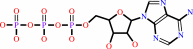 ATP
ATP
|
+
|
H2O
|
=
|
 ADP
ADP
|
+
|
phosphate
|
+
|
H(+)
|
|
|
|
|
|
|
|
|
|
|
|
|
Note, where more than one E.C. class is given (as above), each may
correspond to a different protein domain or, in the case of polyprotein
precursors, to a different mature protein.
|
|
|
|
Molecule diagrams generated from .mol files obtained from the
KEGG ftp site
|
|
|
|
|
|
|
|
|
|
|
|
|
|
 |
|
|
|
|
|
|
| |
|
|
| |
|
DOI no:
|
Cell
108:717-725
(2002)
|
|
PubMed id:
|
|
|
|
|
|
| |
|
Structure of dengue virus: implications for flavivirus organization, maturation, and fusion.
|
|
R.J.Kuhn,
W.Zhang,
M.G.Rossmann,
S.V.Pletnev,
J.Corver,
E.Lenches,
C.T.Jones,
S.Mukhopadhyay,
P.R.Chipman,
E.G.Strauss,
T.S.Baker,
J.H.Strauss.
|
|
|
|
|
| |
ABSTRACT
|
|
|
|
| |
|
|
The first structure of a flavivirus has been determined by using a combination
of cryoelectron microscopy and fitting of the known structure of glycoprotein E
into the electron density map. The virus core, within a lipid bilayer, has a
less-ordered structure than the external, icosahedral scaffold of 90
glycoprotein E dimers. The three E monomers per icosahedral asymmetric unit do
not have quasiequivalent symmetric environments. Difference maps indicate the
location of the small membrane protein M relative to the overlaying scaffold of
E dimers. The structure suggests that flaviviruses, and by analogy also
alphaviruses, employ a fusion mechanism in which the distal beta barrels of
domain II of the glycoprotein E are inserted into the cellular membrane.
|
|
|
|
|
|
| |
Selected figure(s)
|
|
|
|
| |
|
|

|
|

|
|
Figure 1.
Figure 1. The CryoEM Density(A) Surface-shaded
representation of dengue-2 cryoEM reconstruction at 24 Å
resolution, showing the outline of one icosahedral asymmetric
unit and the definition of the coordinate system. Scale bar
represents 100 Å.(B) Central crosssection showing the
cryo-EM density with a plot of the maximum (blue) and averaged
(purple) density. Arrows indicate the position of the 5-fold and
3-fold axes. Shown also are radial density sections at the
defined radii, r1, r2, r3, and r4. Higher density representing
protein is shown in dark shading. Scale bar represents 175
Å.(C) Ribbon drawing of the E dimer situated on an
icosahedral 2-fold axis, showing the largest uninterpreted
electron density peak outside the lipid bilayer, probably
representing the M protein (light blue), located close to the
hole between the E dimers. The white arrow indicates the
position of the dimer holes. The outer leaflet of the lipid
bilayer is shown in green. The domains I, II, and III of an E
monomer are shown in red, yellow, and blue, respectively. The
fusion peptides are in green.(D) Ribbon drawing showing the
position and orientation of the E dimer associated with an
icosahedral 2-fold axis. Shown in white is the outline of one
icosahedral asymmetric unit. The domains of E are colored as in
(C). The portion of the membrane protein M below the dimer is
indicated.
|
|
Figure 2.
Figure 2. CryoEM Density of the Nucleocapsid Shell and the
RNA(A) Stereo diagram of the region corresponding to the yellow
nucleocapsid shell in Figure 1, between 105 and 135 Å
radii.(B) Stereo diagram of density corresponding to the RNA
region of the core (red in Figure 1), inside a radius of 105
Å. Only one hemisphere is shown. Scale bars represent 100
Å.
|
|
|
|
|
|
| |
The above figures are
reprinted
by permission from Cell Press:
Cell
(2002,
108,
717-725)
copyright 2002.
|
|
| |
Figures were
selected
by an automated process.
|
|
|
|
|
|
|
|
|
|
|
|
|
|
|
|
 |
 |
 |
|
Literature references that cite this PDB file's key reference
|
|
|
| |
PubMed id
|
|
Reference
|
|
|
|
|
|
X.Zhang,
P.Ge,
X.Yu,
J.M.Brannan,
G.Bi,
Q.Zhang,
S.Schein,
and
Z.H.Zhou
(2013).
Cryo-EM structure of the mature dengue virus at 3.5-Å resolution.
|
| |
Nat Struct Mol Biol,
20,
105-110.
|
|
|
PDB codes:
|
|
|
|
|
|
|
|
A.L.Rothman
(2011).
Immunity to dengue virus: a tale of original antigenic sin and tropical cytokine storms.
|
| |
Nat Rev Immunol,
11,
532-543.
|
|
|
|
|
|
|
B.R.Murphy,
and
S.S.Whitehead
(2011).
Immune response to dengue virus and prospects for a vaccine.
|
| |
Annu Rev Immunol,
29,
587-619.
|
|
|
|
|
|
|
C.L.Lawson,
M.L.Baker,
C.Best,
C.Bi,
M.Dougherty,
P.Feng,
G.van Ginkel,
B.Devkota,
I.Lagerstedt,
S.J.Ludtke,
R.H.Newman,
T.J.Oldfield,
I.Rees,
G.Sahni,
R.Sala,
S.Velankar,
J.Warren,
J.D.Westbrook,
K.Henrick,
G.J.Kleywegt,
H.M.Berman,
and
W.Chiu
(2011).
EMDataBank.org: unified data resource for CryoEM.
|
| |
Nucleic Acids Res,
39,
D456-D464.
|
|
|
|
|
|
|
I.A.Rodenhuis-Zybert,
J.Wilschut,
and
J.M.Smit
(2011).
Partial maturation: an immune-evasion strategy of dengue virus?
|
| |
Trends Microbiol,
19,
248-254.
|
|
|
|
|
|
|
S.Butrapet,
T.Childers,
K.J.Moss,
S.M.Erb,
B.E.Luy,
A.E.Calvert,
C.D.Blair,
J.T.Roehrig,
and
C.Y.Huang
(2011).
Amino acid changes within the E protein hinge region that affect dengue virus type 2 infectivity and fusion.
|
| |
Virology,
413,
118-127.
|
|
|
|
|
|
|
Y.Q.Deng,
J.X.Dai,
G.H.Ji,
T.Jiang,
H.J.Wang,
H.O.Yang,
W.L.Tan,
R.Liu,
M.Yu,
B.X.Ge,
Q.Y.Zhu,
E.D.Qin,
Y.J.Guo,
and
C.F.Qin
(2011).
A broadly flavivirus cross-neutralizing monoclonal antibody that recognizes a novel epitope within the fusion loop of E protein.
|
| |
PLoS One,
6,
e16059.
|
|
|
|
|
|
|
A.Zheng,
M.Umashankar,
and
M.Kielian
(2010).
In vitro and in vivo studies identify important features of dengue virus pr-E protein interactions.
|
| |
PLoS Pathog,
6,
e1001157.
|
|
|
|
|
|
|
B.Kaufmann,
M.R.Vogt,
J.Goudsmit,
H.A.Holdaway,
A.A.Aksyuk,
P.R.Chipman,
R.J.Kuhn,
M.S.Diamond,
and
M.G.Rossmann
(2010).
Neutralization of West Nile virus by cross-linking of its surface proteins with Fab fragments of the human monoclonal antibody CR4354.
|
| |
Proc Natl Acad Sci U S A,
107,
18950-18955.
|
|
|
PDB codes:
|
|
|
|
|
|
|
|
B.Moesker,
I.A.Rodenhuis-Zybert,
T.Meijerhof,
J.Wilschut,
and
J.M.Smit
(2010).
Characterization of the functional requirements of West Nile virus membrane fusion.
|
| |
J Gen Virol,
91,
389-393.
|
|
|
|
|
|
|
B.Shrestha,
J.D.Brien,
S.Sukupolvi-Petty,
S.K.Austin,
M.A.Edeling,
T.Kim,
K.M.O'Brien,
C.A.Nelson,
S.Johnson,
D.H.Fremont,
and
M.S.Diamond
(2010).
The development of therapeutic antibodies that neutralize homologous and heterologous genotypes of dengue virus type 1.
|
| |
PLoS Pathog,
6,
e1000823.
|
|
|
|
|
|
|
C.L.Lawson
(2010).
Unified data resource for cryo-EM.
|
| |
Methods Enzymol,
483,
73-90.
|
|
|
|
|
|
|
E.Lee,
S.K.Leang,
A.Davidson,
and
M.Lobigs
(2010).
Both E protein glycans adversely affect dengue virus infectivity but are beneficial for virion release.
|
| |
J Virol,
84,
5171-5180.
|
|
|
|
|
|
|
G.Mellado-Sánchez,
J.García-Machorro,
C.Sandoval-Montes,
B.Gutiérrez-Castañeda,
A.Rojo-Domínguez,
J.García-Cordero,
L.Santos-Argumedo,
and
L.Cedillo-Barrón
(2010).
A plasmid encoding parts of the dengue virus E and NS1 proteins induces an immune response in a mouse model.
|
| |
Arch Virol,
155,
847-856.
|
|
|
|
|
|
|
I.A.Rodenhuis-Zybert,
J.Wilschut,
and
J.M.Smit
(2010).
Dengue virus life cycle: viral and host factors modulating infectivity.
|
| |
Cell Mol Life Sci,
67,
2773-2786.
|
|
|
|
|
|
|
J.Junjhon,
T.J.Edwards,
U.Utaipat,
V.D.Bowman,
H.A.Holdaway,
W.Zhang,
P.Keelapang,
C.Puttikhunt,
R.Perera,
P.R.Chipman,
W.Kasinrerk,
P.Malasit,
R.J.Kuhn,
and
N.Sittisombut
(2010).
Influence of pr-M cleavage on the heterogeneity of extracellular dengue virus particles.
|
| |
J Virol,
84,
8353-8358.
|
|
|
|
|
|
|
K.I.Joo,
A.Tai,
C.L.Lee,
C.Wong,
and
P.Wang
(2010).
Imaging multiple intermediates of single-virus membrane fusion mediated by distinct fusion proteins.
|
| |
Microsc Res Tech,
73,
886-900.
|
|
|
|
|
|
|
L.Lazo,
L.Gil,
C.Lopez,
I.Valdes,
E.Marcos,
M.Alvarez,
A.Blanco,
Y.Romero,
V.Falcon,
M.G.Guzmán,
G.Guillén,
and
L.Hermida
(2010).
Nucleocapsid-like particles of dengue-2 virus enhance the immune response against a recombinant protein of dengue-4 virus.
|
| |
Arch Virol,
155,
1587-1595.
|
|
|
|
|
|
|
M.G.Guzman,
L.Hermida,
L.Bernardo,
R.Ramirez,
and
G.Guillén
(2010).
Domain III of the envelope protein as a dengue vaccine target.
|
| |
Expert Rev Vaccines,
9,
137-147.
|
|
|
|
|
|
|
M.Liao,
C.Sánchez-San Martín,
A.Zheng,
and
M.Kielian
(2010).
In vitro reconstitution reveals key intermediate states of trimer formation by the dengue virus membrane fusion protein.
|
| |
J Virol,
84,
5730-5740.
|
|
|
|
|
|
|
R.Zhao,
P.Chinnawirotpisan,
C.Klungthong,
C.Zhang,
and
R.Putnak
(2010).
Evidence for inter- and intra-genotypic variations in dengue serotype 4 viruses representing predominant and non-predominant genotypes co-circulating in Thailand from 1977 to 2001.
|
| |
Virus Genes,
41,
5.
|
|
|
|
|
|
|
S.Sukupolvi-Petty,
S.K.Austin,
M.Engle,
J.D.Brien,
K.A.Dowd,
K.L.Williams,
S.Johnson,
R.Rico-Hesse,
E.Harris,
T.C.Pierson,
D.H.Fremont,
and
M.S.Diamond
(2010).
Structure and function analysis of therapeutic monoclonal antibodies against dengue virus type 2.
|
| |
J Virol,
84,
9227-9239.
|
|
|
|
|
|
|
Y.Ciczora,
N.Callens,
K.Séron,
Y.Rouillé,
and
J.Dubuisson
(2010).
Identification of a dominant endoplasmic reticulum-retention signal in yellow fever virus pre-membrane protein.
|
| |
J Gen Virol,
91,
404-414.
|
|
|
|
|
|
|
A.W.Franz,
I.Sanchez-Vargas,
J.Piper,
M.R.Smith,
C.C.Khoo,
A.A.James,
and
K.E.Olson
(2009).
Stability and loss of a virus resistance phenotype over time in transgenic mosquitoes harbouring an antiviral effector gene.
|
| |
Insect Mol Biol,
18,
661-672.
|
|
|
|
|
|
|
B.J.Geiss,
H.Stahla,
A.M.Hannah,
H.H.Gari,
and
S.M.Keenan
(2009).
Focus on flaviviruses: current and future drug targets.
|
| |
Future Med Chem,
1,
327.
|
|
|
|
|
|
|
B.Kaufmann,
P.R.Chipman,
H.A.Holdaway,
S.Johnson,
D.H.Fremont,
R.J.Kuhn,
M.S.Diamond,
and
M.G.Rossmann
(2009).
Capturing a flavivirus pre-fusion intermediate.
|
| |
PLoS Pathog,
5,
e1000672.
|
|
|
|
|
|
|
B.S.Thompson,
B.Moesker,
J.M.Smit,
J.Wilschut,
M.S.Diamond,
and
D.H.Fremont
(2009).
A therapeutic antibody against west nile virus neutralizes infection by blocking fusion within endosomes.
|
| |
PLoS Pathog,
5,
e1000453.
|
|
|
|
|
|
|
C.G.Patkar,
M.Larsen,
M.Owston,
J.L.Smith,
and
R.J.Kuhn
(2009).
Identification of inhibitors of yellow fever virus replication using a replicon-based high-throughput assay.
|
| |
Antimicrob Agents Chemother,
53,
4103-4114.
|
|
|
|
|
|
|
C.López,
L.Gil,
L.Lazo,
I.Menéndez,
E.Marcos,
J.Sánchez,
I.Valdés,
V.Falcón,
M.C.de la Rosa,
G.Márquez,
G.Guillén,
and
L.Hermida
(2009).
In vitro assembly of nucleocapsid-like particles from purified recombinant capsid protein of dengue-2 virus.
|
| |
Arch Virol,
154,
695-698.
|
|
|
|
|
|
|
C.Puttikhunt,
P.Ong-Ajchaowlerd,
T.Prommool,
S.Sangiambut,
J.Netsawang,
T.Limjindaporn,
P.Malasit,
and
W.Kasinrerk
(2009).
Production and characterization of anti-dengue capsid antibodies suggesting the N terminus region covering the first 20 amino acids of dengue virus capsid protein is predominantly immunogenic in mice.
|
| |
Arch Virol,
154,
1211-1221.
|
|
|
|
|
|
|
D.E.Volk,
F.J.May,
S.H.Gandham,
A.Anderson,
J.J.Von Lindern,
D.W.Beasley,
A.D.Barrett,
and
D.G.Gorenstein
(2009).
Structure of yellow fever virus envelope protein domain III.
|
| |
Virology,
394,
12-18.
|
|
|
PDB code:
|
|
|
|
|
|
|
|
E.G.Acosta,
V.Castilla,
and
E.B.Damonte
(2009).
Alternative infectious entry pathways for dengue virus serotypes into mammalian cells.
|
| |
Cell Microbiol,
11,
1533-1549.
|
|
|
|
|
|
|
G.Añez,
R.Men,
K.H.Eckels,
and
C.J.Lai
(2009).
Passage of dengue virus type 4 vaccine candidates in fetal rhesus lung cells selects heparin-sensitive variants that result in loss of infectivity and immunogenicity in rhesus macaques.
|
| |
J Virol,
83,
10384-10394.
|
|
|
|
|
|
|
I.M.Yu,
H.A.Holdaway,
P.R.Chipman,
R.J.Kuhn,
M.G.Rossmann,
and
J.Chen
(2009).
Association of the pr peptides with dengue virus at acidic pH blocks membrane fusion.
|
| |
J Virol,
83,
12101-12107.
|
|
|
PDB code:
|
|
|
|
|
|
|
|
J.Pan,
L.Dong,
L.Lin,
W.F.Ochoa,
R.S.Sinkovits,
W.M.Havens,
M.L.Nibert,
T.S.Baker,
S.A.Ghabrial,
and
Y.J.Tao
(2009).
Atomic structure reveals the unique capsid organization of a dsRNA virus.
|
| |
Proc Natl Acad Sci U S A,
106,
4225-4230.
|
|
|
PDB codes:
|
|
|
|
|
|
|
|
K.Hacker,
L.White,
and
A.M.de Silva
(2009).
N-Linked glycans on dengue viruses grown in mammalian and insect cells.
|
| |
J Gen Virol,
90,
2097-2106.
|
|
|
|
|
|
|
L.Gil,
C.López,
L.Lazo,
I.Valdés,
E.Marcos,
R.Alonso,
A.Gambe,
J.Martín,
Y.Romero,
M.G.Guzmán,
G.Guillén,
and
L.Hermida
(2009).
Recombinant nucleocapsid-like particles from dengue-2 virus induce protective CD4+ and CD8+ cells against viral encephalitis in mice.
|
| |
Int Immunol,
21,
1175-1183.
|
|
|
|
|
|
|
M.Qing,
F.Yang,
B.Zhang,
G.Zou,
J.M.Robida,
Z.Yuan,
H.Tang,
and
P.Y.Shi
(2009).
Cyclosporine inhibits flavivirus replication through blocking the interaction between host cyclophilins and viral NS5 protein.
|
| |
Antimicrob Agents Chemother,
53,
3226-3235.
|
|
|
|
|
|
|
M.R.Vogt,
B.Moesker,
J.Goudsmit,
M.Jongeneelen,
S.K.Austin,
T.Oliphant,
S.Nelson,
T.C.Pierson,
J.Wilschut,
M.Throsby,
and
M.S.Diamond
(2009).
Human monoclonal antibodies against West Nile virus induced by natural infection neutralize at a postattachment step.
|
| |
J Virol,
83,
6494-6507.
|
|
|
|
|
|
|
M.S.Diamond
(2009).
Progress on the development of therapeutics against West Nile virus.
|
| |
Antiviral Res,
83,
214-227.
|
|
|
|
|
|
|
M.V.Cherrier,
B.Kaufmann,
G.E.Nybakken,
S.M.Lok,
J.T.Warren,
B.R.Chen,
C.A.Nelson,
V.A.Kostyuchenko,
H.A.Holdaway,
P.R.Chipman,
R.J.Kuhn,
M.S.Diamond,
M.G.Rossmann,
and
D.H.Fremont
(2009).
Structural basis for the preferential recognition of immature flaviviruses by a fusion-loop antibody.
|
| |
EMBO J,
28,
3269-3276.
|
|
|
PDB codes:
|
|
|
|
|
|
|
|
P.G.Wang,
M.Kudelko,
J.Lo,
L.Y.Siu,
K.T.Kwok,
M.Sachse,
J.M.Nicholls,
R.Bruzzone,
R.M.Altmeyer,
and
B.Nal
(2009).
Efficient assembly and secretion of recombinant subviral particles of the four dengue serotypes using native prM and E proteins.
|
| |
PLoS One,
4,
e8325.
|
|
|
|
|
|
|
P.Schlick,
C.Taucher,
B.Schittl,
J.L.Tran,
R.M.Kofler,
W.Schueler,
A.von Gabain,
A.Meinke,
and
C.W.Mandl
(2009).
Helices alpha2 and alpha3 of West Nile virus capsid protein are dispensable for assembly of infectious virions.
|
| |
J Virol,
83,
5581-5591.
|
|
|
|
|
|
|
R.S.Russell,
K.Kawaguchi,
J.C.Meunier,
S.Takikawa,
K.Faulk,
J.Bukh,
R.H.Purcell,
and
S.U.Emerson
(2009).
Mutational analysis of the hepatitis C virus E1 glycoprotein in retroviral pseudoparticles and cell-culture-derived H77/JFH1 chimeric infectious virus particles.
|
| |
J Viral Hepat,
16,
621-632.
|
|
|
|
|
|
|
R.Suzuki,
E.R.Winkelmann,
and
P.W.Mason
(2009).
Construction and characterization of a single-cycle chimeric flavivirus vaccine candidate that protects mice against lethal challenge with dengue virus type 2.
|
| |
J Virol,
83,
1870-1880.
|
|
|
|
|
|
|
S.B.Rochal,
and
V.L.Lorman
(2009).
Theory of a reconstructive structural transformation in capsids of icosahedral viruses.
|
| |
Phys Rev E Stat Nonlin Soft Matter Phys,
80,
051905.
|
|
|
|
|
|
|
S.Duquerroy,
B.Da Costa,
C.Henry,
A.Vigouroux,
S.Libersou,
J.Lepault,
J.Navaza,
B.Delmas,
and
F.A.Rey
(2009).
The picobirnavirus crystal structure provides functional insights into virion assembly and cell entry.
|
| |
EMBO J,
28,
1655-1665.
|
|
|
PDB code:
|
|
|
|
|
|
|
|
S.Kiermayr,
K.Stiasny,
and
F.X.Heinz
(2009).
Impact of quaternary organization on the antigenic structure of the tick-borne encephalitis virus envelope glycoprotein E.
|
| |
J Virol,
83,
8482-8491.
|
|
|
|
|
|
|
S.Nelson,
S.Poddar,
T.Y.Lin,
and
T.C.Pierson
(2009).
Protonation of individual histidine residues is not required for the pH-dependent entry of west nile virus: evaluation of the "histidine switch" hypothesis.
|
| |
J Virol,
83,
12631-12635.
|
|
|
|
|
|
|
T.Peng,
J.L.Wang,
W.Chen,
J.L.Zhang,
N.Gao,
Z.T.Chen,
X.F.Xu,
D.Y.Fan,
and
J.An
(2009).
Entry of dengue virus serotype 2 into ECV304 cells depends on clathrin-dependent endocytosis, but not on caveolae-dependent endocytosis.
|
| |
Can J Microbiol,
55,
139-145.
|
|
|
|
|
|
|
V.Nayak,
M.Dessau,
K.Kucera,
K.Anthony,
M.Ledizet,
and
Y.Modis
(2009).
Crystal structure of dengue virus type 1 envelope protein in the postfusion conformation and its implications for membrane fusion.
|
| |
J Virol,
83,
4338-4344.
|
|
|
PDB code:
|
|
|
|
|
|
|
|
W.D.Crill,
H.R.Hughes,
M.J.Delorey,
and
G.J.Chang
(2009).
Humoral immune responses of dengue fever patients using epitope-specific serotype-2 virus-like particle antigens.
|
| |
PLoS ONE,
4,
e4991.
|
|
|
|
|
|
|
A.P.Goncalvez,
C.H.Chien,
K.Tubthong,
I.Gorshkova,
C.Roll,
O.Donau,
P.Schuck,
S.Yoksan,
S.D.Wang,
R.H.Purcell,
and
C.J.Lai
(2008).
Humanized monoclonal antibodies derived from chimpanzee Fabs protect against Japanese encephalitis virus in vitro and in vivo.
|
| |
J Virol,
82,
7009-7021.
|
|
|
|
|
|
|
A.Wilder-Smith,
and
J.L.Deen
(2008).
Dengue vaccines for travelers.
|
| |
Expert Rev Vaccines,
7,
569-578.
|
|
|
|
|
|
|
C.G.Patkar,
and
R.J.Kuhn
(2008).
Yellow Fever virus NS3 plays an essential role in virus assembly independent of its known enzymatic functions.
|
| |
J Virol,
82,
3342-3352.
|
|
|
|
|
|
|
C.L.Murray,
C.T.Jones,
and
C.M.Rice
(2008).
Architects of assembly: roles of Flaviviridae non-structural proteins in virion morphogenesis.
|
| |
Nat Rev Microbiol,
6,
699-708.
|
|
|
|
|
|
|
C.L.Murray,
J.Marcotrigiano,
and
C.M.Rice
(2008).
Bovine viral diarrhea virus core is an intrinsically disordered protein that binds RNA.
|
| |
J Virol,
82,
1294-1304.
|
|
|
|
|
|
|
E.Lee,
and
M.Lobigs
(2008).
E protein domain III determinants of yellow fever virus 17D vaccine strain enhance binding to glycosaminoglycans, impede virus spread, and attenuate virulence.
|
| |
J Virol,
82,
6024-6033.
|
|
|
|
|
|
|
G.B.Hu,
H.Wei,
W.J.Rice,
D.L.Stokes,
and
P.Gottlieb
(2008).
Electron cryo-tomographic structure of cystovirus phi 12.
|
| |
Virology,
372,
1-9.
|
|
|
|
|
|
|
G.D.Gromowski,
N.D.Barrett,
and
A.D.Barrett
(2008).
Characterization of dengue virus complex-specific neutralizing epitopes on envelope protein domain III of dengue 2 virus.
|
| |
J Virol,
82,
8828-8837.
|
|
|
|
|
|
|
H.M.van der Schaar,
M.J.Rust,
C.Chen,
H.van der Ende-Metselaar,
J.Wilschut,
X.Zhuang,
and
J.M.Smit
(2008).
Dissecting the cell entry pathway of dengue virus by single-particle tracking in living cells.
|
| |
PLoS Pathog,
4,
e1000244.
|
|
|
|
|
|
|
I.A.Zybert,
H.van der Ende-Metselaar,
J.Wilschut,
and
J.M.Smit
(2008).
Functional importance of dengue virus maturation: infectious properties of immature virions.
|
| |
J Gen Virol,
89,
3047-3051.
|
|
|
|
|
|
|
I.M.Yu,
W.Zhang,
H.A.Holdaway,
L.Li,
V.A.Kostyuchenko,
P.R.Chipman,
R.J.Kuhn,
M.G.Rossmann,
and
J.Chen
(2008).
Structure of the immature dengue virus at low pH primes proteolytic maturation.
|
| |
Science,
319,
1834-1837.
|
|
|
PDB code:
|
|
|
|
|
|
|
|
J.Junjhon,
M.Lausumpao,
S.Supasa,
S.Noisakran,
A.Songjaeng,
P.Saraithong,
K.Chaichoun,
U.Utaipat,
P.Keelapang,
A.Kanjanahaluethai,
C.Puttikhunt,
W.Kasinrerk,
P.Malasit,
and
N.Sittisombut
(2008).
Differential modulation of prM cleavage, extracellular particle distribution, and virus infectivity by conserved residues at nonfurin consensus positions of the dengue virus pr-M junction.
|
| |
J Virol,
82,
10776-10791.
|
|
|
|
|
|
|
J.T.Roehrig,
J.Hombach,
and
A.D.Barrett
(2008).
Guidelines for Plaque-Reduction Neutralization Testing of Human Antibodies to Dengue Viruses.
|
| |
Viral Immunol,
21,
123-132.
|
|
|
|
|
|
|
K.Werme,
M.Wigerius,
and
M.Johansson
(2008).
Tick-borne encephalitis virus NS5 associates with membrane protein scribble and impairs interferon-stimulated JAK-STAT signalling.
|
| |
Cell Microbiol,
10,
696-712.
|
|
|
|
|
|
|
L.Li,
S.M.Lok,
I.M.Yu,
Y.Zhang,
R.J.Kuhn,
J.Chen,
and
M.G.Rossmann
(2008).
The flavivirus precursor membrane-envelope protein complex: structure and maturation.
|
| |
Science,
319,
1830-1834.
|
|
|
PDB codes:
|
|
|
|
|
|
|
|
M.R.Hamed,
A.W.Tarr,
C.P.McClure,
J.K.Ball,
T.P.Hickling,
and
W.L.Irving
(2008).
Association of antibodies to hepatitis C virus glycoproteins 1 and 2 (anti-E1E2) with HCV disease.
|
| |
J Viral Hepat,
15,
339-345.
|
|
|
|
|
|
|
R.Fritz,
K.Stiasny,
and
F.X.Heinz
(2008).
Identification of specific histidines as pH sensors in flavivirus membrane fusion.
|
| |
J Cell Biol,
183,
353-361.
|
|
|
|
|
|
|
R.Perera,
M.Khaliq,
and
R.J.Kuhn
(2008).
Closing the door on flaviviruses: entry as a target for antiviral drug design.
|
| |
Antiviral Res,
80,
11-22.
|
|
|
|
|
|
|
R.Perera,
and
R.J.Kuhn
(2008).
Structural proteomics of dengue virus.
|
| |
Curr Opin Microbiol,
11,
369-377.
|
|
|
|
|
|
|
R.Qi,
L.Zhang,
and
C.W.Chi
(2008).
Biological characteristics of dengue virus and potential targets for drug design.
|
| |
Acta Biochim Biophys Sin (Shanghai),
40,
91.
|
|
|
|
|
|
|
S.I.Lee,
and
T.T.Nguyen
(2008).
Radial distribution of RNA genomes packaged inside spherical viruses.
|
| |
Phys Rev Lett,
100,
198102.
|
|
|
|
|
|
|
S.J.Seligman
(2008).
Constancy and diversity in the flavivirus fusion peptide.
|
| |
Virol J,
5,
27.
|
|
|
|
|
|
|
S.M.Lok,
V.Kostyuchenko,
G.E.Nybakken,
H.A.Holdaway,
A.J.Battisti,
S.Sukupolvi-Petty,
D.Sedlak,
D.H.Fremont,
P.R.Chipman,
J.T.Roehrig,
M.S.Diamond,
R.J.Kuhn,
and
M.G.Rossmann
(2008).
Binding of a neutralizing antibody to dengue virus alters the arrangement of surface glycoproteins.
|
| |
Nat Struct Mol Biol,
15,
312-317.
|
|
|
PDB codes:
|
|
|
|
|
|
|
|
S.Nelson,
C.A.Jost,
Q.Xu,
J.Ess,
J.E.Martin,
T.Oliphant,
S.S.Whitehead,
A.P.Durbin,
B.S.Graham,
M.S.Diamond,
and
T.C.Pierson
(2008).
Maturation of West Nile virus modulates sensitivity to antibody-mediated neutralization.
|
| |
PLoS Pathog,
4,
e1000060.
|
|
|
|
|
|
|
S.Schrauf,
P.Schlick,
T.Skern,
and
C.W.Mandl
(2008).
Functional analysis of potential carboxy-terminal cleavage sites of tick-borne encephalitis virus capsid protein.
|
| |
J Virol,
82,
2218-2229.
|
|
|
|
|
|
|
T.C.Pierson,
D.H.Fremont,
R.J.Kuhn,
and
M.S.Diamond
(2008).
Structural insights into the mechanisms of antibody-mediated neutralization of flavivirus infection: implications for vaccine development.
|
| |
Cell Host Microbe,
4,
229-238.
|
|
|
|
|
|
|
T.C.Pierson,
and
M.S.Diamond
(2008).
Molecular mechanisms of antibody-mediated neutralisation of flavivirus infection.
|
| |
Expert Rev Mol Med,
10,
e12.
|
|
|
|
|
|
|
W.Fischl,
S.Elshuber,
S.Schrauf,
and
C.W.Mandl
(2008).
Changing the protease specificity for activation of a flavivirus, tick-borne encephalitis virus.
|
| |
J Virol,
82,
8272-8282.
|
|
|
|
|
|
|
W.S.Chang,
H.Shang,
R.M.Perera,
S.M.Lok,
D.Sedlak,
R.J.Kuhn,
and
G.U.Lee
(2008).
Rapid detection of dengue virus in serum using magnetic separation and fluorescence detection.
|
| |
Analyst,
133,
233-240.
|
|
|
|
|
|
|
Y.W.Xie,
P.K.Chan,
C.K.Szeto,
S.Y.Kwok,
I.M.Chu,
S.S.Chu,
J.L.Cheung,
S.W.Wong,
M.B.Ali,
and
B.L.Wong
(2008).
Clearance of dengue virus in the plasma-derived therapeutic proteins.
|
| |
Transfusion,
48,
1342-1347.
|
|
|
|
|
|
|
Z.Zhou,
M.Khaliq,
J.E.Suk,
C.Patkar,
L.Li,
R.J.Kuhn,
and
C.B.Post
(2008).
Antiviral compounds discovered by virtual screening of small-molecule libraries against dengue virus E protein.
|
| |
ACS Chem Biol,
3,
765-775.
|
|
|
|
|
|
|
A.V.Shustov,
P.W.Mason,
and
I.Frolov
(2007).
Production of pseudoinfectious yellow fever virus with a two-component genome.
|
| |
J Virol,
81,
11737-11748.
|
|
|
|
|
|
|
C.G.Patkar,
C.T.Jones,
Y.H.Chang,
R.Warrier,
and
R.J.Kuhn
(2007).
Functional requirements of the yellow fever virus capsid protein.
|
| |
J Virol,
81,
6471-6481.
|
|
|
|
|
|
|
D.E.Volk,
Y.C.Lee,
X.Li,
V.Thiviyanathan,
G.D.Gromowski,
L.Li,
A.R.Lamb,
D.W.Beasley,
A.D.Barrett,
and
D.G.Gorenstein
(2007).
Solution structure of the envelope protein domain III of dengue-4 virus.
|
| |
Virology,
364,
147-154.
|
|
|
PDB code:
|
|
|
|
|
|
|
|
D.Ludolfs,
M.Niedrig,
J.T.Paweska,
and
H.Schmitz
(2007).
Reverse ELISA for the detection of anti West Nile virus IgG antibodies in humans.
|
| |
Eur J Clin Microbiol Infect Dis,
26,
467-473.
|
|
|
|
|
|
|
D.Moradpour,
F.Penin,
and
C.M.Rice
(2007).
Replication of hepatitis C virus.
|
| |
Nat Rev Microbiol,
5,
453-463.
|
|
|
|
|
|
|
E.Falkowska,
F.Kajumo,
E.Garcia,
J.Reinus,
and
T.Dragic
(2007).
Hepatitis C virus envelope glycoprotein E2 glycans modulate entry, CD81 binding, and neutralization.
|
| |
J Virol,
81,
8072-8079.
|
|
|
|
|
|
|
E.Teissier,
and
E.I.Pécheur
(2007).
Lipids as modulators of membrane fusion mediated by viral fusion proteins.
|
| |
Eur Biophys J,
36,
887-899.
|
|
|
|
|
|
|
F.Bai,
T.Town,
D.Pradhan,
J.Cox,
Ashish,
M.Ledizet,
J.F.Anderson,
R.A.Flavell,
J.K.Krueger,
R.A.Koski,
and
E.Fikrig
(2007).
Antiviral peptides targeting the west nile virus envelope protein.
|
| |
J Virol,
81,
2047-2055.
|
|
|
|
|
|
|
G.M.Taylor,
P.I.Hanson,
and
M.Kielian
(2007).
Ubiquitin depletion and dominant-negative VPS4 inhibit rhabdovirus budding without affecting alphavirus budding.
|
| |
J Virol,
81,
13631-13639.
|
|
|
|
|
|
|
H.M.van der Schaar,
M.J.Rust,
B.L.Waarts,
H.van der Ende-Metselaar,
R.J.Kuhn,
J.Wilschut,
X.Zhuang,
and
J.M.Smit
(2007).
Characterization of the early events in dengue virus cell entry by biochemical assays and single-virus tracking.
|
| |
J Virol,
81,
12019-12028.
|
|
|
|
|
|
|
J.F.Conway,
N.Cheng,
P.D.Ross,
R.W.Hendrix,
R.L.Duda,
and
A.C.Steven
(2007).
A thermally induced phase transition in a viral capsid transforms the hexamers, leaving the pentamers unchanged.
|
| |
J Struct Biol,
158,
224-232.
|
|
|
|
|
|
|
J.Fink,
F.Gu,
L.Ling,
T.Tolfvenstam,
F.Olfat,
K.C.Chin,
P.Aw,
J.George,
V.A.Kuznetsov,
M.Schreiber,
S.G.Vasudevan,
and
M.L.Hibberd
(2007).
Host gene expression profiling of dengue virus infection in cell lines and patients.
|
| |
PLoS Negl Trop Dis,
1,
e86.
|
|
|
|
|
|
|
K.Stiasny,
C.Kössl,
J.Lepault,
F.A.Rey,
and
F.X.Heinz
(2007).
Characterization of a structural intermediate of flavivirus membrane fusion.
|
| |
PLoS Pathog,
3,
e20.
|
|
|
|
|
|
|
K.Stiasny,
S.Brandler,
C.Kössl,
and
F.X.Heinz
(2007).
Probing the flavivirus membrane fusion mechanism by using monoclonal antibodies.
|
| |
J Virol,
81,
11526-11531.
|
|
|
|
|
|
|
M.D.Hapugoda,
G.Batra,
W.Abeyewickreme,
S.Swaminathan,
and
N.Khanna
(2007).
Single antigen detects both immunoglobulin M (IgM) and IgG antibodies elicited by all four dengue virus serotypes.
|
| |
Clin Vaccine Immunol,
14,
1505-1514.
|
|
|
|
|
|
|
M.Throsby,
J.Ter Meulen,
C.Geuijen,
J.Goudsmit,
and
J.de Kruif
(2007).
Mapping and analysis of West Nile virus-specific monoclonal antibodies: prospects for vaccine development.
|
| |
Expert Rev Vaccines,
6,
183-191.
|
|
|
|
|
|
|
S.Chen,
M.Yu,
T.Jiang,
Y.Deng,
C.Qin,
and
E.Qin
(2007).
Induction of tetravalent protective immunity against four dengue serotypes by the tandem domain III of the envelope protein.
|
| |
DNA Cell Biol,
26,
361-367.
|
|
|
|
|
|
|
S.S.Whitehead,
J.E.Blaney,
A.P.Durbin,
and
B.R.Murphy
(2007).
Prospects for a dengue virus vaccine.
|
| |
Nat Rev Microbiol,
5,
518-528.
|
|
|
|
|
|
|
S.Sukupolvi-Petty,
S.K.Austin,
W.E.Purtha,
T.Oliphant,
G.E.Nybakken,
J.J.Schlesinger,
J.T.Roehrig,
G.D.Gromowski,
A.D.Barrett,
D.H.Fremont,
and
M.S.Diamond
(2007).
Type- and subcomplex-specific neutralizing antibodies against domain III of dengue virus type 2 envelope protein recognize adjacent epitopes.
|
| |
J Virol,
81,
12816-12826.
|
|
|
|
|
|
|
T.C.Pierson,
Q.Xu,
S.Nelson,
T.Oliphant,
G.E.Nybakken,
D.H.Fremont,
and
M.S.Diamond
(2007).
The stoichiometry of antibody-mediated neutralization and enhancement of West Nile virus infection.
|
| |
Cell Host Microbe,
1,
135-145.
|
|
|
|
|
|
|
T.L.Tellinghuisen,
M.J.Evans,
T.von Hahn,
S.You,
and
C.M.Rice
(2007).
Studying hepatitis C virus: making the best of a bad virus.
|
| |
J Virol,
81,
8853-8867.
|
|
|
|
|
|
|
T.Oliphant,
G.E.Nybakken,
S.K.Austin,
Q.Xu,
J.Bramson,
M.Loeb,
M.Throsby,
D.H.Fremont,
T.C.Pierson,
and
M.S.Diamond
(2007).
Induction of epitope-specific neutralizing antibodies against West Nile virus.
|
| |
J Virol,
81,
11828-11839.
|
|
|
|
|
|
|
T.Oliphant,
and
M.S.Diamond
(2007).
The molecular basis of antibody-mediated neutralization of West Nile virus.
|
| |
Expert Opin Biol Ther,
7,
885-892.
|
|
|
|
|
|
|
V.L.Lorman,
and
S.B.Rochal
(2007).
Density-wave theory of the capsid structure of small icosahedral viruses.
|
| |
Phys Rev Lett,
98,
185502.
|
|
|
|
|
|
|
Y.Zhang,
V.A.Kostyuchenko,
and
M.G.Rossmann
(2007).
Structural analysis of viral nucleocapsids by subtraction of partial projections.
|
| |
J Struct Biol,
157,
356-364.
|
|
|
|
|
|
|
B.Kaufmann,
G.E.Nybakken,
P.R.Chipman,
W.Zhang,
M.S.Diamond,
D.H.Fremont,
R.J.Kuhn,
and
M.G.Rossmann
(2006).
West Nile virus in complex with the Fab fragment of a neutralizing monoclonal antibody.
|
| |
Proc Natl Acad Sci U S A,
103,
12400-12404.
|
|
|
|
|
|
|
C.A.Fitch,
S.T.Whitten,
V.J.Hilser,
and
B.García-Moreno E
(2006).
Molecular mechanisms of pH-driven conformational transitions of proteins: insights from continuum electrostatics calculations of acid unfolding.
|
| |
Proteins,
63,
113-126.
|
|
|
|
|
|
|
C.W.Davis,
L.M.Mattei,
H.Y.Nguyen,
C.Ansarah-Sobrinho,
R.W.Doms,
and
T.C.Pierson
(2006).
The location of asparagine-linked glycans on West Nile virions controls their interactions with CD209 (dendritic cell-specific ICAM-3 grabbing nonintegrin).
|
| |
J Biol Chem,
281,
37183-37194.
|
|
|
|
|
|
|
D.M.Tscherne,
C.T.Jones,
M.J.Evans,
B.D.Lindenbach,
J.A.McKeating,
and
C.M.Rice
(2006).
Time- and temperature-dependent activation of hepatitis C virus for low-pH-triggered entry.
|
| |
J Virol,
80,
1734-1741.
|
|
|
|
|
|
|
E.Pokidysheva,
Y.Zhang,
A.J.Battisti,
C.M.Bator-Kelly,
P.R.Chipman,
C.Xiao,
G.G.Gregorio,
W.A.Hendrickson,
R.J.Kuhn,
and
M.G.Rossmann
(2006).
Cryo-EM reconstruction of dengue virus in complex with the carbohydrate recognition domain of DC-SIGN.
|
| |
Cell,
124,
485-493.
|
|
|
PDB code:
|
|
|
|
|
|
|
|
F.Puig-Basagoiti,
M.Tilgner,
B.M.Forshey,
S.M.Philpott,
N.G.Espina,
D.E.Wentworth,
S.J.Goebel,
P.S.Masters,
B.Falgout,
P.Ren,
D.M.Ferguson,
and
P.Y.Shi
(2006).
Triaryl pyrazoline compound inhibits flavivirus RNA replication.
|
| |
Antimicrob Agents Chemother,
50,
1320-1329.
|
|
|
|
|
|
|
G.E.Nybakken,
C.A.Nelson,
B.R.Chen,
M.S.Diamond,
and
D.H.Fremont
(2006).
Crystal structure of the West Nile virus envelope glycoprotein.
|
| |
J Virol,
80,
11467-11474.
|
|
|
PDB code:
|
|
|
|
|
|
|
|
H.M.Berman,
S.K.Burley,
W.Chiu,
A.Sali,
A.Adzhubei,
P.E.Bourne,
S.H.Bryant,
R.L.Dunbrack,
K.Fidelis,
J.Frank,
A.Godzik,
K.Henrick,
A.Joachimiak,
B.Heymann,
D.Jones,
J.L.Markley,
J.Moult,
G.T.Montelione,
C.Orengo,
M.G.Rossmann,
B.Rost,
H.Saibil,
T.Schwede,
D.M.Standley,
and
J.D.Westbrook
(2006).
Outcome of a workshop on archiving structural models of biological macromolecules.
|
| |
Structure,
14,
1211-1217.
|
|
|
|
|
|
|
I.M.Yu,
M.L.Oldham,
J.Zhang,
and
J.Chen
(2006).
Crystal structure of the severe acute respiratory syndrome (SARS) coronavirus nucleocapsid protein dimerization domain reveals evolutionary linkage between corona- and arteriviridae.
|
| |
J Biol Chem,
281,
17134-17139.
|
|
|
PDB code:
|
|
|
|
|
|
|
|
J.E.Blaney,
A.P.Durbin,
B.R.Murphy,
and
S.S.Whitehead
(2006).
Development of a live attenuated dengue virus vaccine using reverse genetics.
|
| |
Viral Immunol,
19,
10-32.
|
|
|
|
|
|
|
K.K.Orlinger,
V.M.Hoenninger,
R.M.Kofler,
and
C.W.Mandl
(2006).
Construction and mutagenesis of an artificial bicistronic tick-borne encephalitis virus genome reveals an essential function of the second transmembrane region of protein e in flavivirus assembly.
|
| |
J Virol,
80,
12197-12208.
|
|
|
|
|
|
|
K.Stiasny,
S.Kiermayr,
H.Holzmann,
and
F.X.Heinz
(2006).
Cryptic properties of a cluster of dominant flavivirus cross-reactive antigenic sites.
|
| |
J Virol,
80,
9557-9568.
|
|
|
|
|
|
|
M.Kielian,
and
F.A.Rey
(2006).
Virus membrane-fusion proteins: more than one way to make a hairpin.
|
| |
Nat Rev Microbiol,
4,
67-76.
|
|
|
|
|
|
|
M.Kobayashi,
M.C.Bennett,
T.Bercot,
and
I.R.Singh
(2006).
Functional analysis of hepatitis C virus envelope proteins, using a cell-cell fusion assay.
|
| |
J Virol,
80,
1817-1825.
|
|
|
|
|
|
|
S.Mukhopadhyay,
W.Zhang,
S.Gabler,
P.R.Chipman,
E.G.Strauss,
J.H.Strauss,
T.S.Baker,
R.J.Kuhn,
and
M.G.Rossmann
(2006).
Mapping the structure and function of the E1 and E2 glycoproteins in alphaviruses.
|
| |
Structure,
14,
63-73.
|
|
|
PDB code:
|
|
|
|
|
|
|
|
T.Oliphant,
G.E.Nybakken,
M.Engle,
Q.Xu,
C.A.Nelson,
S.Sukupolvi-Petty,
A.Marri,
B.E.Lachmi,
U.Olshevsky,
D.H.Fremont,
T.C.Pierson,
and
M.S.Diamond
(2006).
Antibody recognition and neutralization determinants on domains I and II of West Nile Virus envelope protein.
|
| |
J Virol,
80,
12149-12159.
|
|
|
|
|
|
|
A.Premkumar,
C.R.Horan,
and
P.W.Gage
(2005).
Dengue virus M protein C-terminal peptide (DVM-C) forms ion channels.
|
| |
J Membr Biol,
204,
33-38.
|
|
|
|
|
|
|
A.Y.Limon-Flores,
M.Perez-Tapia,
I.Estrada-Garcia,
G.Vaughan,
A.Escobar-Gutierrez,
J.Calderon-Amador,
S.E.Herrera-Rodriguez,
A.Brizuela-Garcia,
M.Heras-Chavarria,
A.Flores-Langarica,
L.Cedillo-Barron,
and
L.Flores-Romo
(2005).
Dengue virus inoculation to human skin explants: an effective approach to assess in situ the early infection and the effects on cutaneous dendritic cells.
|
| |
Int J Exp Pathol,
86,
323-334.
|
|
|
|
|
|
|
B.Malewicz,
J.T.Valiyaveettil,
K.Jacob,
H.S.Byun,
P.Mattjus,
W.J.Baumann,
R.Bittman,
and
R.E.Brown
(2005).
The 3-hydroxy group and 4,5-trans double bond of sphingomyelin are essential for modulation of galactosylceramide transmembrane asymmetry.
|
| |
Biophys J,
88,
2670-2680.
|
|
|
|
|
|
|
C.Fermin,
and
R.Garry
(2005).
Alterations of lymphocyte membranes during HIV-1 infection via multiple and simultaneous entry strategies.
|
| |
Microsc Res Tech,
68,
149-167.
|
|
|
|
|
|
|
D.Quinkert,
R.Bartenschlager,
and
V.Lohmann
(2005).
Quantitative analysis of the hepatitis C virus replication complex.
|
| |
J Virol,
79,
13594-13605.
|
|
|
|
|
|
|
F.Puig-Basagoiti,
T.S.Deas,
P.Ren,
M.Tilgner,
D.M.Ferguson,
and
P.Y.Shi
(2005).
High-throughput assays using a luciferase-expressing replicon, virus-like particles, and full-length virus for West Nile virus drug discovery.
|
| |
Antimicrob Agents Chemother,
49,
4980-4988.
|
|
|
|
|
|
|
G.E.Nybakken,
T.Oliphant,
S.Johnson,
S.Burke,
M.S.Diamond,
and
D.H.Fremont
(2005).
Structural basis of West Nile virus neutralization by a therapeutic antibody.
|
| |
Nature,
437,
764-769.
|
|
|
PDB code:
|
|
|
|
|
|
|
|
J.García-Cordero,
H.R.Ramirez,
M.Vazquez-Ochoa,
B.Gutierrez-Castañeda,
L.Santos-Argumedo,
N.Villegas-Sepúlveda,
and
L.Cedillo-Barrón
(2005).
Production and characterization of a monoclonal antibody specific for NS3 protease and the ATPase region of Dengue-2 virus.
|
| |
Hybridoma (Larchmt),
24,
160-164.
|
|
|
|
|
|
|
J.M.Berke,
and
D.Moradpour
(2005).
Hepatitis C virus comes full circle: production of recombinant infectious virus in tissue culture.
|
| |
Hepatology,
42,
1264-1269.
|
|
|
|
|
|
|
M.G.Rossmann,
M.C.Morais,
P.G.Leiman,
and
W.Zhang
(2005).
Combining X-ray crystallography and electron microscopy.
|
| |
Structure,
13,
355-362.
|
|
|
|
|
|
|
M.Liao,
and
M.Kielian
(2005).
Domain III from class II fusion proteins functions as a dominant-negative inhibitor of virus membrane fusion.
|
| |
J Cell Biol,
171,
111-120.
|
|
|
|
|
|
|
M.S.Diamond
(2005).
Development of effective therapies against West Nile virus infection.
|
| |
Expert Rev Anti Infect Ther,
3,
931-944.
|
|
|
|
|
|
|
M.Tsurudome
(2005).
[Viral fusion mechanisms]
|
| |
Uirusu,
55,
207-219.
|
|
|
|
|
|
|
P.Y.Lozach,
L.Burleigh,
I.Staropoli,
E.Navarro-Sanchez,
J.Harriague,
J.L.Virelizier,
F.A.Rey,
P.Desprès,
F.Arenzana-Seisdedos,
and
A.Amara
(2005).
Dendritic cell-specific intercellular adhesion molecule 3-grabbing non-integrin (DC-SIGN)-mediated enhancement of dengue virus infection is independent of DC-SIGN internalization signals.
|
| |
J Biol Chem,
280,
23698-23708.
|
|
|
|
|
|
|
R.R.Novoa,
G.Calderita,
P.Cabezas,
R.M.Elliott,
and
C.Risco
(2005).
Key Golgi factors for structural and functional maturation of bunyamwera virus.
|
| |
J Virol,
79,
10852-10863.
|
|
|
|
|
|
|
S.Daffis,
R.E.Kontermann,
J.Korimbocus,
H.Zeller,
H.D.Klenk,
and
J.Ter Meulen
(2005).
Antibody responses against wild-type yellow fever virus and the 17D vaccine strain: characterization with human monoclonal antibody fragments and neutralization escape variants.
|
| |
Virology,
337,
262-272.
|
|
|
|
|
|
|
S.Elshuber,
and
C.W.Mandl
(2005).
Resuscitating mutations in a furin cleavage-deficient mutant of the flavivirus tick-borne encephalitis virus.
|
| |
J Virol,
79,
11813-11823.
|
|
|
|
|
|
|
S.Mukhopadhyay,
R.J.Kuhn,
and
M.G.Rossmann
(2005).
A structural perspective of the flavivirus life cycle.
|
| |
Nat Rev Microbiol,
3,
13-22.
|
|
|
|
|
|
|
T.S.Deas,
I.Binduga-Gajewska,
M.Tilgner,
P.Ren,
D.A.Stein,
H.M.Moulton,
P.L.Iversen,
E.B.Kauffman,
L.D.Kramer,
and
P.Y.Shi
(2005).
Inhibition of flavivirus infections by antisense oligomers specifically suppressing viral translation and RNA replication.
|
| |
J Virol,
79,
4599-4609.
|
|
|
|
|
|
|
X.Zhang,
and
M.Kielian
(2005).
An interaction site of the envelope proteins of Semliki Forest virus that is preserved after proteolytic activation.
|
| |
Virology,
337,
344-352.
|
|
|
|
|
|
|
Y.M.Hrobowski,
R.F.Garry,
and
S.F.Michael
(2005).
Peptide inhibitors of dengue virus and West Nile virus infectivity.
|
| |
Virol J,
2,
49.
|
|
|
|
|
|
|
Y.Modis,
S.Ogata,
D.Clements,
and
S.C.Harrison
(2005).
Variable surface epitopes in the crystal structure of dengue virus type 3 envelope glycoprotein.
|
| |
J Virol,
79,
1223-1231.
|
|
|
PDB code:
|
|
|
|
|
|
|
|
A.L.Rothman
(2004).
Dengue: defining protective versus pathologic immunity.
|
| |
J Clin Invest,
113,
946-951.
|
|
|
|
|
|
|
A.Op De Beeck,
Y.Rouillé,
M.Caron,
S.Duvet,
and
J.Dubuisson
(2004).
The transmembrane domains of the prM and E proteins of yellow fever virus are endoplasmic reticulum localization signals.
|
| |
J Virol,
78,
12591-12602.
|
|
|
|
|
|
|
C.E.Garry,
and
R.F.Garry
(2004).
Proteomics computational analyses suggest that the carboxyl terminal glycoproteins of Bunyaviruses are class II viral fusion protein (beta-penetrenes).
|
| |
Theor Biol Med Model,
1,
10.
|
|
|
|
|
|
|
C.W.Mandl
(2004).
Flavivirus immunization with capsid-deletion mutants: basics, benefits, and barriers.
|
| |
Viral Immunol,
17,
461-472.
|
|
|
|
|
|
|
D.E.Volk,
D.W.Beasley,
D.A.Kallick,
M.R.Holbrook,
A.D.Barrett,
and
D.G.Gorenstein
(2004).
Solution structure and antibody binding studies of the envelope protein domain III from the New York strain of West Nile virus.
|
| |
J Biol Chem,
279,
38755-38761.
|
|
|
PDB code:
|
|
|
|
|
|
|
|
D.L.Gibbons,
B.Reilly,
A.Ahn,
M.C.Vaney,
A.Vigouroux,
F.A.Rey,
and
M.Kielian
(2004).
Purification and crystallization reveal two types of interactions of the fusion protein homotrimer of Semliki Forest virus.
|
| |
J Virol,
78,
3514-3523.
|
|
|
|
|
|
|
D.Moradpour,
and
H.E.Blum
(2004).
A primer on the molecular virology of hepatitis C.
|
| |
Liver Int,
24,
519-525.
|
|
|
|
|
|
|
D.S.Dimitrov
(2004).
Virus entry: molecular mechanisms and biomedical applications.
|
| |
Nat Rev Microbiol,
2,
109-122.
|
|
|
|
|
|
|
F.F.Rossetti,
I.Reviakine,
G.Csúcs,
F.Assi,
J.Vörös,
and
M.Textor
(2004).
Interaction of poly(L-lysine)-g-poly(ethylene glycol) with supported phospholipid bilayers.
|
| |
Biophys J,
87,
1711-1721.
|
|
|
|
|
|
|
F.Penin,
J.Dubuisson,
F.A.Rey,
D.Moradpour,
and
J.M.Pawlotsky
(2004).
Structural biology of hepatitis C virus.
|
| |
Hepatology,
39,
5.
|
|
|
|
|
|
|
J.J.Hung,
M.T.Hsieh,
M.J.Young,
C.L.Kao,
C.C.King,
and
W.Chang
(2004).
An external loop region of domain III of dengue virus type 2 envelope protein is involved in serotype-specific binding to mosquito but not mammalian cells.
|
| |
J Virol,
78,
378-388.
|
|
|
|
|
|
|
K.V.Pugachev,
F.Guirakhoo,
S.W.Ocran,
F.Mitchell,
M.Parsons,
C.Penal,
S.Girakhoo,
S.O.Pougatcheva,
J.Arroyo,
D.W.Trent,
and
T.P.Monath
(2004).
High fidelity of yellow fever virus RNA polymerase.
|
| |
J Virol,
78,
1032-1038.
|
|
|
|
|
|
|
L.Ma,
C.T.Jones,
T.D.Groesch,
R.J.Kuhn,
and
C.B.Post
(2004).
Solution structure of dengue virus capsid protein reveals another fold.
|
| |
Proc Natl Acad Sci U S A,
101,
3414-3419.
|
|
|
PDB code:
|
|
|
|
|
|
|
|
M.Lobigs,
A.Müllbacher,
and
E.Lee
(2004).
Evidence that a mechanism for efficient flavivirus budding upregulates MHC class I.
|
| |
Immunol Cell Biol,
82,
184-188.
|
|
|
|
|
|
|
M.Lobigs,
and
E.Lee
(2004).
Inefficient signalase cleavage promotes efficient nucleocapsid incorporation into budding flavivirus membranes.
|
| |
J Virol,
78,
178-186.
|
|
|
|
|
|
|
P.Keelapang,
R.Sriburi,
S.Supasa,
N.Panyadee,
A.Songjaeng,
A.Jairungsri,
C.Puttikhunt,
W.Kasinrerk,
P.Malasit,
and
N.Sittisombut
(2004).
Alterations of pr-M cleavage and virus export in pr-M junction chimeric dengue viruses.
|
| |
J Virol,
78,
2367-2381.
|
|
|
|
|
|
|
S.Bressanelli,
K.Stiasny,
S.L.Allison,
E.A.Stura,
S.Duquerroy,
J.Lescar,
F.X.Heinz,
and
F.A.Rey
(2004).
Structure of a flavivirus envelope glycoprotein in its low-pH-induced membrane fusion conformation.
|
| |
EMBO J,
23,
728-738.
|
|
|
PDB code:
|
|
|
|
|
|
|
|
S.D.Fuller
(2004).
Visualizing the house from the brick.
|
| |
Structure,
12,
1119-1120.
|
|
|
|
|
|
|
S.Kiermayr,
R.M.Kofler,
C.W.Mandl,
P.Messner,
and
F.X.Heinz
(2004).
Isolation of capsid protein dimers from the tick-borne encephalitis flavivirus and in vitro assembly of capsid-like particles.
|
| |
J Virol,
78,
8078-8084.
|
|
|
|
|
|
|
T.H.Söllner
(2004).
Intracellular and viral membrane fusion: a uniting mechanism.
|
| |
Curr Opin Cell Biol,
16,
429-435.
|
|
|
|
|
|
|
T.P.Wallis,
C.Y.Huang,
S.B.Nimkar,
P.R.Young,
and
J.J.Gorman
(2004).
Determination of the disulfide bond arrangement of dengue virus NS1 protein.
|
| |
J Biol Chem,
279,
20729-20741.
|
|
|
|
|
|
|
V.Brass,
H.E.Blum,
and
D.Moradpour
(2004).
Recent developments in target identification against hepatitis C virus.
|
| |
Expert Opin Ther Targets,
8,
295-307.
|
|
|
|
|
|
|
W.D.Crill,
and
G.J.Chang
(2004).
Localization and characterization of flavivirus envelope glycoprotein cross-reactive epitopes.
|
| |
J Virol,
78,
13975-13986.
|
|
|
|
|
|
|
Y.Modis,
S.Ogata,
D.Clements,
and
S.C.Harrison
(2004).
Structure of the dengue virus envelope protein after membrane fusion.
|
| |
Nature,
427,
313-319.
|
|
|
PDB code:
|
|
|
|
|
|
|
|
Y.Zhang,
W.Zhang,
S.Ogata,
D.Clements,
J.H.Strauss,
T.S.Baker,
R.J.Kuhn,
and
M.G.Rossmann
(2004).
Conformational changes of the flavivirus E glycoprotein.
|
| |
Structure,
12,
1607-1618.
|
|
|
PDB codes:
|
|
|
|
|
|
|
|
A.Op De Beeck,
R.Molenkamp,
M.Caron,
A.Ben Younes,
P.Bredenbeek,
and
J.Dubuisson
(2003).
Role of the transmembrane domains of prM and E proteins in the formation of yellow fever virus envelope.
|
| |
J Virol,
77,
813-820.
|
|
|
|
|
|
|
B.Tassaneetrithep,
T.H.Burgess,
A.Granelli-Piperno,
C.Trumpfheller,
J.Finke,
W.Sun,
M.A.Eller,
K.Pattanapanyasat,
S.Sarasombath,
D.L.Birx,
R.M.Steinman,
S.Schlesinger,
and
M.A.Marovich
(2003).
DC-SIGN (CD209) mediates dengue virus infection of human dendritic cells.
|
| |
J Exp Med,
197,
823-829.
|
|
|
|
|
|
|
C.T.Jones,
L.Ma,
J.W.Burgner,
T.D.Groesch,
C.B.Post,
and
R.J.Kuhn
(2003).
Flavivirus capsid is a dimeric alpha-helical protein.
|
| |
J Virol,
77,
7143-7149.
|
|
|
|
|
|
|
C.W.Lin,
and
S.C.Wu
(2003).
A functional epitope determinant on domain III of the Japanese encephalitis virus envelope protein interacted with neutralizing-antibody combining sites.
|
| |
J Virol,
77,
2600-2606.
|
|
|
|
|
|
|
E.Navarro-Sanchez,
R.Altmeyer,
A.Amara,
O.Schwartz,
F.Fieschi,
J.L.Virelizier,
F.Arenzana-Seisdedos,
and
P.Desprès
(2003).
Dendritic-cell-specific ICAM3-grabbing non-integrin is essential for the productive infection of human dendritic cells by mosquito-cell-derived dengue viruses.
|
| |
EMBO Rep,
4,
723-728.
|
|
|
|
|
|
|
F.A.Rey
(2003).
Dengue virus envelope glycoprotein structure: new insight into its interactions during viral entry.
|
| |
Proc Natl Acad Sci U S A,
100,
6899-6901.
|
|
|
|
|
|
|
G.Shemer,
and
B.Podbilewicz
(2003).
The story of cell fusion: big lessons from little worms.
|
| |
Bioessays,
25,
672-682.
|
|
|
|
|
|
|
I.C.Lorenz,
J.Kartenbeck,
A.Mezzacasa,
S.L.Allison,
F.X.Heinz,
and
A.Helenius
(2003).
Intracellular assembly and secretion of recombinant subviral particles from tick-borne encephalitis virus.
|
| |
J Virol,
77,
4370-4382.
|
|
|
|
|
|
|
J.Corver,
E.Lenches,
K.Smith,
R.A.Robison,
T.Sando,
E.G.Strauss,
and
J.H.Strauss
(2003).
Fine mapping of a cis-acting sequence element in yellow fever virus RNA that is required for RNA replication and cyclization.
|
| |
J Virol,
77,
2265-2270.
|
|
|
|
|
|
|
K.P.Wu,
C.W.Wu,
Y.P.Tsao,
T.W.Kuo,
Y.C.Lou,
C.W.Lin,
S.C.Wu,
and
J.W.Cheng
(2003).
Structural basis of a flavivirus recognized by its neutralizing antibody: solution structure of the domain III of the Japanese encephalitis virus envelope protein.
|
| |
J Biol Chem,
278,
46007-46013.
|
|
|
PDB code:
|
|
|
|
|
|
|
|
K.Stiasny,
C.Koessl,
and
F.X.Heinz
(2003).
Involvement of lipids in different steps of the flavivirus fusion mechanism.
|
| |
J Virol,
77,
7856-7862.
|
|
|
|
|
|
|
L.J.Earp,
S.E.Delos,
R.C.Netter,
P.Bates,
and
J.M.White
(2003).
The avian retrovirus avian sarcoma/leukosis virus subtype A reaches the lipid mixing stage of fusion at neutral pH.
|
| |
J Virol,
77,
3058-3066.
|
|
|
|
|
|
|
L.K.Tamm,
J.Crane,
and
V.Kiessling
(2003).
Membrane fusion: a structural perspective on the interplay of lipids and proteins.
|
| |
Curr Opin Struct Biol,
13,
453-466.
|
|
|
|
|
|
|
L.V.Chernomordik,
and
M.M.Kozlov
(2003).
Protein-lipid interplay in fusion and fission of biological membranes.
|
| |
Annu Rev Biochem,
72,
175-207.
|
|
|
|
|
|
|
R.M.Kofler,
A.Leitner,
G.O'Riordain,
F.X.Heinz,
and
C.W.Mandl
(2003).
Spontaneous mutations restore the viability of tick-borne encephalitis virus mutants with large deletions in protein C.
|
| |
J Virol,
77,
443-451.
|
|
|
|
|
|
|
S.J.Seligman,
and
D.J.Bucher
(2003).
The importance of being outer: consequences of the distinction between the outer and inner surfaces of flavivirus glycoprotein E.
|
| |
Trends Microbiol,
11,
108-110.
|
|
|
|
|
|
|
S.Jaiswal,
N.Khanna,
and
S.Swaminathan
(2003).
Replication-defective adenoviral vaccine vector for the induction of immune responses to dengue virus type 2.
|
| |
J Virol,
77,
12907-12913.
|
|
|
|
|
|
|
S.L.Allison,
Y.J.Tao,
G.O'Riordain,
C.W.Mandl,
S.C.Harrison,
and
F.X.Heinz
(2003).
Two distinct size classes of immature and mature subviral particles from tick-borne encephalitis virus.
|
| |
J Virol,
77,
11357-11366.
|
|
|
|
|
|
|
S.Mukhopadhyay,
B.S.Kim,
P.R.Chipman,
M.G.Rossmann,
and
R.J.Kuhn
(2003).
Structure of West Nile virus.
|
| |
Science,
302,
248.
|
|
|
|
|
|
|
W.Zhang,
P.R.Chipman,
J.Corver,
P.R.Johnson,
Y.Zhang,
S.Mukhopadhyay,
T.S.Baker,
J.H.Strauss,
M.G.Rossmann,
and
R.J.Kuhn
(2003).
Visualization of membrane protein domains by cryo-electron microscopy of dengue virus.
|
| |
Nat Struct Biol,
10,
907-912.
|
|
|
PDB code:
|
|
|
|
|
|
|
|
Y.Modis,
S.Ogata,
D.Clements,
and
S.C.Harrison
(2003).
A ligand-binding pocket in the dengue virus envelope glycoprotein.
|
| |
Proc Natl Acad Sci U S A,
100,
6986-6991.
|
|
|
PDB codes:
|
|
|
|
|
|
|
|
Y.Zhang,
J.Corver,
P.R.Chipman,
W.Zhang,
S.V.Pletnev,
D.Sedlak,
T.S.Baker,
J.H.Strauss,
R.J.Kuhn,
and
M.G.Rossmann
(2003).
Structures of immature flavivirus particles.
|
| |
EMBO J,
22,
2604-2613.
|
|
|
PDB codes:
|
|
|
|
|
|
|
|
D.Moradpour,
V.Brass,
R.Gosert,
B.Wölk,
and
H.E.Blum
(2002).
Hepatitis C: molecular virology and antiviral targets.
|
| |
Trends Mol Med,
8,
476-482.
|
|
|
|
|
|
|
M.A.Brinton
(2002).
The molecular biology of West Nile Virus: a new invader of the western hemisphere.
|
| |
Annu Rev Microbiol,
56,
371-402.
|
|
|
|
|
|
|
M.Kielian
(2002).
Structural surprises from the flaviviruses and alphaviruses.
|
| |
Mol Cell,
9,
454-456.
|
|
|
|
|
|
|
W.Zhang,
B.R.Fisher,
N.H.Olson,
J.H.Strauss,
R.J.Kuhn,
and
T.S.Baker
(2002).
Aura virus structure suggests that the T=4 organization is a fundamental property of viral structural proteins.
|
| |
J Virol,
76,
7239-7246.
|
|
|
|
|
|
|
W.Zhang,
S.Mukhopadhyay,
S.V.Pletnev,
T.S.Baker,
R.J.Kuhn,
and
M.G.Rossmann
(2002).
Placement of the structural proteins in Sindbis virus.
|
| |
J Virol,
76,
11645-11658.
|
|
|
PDB code:
|
|
|
|
|
|
|
The most recent references are shown first.
Citation data come partly from CiteXplore and partly
from an automated harvesting procedure. Note that this is likely to be
only a partial list as not all journals are covered by
either method. However, we are continually building up the citation data
so more and more references will be included with time.
Where a reference describes a PDB structure, the PDB
codes are
shown on the right.
|
|


 Links
Links


