 |
PDBsum entry 1k2m

|
|
|
|
|
 |
Contents |
 |
|
|
|
|
|
|
|
|
|
|
* Residue conservation analysis
|
|
|
|
|
|
|
|
|
|
|
Enzyme class:
|
|
E.C.2.7.12.1
- dual-specificity kinase.
|
|
|
|
|
|
|
Reaction:
|
|
|
1.
|
L-seryl-[protein] + ATP = O-phospho-L-seryl-[protein] + ADP + H+
|
|
2.
|
L-threonyl-[protein] + ATP = O-phospho-L-threonyl-[protein] + ADP + H+
|
|
3.
|
L-tyrosyl-[protein] + ATP = O-phospho-L-tyrosyl-[protein] + ADP + H+
|
|
|
|
|
|
|
L-seryl-[protein]
|
+
|
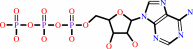 ATP
ATP
|
=
|
O-phospho-L-seryl-[protein]
|
+
|
 ADP
ADP
|
+
|
H(+)
|
|
|
|
|
|
|
L-threonyl-[protein]
|
+
|
ATP
|
=
|
O-phospho-L-threonyl-[protein]
|
+
|
ADP
|
+
|
H(+)
|
|
|
|
|
|
|
L-tyrosyl-[protein]
|
+
|
ATP
|
=
|
O-phospho-L-tyrosyl-[protein]
|
+
|
ADP
|
+
|
H(+)
|
|
|
|
|
|
|
|
|
|
|
|
|
Molecule diagrams generated from .mol files obtained from the
KEGG ftp site
|
|
|
|
|
|
|
|
|
|
|
|
|
|
 |
|
|
|
|
|
|
| |
|
|
| |
|
DOI no:
|
J Mol Biol
314:577-588
(2001)
|
|
PubMed id:
|
|
|
|
|
|
| |
|
Solution structure of the yeast Rad53 FHA2 complexed with a phosphothreonine peptide pTXXL: comparison with the structures of FHA2-pYXL and FHA1-pTXXD complexes.
|
|
I.J.Byeon,
S.Yongkiettrakul,
M.D.Tsai.
|
|
|
|
|
| |
ABSTRACT
|
|
|
|
| |
|
|
It was proposed previously that the FHA2 domain of the yeast protein kinase
Rad53 has dual specificity toward pY and pT peptides. The consensus sequences of
pY peptides for binding to FHA2, as well as the solution structures of free FHA2
and FHA2 complex with a pY peptide derived from Rad9, have been obtained
previously. We now report the use of a pT library to screen for binding of pT
peptides with the FHA2 domain. The results show that FHA2 binds favorably to pT
peptides with Ile at the +3 position. We then searched the Rad9 sequences with a
pTXXI/L motif, and tested the binding affinity of FHA2 toward ten pT peptides
derived from Rad9. One of the peptides, (599)EVEL(pT)QELP(607), displayed the
best binding affinity (K(d)=12.9 microM) and the greatest chemical shift
changes. The structure of the FHA2 complex with this peptide was then determined
by solution NMR and the structure of the complex between FHA2 and the pY peptide
(826)EDI(pY)YLD(832) was further refined. Structural comparison of these two
complexes indicates that the Leu residue at the +3 position in the pT peptide
and that at the +2 position in the pY peptide occupy a very similar position
relative to the binding site residues from FHA2. This can explain why FHA2 is
able to bind both pT and pY peptides. This position change from +3 to +2 could
be the consequence of the size difference between Thr and Tyr. Further insight
into the structural basis of ligand specificity of FHA domains was obtained by
comparing the structures of the FHA2-pTXXL complex obtained in this work and the
FHA1-pTXXD complex reported in the accompanying paper.
|
|
|
|
|
|
| |
Selected figure(s)
|
|
|
|
| |
|
|

|
|

|
|
Figure 5.
Figure 5. Structures of (a) the FHA2-pT peptide complex and
(b) the FHA2-pY peptide complex. FHA2 is shown in ribbons and
the peptides are shown as sticks. The side-chains of (a) pT and
(b) pY are colored magenta, and those of Leu at (a) +3 and at
(b) +2 are colored green. The minimized mean structures are used.
|
|
Figure 7.
Figure 7. Diagrams showing detailed interactions between
the phosphopeptide and the protein in (a) the FHA2-pT peptide
complex and (b) the FHA2-pY peptide complex. Possible hydrogen
bonds are defined as for Figure 6 and shown as dotted lines.
Intermolecular NOEs are shown as double-pointed arrows, where
thick and thin lines indicate strong and medium-sized NOEs,
respectively. Highly conserved residues are colored cyan. The
intramolecular hydrogen bond between Arg617 and Asp683 is also
predicted and is shown with a question mark because the distance
between donor and acceptor heavy atoms is somewhat larger than
the definition: (a) 4.6 Å in the pT complex and (b) 4.8
Å in the pY complex.
|
|
|
|
|
|
| |
The above figures are
reprinted
by permission from Elsevier:
J Mol Biol
(2001,
314,
577-588)
copyright 2001.
|
|
| |
Figures were
selected
by an automated process.
|
|
|
|
|
|
|
|
|
|
|
|
|
|
|
|
 |
 |
 |
|
Literature references that cite this PDB file's key reference
|
|
|
| |
PubMed id
|
|
Reference
|
|
|
|
|
|
C.C.Lin,
Y.S.Huoh,
K.R.Schmitz,
L.E.Jensen,
and
K.M.Ferguson
(2008).
Pellino proteins contain a cryptic FHA domain that mediates interaction with phosphorylated IRAK1.
|
| |
Structure,
16,
1806-1816.
|
|
|
PDB codes:
|
|
|
|
|
|
|
|
H.Kumeta,
K.Ogura,
S.Adachi,
Y.Fujioka,
N.Tanuma,
K.Tanuma,
K.Kikuchi,
and
F.Inagaki
(2008).
The NMR structure of the NIPP1 FHA domain.
|
| |
J Biomol NMR,
40,
219-224.
|
|
|
PDB code:
|
|
|
|
|
|
|
|
X.Liang,
and
S.R.Van Doren
(2008).
Mechanistic insights into phosphoprotein-binding FHA domains.
|
| |
Acc Chem Res,
41,
991-999.
|
|
|
|
|
|
|
G.Guillemain,
E.Ma,
S.Mauger,
S.Miron,
R.Thai,
R.Guérois,
F.Ochsenbein,
and
M.C.Marsolier-Kergoat
(2007).
Mechanisms of checkpoint kinase Rad53 inactivation after a double-strand break in Saccharomyces cerevisiae.
|
| |
Mol Cell Biol,
27,
3378-3389.
|
|
|
|
|
|
|
Y.Tanaka,
M.Kuroda,
Y.Yasutake,
M.Yao,
K.Tsumoto,
N.Watanabe,
T.Ohta,
and
I.Tanaka
(2007).
Crystal structure analysis reveals a novel forkhead-associated domain of ESAT-6 secretion system C protein in Staphylococcus aureus.
|
| |
Proteins,
69,
659-664.
|
|
|
PDB code:
|
|
|
|
|
|
|
|
I.J.Byeon,
H.Li,
H.Song,
A.M.Gronenborn,
and
M.D.Tsai
(2005).
Sequential phosphorylation and multisite interactions characterize specific target recognition by the FHA domain of Ki67.
|
| |
Nat Struct Mol Biol,
12,
987-993.
|
|
|
PDB code:
|
|
|
|
|
|
|
|
Z.Ding,
G.I.Lee,
X.Liang,
F.Gallazzi,
A.Arunima,
and
S.R.Van Doren
(2005).
PhosphoThr peptide binding globally rigidifies much of the FHA domain from Arabidopsis receptor kinase-associated protein phosphatase.
|
| |
Biochemistry,
44,
10119-10134.
|
|
|
|
|
|
|
G.I.Lee,
Z.Ding,
J.C.Walker,
and
S.R.Van Doren
(2003).
NMR structure of the forkhead-associated domain from the Arabidopsis receptor kinase-associated protein phosphatase.
|
| |
Proc Natl Acad Sci U S A,
100,
11261-11266.
|
|
|
PDB codes:
|
|
|
|
|
|
|
|
J.M.Sidorova,
and
L.L.Breeden
(2003).
Rad53 checkpoint kinase phosphorylation site preference identified in the Swi6 protein of Saccharomyces cerevisiae.
|
| |
Mol Cell Biol,
23,
3405-3416.
|
|
|
|
|
|
|
S.J.Lee,
M.F.Schwartz,
J.K.Duong,
and
D.F.Stern
(2003).
Rad53 phosphorylation site clusters are important for Rad53 regulation and signaling.
|
| |
Mol Cell Biol,
23,
6300-6314.
|
|
|
|
|
|
|
M.D.Tsai
(2002).
FHA: a signal transduction domain with diverse specificity and function.
|
| |
Structure,
10,
887-888.
|
|
|
|
|
|
The most recent references are shown first.
Citation data come partly from CiteXplore and partly
from an automated harvesting procedure. Note that this is likely to be
only a partial list as not all journals are covered by
either method. However, we are continually building up the citation data
so more and more references will be included with time.
Where a reference describes a PDB structure, the PDB
codes are
shown on the right.
|
|


 Links
Links


