
|
|
|
|
|
 |
Contents |
 |
|
|
|
|
|
|
|
|
|
|
|


 (+ 1 more)
67 a.a.
(+ 1 more)
67 a.a.
|
|
|
|
|
|
|
|
|
|
|
 63 a.a.
|
|
|
|
|
|
|
|
|
|
|
|
|
PDB id:
|
|
|
|
| Name: |
|
Transferase
|
|
|
Title:
|
|
Structure of the bcr-abl oncoprotein oligomerization domain
|
|
Structure:
|
|
Breakpoint cluster region protein. Chain: a, b, c, d, e, f, g, h. Fragment: bcr1-72. Engineered: yes. Mutation: yes
|
|
Source:
|
|
Homo sapiens. Human. Organism_taxid: 9606. Expressed in: escherichia coli. Expression_system_taxid: 562
|
|
Biol. unit:
|
|
 Tetramer (from
)
Tetramer (from
)
|
|
Resolution:
|
|
|
2.20Å
|
R-factor:
|
0.262
|
R-free:
|
0.295
|
|
|
Authors:
|
|
X.Zhao,S.Ghaffari,H.Lodish,V.N.Malashkevich,P.S.Kim
|
Key ref:

|
|
X.Zhao
et al.
(2002).
Structure of the Bcr-Abl oncoprotein oligomerization domain.
Nat Struct Biol,
9,
117-120.
PubMed id:
DOI:

|
|
|
Date:
|
|
|
25-Sep-01
|
Release date:
|
06-Feb-02
|
|
|
|
|
|
|
PROCHECK
|

|
|
|
|
|
Headers
|
|
|
|
References
|
|
|
|
|
|
|
|
|
|
|
|
Enzyme class:
|
|
Chains A, B, C, D, E, F, G, H:
E.C.2.7.11.1
- non-specific serine/threonine protein kinase.
|
|
|
|
|
|
|
Reaction:
|
|
|
1.
|
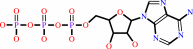
L-seryl-[protein] + ATP = O-phospho-L-seryl-[protein] + ADP + H+
|
|
2.
|
L-threonyl-[protein] + ATP = O-phospho-L-threonyl-[protein] + ADP + H+
|
|
|
|
|
|
|
L-seryl-[protein]
|
+
|
 ATP
ATP
|
=
|
O-phospho-L-seryl-[protein]
|
+
|
 ADP
ADP
|
+
|
H(+)
|
|
|
|
|
|
|
L-threonyl-[protein]
|
+
|
ATP
|
=
|
O-phospho-L-threonyl-[protein]
|
+
|
ADP
|
+
|
H(+)
|
|
|
|
|
|
|
|
|
|
|
|
|
Molecule diagrams generated from .mol files obtained from the
KEGG ftp site
|
|
|
|
|
|
|
|
|
|
|
|
|
|
 |
|
|
|
|
|
|
| |
|
|
| |
|
DOI no:
|
Nat Struct Biol
9:117-120
(2002)
|
|
PubMed id:
|
|
|
|
|
|
| |
|
Structure of the Bcr-Abl oncoprotein oligomerization domain.
|
|
X.Zhao,
S.Ghaffari,
H.Lodish,
V.N.Malashkevich,
P.S.Kim.
|
|
|
|
|
| |
ABSTRACT
|
|
|
|
| |
|
|
The Bcr-Abl oncoprotein is responsible for a wide range of human leukemias,
including most cases of Philadelphia chromosome-positive chronic myelogenous
leukemia. Oligomerization of Bcr-Abl is essential for oncogenicity. We
determined the crystal structure of the N-terminal oligomerization domain of
Bcr-Abl (residues 1-72 or Bcr1-72) and found a novel mode of oligomer formation.
Two N-shaped monomers dimerize by swapping N-terminal helices and by forming an
antiparallel coiled coil between C-terminal helices. Two dimers then stack onto
each other to form a tetramer. The Bcr1-72 structure provides a basis for the
design of inhibitors of Bcr-Abl transforming activity by disrupting Bcr-Abl
oligomerization.
|
|
|
|
|
|
| |
Selected figure(s)
|
|
|
|
| |
|
|

|
|

|
|
Figure 3.
Figure 3. Packing of Bcr[1−72] tetramers with two orthogonal
views. The tetramer has an approximate 222-point symmetry,
with three two-fold rotation axes intersecting near Leu 45. The
four monomers are colored in yellow, blue, dark purple and light
purple. a, Top view looking down the flat surface of helix
bundles in dimers. b, Side view showing dimer−dimer stacking.
|
|
Figure 4.
Figure 4. Dimer−dimer interface. Upon the association of
two dimers,  3,400
Å^2 of the solvent-accessible surface is buried. There are
two views of the surface electrostatic potential of one dimer,
with the other dimer displayed as a ribbon. Basic regions on the
surface are blue, and acidic regions are red. The side chains of
the residues involved in dimer−dimer interactions are shown.
a, Front view of the highly hydrophobic surface involved in the
association with another dimer. b, Back view showing the highly
hydrophilic surface that is solvent exposed. 3,400
Å^2 of the solvent-accessible surface is buried. There are
two views of the surface electrostatic potential of one dimer,
with the other dimer displayed as a ribbon. Basic regions on the
surface are blue, and acidic regions are red. The side chains of
the residues involved in dimer−dimer interactions are shown.
a, Front view of the highly hydrophobic surface involved in the
association with another dimer. b, Back view showing the highly
hydrophilic surface that is solvent exposed.
|
|
|
|
|
|
| |
The above figures are
reprinted
by permission from Macmillan Publishers Ltd:
Nat Struct Biol
(2002,
9,
117-120)
copyright 2002.
|
|
| |
Figures were
selected
by an automated process.
|
|
|
|
|
|
|
|
|
|
|
|
|
|
|
|
 |
 |
 |
|
Literature references that cite this PDB file's key reference
|
|
|
| |
PubMed id
|
|
Reference
|
|
|
|
|
|
M.Preyer,
P.Vigneri,
and
J.Y.Wang
(2011).
Interplay between Kinase Domain Autophosphorylation and F-Actin Binding Domain in Regulating Imatinib Sensitivity and Nuclear Import of BCR-ABL.
|
| |
PLoS One,
6,
e17020.
|
|
|
|
|
|
|
S.J.Yi,
J.Groffen,
and
N.Heisterkamp
(2011).
Bcr is a substrate for Transglutaminase 2 cross-linking activity.
|
| |
BMC Biochem,
12,
8.
|
|
|
|
|
|
|
V.N.Uversky
(2011).
Multitude of binding modes attainable by intrinsically disordered proteins: a portrait gallery of disorder-based complexes.
|
| |
Chem Soc Rev,
40,
1623-1634.
|
|
|
|
|
|
|
C.Wichmann,
Y.Becker,
L.Chen-Wichmann,
V.Vogel,
A.Vojtkova,
J.Herglotz,
S.Moore,
J.Koch,
J.Lausen,
W.Mäntele,
H.Gohlke,
and
M.Grez
(2010).
Dimer-tetramer transition controls RUNX1/ETO leukemogenic activity.
|
| |
Blood,
116,
603-613.
|
|
|
|
|
|
|
J.Colicelli
(2010).
ABL tyrosine kinases: evolution of function, regulation, and specificity.
|
| |
Sci Signal,
3,
re6.
|
|
|
|
|
|
|
A.Quintás-Cardama,
and
J.Cortes
(2009).
Molecular biology of bcr-abl1-positive chronic myeloid leukemia.
|
| |
Blood,
113,
1619-1630.
|
|
|
|
|
|
|
A.S.Dixon,
M.Kakar,
K.M.Schneider,
J.E.Constance,
B.C.Paullin,
and
C.S.Lim
(2009).
Controlling subcellular localization to alter function: Sending oncogenic Bcr-Abl to the nucleus causes apoptosis.
|
| |
J Control Release,
140,
245-249.
|
|
|
|
|
|
|
H.Hegyi,
L.Buday,
and
P.Tompa
(2009).
Intrinsic structural disorder confers cellular viability on oncogenic fusion proteins.
|
| |
PLoS Comput Biol,
5,
e1000552.
|
|
|
|
|
|
|
Q.Y.Zhang,
J.H.Mao,
P.Liu,
Q.H.Huang,
J.Lu,
Y.Y.Xie,
L.Weng,
Y.Zhang,
Q.Chen,
S.J.Chen,
and
Z.Chen
(2009).
A systems biology understanding of the synergistic effects of arsenic sulfide and Imatinib in BCR/ABL-associated leukemia.
|
| |
Proc Natl Acad Sci U S A,
106,
3378-3383.
|
|
|
|
|
|
|
D.W.Sherbenou,
O.Hantschel,
L.Turaga,
I.Kaupe,
S.Willis,
T.Bumm,
R.D.Press,
G.Superti-Furga,
B.J.Druker,
and
M.W.Deininger
(2008).
Characterization of BCR-ABL deletion mutants from patients with chronic myeloid leukemia.
|
| |
Leukemia,
22,
1184-1190.
|
|
|
|
|
|
|
T.Beissert,
A.Hundertmark,
V.Kaburova,
L.Travaglini,
A.A.Mian,
C.Nervi,
and
M.Ruthardt
(2008).
Targeting of the N-terminal coiled coil oligomerization interface by a helix-2 peptide inhibits unmutated and imatinib-resistant BCR/ABL.
|
| |
Int J Cancer,
122,
2744-2752.
|
|
|
|
|
|
|
D.W.Sherbenou,
and
B.J.Druker
(2007).
Applying the discovery of the Philadelphia chromosome.
|
| |
J Clin Invest,
117,
2067-2074.
|
|
|
|
|
|
|
N.M.Levinson,
O.Kuchment,
K.Shen,
M.A.Young,
M.Koldobskiy,
M.Karplus,
P.A.Cole,
and
J.Kuriyan
(2006).
A Src-like inactive conformation in the abl tyrosine kinase domain.
|
| |
PLoS Biol,
4,
e144.
|
|
|
PDB codes:
|
|
|
|
|
|
|
|
D.C.Fry,
and
L.T.Vassilev
(2005).
Targeting protein-protein interactions for cancer therapy.
|
| |
J Mol Med,
83,
955-963.
|
|
|
|
|
|
|
L.P.Silva,
R.B.Azevedo,
P.C.Morais,
M.M.Ventura,
and
S.M.Freitas
(2005).
Oligomerization states of Bowman-Birk inhibitor by atomic force microscopy and computational approaches.
|
| |
Proteins,
61,
642-648.
|
|
|
|
|
|
|
C.E.Tognon,
C.D.Mackereth,
A.M.Somasiri,
L.P.McIntosh,
and
P.H.Sorensen
(2004).
Mutations in the SAM domain of the ETV6-NTRK3 chimeric tyrosine kinase block polymerization and transformation activity.
|
| |
Mol Cell Biol,
24,
4636-4650.
|
|
|
|
|
|
|
K.M.Smith,
R.Yacobi,
and
R.A.Van Etten
(2003).
Autoinhibition of Bcr-Abl through its SH3 domain.
|
| |
Mol Cell,
12,
27-37.
|
|
|
|
|
|
|
C.L.Sawyers
(2002).
Disabling Abl-perspectives on Abl kinase regulation and cancer therapeutics.
|
| |
Cancer Cell,
1,
13-15.
|
|
|
|
|
|
The most recent references are shown first.
Citation data come partly from CiteXplore and partly
from an automated harvesting procedure. Note that this is likely to be
only a partial list as not all journals are covered by
either method. However, we are continually building up the citation data
so more and more references will be included with time.
Where a reference describes a PDB structure, the PDB
codes are
shown on the right.
|
 |


 Links
Links


