 |
PDBsum entry 1jqh

|
|
|
|
|
 |
Contents |
 |
|
|
|
|
|
|
|
|
|
|
|
|
|
|
* Residue conservation analysis
|
|
|
|
|
|
|
|
|
|
|
Enzyme class:
|
|
E.C.2.7.10.1
- receptor protein-tyrosine kinase.
|
|
|
|
|
|
|
Reaction:
|
|
L-tyrosyl-[protein] + ATP = O-phospho-L-tyrosyl-[protein] + ADP + H+
|
|
|
|
|
|
L-tyrosyl-[protein]
|
+
|
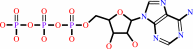 ATP
ATP
|
=
|
O-phospho-L-tyrosyl-[protein]
|
+
|
ADP
Bound ligand (Het Group name = )
matches with 81.25% similarity
|
+
|
H(+)
|
|
|
|
|
|
|
|
|
|
|
|
|
Molecule diagrams generated from .mol files obtained from the
KEGG ftp site
|
|
|
|
|
|
|
|
|
|
|
|
|
|
 |
|
|
|
|
|
|
| |
|
|
| |
|
DOI no:
|
Structure
9:955-965
(2001)
|
|
PubMed id:
|
|
|
|
|
|
| |
|
Crystal structure of bisphosphorylated IGF-1 receptor kinase: insight into domain movements upon kinase activation.
|
|
A.Pautsch,
A.Zoephel,
H.Ahorn,
W.Spevak,
R.Hauptmann,
H.Nar.
|
|
|
|
|
| |
ABSTRACT
|
|
|
|
| |
|
|
BACKGROUND: The insulin-like growth-factor-1 (IGF-1) receptor, which is widely
expressed in cells that have undergone oncogenic transformation, is emerging as
a novel target in cancer therapy. IGF-1-induced receptor activation results in
autophosphorylation of cytoplasmic kinase domains and enhances their capability
to phosphorylate downstream substrates. Structures of the homologous insulin
receptor kinase (IRK) exist in an open, unphosphorylated form and a closed,
trisphosphorylated form. RESULTS: We have determined the 2.1 A crystal structure
of the IGF-1 receptor protein tyrosine kinase domain phosphorylated at two
tyrosine residues within the activation loop (IGF-1RK2P) and bound to an ATP
analog. The ligand is not in a conformation compatible with phosphoryl transfer,
and the activation loop is partially disordered. Compared to the homologous
insulin receptor kinase, IGF-1RK2P is trapped in a half-closed, previously
unobserved conformation. Observed domain movements can be dissected into two
orthogonal rotational components. CONCLUSIONS: Conformational changes upon
kinase activation are triggered by the degree of phosphorylation and are
crucially dependent on the conformation of the proximal end of the kinase
activation loop. This IGF-1RK structure will provide a molecular basis for the
design of selective antioncogenic therapeutic agents.
|
|
|
|
|
|
| |
Selected figure(s)
|
|
|
|
| |
|
|

|
|
Figure 5.
Figure 5. Active Center and AMP-PNP Binding(a) AMP-PNP
interactions in the active site of IGF-1RK2P. The protein is
shown as a backbone representation (the glycine-rich loop is
orange and transparent, the hinge region is magenta, the
catalytic loop is green, and the activation loop is light
yellow). Atoms are color coded by type: carbon is yellow, oxygen
is red, nitrogen is blue, sulfur is green, phosphorous is
purple, and Mg2+ is black. Water molecules are blue-green
spheres.
|
|
|
|
|
|
| |
The above figure is
reprinted
by permission from Cell Press:
Structure
(2001,
9,
955-965)
copyright 2001.
|
|
| |
Figure was
selected
by an automated process.
|
|
|
|
|
|
|
|
|
|
|
|
|
|
|
|
 |
 |
 |
|
Literature references that cite this PDB file's key reference
|
|
|
| |
PubMed id
|
|
Reference
|
|
|
|
|
|
F.Brahimi,
A.Malakhov,
H.B.Lee,
M.Pattarawarapan,
L.Ivanisevic,
K.Burgess,
and
H.U.Saragovi
(2009).
A peptidomimetic of NT-3 acts as a TrkC antagonist.
|
| |
Peptides,
30,
1833-1839.
|
|
|
|
|
|
|
M.L.Peach,
N.Tan,
S.J.Choyke,
A.Giubellino,
G.Athauda,
T.R.Burke,
M.C.Nicklaus,
and
D.P.Bottaro
(2009).
Directed discovery of agents targeting the Met tyrosine kinase domain by virtual screening.
|
| |
J Med Chem,
52,
943-951.
|
|
|
|
|
|
|
M.Muddassar,
F.A.Pasha,
H.W.Chung,
K.H.Yoo,
C.H.Oh,
and
S.J.Cho
(2008).
Receptor guided 3D-QSAR: a useful approach for designing of IGF-1R inhibitors.
|
| |
J Biomed Biotechnol,
2008,
837653.
|
|
|
|
|
|
|
Y.Mori,
T.Hirokawa,
K.Aoki,
H.Satomi,
S.Takeda,
M.Aburada,
and
K.Miyamoto
(2008).
Structure activity relationships of quinoxalin-2-one derivatives as platelet-derived growth factor-beta receptor (PDGFbeta R) inhibitors, derived from molecular modeling.
|
| |
Chem Pharm Bull (Tokyo),
56,
682-687.
|
|
|
|
|
|
|
A.Garza-Garcia,
D.S.Patel,
D.Gems,
and
P.C.Driscoll
(2007).
RILM: a web-based resource to aid comparative and functional analysis of the insulin and IGF-1 receptor family.
|
| |
Hum Mutat,
28,
660-668.
|
|
|
|
|
|
|
B.P.Craddock,
C.Cotter,
and
W.T.Miller
(2007).
Autoinhibition of the insulin-like growth factor I receptor by the juxtamembrane region.
|
| |
FEBS Lett,
581,
3235-3240.
|
|
|
|
|
|
|
D.Mahadevan,
L.Cooke,
C.Riley,
R.Swart,
B.Simons,
K.Della Croce,
L.Wisner,
M.Iorio,
K.Shakalya,
H.Garewal,
R.Nagle,
and
D.Bearss
(2007).
A novel tyrosine kinase switch is a mechanism of imatinib resistance in gastrointestinal stromal tumors.
|
| |
Oncogene,
26,
3909-3919.
|
|
|
|
|
|
|
R.D.Hubbard,
and
J.L.Wilsbacher
(2007).
Advances towards the Development of ATP-Competitive Small-Molecule Inhibitors of the Insulin-Like Growth Factor Receptor (IGF-IR).
|
| |
ChemMedChem,
2,
41-46.
|
|
|
|
|
|
|
S.W.Cowan-Jacob,
G.Fendrich,
A.Floersheimer,
P.Furet,
J.Liebetanz,
G.Rummel,
P.Rheinberger,
M.Centeleghe,
D.Fabbro,
and
P.W.Manley
(2007).
Structural biology contributions to the discovery of drugs to treat chronic myelogenous leukaemia.
|
| |
Acta Crystallogr D Biol Crystallogr,
63,
80-93.
|
|
|
PDB codes:
|
|
|
|
|
|
|
|
K.Breuhahn,
T.Longerich,
and
P.Schirmacher
(2006).
Dysregulation of growth factor signaling in human hepatocellular carcinoma.
|
| |
Oncogene,
25,
3787-3800.
|
|
|
|
|
|
|
W.Li,
and
W.T.Miller
(2006).
Role of the activation loop tyrosines in regulation of the insulin-like growth factor I receptor-tyrosine kinase.
|
| |
J Biol Chem,
281,
23785-23791.
|
|
|
|
|
|
|
F.Hofmann,
and
C.García-Echeverría
(2005).
Blocking the insulin-like growth factor-I receptor as a strategy for targeting cancer.
|
| |
Drug Discov Today,
10,
1041-1047.
|
|
|
|
|
|
|
N.J.Dibb,
S.M.Dilworth,
and
C.D.Mol
(2004).
Switching on kinases: oncogenic activation of BRAF and the PDGFR family.
|
| |
Nat Rev Cancer,
4,
718-727.
|
|
|
|
|
|
|
S.Li,
N.D.Covino,
E.G.Stein,
J.H.Till,
and
S.R.Hubbard
(2003).
Structural and biochemical evidence for an autoinhibitory role for tyrosine 984 in the juxtamembrane region of the insulin receptor.
|
| |
J Biol Chem,
278,
26007-26014.
|
|
|
PDB code:
|
|
|
|
|
|
|
|
S.Munshi,
D.L.Hall,
M.Kornienko,
P.L.Darke,
and
L.C.Kuo
(2003).
Structure of apo, unactivated insulin-like growth factor-1 receptor kinase at 1.5 A resolution.
|
| |
Acta Crystallogr D Biol Crystallogr,
59,
1725-1730.
|
|
|
PDB code:
|
|
|
|
|
|
|
|
P.De Meyts,
and
J.Whittaker
(2002).
Structural biology of insulin and IGF1 receptors: implications for drug design.
|
| |
Nat Rev Drug Discov,
1,
769-783.
|
|
|
|
|
|
|
S.Munshi,
M.Kornienko,
D.L.Hall,
J.C.Reid,
L.Waxman,
S.M.Stirdivant,
P.L.Darke,
and
L.C.Kuo
(2002).
Crystal structure of the Apo, unactivated insulin-like growth factor-1 receptor kinase. Implication for inhibitor specificity.
|
| |
J Biol Chem,
277,
38797-38802.
|
|
|
PDB code:
|
|
|
|
|
|
|
The most recent references are shown first.
Citation data come partly from CiteXplore and partly
from an automated harvesting procedure. Note that this is likely to be
only a partial list as not all journals are covered by
either method. However, we are continually building up the citation data
so more and more references will be included with time.
Where a reference describes a PDB structure, the PDB
codes are
shown on the right.
|
|


 Links
Links


