 |
PDBsum entry 1jjs

|
|
|
|
|
|

|

|

|

|
|

|
|

|
|
|
 |

|

|
|
|
|
|
|
|
|
|
|
|
|
|
|
|
|
|
|
|
|
|
|
|
|
|
|
|
|
|
|
|
Transcription
|
PDB id
|
|
|
|
1jjs
|
|
|
|
|
|
|
|
|
|
|
|
|
|
|

|

|

|
|
|
|
|
|
|
|
|
Enzyme class 1:
|
|
E.C.2.3.1.-
- ?????
|
|
|
|
|
|
|
Enzyme class 2:
|
|
E.C.2.3.1.48
- histone acetyltransferase.
|
|
|
|
|
|
|
Reaction:
|
|
L-lysyl-[protein] + acetyl-CoA = N6-acetyl-L-lysyl-[protein] + CoA + H+
|
|
|
|
|
|
L-lysyl-[protein]
|
+
|
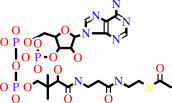 acetyl-CoA
|
=
|
N(6)-acetyl-L-lysyl-[protein]
|
+
|
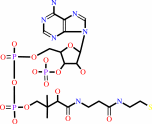 CoA
CoA
|
+
|
H(+)
|
|
|
|
|
|
|
|
|
|
|
|
|
Note, where more than one E.C. class is given (as above), each may
correspond to a different protein domain or, in the case of polyprotein
precursors, to a different mature protein.
|
|
|
|
Molecule diagrams generated from .mol files obtained from the
KEGG ftp site
|
|
|
|
|
|
|
|
|
|
|
|
|
|
 |
|
|
|
|
|
|
| |
|
|
| |
|
DOI no:
|
Mol Cell
8:581-590
(2001)
|
|
PubMed id:
|
|
|
|
|
|
| |
|
A small domain of CBP/p300 binds diverse proteins: solution structure and functional studies.
|
|
C.H.Lin,
B.J.Hare,
G.Wagner,
S.C.Harrison,
T.Maniatis,
E.Fraenkel.
|
|
|
|
|
| |
ABSTRACT
|
|
|
|
| |
|
|
The transcriptional coactivators CBP and p300 are critical regulators of
metazoan gene expression. They associate with many different DNA-bound
transcription factors through small, conserved domains. We have identified a
compactly folded 46 residue domain in CBP and p300, the IRF-3 binding domain
(IBiD), and we have determined its structure by NMR. It has a helical framework
containing an apparently flexible polyglutamine loop that participates in ligand
binding. Spectroscopic data indicate that induced folding accompanies
association of IBiD with its partners, which exhibit no evident sequence
similarities. We demonstrate the significance both in vitro and in vivo of
interactions between IBiD and a number of diverse partners. Thus, IBiD is an
important contributor to signal integration by CBP and p300.
|
|
|
|
|
|
| |
Selected figure(s)
|
|
|
|
| |
|
|

|
|

|
|
Figure 5.
Figure 5. IRF-3, KSHV IRF-1, TIF-2, and E1A Compete for
Binding to IBiD(A) CAT reporter activity measured in extracts of
cells transfected with the indicated plasmids (E1A 12S WT or
H3N: 1 μg; IRF-3 E5: 0.5 μg and 1 μg; KSHV IRF-1: 0.5 μg and
1 μg) or infected with Sendai virus.(B) In vitro pull-down
analysis using immobilized IBiD showing the competition for
binding to IBiD between TIF-2 (cold) and either IRF-3 E5 or KSHV
IRF-1 (^35S-labeled). The percentages of IRF-3 E5 and KSHV IRF-1
that remained bound are shown.(C) CAT assays showing the
inhibitory effect of either WT or H3N E1A 12S on virus induction
of (PRDIII-I)[3]. Amounts of effector constructs transfected:
0.5 and 1 μg. Immunoblot analysis (inset) using an α-E1A
antibody (Santa Cruz) indicates the expression levels of these
E1A constructs.(D) CAT assays showing the inhibitory effect of
either WT or H3N E1A 12S, and KSHV IRF-1 on the transcription
driven by Gal4-IRF-3 E5. Amounts of effector constructs
transfected: Gal4-IRF-3 E5, 50 ng; viral gene constructs, 0.25,
0.5, and 1 μg
|
|
Figure 6.
Figure 6. Flexible Domain Organization of CBP/p300Schematic
diagram illustrating how flexible tethers may permit CBP/p300
molecules to adapt to different enhancers. Binding of ligands
can indirectly modify acetyltransferase activity by causing
domain rearrangements. Two mechanisms by which phosphorylation
of a ligand regulates its binding to CBP/p300 are also shown
|
|
|
|
|
|
| |
The above figures are
reprinted
by permission from Cell Press:
Mol Cell
(2001,
8,
581-590)
copyright 2001.
|
|
| |
Figures were
selected
by an automated process.
|
|
|
|
|
|
|
|
|
|
|
|
|
|
|
|
 |
 |
 |
|
Literature references that cite this PDB file's key reference
|
|
|
| |
PubMed id
|
|
Reference
|
|
|
|
|
|
M.Kjaergaard,
K.Teilum,
and
F.M.Poulsen
(2010).
Conformational selection in the molten globule state of the nuclear coactivator binding domain of CBP.
|
| |
Proc Natl Acad Sci U S A,
107,
12535-12540.
|
|
|
PDB code:
|
|
|
|
|
|
|
|
S.Ghisletti,
I.Barozzi,
F.Mietton,
S.Polletti,
F.De Santa,
E.Venturini,
L.Gregory,
L.Lonie,
A.Chew,
C.L.Wei,
J.Ragoussis,
and
G.Natoli
(2010).
Identification and characterization of enhancers controlling the inflammatory gene expression program in macrophages.
|
| |
Immunity,
32,
317-328.
|
|
|
|
|
|
|
A.von Mikecz
(2009).
PolyQ fibrillation in the cell nucleus: who's bad?
|
| |
Trends Cell Biol,
19,
685-691.
|
|
|
|
|
|
|
L.M.Jenkins,
H.Yamaguchi,
R.Hayashi,
S.Cherry,
J.E.Tropea,
M.Miller,
A.Wlodawer,
E.Appella,
and
S.J.Mazur
(2009).
Two distinct motifs within the p53 transactivation domain bind to the Taz2 domain of p300 and are differentially affected by phosphorylation.
|
| |
Biochemistry,
48,
1244-1255.
|
|
|
|
|
|
|
P.Génin,
A.Vaccaro,
and
A.Civas
(2009).
The role of differential expression of human interferon--a genes in antiviral immunity.
|
| |
Cytokine Growth Factor Rev,
20,
283-295.
|
|
|
|
|
|
|
C.H.Lin,
J.A.MacGurn,
T.Chu,
C.J.Stefan,
and
S.D.Emr
(2008).
Arrestin-related ubiquitin-ligase adaptors regulate endocytosis and protein turnover at the cell surface.
|
| |
Cell,
135,
714-725.
|
|
|
|
|
|
|
D.Panne,
T.Maniatis,
and
S.C.Harrison
(2007).
An atomic model of the interferon-beta enhanceosome.
|
| |
Cell,
129,
1111-1123.
|
|
|
PDB codes:
|
|
|
|
|
|
|
|
J.Johnson,
V.Albarani,
M.Nguyen,
M.Goldman,
F.Willems,
and
E.Aksoy
(2007).
Protein kinase Calpha is involved in interferon regulatory factor 3 activation and type I interferon-beta synthesis.
|
| |
J Biol Chem,
282,
15022-15032.
|
|
|
|
|
|
|
A.Civas,
P.Génin,
P.Morin,
R.Lin,
and
J.Hiscott
(2006).
Promoter organization of the interferon-A genes differentially affects virus-induced expression and responsiveness to TBK1 and IKKepsilon.
|
| |
J Biol Chem,
281,
4856-4866.
|
|
|
|
|
|
|
L.Waters,
B.Yue,
V.Veverka,
P.Renshaw,
J.Bramham,
S.Matsuda,
T.Frenkiel,
G.Kelly,
F.Muskett,
M.Carr,
and
D.M.Heery
(2006).
Structural diversity in p160/CREB-binding protein coactivator complexes.
|
| |
J Biol Chem,
281,
14787-14795.
|
|
|
PDB code:
|
|
|
|
|
|
|
|
M.G.Gold,
D.Barford,
and
D.Komander
(2006).
Lining the pockets of kinases and phosphatases.
|
| |
Curr Opin Struct Biol,
16,
693-701.
|
|
|
|
|
|
|
A.Båvner,
J.Matthews,
S.Sanyal,
J.A.Gustafsson,
and
E.Treuter
(2005).
EID3 is a novel EID family member and an inhibitor of CBP-dependent co-activation.
|
| |
Nucleic Acids Res,
33,
3561-3569.
|
|
|
|
|
|
|
B.Y.Qin,
C.Liu,
H.Srinath,
S.S.Lam,
J.J.Correia,
R.Derynck,
and
K.Lin
(2005).
Crystal structure of IRF-3 in complex with CBP.
|
| |
Structure,
13,
1269-1277.
|
|
|
|
|
|
|
H.J.Dyson,
and
P.E.Wright
(2005).
Intrinsically unstructured proteins and their functions.
|
| |
Nat Rev Mol Cell Biol,
6,
197-208.
|
|
|
|
|
|
|
J.Hiscott,
and
R.Lin
(2005).
IRF-3 releases its inhibitions.
|
| |
Structure,
13,
1235-1236.
|
|
|
PDB code:
|
|
|
|
|
|
|
|
Y.H.Lee,
S.A.Coonrod,
W.L.Kraus,
M.A.Jelinek,
and
M.R.Stallcup
(2005).
Regulation of coactivator complex assembly and function by protein arginine methylation and demethylimination.
|
| |
Proc Natl Acad Sci U S A,
102,
3611-3616.
|
|
|
|
|
|
|
B.Lubyova,
M.J.Kellum,
A.J.Frisancho,
and
P.M.Pitha
(2004).
Kaposi's sarcoma-associated herpesvirus-encoded vIRF-3 stimulates the transcriptional activity of cellular IRF-3 and IRF-7.
|
| |
J Biol Chem,
279,
7643-7654.
|
|
|
|
|
|
|
H.Yang,
G.Ma,
C.H.Lin,
M.Orr,
and
M.G.Wathelet
(2004).
Mechanism for transcriptional synergy between interferon regulatory factor (IRF)-3 and IRF-7 in activation of the interferon-beta gene promoter.
|
| |
Eur J Biochem,
271,
3693-3703.
|
|
|
|
|
|
|
L.Finlan,
and
T.R.Hupp
(2004).
The N-terminal interferon-binding domain (IBiD) homology domain of p300 binds to peptides with homology to the p53 transactivation domain.
|
| |
J Biol Chem,
279,
49395-49405.
|
|
|
|
|
|
|
S.J.Demarest,
S.Deechongkit,
H.J.Dyson,
R.M.Evans,
and
P.E.Wright
(2004).
Packing, specificity, and mutability at the binding interface between the p160 coactivator and CREB-binding protein.
|
| |
Protein Sci,
13,
203-210.
|
|
|
|
|
|
|
S.Matsuda,
J.C.Harries,
M.Viskaduraki,
P.J.Troke,
K.B.Kindle,
C.Ryan,
and
D.M.Heery
(2004).
A Conserved alpha-helical motif mediates the binding of diverse nuclear proteins to the SRC1 interaction domain of CBP.
|
| |
J Biol Chem,
279,
14055-14064.
|
|
|
|
|
|
|
C.Wietek,
S.M.Miggin,
C.A.Jefferies,
and
L.A.O'Neill
(2003).
Interferon regulatory factor-3-mediated activation of the interferon-sensitive response element by Toll-like receptor (TLR) 4 but not TLR3 requires the p65 subunit of NF-kappa.
|
| |
J Biol Chem,
278,
50923-50931.
|
|
|
|
|
|
|
D.Dornan,
H.Shimizu,
L.Burch,
A.J.Smith,
and
T.R.Hupp
(2003).
The proline repeat domain of p53 binds directly to the transcriptional coactivator p300 and allosterically controls DNA-dependent acetylation of p53.
|
| |
Mol Cell Biol,
23,
8846-8861.
|
|
|
|
|
|
|
D.Dornan,
H.Shimizu,
N.D.Perkins,
and
T.R.Hupp
(2003).
DNA-dependent acetylation of p53 by the transcription coactivator p300.
|
| |
J Biol Chem,
278,
13431-13441.
|
|
|
|
|
|
|
H.Yang,
C.H.Lin,
G.Ma,
M.O.Baffi,
and
M.G.Wathelet
(2003).
Interferon regulatory factor-7 synergizes with other transcription factors through multiple interactions with p300/CBP coactivators.
|
| |
J Biol Chem,
278,
15495-15504.
|
|
|
|
|
|
|
K.Takahasi,
N.N.Suzuki,
M.Horiuchi,
M.Mori,
W.Suhara,
Y.Okabe,
Y.Fukuhara,
H.Terasawa,
S.Akira,
T.Fujita,
and
F.Inagaki
(2003).
X-ray crystal structure of IRF-3 and its functional implications.
|
| |
Nat Struct Biol,
10,
922-927.
|
|
|
PDB code:
|
|
|
|
|
|
|
|
M.Hiroi,
and
Y.Ohmori
(2003).
The transcriptional coactivator CREB-binding protein cooperates with STAT1 and NF-kappa B for synergistic transcriptional activation of the CXC ligand 9/monokine induced by interferon-gamma gene.
|
| |
J Biol Chem,
278,
651-660.
|
|
|
|
|
|
|
S.Bhattacharya,
and
P.J.Ratcliffe
(2003).
ExCITED about HIF.
|
| |
Nat Struct Biol,
10,
501-503.
|
|
|
|
|
|
|
A.J.Warren
(2002).
Eukaryotic transcription factors.
|
| |
Curr Opin Struct Biol,
12,
107-114.
|
|
|
|
|
|
|
H.Yang,
C.H.Lin,
G.Ma,
M.Orr,
M.O.Baffi,
and
M.G.Wathelet
(2002).
Transcriptional activity of interferon regulatory factor (IRF)-3 depends on multiple protein-protein interactions.
|
| |
Eur J Biochem,
269,
6142-6151.
|
|
|
|
|
|
|
J.A.Livengood,
K.E.Scoggin,
K.Van Orden,
S.J.McBryant,
R.S.Edayathumangalam,
P.J.Laybourn,
and
J.K.Nyborg
(2002).
p53 Transcriptional activity is mediated through the SRC1-interacting domain of CBP/p300.
|
| |
J Biol Chem,
277,
9054-9061.
|
|
|
|
|
|
|
L.H.Wong,
H.Sim,
M.Chatterjee-Kishore,
I.Hatzinisiriou,
R.J.Devenish,
G.Stark,
and
S.J.Ralph
(2002).
Isolation and characterization of a human STAT1 gene regulatory element. Inducibility by interferon (IFN) types I and II and role of IFN regulatory factor-1.
|
| |
J Biol Chem,
277,
19408-19417.
|
|
|
|
|
|
|
P.Misra,
C.Qi,
S.Yu,
S.H.Shah,
W.Q.Cao,
M.S.Rao,
B.Thimmapaya,
Y.Zhu,
and
J.K.Reddy
(2002).
Interaction of PIMT with transcriptional coactivators CBP, p300, and PBP differential role in transcriptional regulation.
|
| |
J Biol Chem,
277,
20011-20019.
|
|
|
|
|
|
|
S.J.Freedman,
Z.Y.Sun,
F.Poy,
A.L.Kung,
D.M.Livingston,
G.Wagner,
and
M.J.Eck
(2002).
Structural basis for recruitment of CBP/p300 by hypoxia-inducible factor-1 alpha.
|
| |
Proc Natl Acad Sci U S A,
99,
5367-5372.
|
|
|
PDB code:
|
|
|
|
|
|
|
|
T.Kino,
A.Gragerov,
O.Slobodskaya,
M.Tsopanomichalou,
G.P.Chrousos,
and
G.N.Pavlakis
(2002).
Human immunodeficiency virus type 1 (HIV-1) accessory protein Vpr induces transcription of the HIV-1 and glucocorticoid-responsive promoters by binding directly to p300/CBP coactivators.
|
| |
J Virol,
76,
9724-9734.
|
|
|
|
|
|
|
W.Suhara,
M.Yoneyama,
I.Kitabayashi,
and
T.Fujita
(2002).
Direct involvement of CREB-binding protein/p300 in sequence-specific DNA binding of virus-activated interferon regulatory factor-3 holocomplex.
|
| |
J Biol Chem,
277,
22304-22313.
|
|
|
|
|
|
The most recent references are shown first.
Citation data come partly from CiteXplore and partly
from an automated harvesting procedure. Note that this is likely to be
only a partial list as not all journals are covered by
either method. However, we are continually building up the citation data
so more and more references will be included with time.
Where a reference describes a PDB structure, the PDB
code is
shown on the right.
|
|


 Links
Links


