 |
PDBsum entry 1hcl

|
|
|
|
|
|

|

|

|

|
|

|
|

|
|

|
|
|
 |

|

|
|
|
|
|
|
|
|
|
|
|
|
|
|
|
|
|
|
|
|
|
|
|
|
|
|
|
|
|
|
|
|
Protein kinase
|
PDB id
|
|
|
|
1hcl
|
|
|
|
|
|
|
|
|
|
|
|
|
|
|

|

|

|
|
|
|
|
|
|
|
 |
Contents |
 |
|
|
|
|
|
|
|
|
|
|
* Residue conservation analysis
|
|
|
|
|
|
|
|
|
|
|
Enzyme class:
|
|
E.C.2.7.11.22
- cyclin-dependent kinase.
|
|
|
|
|
|
|
Reaction:
|
|
|
1.
|
L-seryl-[protein] + ATP = O-phospho-L-seryl-[protein] + ADP + H+
|
|
2.
|
L-threonyl-[protein] + ATP = O-phospho-L-threonyl-[protein] + ADP + H+
|
|
|
|
|
|
|
L-seryl-[protein]
|
+
|
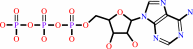 ATP
ATP
|
=
|
O-phospho-L-seryl-[protein]
|
+
|
 ADP
ADP
|
+
|
H(+)
|
|
|
|
|
|
|
L-threonyl-[protein]
|
+
|
ATP
|
=
|
O-phospho-L-threonyl-[protein]
|
+
|
ADP
|
+
|
H(+)
|
|
|
|
|
|
|
|
|
|
|
|
|
Molecule diagrams generated from .mol files obtained from the
KEGG ftp site
|
|
|
|
|
|
|
|
|
|
|
|
|
|
 |
|
|
|
|
|
|
| |
|
|
| |
|
DOI no:
|
J Med Chem
39:4540-4546
(1996)
|
|
PubMed id:
|
|
|
|
|
|
| |
|
High-resolution crystal structures of human cyclin-dependent kinase 2 with and without ATP: bound waters and natural ligand as guides for inhibitor design.
|
|
U.Schulze-Gahmen,
H.L.De Bondt,
S.H.Kim.
|
|
|
|
|
| |
ABSTRACT
|
|
|
|
| |
|
|
Inhibition of the cell cycle is widely considered as a new approach toward
treatment for diseases caused by unregulated cell proliferation, including
cancer. Since cyclin-dependent kinases (CDKs) are key enzymes of cell cycle
control, they are promissing targets for the design and discovery of drugs with
antiproliferative activity. The detailed structural analysis of CDK2 can provide
valuable information for the design of new ligands that can bind in the ATP
binding pocket and inhibit CDK2 activity. For this objective, the crystal
structures of human CDK2 apoenzyme and its ATP complex were refined to 1.8 and
1.9 A, respectively. The high-resolution refinement reveals 12 ordered water
molecules in the ATP binding pocket of the apoenzyme and five ordered waters in
that of the ATP complex. Despite a large number of hydrogen bonds between
ATP-phosphates and CDK2, binding studies of cyclic AMP-dependent protein kinase
with ATP analogues show that the triphosphate moiety contributes little and the
adenine ring is most important for binding affinity. Our analysis of CDK2
structural data, hydration of residues in the binding pocket of the apoenzyme,
flexibility of the ligand, and structural differences between the apoenzyme and
CDK2-ATP complex provide an explanation for the results of earlier binding
studies with ATP analogues and a basis for future inhibitor design.
|
|
|
|
|
|
|
|
|
|
|
|
|
|
|
|
|
|
 |
 |
 |
|
Literature references that cite this PDB file's key reference
|
|
|
| |
PubMed id
|
|
Reference
|
|
|
|
|
|
M.Rabiller,
M.Getlik,
S.Klüter,
A.Richters,
S.Tückmantel,
J.R.Simard,
and
D.Rauh
(2010).
Proteus in the world of proteins: conformational changes in protein kinases.
|
| |
Arch Pharm (Weinheim),
343,
193-206.
|
|
|
|
|
|
|
A.Gárriz,
H.Qiu,
M.Dey,
E.J.Seo,
T.E.Dever,
and
A.G.Hinnebusch
(2009).
A network of hydrophobic residues impeding helix alphaC rotation maintains latency of kinase Gcn2, which phosphorylates the alpha subunit of translation initiation factor 2.
|
| |
Mol Cell Biol,
29,
1592-1607.
|
|
|
|
|
|
|
A.G.Turjanski,
G.Hummer,
and
J.S.Gutkind
(2009).
How mitogen-activated protein kinases recognize and phosphorylate their targets: A QM/MM study.
|
| |
J Am Chem Soc,
131,
6141-6148.
|
|
|
|
|
|
|
B.T.Tobe,
A.A.Kitazono,
J.S.Garcia,
R.A.Gerber,
B.J.Bevis,
J.S.Choy,
D.Chasman,
and
S.J.Kron
(2009).
Morphogenesis signaling components influence cell cycle regulation by cyclin dependent kinase.
|
| |
Cell Div,
4,
12.
|
|
|
|
|
|
|
E.Zeqiraj,
B.M.Filippi,
S.Goldie,
I.Navratilova,
J.Boudeau,
M.Deak,
D.R.Alessi,
and
D.M.van Aalten
(2009).
ATP and MO25alpha regulate the conformational state of the STRADalpha pseudokinase and activation of the LKB1 tumour suppressor.
|
| |
PLoS Biol,
7,
e1000126.
|
|
|
PDB code:
|
|
|
|
|
|
|
|
K.O.Wrzeszczynski,
and
B.Rost
(2009).
Cell cycle kinases predicted from conserved biophysical properties.
|
| |
Proteins,
74,
655-668.
|
|
|
|
|
|
|
L.M.Elphick,
S.E.Lee,
E.S.Child,
A.Prasad,
C.Pignocchi,
S.Thibaudeau,
A.A.Anderson,
L.Bonnac,
V.Gouverneur,
and
D.J.Mann
(2009).
A quantitative comparison of wild-type and gatekeeper mutant cdk2 for chemical genetic studies with ATP analogues.
|
| |
Chembiochem,
10,
1519-1526.
|
|
|
|
|
|
|
B.Zhang,
V.B.Tan,
K.M.Lim,
T.E.Tay,
and
S.Zhuang
(2007).
Study of the inhibition of cyclin-dependent kinases with roscovitine and indirubin-3'-oxime from molecular dynamics simulations.
|
| |
J Mol Model,
13,
79-89.
|
|
|
|
|
|
|
J.Gu,
and
P.E.Bourne
(2007).
Identifying allosteric fluctuation transitions between different protein conformational states as applied to Cyclin Dependent Kinase 2.
|
| |
BMC Bioinformatics,
8,
45.
|
|
|
|
|
|
|
A.T.García-Sosa,
and
R.L.Mancera
(2006).
The effect of a tightly bound water molecule on scaffold diversity in the computer-aided de novo ligand design of CDK2 inhibitors.
|
| |
J Mol Model,
12,
422-431.
|
|
|
|
|
|
|
C.Aubry,
A.J.Wilson,
P.R.Jenkins,
S.Mahale,
B.Chaudhuri,
J.D.Maréchal,
and
M.J.Sutcliffe
(2006).
Design, synthesis and biological activity of new CDK4-specific inhibitors, based on fascaplysin.
|
| |
Org Biomol Chem,
4,
787-801.
|
|
|
|
|
|
|
J.Sridhar,
N.Akula,
and
N.Pattabiraman
(2006).
Selectivity and potency of cyclin-dependent kinase inhibitors.
|
| |
AAPS J,
8,
E204-E221.
|
|
|
|
|
|
|
M.D.Kelly,
and
R.L.Mancera
(2006).
Comparative analysis of the surface interaction properties of the binding sites of CDK2, CDK4, and ERK2.
|
| |
ChemMedChem,
1,
366-375.
|
|
|
|
|
|
|
E.D.Scheeff,
and
P.E.Bourne
(2005).
Structural evolution of the protein kinase-like superfamily.
|
| |
PLoS Comput Biol,
1,
e49.
|
|
|
|
|
|
|
E.De Moliner,
N.R.Brown,
and
L.N.Johnson
(2003).
Alternative binding modes of an inhibitor to two different kinases.
|
| |
Eur J Biochem,
270,
3174-3181.
|
|
|
PDB code:
|
|
|
|
|
|
|
|
I.R.Hardcastle,
B.T.Golding,
and
R.J.Griffin
(2002).
Designing inhibitors of cyclin-dependent kinases.
|
| |
Annu Rev Pharmacol Toxicol,
42,
325-348.
|
|
|
|
|
|
|
T.G.Davies,
D.J.Pratt,
J.A.Endicott,
L.N.Johnson,
and
M.E.Noble
(2002).
Structure-based design of cyclin-dependent kinase inhibitors.
|
| |
Pharmacol Ther,
93,
125-133.
|
|
|
|
|
|
|
A.C.Bishop,
O.Buzko,
and
K.M.Shokat
(2001).
Magic bullets for protein kinases.
|
| |
Trends Cell Biol,
11,
167-172.
|
|
|
|
|
|
|
T.M.Sielecki,
T.L.Johnson,
J.Liu,
J.K.Muckelbauer,
R.H.Grafstrom,
S.Cox,
J.Boylan,
C.R.Burton,
H.Chen,
A.Smallwood,
C.H.Chang,
M.Boisclair,
P.A.Benfield,
G.L.Trainor,
and
S.P.Seitz
(2001).
Quinazolines as cyclin dependent kinase inhibitors.
|
| |
Bioorg Med Chem Lett,
11,
1157-1160.
|
|
|
PDB code:
|
|
|
|
|
|
|
|
C.García-Echeverría,
P.Traxler,
and
D.B.Evans
(2000).
ATP site-directed competitive and irreversible inhibitors of protein kinases.
|
| |
Med Res Rev,
20,
28-57.
|
|
|
|
|
|
|
K.A.Denessiouk,
and
M.S.Johnson
(2000).
When fold is not important: a common structural framework for adenine and AMP binding in 12 unrelated protein families.
|
| |
Proteins,
38,
310-326.
|
|
|
|
|
|
|
L.Meijer,
A.M.Thunnissen,
A.W.White,
M.Garnier,
M.Nikolic,
L.H.Tsai,
J.Walter,
K.E.Cleverley,
P.C.Salinas,
Y.Z.Wu,
J.Biernat,
E.M.Mandelkow,
S.H.Kim,
and
G.R.Pettit
(2000).
Inhibition of cyclin-dependent kinases, GSK-3beta and CK1 by hymenialdisine, a marine sponge constituent.
|
| |
Chem Biol,
7,
51-63.
|
|
|
PDB code:
|
|
|
|
|
|
|
|
M.E.Noble,
and
J.A.Endicott
(1999).
Chemical inhibitors of cyclin-dependent kinases: insights into design from X-ray crystallographic studies.
|
| |
Pharmacol Ther,
82,
269-278.
|
|
|
|
|
|
|
N.Narayana,
T.C.Diller,
K.Koide,
M.E.Bunnage,
K.C.Nicolaou,
L.L.Brunton,
N.H.Xuong,
L.F.Ten Eyck,
and
S.S.Taylor
(1999).
Crystal structure of the potent natural product inhibitor balanol in complex with the catalytic subunit of cAMP-dependent protein kinase.
|
| |
Biochemistry,
38,
2367-2376.
|
|
|
PDB code:
|
|
|
|
|
|
|
The most recent references are shown first.
Citation data come partly from CiteXplore and partly
from an automated harvesting procedure. Note that this is likely to be
only a partial list as not all journals are covered by
either method. However, we are continually building up the citation data
so more and more references will be included with time.
Where a reference describes a PDB structure, the PDB
code is
shown on the right.
|
|


 Links
Links


