 |
PDBsum entry 1h1h

|
|
|
|
|
 |
Contents |
 |
|
|
|
|
|
|
|
|
|
|
|
|
* Residue conservation analysis
|
|
|
|
|
|
PDB id:
|
|
|
|
| Name: |
|
Hydrolase
|
|
|
Title:
|
|
Crystal structure of eosinophil cationic protein in complex with 2', 5'-adp at 2.0 a resolution reveals the details of the ribonucleolytic active site
|
|
Structure:
|
|
Eosinophil cationic protein. Chain: a. Synonym: ecp, ribonuclease 3, rnase 3. Engineered: yes
|
|
Source:
|
|
Homo sapiens. Organism_taxid: 9606. Expressed in: escherichia coli. Expression_system_taxid: 469008.
|
|
Resolution:
|
|
|
2.00Å
|
R-factor:
|
0.205
|
R-free:
|
0.210
|
|
|
Authors:
|
|
C.G.Mohan,E.Boix,H.R.Evans,Z.Nikolovski,M.V.Nogues,C.M.Cuchillo, K.R.Acharya
|
Key ref:

|
|
C.G.Mohan
et al.
(2002).
The crystal structure of eosinophil cationic protein in complex with 2',5'-ADP at 2.0 A resolution reveals the details of the ribonucleolytic active site.
Biochemistry,
41,
12100-12106.
PubMed id:
DOI:
|
|
|
Date:
|
|
|
15-Jul-02
|
Release date:
|
03-Oct-02
|
|
|
|
|
|
|
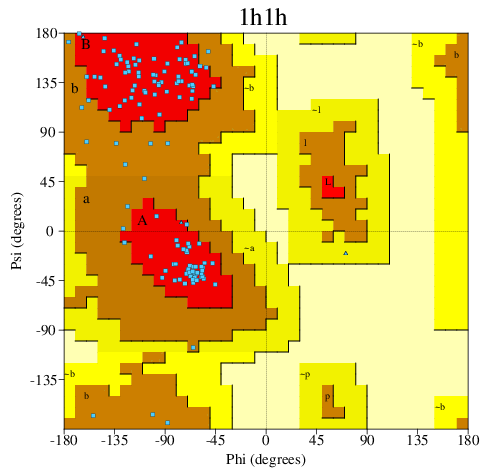
PROCHECK
|
|
|
|
|
|
Headers
|
|
|
|
References
|
|
|
|
|
|

|
|
P12724
(ECP_HUMAN) -
Eosinophil cationic protein from Homo sapiens
|
|
|
|
Seq:
Struc:
|
|
|
|
160 a.a.
134 a.a.*
|
|

|

|
|
|
|
|
|
|
|
|
|
|
|
Key: |
 |
PfamA domain |
|
|
 |
Secondary structure |
|
 |
CATH domain |
|
|
*
PDB and UniProt seqs differ
at 2 residue positions (black
crosses)
|
|
|
|
|
|
|
|
|
|
|
|
|
|
|
|
|
 |
|
|
|
|
|
|
| |
|
DOI no:
|
Biochemistry
41:12100-12106
(2002)
|
|
PubMed id:
|
|
|
|
|
|
| |
|
The crystal structure of eosinophil cationic protein in complex with 2',5'-ADP at 2.0 A resolution reveals the details of the ribonucleolytic active site.
|
|
C.G.Mohan,
E.Boix,
H.R.Evans,
Z.Nikolovski,
M.V.Nogués,
C.M.Cuchillo,
K.R.Acharya.
|
|
|
|
|
| |
ABSTRACT
|
|
|
|
| |
|
|
Eosinophil cationic protein (ECP) is a component of the eosinophil granule
matrix. It shows marked toxicity against helminth parasites, bacteria
single-stranded RNA viruses, and host epithelial cells. Secretion of human ECP
is related to eosinophil-associated allergic, asthmatic, and inflammatory
diseases. ECP belongs to the pancreatic ribonuclease superfamily of proteins,
and the crystal structure of ECP in the unliganded form (determined previously)
exhibited a conserved RNase A fold [Boix, E., et al. (1999) Biochemistry 38,
16794-16801]. We have now determined a high-resolution (2.0 A) crystal structure
of ECP in complex with adenosine 2',5'-diphosphate (2',5'-ADP) which has
revealed the details of the ribonucleolytic active site. Residues Gln-14,
His-15, and Lys-38 make hydrogen bond interactions with the phosphate at the
P(1) site, while His-128 interacts with the purine ring at the B(2) site. A new
phosphate binding site, P(-)(1), has been identified which involves Arg-34. This
study is the first detailed structural analysis of the nucleotide recognition
site in ECP and provides a starting point for the understanding of its substrate
specificity and low catalytic efficiency compared with that of the
eosinophil-derived neurotoxin (EDN), a close homologue.
|
|
|
|
|
|
|
|
|
|
|
|
|
|
|
|
|
|
 |
 |
 |
|
Literature references that cite this PDB file's key reference
|
|
|
| |
PubMed id
|
|
Reference
|
|
|
|
|
|
M.Torrent,
M.V.Nogués,
and
E.Boix
(2011).
Eosinophil cationic protein (ECP) can bind heparin and other glycosaminoglycans through its RNase active site.
|
| |
J Mol Recognit,
24,
90.
|
|
|
|
|
|
|
D.E.Holloway,
G.B.Chavali,
D.D.Leonidas,
M.D.Baker,
and
K.R.Acharya
(2009).
Influence of naturally-occurring 5'-pyrophosphate-linked substituents on the binding of adenylic inhibitors to ribonuclease a: An X-ray crystallographic study.
|
| |
Biopolymers,
91,
995.
|
|
|
PDB codes:
|
|
|
|
|
|
|
|
D.V.Laurents,
M.Bruix,
M.A.Jiménez,
J.Santoro,
E.Boix,
M.Moussaoui,
M.V.Nogués,
and
M.Rico
(2009).
The (1)H, (13)C, (15)N resonance assignment, solution structure, and residue level stability of eosinophil cationic protein/RNase 3 determined by NMR spectroscopy.
|
| |
Biopolymers,
91,
1018-1028.
|
|
|
PDB code:
|
|
|
|
|
|
|
|
N.Doucet,
E.D.Watt,
and
J.P.Loria
(2009).
The flexibility of a distant loop modulates active site motion and product release in ribonuclease A.
|
| |
Biochemistry,
48,
7160-7168.
|
|
|
|
|
|
|
K.Kazakou,
D.E.Holloway,
S.H.Prior,
V.Subramanian,
and
K.R.Acharya
(2008).
Ribonuclease A homologues of the zebrafish: polymorphism, crystal structures of two representatives and their evolutionary implications.
|
| |
J Mol Biol,
380,
206-222.
|
|
|
PDB codes:
|
|
|
|
|
|
|
|
M.Ulrich,
A.Petre,
N.Youhnovski,
F.Prömm,
M.Schirle,
M.Schumm,
R.S.Pero,
A.Doyle,
J.Checkel,
H.Kita,
N.Thiyagarajan,
K.R.Acharya,
P.Schmid-Grendelmeier,
H.U.Simon,
H.Schwarz,
M.Tsutsui,
H.Shimokawa,
G.Bellon,
J.J.Lee,
M.Przybylski,
and
G.Döring
(2008).
Post-translational Tyrosine Nitration of Eosinophil Granule Toxins Mediated by Eosinophil Peroxidase.
|
| |
J Biol Chem,
283,
28629-28640.
|
|
|
|
|
|
|
D.D.Leonidas,
G.B.Chavali,
N.G.Oikonomakos,
E.D.Chrysina,
M.N.Kosmopoulou,
M.Vlassi,
C.Frankling,
and
K.R.Acharya
(2003).
High-resolution crystal structures of ribonuclease A complexed with adenylic and uridylic nucleotide inhibitors. Implications for structure-based design of ribonucleolytic inhibitors.
|
| |
Protein Sci,
12,
2559-2574.
|
|
|
PDB codes:
|
|
|
|
|
|
|
The most recent references are shown first.
Citation data come partly from CiteXplore and partly
from an automated harvesting procedure. Note that this is likely to be
only a partial list as not all journals are covered by
either method. However, we are continually building up the citation data
so more and more references will be included with time.
Where a reference describes a PDB structure, the PDB
codes are
shown on the right.
|
|


 Links
Links


