 |
PDBsum entry 1gx0

|
|
|
|
|
 |
Contents |
 |
|
|
|
|
|
|
|
|
|
|
|
|
|
|
* Residue conservation analysis
|
|
|
|
|
|
PDB id:
|
|
|
|
| Name: |
|
Transferase
|
|
|
Title:
|
|
Alpha-,1,3 galactosyltransferase - beta-d-galactose complex
|
|
Structure:
|
|
N-acetyllactosaminide alpha-1,3-galactosyltransferase. Chain: a, b. Fragment: catalytic domain, residues 80-368. Synonym: galactosyltransferase, udp-galactose\: beta-d-galactosyl-1, 4-n-acetyl-d-glucosaminide alpha-1,3-galactosyltransferase. Engineered: yes
|
|
Source:
|
|
Bos taurus. Bovine. Organism_taxid: 9913. Expressed in: escherichia coli. Expression_system_taxid: 668369. Expression_system_variant: dh5[alpha].
|
|
Resolution:
|
|
|
1.80Å
|
R-factor:
|
0.189
|
R-free:
|
0.211
|
|
|
Authors:
|
|
E.Boix,Y.Zhang,G.J.Swaminathan,K.Brew,K.R.Acharya
|
Key ref:

|
|
E.Boix
et al.
(2002).
Structural basis of ordered binding of donor and acceptor substrates to the retaining glycosyltransferase, alpha-1,3-galactosyltransferase.
J Biol Chem,
277,
28310-28318.
PubMed id:
DOI:

|
|
|
Date:
|
|
|
26-Mar-02
|
Release date:
|
20-Mar-03
|
|
|
|
|
|
|
PROCHECK
|

|
|
|
|
|
Headers
|
|
|
|
References
|
|
|
|
|
|

|
|
P14769
(GGTA1_BOVIN) -
N-acetyllactosaminide alpha-1,3-galactosyltransferase from Bos taurus
|
|
|
|
Seq:
Struc:
|
|
|
|
368 a.a.
287 a.a.
|
|

|

|

|
|
|
|
|
|
|
|
|
|
|
Key: |
 |
PfamA domain |
|
|
 |
Secondary structure |
|
 |
CATH domain |
|
|
|
|
|
|
|
|
|
|
|
|
|
Enzyme class:
|
|
E.C.2.4.1.87
- N-acetyllactosaminide 3-alpha-galactosyltransferase.
|
|
|
|
|
|
|
Reaction:
|
|
a beta-D-galactosyl-(1->4)-N-acetyl-beta-D-glucosaminyl derivative + UDP- alpha-D-galactose = an alpha-D-galactosyl-(1->3)-beta-D-galactosyl- (1->4)-N-acetyl-beta-D-glucosaminyl derivative + UDP + H+
|
|
|
|
|
|
beta-D-galactosyl-(1->4)-N-acetyl-beta-D-glucosaminyl derivative
|
+
|
UDP- alpha-D-galactose
|
=
|
alpha-D-galactosyl-(1->3)-beta-D-galactosyl- (1->4)-N-acetyl-beta-D-glucosaminyl derivative
|
+
|
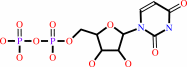 UDP
UDP
|
+
|
H(+)
Bound ligand (Het Group name = )
corresponds exactly
|
|
|
|
|
|
|
|
|
|
|
|
|
Molecule diagrams generated from .mol files obtained from the
KEGG ftp site
|
|
|
|
|
|
|
|
|
|
|
|
|
|
 |
|
|
|
|
|
|
| |
|
|
| |
|
DOI no:
|
J Biol Chem
277:28310-28318
(2002)
|
|
PubMed id:
|
|
|
|
|
|
| |
|
Structural basis of ordered binding of donor and acceptor substrates to the retaining glycosyltransferase, alpha-1,3-galactosyltransferase.
|
|
E.Boix,
Y.Zhang,
G.J.Swaminathan,
K.Brew,
K.R.Acharya.
|
|
|
|
|
| |
ABSTRACT
|
|
|
|
| |
|
|
Bovine alpha-1,3-galactosyltransferase (alpha3GT) catalyzes the synthesis of the
alpha-galactose (alpha-Gal) epitope, the target of natural human antibodies. It
represents a family of enzymes, including the histo blood group A and B
transferases, that catalyze retaining glycosyltransfer reactions of unknown
mechanism. An initial study of alpha3GT in a crystal form with limited
resolution and considerable disorder suggested the possible formation of a
beta-galactosyl-enzyme covalent intermediate (Gastinel, L. N., Bignon, C.,
Misra, A. K., Hindsgaul, O., Shaper, J. H., and Joziasse, D. H. (2001) EMBO J.
20, 638-649). Highly ordered structures are described for complexes of alpha3GT
with donor substrate, UDP-galactose, UDP- glucose, and two acceptor substrates,
lactose and N-acetyllactosamine, at resolutions up to 1.46 A. Structural and
calorimetric binding studies suggest an obligatory ordered binding of donor and
acceptor substrates, linked to a donor substrate-induced conformational change,
and the direct participation of UDP in acceptor binding. The monosaccharide-UDP
bond is cleaved in the structures containing UDP-galactose and UDP-glucose,
producing non-covalent complexes containing buried beta-galactose and
alpha-glucose. The location of these monosaccharides and molecular modeling
suggest that binding of a distorted conformation of UDP-galactose may be
important in the catalytic mechanism of alpha3GT.
|
|
|
|
|
|
| |
Selected figure(s)
|
|
|
|
| |
|
|

|
|

|
|
Figure 2.
Fig. 2. A, C, E, and G: diagrams of the |F[o]|  |F[c]|
electron density omit map, contoured at 3.0- |F[c]|
electron density omit map, contoured at 3.0-  level, of
LacNAc (1.46 Å), Lac (2.5 Å), level, of
LacNAc (1.46 Å), Lac (2.5 Å),  -Gal (1.8
Å), and -Gal (1.8
Å), and  -Glc (1.8
Å), respectively. B, D, F, and H: diagrams showing the
interactions of 3GT with
LacNAc, lactose, -Gal, and
-Glc,
respectively. The protein residues are drawn as ball-and-stick
models, water molecules appear as blue spheres, and the ligands
are shown in orange. The Mn2+ ion is shown as a magenta sphere.
H-bonds are indicated by dashed lines. The figures were created
with BOBSCRIPT (34). -Glc (1.8
Å), respectively. B, D, F, and H: diagrams showing the
interactions of 3GT with
LacNAc, lactose, -Gal, and
-Glc,
respectively. The protein residues are drawn as ball-and-stick
models, water molecules appear as blue spheres, and the ligands
are shown in orange. The Mn2+ ion is shown as a magenta sphere.
H-bonds are indicated by dashed lines. The figures were created
with BOBSCRIPT (34).
|
|
Figure 4.
Fig. 4. Schematic showing the 3GT
residues at the active site and the bound ligands. The Mn2+ ion
is shown in magenta, UDP in orange, -Gal in
green, and LacNAc in pink. The protein residues are drawn as
light gray ball-and-stick models. H-bonds are shown in dashed
lines. The figure was created with MOLSCRIPT (33) and rendered
using Raster3D (35).
|
|
|
|
|
|
| |
The above figures are
reprinted
by permission from the ASBMB:
J Biol Chem
(2002,
277,
28310-28318)
copyright 2002.
|
|
| |
Figures were
selected
by the author.
|
|
|
|
|
|
|
|
|
|
|
|
|
|
|
|
 |
 |
 |
|
Literature references that cite this PDB file's key reference
|
|
|
| |
PubMed id
|
|
Reference
|
|
|
|
|
|
B.Schuman,
M.Persson,
R.C.Landry,
R.Polakowski,
J.T.Weadge,
N.O.Seto,
S.N.Borisova,
M.M.Palcic,
and
S.V.Evans
(2010).
Cysteine-to-serine mutants dramatically reorder the active site of human ABO(H) blood group B glycosyltransferase without affecting activity: structural insights into cooperative substrate binding.
|
| |
J Mol Biol,
402,
399-411.
|
|
|
PDB codes:
|
|
|
|
|
|
|
|
C.J.Bosques,
B.E.Collins,
J.W.Meador,
H.Sarvaiya,
J.L.Murphy,
G.Dellorusso,
D.A.Bulik,
I.H.Hsu,
N.Washburn,
S.F.Sipsey,
J.R.Myette,
R.Raman,
Z.Shriver,
R.Sasisekharan,
and
G.Venkataraman
(2010).
Chinese hamster ovary cells can produce galactose-α-1,3-galactose antigens on proteins.
|
| |
Nat Biotechnol,
28,
1153-1156.
|
|
|
|
|
|
|
F.Yamamoto,
M.Yamamoto,
and
A.Blancher
(2010).
Generation of histo-blood group B transferase by replacing the N-acetyl-d-galactosamine recognition domain of human A transferase with the galactose-recognition domain of evolutionarily related murine alpha1,3-galactosyltransferase.
|
| |
Transfusion,
50,
622-630.
|
|
|
|
|
|
|
G.K.Wagner,
and
T.Pesnot
(2010).
Glycosyltransferases and their assays.
|
| |
Chembiochem,
11,
1939-1949.
|
|
|
|
|
|
|
F.Sheng,
X.Jia,
A.Yep,
J.Preiss,
and
J.H.Geiger
(2009).
The crystal structures of the open and catalytically competent closed conformation of Escherichia coli glycogen synthase.
|
| |
J Biol Chem,
284,
17796-17807.
|
|
|
PDB codes:
|
|
|
|
|
|
|
|
S.Liu,
L.Meng,
K.W.Moremen,
and
J.H.Prestegard
(2009).
Nuclear magnetic resonance structural characterization of substrates bound to the alpha-2,6-sialyltransferase, ST6Gal-I.
|
| |
Biochemistry,
48,
11211-11219.
|
|
|
|
|
|
|
B.A.Macher,
and
U.Galili
(2008).
The Galalpha1,3Galbeta1,4GlcNAc-R (alpha-Gal) epitope: a carbohydrate of unique evolution and clinical relevance.
|
| |
Biochim Biophys Acta,
1780,
75-88.
|
|
|
|
|
|
|
C.Goedl,
and
B.Nidetzky
(2008).
The phosphate site of trehalose phosphorylase from Schizophyllum commune probed by site-directed mutagenesis and chemical rescue studies.
|
| |
FEBS J,
275,
903-913.
|
|
|
|
|
|
|
C.J.Thibodeaux,
C.E.Melançon,
and
H.W.Liu
(2008).
Natural-product sugar biosynthesis and enzymatic glycodiversification.
|
| |
Angew Chem Int Ed Engl,
47,
9814-9859.
|
|
|
|
|
|
|
C.J.Zea,
G.Camci-Unal,
and
N.L.Pohl
(2008).
Thermodynamics of binding of divalent magnesium and manganese to uridine phosphates: implications for diabetes-related hypomagnesaemia and carbohydrate biocatalysis.
|
| |
Chem Cent J,
2,
15.
|
|
|
|
|
|
|
P.Tumbale,
H.Jamaluddin,
N.Thiyagarajan,
K.R.Acharya,
and
K.Brew
(2008).
Screening a limited structure-based library identifies UDP-GalNAc-specific mutants of alpha-1,3-galactosyltransferase.
|
| |
Glycobiology,
18,
1036-1043.
|
|
|
PDB codes:
|
|
|
|
|
|
|
|
A.L.Milac,
N.V.Buchete,
T.A.Fritz,
G.Hummer,
and
L.A.Tabak
(2007).
Substrate-induced conformational changes and dynamics of UDP-N-acetylgalactosamine:polypeptide N-acetylgalactosaminyltransferase-2.
|
| |
J Mol Biol,
373,
439-451.
|
|
|
|
|
|
|
C.J.Thibodeaux,
C.E.Melançon,
and
H.W.Liu
(2007).
Unusual sugar biosynthesis and natural product glycodiversification.
|
| |
Nature,
446,
1008-1016.
|
|
|
|
|
|
|
J.A.Letts,
M.Persson,
B.Schuman,
S.N.Borisova,
M.M.Palcic,
and
S.V.Evans
(2007).
The effect of heavy atoms on the conformation of the active-site polypeptide loop in human ABO(H) blood-group glycosyltransferase B.
|
| |
Acta Crystallogr D Biol Crystallogr,
63,
860-865.
|
|
|
PDB codes:
|
|
|
|
|
|
|
|
P.Molina,
R.M.Knegtel,
and
B.A.Macher
(2007).
Site-directed mutagenesis of glutamate 317 of bovine alpha-1,3Galactosyltransferase and its effect on enzyme activity: implications for reaction mechanism.
|
| |
Biochim Biophys Acta,
1770,
1266-1273.
|
|
|
|
|
|
|
A.Valade,
D.Urban,
and
J.M.Beau
(2006).
Target-assisted selection of galactosyltransferase binders from dynamic combinatorial libraries. An unexpected solution with restricted amounts of the enzyme.
|
| |
Chembiochem,
7,
1023-1027.
|
|
|
|
|
|
|
M.Sobhany,
and
M.Negishi
(2006).
Characterization of specific donor binding to alpha1,4-N-acetylhexosaminyltransferase EXTL2 using isothermal titration calorimetry.
|
| |
Methods Enzymol,
416,
3.
|
|
|
|
|
|
|
C.J.Zea,
and
N.L.Pohl
(2005).
Unusual sugar nucleotide recognition elements of mesophilic vs. thermophilic glycogen synthases.
|
| |
Biopolymers,
79,
106-113.
|
|
|
|
|
|
|
P.K.Qasba,
B.Ramakrishnan,
and
E.Boeggeman
(2005).
Substrate-induced conformational changes in glycosyltransferases.
|
| |
Trends Biochem Sci,
30,
53-62.
|
|
|
|
|
|
The most recent references are shown first.
Citation data come partly from CiteXplore and partly
from an automated harvesting procedure. Note that this is likely to be
only a partial list as not all journals are covered by
either method. However, we are continually building up the citation data
so more and more references will be included with time.
Where a reference describes a PDB structure, the PDB
codes are
shown on the right.
|
|


 Links
Links


