 |
PDBsum entry 1g1c

|
|
|
|
|
|

|

|

|

|
|

|
|

|
|
|
 |

|

|
|
|
|
|
|
|
|
|
|
|
|
|
|
|
|
|
|
|
|
|
|
|
|
|
|
|
|
|
|
|
Structural protein
|
PDB id
|
|
|
|
1g1c
|
|
|
|
|
|
|
|
|
|
|
|
|
|
|

|

|

|
|
|
|
|
|
|
|
 |
Contents |
 |
|
|
|
|
|
|
|
|
|
|
* Residue conservation analysis
|
|
|
|
|
|
|
|
|
|
|
Enzyme class:
|
|
E.C.2.7.11.1
- non-specific serine/threonine protein kinase.
|
|
|
|
|
|
|
Reaction:
|
|
|
1.
|
L-seryl-[protein] + ATP = O-phospho-L-seryl-[protein] + ADP + H+
|
|
2.
|
L-threonyl-[protein] + ATP = O-phospho-L-threonyl-[protein] + ADP + H+
|
|
|
|
|
|
|
L-seryl-[protein]
|
+
|
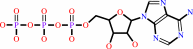 ATP
ATP
|
=
|
O-phospho-L-seryl-[protein]
|
+
|
 ADP
ADP
|
+
|
H(+)
|
|
|
|
|
|
|
L-threonyl-[protein]
|
+
|
ATP
|
=
|
O-phospho-L-threonyl-[protein]
|
+
|
ADP
|
+
|
H(+)
|
|
|
|
|
|
|
|
|
|
|
|
|
Molecule diagrams generated from .mol files obtained from the
KEGG ftp site
|
|
|
|
|
|
|
|
|
|
|
|
|
|
 |
|
|
|
|
|
|
| |
|
|
| |
|
DOI no:
|
Structure
9:331-340
(2001)
|
|
PubMed id:
|
|
|
|
|
|
| |
|
Structural evidence for a possible role of reversible disulphide bridge formation in the elasticity of the muscle protein titin.
|
|
O.Mayans,
J.Wuerges,
S.Canela,
M.Gautel,
M.Wilmanns.
|
|
|
|
|
| |
ABSTRACT
|
|
|
|
| |
|
|
BACKGROUND: The giant muscle protein titin contributes to the filament system in
skeletal and cardiac muscle cells by connecting the Z disk and the central M
line of the sarcomere. One of the physiological functions of titin is to act as
a passive spring in the sarcomere, which is achieved by the elastic properties
of its central I band region. Titin contains about 300 domains of which more
than half are folded as immunoglobulin-like (Ig) domains. Ig domain segments of
the I band of titin have been extensively used as templates to investigate the
molecular basis of protein elasticity. RESULTS: The structure of the Ig domain
I1 from the I band of titin has been determined to 2.1 A resolution. It reveals
a novel, reversible disulphide bridge, which is neither required for correct
folding nor changes the chemical stability of I1, but it is predicted to
contribute mechanically to the elastic properties of titin in active sarcomeres.
From the 92 Ig domains in the longest isoform of titin, at least 40 domains have
a potential for disulphide bridge formation. CONCLUSIONS: We propose a model
where the formation of disulphide bridges under oxidative stress conditions
could regulate the elasticity of the I band in titin by increasing sarcomeric
resistance. In this model, the formation of the disulphide bridge could refrain
a possible directed motion of the two beta sheets or other mechanically stable
entities of the I1 Ig domain with respect to each other when exposed to
mechanical forces.
|
|
|
|
|
|
| |
Selected figure(s)
|
|
|
|
| |
|
|

|
|
Figure 1.
Figure 1. Overall Structure of the I1 Ig Domain(a) Ribbon
representation. b strands of the sheets ABDE and the A'CC'FG are
color coded in pink and cyan, respectively. The two loops B-C
and F-G, close to the N terminus, are colored in light green and
dark green, respectively. The two loops A'-B and E-F, close to
the C terminus, are colored in orange and brown,
respectively.(b) Same presentation as (a) but tilted. The
disulphide bridge connecting residues 37 (b strand C) and 62 (b
strand E) is shown in ball-and-stick representation. The 3
tryptophan residues (W39, W54, and W56) surrounding the
disulphide bridge are also included.(c) Stereoview of the
2F[o]-F[c] (a[calc]) electron density map of the disulphide
bridge region contoured at 1.5 s

|
|
|
|
|
|
| |
The above figure is
reprinted
by permission from Cell Press:
Structure
(2001,
9,
331-340)
copyright 2001.
|
|
| |
Figure was
selected
by an automated process.
|
|
|
|
|
|
|
|
|
|
|
|
|
|
|
|
 |
 |
 |
|
Literature references that cite this PDB file's key reference
|
|
|
| |
PubMed id
|
|
Reference
|
|
|
|
|
|
J.Hsin,
J.Strümpfer,
E.H.Lee,
and
K.Schulten
(2011).
Molecular origin of the hierarchical elasticity of titin: simulation, experiment, and theory.
|
| |
Annu Rev Biophys,
40,
187-203.
|
|
|
|
|
|
|
A.Grützner,
S.Garcia-Manyes,
S.Kötter,
C.L.Badilla,
J.M.Fernandez,
and
W.A.Linke
(2009).
Modulation of titin-based stiffness by disulfide bonding in the cardiac titin N2-B unique sequence.
|
| |
Biophys J,
97,
825-834.
|
|
|
|
|
|
|
A.Kontrogianni-Konstantopoulos,
M.A.Ackermann,
A.L.Bowman,
S.V.Yap,
and
R.J.Bloch
(2009).
Muscle giants: molecular scaffolds in sarcomerogenesis.
|
| |
Physiol Rev,
89,
1217-1267.
|
|
|
|
|
|
|
C.A.Otey,
R.Dixon,
C.Stack,
and
S.M.Goicoechea
(2009).
Cytoplasmic Ig-domain proteins: cytoskeletal regulators with a role in human disease.
|
| |
Cell Motil Cytoskeleton,
66,
618-634.
|
|
|
|
|
|
|
J.Liang,
and
J.M.Fernández
(2009).
Mechanochemistry: One Bond at a Time.
|
| |
ACS Nano,
3,
1628-1645.
|
|
|
|
|
|
|
T.I.Garcia,
A.F.Oberhauser,
and
W.Braun
(2009).
Mechanical stability and differentially conserved physical-chemical properties of titin Ig-domains.
|
| |
Proteins,
75,
706-718.
|
|
|
|
|
|
|
A.Ababou,
E.Rostkova,
S.Mistry,
C.Le Masurier,
M.Gautel,
and
M.Pfuhl
(2008).
Myosin binding protein C positioned to play a key role in regulation of muscle contraction: structure and interactions of domain C1.
|
| |
J Mol Biol,
384,
615-630.
|
|
|
PDB code:
|
|
|
|
|
|
|
|
E.Eyal,
and
I.Bahar
(2008).
Toward a molecular understanding of the anisotropic response of proteins to external forces: insights from elastic network models.
|
| |
Biophys J,
94,
3424-3435.
|
|
|
|
|
|
|
R.R.Thangudu,
M.Manoharan,
N.Srinivasan,
F.Cadet,
R.Sowdhamini,
and
B.Offmann
(2008).
Analysis on conservation of disulphide bonds and their structural features in homologous protein domain families.
|
| |
BMC Struct Biol,
8,
55.
|
|
|
|
|
|
|
S.Marchetti,
F.Sbrana,
R.Raccis,
L.Lanzi,
C.M.Gambi,
M.Vassalli,
B.Tiribilli,
A.Pacini,
and
A.Toscano
(2008).
Dynamic light scattering and atomic force microscopy imaging on fragments of beta-connectin from human cardiac muscle.
|
| |
Phys Rev E Stat Nonlin Soft Matter Phys,
77,
021910.
|
|
|
|
|
|
|
W.A.Linke,
and
A.Grützner
(2008).
Pulling single molecules of titin by AFM--recent advances and physiological implications.
|
| |
Pflugers Arch,
456,
101-115.
|
|
|
|
|
|
|
A.Ababou,
M.Gautel,
and
M.Pfuhl
(2007).
Dissecting the N-terminal myosin binding site of human cardiac myosin-binding protein C. Structure and myosin binding of domain C2.
|
| |
J Biol Chem,
282,
9204-9215.
|
|
|
PDB code:
|
|
|
|
|
|
|
|
E.H.Lee,
J.Hsin,
O.Mayans,
and
K.Schulten
(2007).
Secondary and tertiary structure elasticity of titin Z1Z2 and a titin chain model.
|
| |
Biophys J,
93,
1719-1735.
|
|
|
|
|
|
|
M.Gao,
M.Sotomayor,
E.Villa,
E.H.Lee,
and
K.Schulten
(2006).
Molecular mechanisms of cellular mechanics.
|
| |
Phys Chem Chem Phys,
8,
3692-3706.
|
|
|
|
|
|
|
B.A.Manjasetty,
F.H.Niesen,
C.Scheich,
Y.Roske,
F.Goetz,
J.Behlke,
V.Sievert,
U.Heinemann,
and
K.Büssow
(2005).
X-ray structure of engineered human Aortic Preferentially Expressed Protein-1 (APEG-1).
|
| |
BMC Struct Biol,
5,
21.
|
|
|
PDB code:
|
|
|
|
|
|
|
|
M.Cieplak,
A.Pastore,
and
T.X.Hoang
(2005).
Mechanical properties of the domains of titin in a Go-like model.
|
| |
J Chem Phys,
122,
54906.
|
|
|
|
|
|
|
M.Marino,
D.I.Svergun,
L.Kreplak,
P.V.Konarev,
B.Maco,
D.Labeit,
and
O.Mayans
(2005).
Poly-Ig tandems from I-band titin share extended domain arrangements irrespective of the distinct features of their modular constituents.
|
| |
J Muscle Res Cell Motil,
26,
355-365.
|
|
|
|
|
|
|
L.Tskhovrebova,
and
J.Trinick
(2004).
Properties of titin immunoglobulin and fibronectin-3 domains.
|
| |
J Biol Chem,
279,
46351-46354.
|
|
|
|
|
|
|
M.Cieplak,
T.X.Hoang,
and
M.O.Robbins
(2004).
Thermal effects in stretching of Go-like models of titin and secondary structures.
|
| |
Proteins,
56,
285-297.
|
|
|
|
|
|
|
L.Tskhovrebova,
and
J.Trinick
(2003).
Titin: properties and family relationships.
|
| |
Nat Rev Mol Cell Biol,
4,
679-689.
|
|
|
|
|
|
|
L.Janda,
J.Damborský,
G.A.Rezniczek,
and
G.Wiche
(2001).
Plectin repeats and modules: strategic cysteines and their presumed impact on cytolinker functions.
|
| |
Bioessays,
23,
1064-1069.
|
|
|
|
|
|
The most recent references are shown first.
Citation data come partly from CiteXplore and partly
from an automated harvesting procedure. Note that this is likely to be
only a partial list as not all journals are covered by
either method. However, we are continually building up the citation data
so more and more references will be included with time.
Where a reference describes a PDB structure, the PDB
code is
shown on the right.
|
|


 Links
Links


