 |
PDBsum entry 1fbz

|
|
|
|
|
 |
Contents |
 |
|
|
|
|
|
|
|
|
|
|
|
|
* Residue conservation analysis
|
|
|
|
|
|
PDB id:
|
|
|
|
| Name: |
|
Transferase
|
|
|
Title:
|
|
Structure-based design of a novel, osteoclast-selective, nonpeptide src sh2 inhibitor with in vivo anti-resorptive activity
|
|
Structure:
|
|
Proto-oncogene tyrosine-protein kinase lck. Chain: a, b. Fragment: sh2 domain. Engineered: yes
|
|
Source:
|
|
Homo sapiens. Human. Organism_taxid: 9606. Expressed in: escherichia coli. Expression_system_taxid: 562
|
|
Resolution:
|
|
|
2.40Å
|
R-factor:
|
0.230
|
R-free:
|
0.360
|
|
|
Authors:
|
|
W.Shakespeare,M.Yang,R.Bohacek,F.Cerasoli,K.Stebbis,R.Sundaramoorthi, C.Vu,S.Pradeepan,C.Metcalf,C.Haraldson,T.Merry,D.Dalgarno,S.Narula, M.Hatada,X.Lu,M.R.Van Schravendijk,S.Adams,S.Violette,J.Smith, W.Guan,C.Bartlett,J.Herson,J.Iuliucci,M.Weigele,T.Sawyer
|
Key ref:

|
|
W.Shakespeare
et al.
(2000).
Structure-based design of an osteoclast-selective, nonpeptide src homology 2 inhibitor with in vivo antiresorptive activity.
Proc Natl Acad Sci U S A,
97,
9373-9378.
PubMed id:
DOI:

|
|
|
Date:
|
|
|
17-Jul-00
|
Release date:
|
23-Aug-00
|
|
|
|
|
|
|
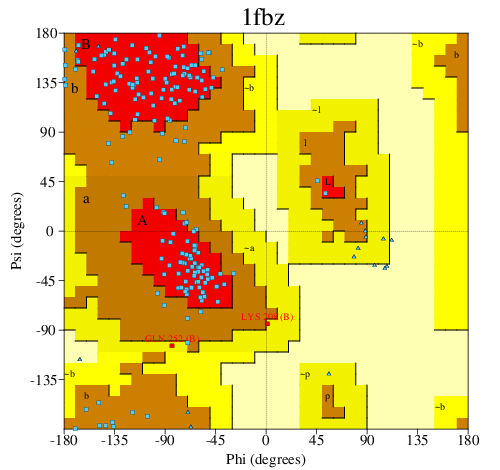
PROCHECK
|
|
|
|
|
|
Headers
|
|
|
|
References
|
|
|
|
|
|
|
|
P06239
(LCK_HUMAN) -
Tyrosine-protein kinase Lck from Homo sapiens
|
|
|
|
Seq:
Struc:
|
|
|
|
509 a.a.
104 a.a.*
|
|

|

|

|
|
|
|
|
|
|
|
|
|
|
Key: |
 |
PfamA domain |
|
|
 |
Secondary structure |
|
 |
CATH domain |
|
|
*
PDB and UniProt seqs differ
at 1 residue position (black
cross)
|
|
|
|
|
|
|
|
|
|
|
|
|
Enzyme class:
|
|
E.C.2.7.10.2
- non-specific protein-tyrosine kinase.
|
|
|
|
|
|
|
Reaction:
|
|
L-tyrosyl-[protein] + ATP = O-phospho-L-tyrosyl-[protein] + ADP + H+
|
|
|
|
|
|
L-tyrosyl-[protein]
|
+
|
 ATP
ATP
|
=
|
O-phospho-L-tyrosyl-[protein]
|
+
|
 ADP
ADP
|
+
|
H(+)
|
|
|
|
|
|
|
|
|
|
|
|
|
Molecule diagrams generated from .mol files obtained from the
KEGG ftp site
|
|
|
|
|
|
|
|
|
|
|
|
|
|
 |
|
|
|
|
|
|
| |
|
|
| |
|
DOI no:
|
Proc Natl Acad Sci U S A
97:9373-9378
(2000)
|
|
PubMed id:
|
|
|
|
|
|
| |
|
Structure-based design of an osteoclast-selective, nonpeptide src homology 2 inhibitor with in vivo antiresorptive activity.
|
|
W.Shakespeare,
M.Yang,
R.Bohacek,
F.Cerasoli,
K.Stebbins,
R.Sundaramoorthi,
M.Azimioara,
C.Vu,
S.Pradeepan,
C.Metcalf,
C.Haraldson,
T.Merry,
D.Dalgarno,
S.Narula,
M.Hatada,
X.Lu,
M.R.van Schravendijk,
S.Adams,
S.Violette,
J.Smith,
W.Guan,
C.Bartlett,
J.Herson,
J.Iuliucci,
M.Weigele,
T.Sawyer.
|
|
|
|
|
| |
ABSTRACT
|
|
|
|
| |
|
|
Targeted disruption of the pp60(src) (Src) gene has implicated this tyrosine
kinase in osteoclast-mediated bone resorption and as a therapeutic target for
the treatment of osteoporosis and other bone-related diseases. Herein we
describe the discovery of a nonpeptide inhibitor (AP22408) of Src that
demonstrates in vivo antiresorptive activity. Based on a cocrystal structure of
the noncatalytic Src homology 2 (SH2) domain of Src complexed with citrate [in
the phosphotyrosine (pTyr) binding pocket], we designed
3',4'-diphosphonophenylalanine (Dpp) as a pTyr mimic. In addition to its design
to bind Src SH2, the Dpp moiety exhibits bone-targeting properties that confer
osteoclast selectivity, hence minimizing possible undesired effects on other
cells that have Src-dependent activities. The chemical structure AP22408 also
illustrates a bicyclic template to replace the post-pTyr sequence of cognate Src
SH2 phosphopeptides such as Ac-pTyr-Glu-Glu-Ile (1). An x-ray structure of
AP22408 complexed with Lck (S164C) SH2 confirmed molecular interactions of both
the Dpp and bicyclic template of AP22408 as predicted from molecular modeling.
Relative to the cognate phosphopeptide, AP22408 exhibits significantly increased
Src SH2 binding affinity (IC(50) = 0.30 microM for AP22408 and 5.5 microM for
1). Furthermore, AP22408 inhibits rabbit osteoclast-mediated resorption of
dentine in a cellular assay, exhibits bone-targeting properties based on a
hydroxyapatite adsorption assay, and demonstrates in vivo antiresorptive
activity in a parathyroid hormone-induced rat model.
|
|
|
|
|
|
| |
Selected figure(s)
|
|
|
|
| |
|
|

|
|

|
|
Figure 2.
Fig. 2. Chemical structures of pTyr, citrate, and Dpp (2).
|
|
Figure 3.
Fig. 3. Chemical structures of 1, 3, AP22408, AP22409,
and AP22650.
|
|
|
|
| |
Figures were
selected
by an automated process.
|
|
|
|
|
|
|
|
|
|
|
|
|
|
|
|
 |
 |
 |
|
Literature references that cite this PDB file's key reference
|
|
|
| |
PubMed id
|
|
Reference
|
|
|
|
|
|
M.Karlou,
V.Tzelepi,
and
E.Efstathiou
(2010).
Therapeutic targeting of the prostate cancer microenvironment.
|
| |
Nat Rev Urol,
7,
494-509.
|
|
|
|
|
|
|
N.Huang,
and
M.P.Jacobson
(2010).
Binding-site assessment by virtual fragment screening.
|
| |
PLoS One,
5,
e10109.
|
|
|
|
|
|
|
S.Virdee,
D.Macmillan,
and
G.Waksman
(2010).
Semisynthetic Src SH2 domains demonstrate altered phosphopeptide specificity induced by incorporation of unnatural lysine derivatives.
|
| |
Chem Biol,
17,
274-284.
|
|
|
|
|
|
|
W.Jahnke,
and
C.Henry
(2010).
An in vitro assay to measure targeted drug delivery to bone mineral.
|
| |
ChemMedChem,
5,
770-776.
|
|
|
|
|
|
|
G.Ye,
A.D.Schuler,
Y.Ahmadibeni,
J.R.Morgan,
A.Faruqui,
K.Huang,
G.Sun,
J.A.Zebala,
and
K.Parang
(2009).
Synthesis and evaluation of phosphopeptides containing iminodiacetate groups as binding ligands of the Src SH2 domain.
|
| |
Bioorg Chem,
37,
133-142.
|
|
|
|
|
|
|
J.Araujo,
and
C.Logothetis
(2009).
Targeting Src signaling in metastatic bone disease.
|
| |
Int J Cancer,
124,
1-6.
|
|
|
|
|
|
|
L.C.Kim,
L.Song,
and
E.B.Haura
(2009).
Src kinases as therapeutic targets for cancer.
|
| |
Nat Rev Clin Oncol,
6,
587-595.
|
|
|
|
|
|
|
P.K.Mandal,
D.Limbrick,
D.R.Coleman,
G.A.Dyer,
Z.Ren,
J.S.Birtwistle,
C.Xiong,
X.Chen,
J.M.Briggs,
and
J.S.McMurray
(2009).
Conformationally constrained peptidomimetic inhibitors of signal transducer and activator of transcription. 3: Evaluation and molecular modeling.
|
| |
J Med Chem,
52,
2429-2442.
|
|
|
|
|
|
|
J.D.Taylor,
A.Ababou,
R.R.Fawaz,
C.J.Hobbs,
M.A.Williams,
and
J.E.Ladbury
(2008).
Structure, dynamics, and binding thermodynamics of the v-Src SH2 domain: implications for drug design.
|
| |
Proteins,
73,
929-940.
|
|
|
PDB code:
|
|
|
|
|
|
|
|
W.C.Shakespeare,
Y.Wang,
R.Bohacek,
T.Keenan,
R.Sundaramoorthi,
C.Metcalf,
A.Dilauro,
S.Roeloffzen,
S.Liu,
J.Saltmarsh,
G.Paramanathan,
D.Dalgarno,
S.Narula,
S.Pradeepan,
M.R.van Schravendijk,
J.Keats,
M.Ram,
S.Liou,
S.Adams,
S.Wardwell,
J.Bogus,
J.Iuliucci,
M.Weigele,
L.Xing,
B.Boyce,
and
T.K.Sawyer
(2008).
SAR of carbon-linked, 2-substituted purines: synthesis and characterization of AP23451 as a novel bone-targeted inhibitor of Src tyrosine kinase with in vivo anti-resorptive activity.
|
| |
Chem Biol Drug Des,
71,
97.
|
|
|
|
|
|
|
S.Zhang,
G.Gangal,
and
H.Uludağ
(2007).
'Magic bullets' for bone diseases: progress in rational design of bone-seeking medicinal agents.
|
| |
Chem Soc Rev,
36,
507-531.
|
|
|
|
|
|
|
L.V.Kalia,
G.M.Pitcher,
K.A.Pelkey,
and
M.W.Salter
(2006).
PSD-95 is a negative regulator of the tyrosine kinase Src in the NMDA receptor complex.
|
| |
EMBO J,
25,
4971-4982.
|
|
|
|
|
|
|
T.Chen,
J.A.George,
and
C.C.Taylor
(2006).
Src tyrosine kinase as a chemotherapeutic target: is there a clinical case?
|
| |
Anticancer Drugs,
17,
123-131.
|
|
|
|
|
|
|
D.S.Lee,
E.Flachsová,
M.Bodnárová,
B.Demeler,
P.Martásek,
and
C.S.Raman
(2005).
Structural basis of hereditary coproporphyria.
|
| |
Proc Natl Acad Sci U S A,
102,
14232-14237.
|
|
|
PDB code:
|
|
|
|
|
|
|
|
W.Kozlow,
and
T.A.Guise
(2005).
Breast cancer metastasis to bone: mechanisms of osteolysis and implications for therapy.
|
| |
J Mammary Gland Biol Neoplasia,
10,
169-180.
|
|
|
|
|
|
|
R.Ishizawar,
and
S.J.Parsons
(2004).
c-Src and cooperating partners in human cancer.
|
| |
Cancer Cell,
6,
209-214.
|
|
|
|
|
|
|
D.M.Biskobing
(2003).
Novel therapies for osteoporosis.
|
| |
Expert Opin Investig Drugs,
12,
611-621.
|
|
|
|
|
|
|
R.Sundaramoorthi,
N.Kawahata,
M.G.Yang,
W.C.Shakespeare,
C.A.Metcalf,
Y.Wang,
T.Merry,
C.J.Eyermann,
R.S.Bohacek,
S.Narula,
D.C.Dalgarno,
and
T.K.Sawyer
(2003).
Structure-based design of novel nonpeptide inhibitors of the Src SH2 domain:phosphotyrosine mimetics exploiting multifunctional group replacement chemistry.
|
| |
Biopolymers,
71,
717-729.
|
|
|
|
|
|
|
A.D.Robertson
(2002).
Intramolecular interactions at protein surfaces and their impact on protein function.
|
| |
Trends Biochem Sci,
27,
521-526.
|
|
|
|
|
|
|
A.V.Veselovsky,
Y.D.Ivanov,
A.S.Ivanov,
A.I.Archakov,
P.Lewi,
and
P.Janssen
(2002).
Protein-protein interactions: mechanisms and modification by drugs.
|
| |
J Mol Recognit,
15,
405-422.
|
|
|
|
|
|
|
B.K.Shoichet,
S.L.McGovern,
B.Wei,
and
J.J.Irwin
(2002).
Lead discovery using molecular docking.
|
| |
Curr Opin Chem Biol,
6,
439-446.
|
|
|
|
|
|
|
G.Scapin
(2002).
Structural biology in drug design: selective protein kinase inhibitors.
|
| |
Drug Discov Today,
7,
601-611.
|
|
|
|
|
|
|
H.W.Kessels,
A.C.Ward,
and
T.N.Schumacher
(2002).
Specificity and affinity motifs for Grb2 SH2-ligand interactions.
|
| |
Proc Natl Acad Sci U S A,
99,
8524-8529.
|
|
|
|
|
|
|
I.H.Choi,
and
C.Kim
(2002).
Flexible docking of an acetoxyethoxymethyl derivative of thiosemicarbazone into three different species of dihydrofolate reductase.
|
| |
Arch Pharm Res,
25,
807-816.
|
|
|
|
|
|
|
M.B.Yaffe
(2002).
Phosphotyrosine-binding domains in signal transduction.
|
| |
Nat Rev Mol Cell Biol,
3,
177-186.
|
|
|
|
|
|
|
M.Koida
(2002).
[Pharmacotherapy of osteoporosis]
|
| |
Nippon Yakurigaku Zasshi,
120,
379-389.
|
|
|
|
|
|
|
P.Kuhn,
K.Wilson,
M.G.Patch,
and
R.C.Stevens
(2002).
The genesis of high-throughput structure-based drug discovery using protein crystallography.
|
| |
Curr Opin Chem Biol,
6,
704-710.
|
|
|
|
|
|
|
R.R.Neubig,
and
D.P.Siderovski
(2002).
Regulators of G-protein signalling as new central nervous system drug targets.
|
| |
Nat Rev Drug Discov,
1,
187-197.
|
|
|
|
|
|
|
Z.Y.Zhang
(2002).
Protein tyrosine phosphatases: structure and function, substrate specificity, and inhibitor development.
|
| |
Annu Rev Pharmacol Toxicol,
42,
209-234.
|
|
|
|
|
|
|
G.M.Verkhivker,
D.Bouzida,
D.K.Gehlhaar,
P.A.Rejto,
L.Schaffer,
S.Arthurs,
A.B.Colson,
S.T.Freer,
V.Larson,
B.A.Luty,
T.Marrone,
and
P.W.Rose
(2001).
Hierarchy of simulation models in predicting molecular recognition mechanisms from the binding energy landscapes: structural analysis of the peptide complexes with SH2 domains.
|
| |
Proteins,
45,
456-470.
|
|
|
|
|
|
|
J.Schoepfer,
B.Gay,
N.End,
E.Muller,
G.Scheffel,
G.Caravatti,
and
P.Furet
(2001).
Convergent synthesis of potent peptide inhibitors of the Grb2-SH2 domain by palladium catalyzed coupling of a terminal alkyne.
|
| |
Bioorg Med Chem Lett,
11,
1201-1203.
|
|
|
|
|
|
|
M.Vidal,
V.Gigoux,
and
C.Garbay
(2001).
SH2 and SH3 domains as targets for anti-proliferative agents.
|
| |
Crit Rev Oncol Hematol,
40,
175-186.
|
|
|
|
|
|
|
W.C.Shakespeare
(2001).
SH2 domain inhibition: a problem solved?
|
| |
Curr Opin Chem Biol,
5,
409-415.
|
|
|
|
|
|
|
A.M.Petros,
D.G.Nettesheim,
Y.Wang,
E.T.Olejniczak,
R.P.Meadows,
J.Mack,
K.Swift,
E.D.Matayoshi,
H.Zhang,
C.B.Thompson,
and
S.W.Fesik
(2000).
Rationale for Bcl-xL/Bad peptide complex formation from structure, mutagenesis, and biophysical studies.
|
| |
Protein Sci,
9,
2528-2534.
|
|
|
PDB code:
|
|
|
|
|
|
|
|
M.Susva,
M.Missbach,
and
J.Green
(2000).
Src inhibitors: drugs for the treatment of osteoporosis, cancer or both?
|
| |
Trends Pharmacol Sci,
21,
489-495.
|
|
|
|
|
|
The most recent references are shown first.
Citation data come partly from CiteXplore and partly
from an automated harvesting procedure. Note that this is likely to be
only a partial list as not all journals are covered by
either method. However, we are continually building up the citation data
so more and more references will be included with time.
Where a reference describes a PDB structure, the PDB
code is
shown on the right.
|
|


 Links
Links


