 |
PDBsum entry 1f2f

|
|
|
|
|
 |
Contents |
 |
|
|
|
|
|
|
|
|
|
|
|
|
* Residue conservation analysis
|
|
|
|
|
|
|
|
|
|
|
Enzyme class:
|
|
E.C.2.7.10.2
- non-specific protein-tyrosine kinase.
|
|
|
|
|
|
|
Reaction:
|
|
L-tyrosyl-[protein] + ATP = O-phospho-L-tyrosyl-[protein] + ADP + H+
|
|
|
|
|
|
L-tyrosyl-[protein]
|
+
|
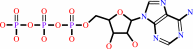 ATP
ATP
|
=
|
O-phospho-L-tyrosyl-[protein]
|
+
|
 ADP
ADP
|
+
|
H(+)
|
|
|
|
|
|
|
|
|
|
|
|
|
Molecule diagrams generated from .mol files obtained from the
KEGG ftp site
|
|
|
|
|
|
|
|
|
|
|
|
|
|
 |
|
|
|
|
|
|
| |
|
|
| |
|
DOI no:
|
Mol Cell
5:1043-1049
(2000)
|
|
PubMed id:
|
|
|
|
|
|
| |
|
Structural basis for specificity switching of the Src SH2 domain.
|
|
M.S.Kimber,
J.Nachman,
A.M.Cunningham,
G.D.Gish,
T.Pawson,
E.F.Pai.
|
|
|
|
|
| |
ABSTRACT
|
|
|
|
| |
|
|
The Src SH2 domain binds pYEEI-containing phosphopeptides in an extended
conformation with a hydrophobic pocket, which includes ThrEF1, binding Ile(pY
+3). Mutating ThrEF1 to tryptophan switches specificity to an Asn(pY +2)
requirement, yielding a biological mimic of the Grb2 SH2 domain. Here we show
that the Src ThrEF1Trp SH2 domain mutant binds pYVNV phosphopeptides in a beta
turn conformation, which, despite differing conformations of the interacting
tryptophan, closely resembles the native Grb2/pYVNV cognate peptide binding
mode. The ThrEF1Trp substitution therefore switches specificity by physically
occluding the pTyr +3 binding pocket and by providing additional interaction
surface area for Asn(pY +2). This demonstrates structurally how novel SH2 domain
specificities may rapidly evolve through single amino acid substitutions and
suggests how new signaling pathways may develop.
|
|
|
|
|
|
| |
Selected figure(s)
|
|
|
|
| |
|
|

|
|

|
|
Figure 1.
Figure 1. Structure of the Ligand-Free Src TEF1W Mutant(a)
Structure of the unliganded form of TEF1W Src SH2 showing the
phosphate group and the residues interacting with TrpEF1. The
secondary structure nomenclature indicated follows [8], which
names the secondary structural elements sequentially, αA, βB,
βC, etc., loops being named for the two secondary structural
elements they connect, and residues then being designated by the
sequential position they occupy on that secondary structural
element. For the residues of the phosphotyrosylated peptide, pY
0 indicates the phosphotyrosine, and pY +n and pY-n designate
residues n amino acids C- and N-terminal to it, respectively. It
should be noted that packing interactions stabilize much of the
BC loop in β strand conformation, but these residues are still
shown as loop so as to facilitate comparison with other SH2
domains. Residues discussed in the text are displayed and
labeled.(b) Stereo diagram of the σ[A] weighted 2F[obs] −
F[c] electron density map for the unliganded TEF1W Src SH2
showing TrpEF1 and the phosphate group. Density is contoured at
1.0 σ. The figure is in approximately the same orientation as
in (a).
|
|
Figure 2.
Figure 2. Binding of pYVNV to TEF1W Src SH2(a) Stereo
ribbon diagram of TEF1W Src SH2 complexed with the
phosphopeptide SpYVNVQN. A σ[A] weighted 2F[obs] − F[c]
electron density map at 1.0 σ is contoured around the
phosphopeptide.(b) In the same orientation as (a) but with the
SH2 domain represented as van der Waals spheres and the
phosphopeptide as a ball-and-stick model. The pYVNV peptide is
shown with bonds in orange, Src with atoms in white except
residue TrpEF1 (in magenta), TyrβD5 (in green), IleβE4 (in
peach), LysβD6 (in pink), and ArgαA2 and ArgβB5 (in cyan).(c)
Superposition of the TEF1W Src SH2 complexed with the SpYVNVQN
structure onto the native Grb2 SH2 complexed with KRFpYVNV. For
clarity, only the phosphopeptide residues resolved in both
structures are shown (SpYVNV for Src TEF1W, FpYVNV for Grb2).
Src TEF1W is in lighter shades (yellow, cyan, light green, and
magenta for Src, the peptide, TyrβD5, and TrpEF1, respectively)
while Grb2 is in darker shades (orange, blue, dark green, and
purple for Grb2, the peptide, PheβD6, and TrpEF1,
respectively). Coordinates for Grb2 SH2 were taken from the
crystal structure of Rahuel et al. ([25]) (RCSB ID code 1tze).
|
|
|
|
|
|
| |
The above figures are
reprinted
by permission from Cell Press:
Mol Cell
(2000,
5,
1043-1049)
copyright 2000.
|
|
| |
Figures were
selected
by an automated process.
|
|
|
|
|
|
|
|
|
|
|
|
|
|
|
|
 |
 |
 |
|
Literature references that cite this PDB file's key reference
|
|
|
| |
PubMed id
|
|
Reference
|
|
|
|
|
|
T.Kaneko,
S.S.Sidhu,
and
S.S.Li
(2011).
Evolving specificity from variability for protein interaction domains.
|
| |
Trends Biochem Sci,
36,
183-190.
|
|
|
|
|
|
|
J.Nachman,
G.Gish,
C.Virag,
T.Pawson,
R.Pomès,
and
E.Pai
(2010).
Conformational determinants of phosphotyrosine peptides complexed with the Src SH2 domain.
|
| |
PLoS One,
5,
e11215.
|
|
|
|
|
|
|
S.Fox-Erlich,
M.R.Schiller,
and
M.R.Gryk
(2009).
Structural conservation of a short, functional, peptide-sequence motif.
|
| |
Front Biosci,
14,
1143-1151.
|
|
|
|
|
|
|
I.E.Sánchez,
P.Beltrao,
F.Stricher,
J.Schymkowitz,
J.Ferkinghoff-Borg,
F.Rousseau,
and
L.Serrano
(2008).
Genome-wide prediction of SH2 domain targets using structural information and the FoldX algorithm.
|
| |
PLoS Comput Biol,
4,
e1000052.
|
|
|
|
|
|
|
M.Rovedo,
and
R.Longnecker
(2008).
Epstein-Barr virus latent membrane protein 2A preferentially signals through the Src family kinase Lyn.
|
| |
J Virol,
82,
8520-8528.
|
|
|
|
|
|
|
T.Ozawa,
and
K.Okazaki
(2008).
CH/pi hydrogen bonds determine the selectivity of the Src homology 2 domain to tyrosine phosphotyrosyl peptides: an ab initio fragment molecular orbital study.
|
| |
J Comput Chem,
29,
2656-2666.
|
|
|
|
|
|
|
K.H.Lau,
L.W.Wu,
M.H.Sheng,
M.Amoui,
S.M.Suhr,
and
D.J.Baylink
(2006).
An osteoclastic protein-tyrosine phosphatase is a potential positive regulator of the c-Src protein-tyrosine kinase activity: a mediator of osteoclast activity.
|
| |
J Cell Biochem,
97,
940-955.
|
|
|
|
|
|
|
M.G.Yeo,
M.A.Partridge,
E.J.Ezratty,
Q.Shen,
G.G.Gundersen,
and
E.E.Marcantonio
(2006).
Src SH2 arginine 175 is required for cell motility: specific focal adhesion kinase targeting and focal adhesion assembly function.
|
| |
Mol Cell Biol,
26,
4399-4409.
|
|
|
|
|
|
|
A.C.Roque,
and
C.R.Lowe
(2005).
Lessons from nature: On the molecular recognition elements of the phosphoprotein binding-domains.
|
| |
Biotechnol Bioeng,
91,
546-555.
|
|
|
|
|
|
|
M.K.Ayrapetov,
N.H.Nam,
G.Ye,
A.Kumar,
K.Parang,
and
G.Sun
(2005).
Functional diversity of Csk, Chk, and Src SH2 domains due to a single residue variation.
|
| |
J Biol Chem,
280,
25780-25787.
|
|
|
|
|
|
|
T.Pawson,
and
P.Nash
(2003).
Assembly of cell regulatory systems through protein interaction domains.
|
| |
Science,
300,
445-452.
|
|
|
|
|
|
|
G.S.Baillie,
E.Huston,
G.Scotland,
M.Hodgkin,
I.Gall,
A.H.Peden,
C.MacKenzie,
E.S.Houslay,
R.Currie,
T.R.Pettitt,
A.R.Walmsley,
M.J.Wakelam,
J.Warwicker,
and
M.D.Houslay
(2002).
TAPAS-1, a novel microdomain within the unique N-terminal region of the PDE4A1 cAMP-specific phosphodiesterase that allows rapid, Ca2+-triggered membrane association with selectivity for interaction with phosphatidic acid.
|
| |
J Biol Chem,
277,
28298-28309.
|
|
|
|
|
|
|
L.A.Cary,
R.A.Klinghoffer,
C.Sachsenmaier,
and
J.A.Cooper
(2002).
SRC catalytic but not scaffolding function is needed for integrin-regulated tyrosine phosphorylation, cell migration, and cell spreading.
|
| |
Mol Cell Biol,
22,
2427-2440.
|
|
|
|
|
|
|
M.B.Yaffe
(2002).
Phosphotyrosine-binding domains in signal transduction.
|
| |
Nat Rev Mol Cell Biol,
3,
177-186.
|
|
|
|
|
|
|
N.Schiering,
E.Casale,
P.Caccia,
P.Giordano,
and
C.Battistini
(2000).
Dimer formation through domain swapping in the crystal structure of the Grb2-SH2-Ac-pYVNV complex.
|
| |
Biochemistry,
39,
13376-13382.
|
|
|
PDB code:
|
|
|
|
|
|
|
The most recent references are shown first.
Citation data come partly from CiteXplore and partly
from an automated harvesting procedure. Note that this is likely to be
only a partial list as not all journals are covered by
either method. However, we are continually building up the citation data
so more and more references will be included with time.
Where a reference describes a PDB structure, the PDB
code is
shown on the right.
|
|


 Links
Links


