 |
PDBsum entry 1e8b

|
|
|
|
|
|

|

|

|

|
|

|
|

|
|

|
|

|
|
|
 |

|

|
|
|
|
|
|
|
|
|
|
|
|
|
|
|
|
|
|
|
|
|
|
|
|
|
|
|
|
|
|
|
|
|
Cell adhesion
|
PDB id
|
|
|
|
1e8b
|
|
|
|
|
|
|
|
|
|
|
|
|
|
|

|

|

|
|
|
|
|
|
|
|
 |
Contents |
 |
|
|
|
|
|
|
|
|
|
|
* Residue conservation analysis
|
|
|
|
|
|
PDB id:
|
|
|
|
| Name: |
|
Cell adhesion
|
|
|
Title:
|
|
Solution structure of 6f11f22f2, a compact three-module fragment of the gelatin-binding domain of human fibronectin
|
|
Structure:
|
|
Fibronectin. Chain: a. Fragment: 6f11f22f2, residues 305-464. Synonym: fn, cold-insoluble globulin, cig,. Engineered: yes
|
|
Source:
|
|
Homo sapiens. Human. Organism_taxid: 9606. Cellular_location: extracellular. Expressed in: pichia pastoris. Expression_system_taxid: 4922.
|
|
NMR struc:
|
|
1 models
|
|
|
Authors:
|
|
A.R.Pickford,S.P.Smith,D.Staunton,J.Boyd,I.D.Campbell
|
Key ref:

|
|
A.R.Pickford
et al.
(2001).
The hairpin structure of the (6)F1(1)F2(2)F2 fragment from human fibronectin enhances gelatin binding.
EMBO J,
20,
1519-1529.
PubMed id:
DOI:

|
|
|
Date:
|
|
|
18-Sep-00
|
Release date:
|
15-Oct-00
|
|
|
|
|
|
|
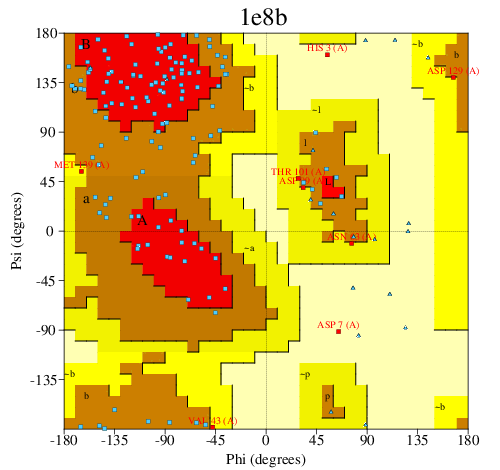
PROCHECK
|
|
|
|
|
|
Headers
|
|
|
|
References
|
|
|
|
|
|

|
|
P02751
(FINC_HUMAN) -
Fibronectin from Homo sapiens
|
|
|
|
Seq:
Struc:
|
|
|
|
2477 a.a.
160 a.a.
|
|

|

|

|
|
|
|
|
|
|
|
|
|
|
Key: |
 |
PfamA domain |
|
|
 |
Secondary structure |
|
 |
CATH domain |
|
|
|
|
|
|
|
|
|
|
|
|
|
|
|
|
|
 |
|
|
|
|
|
|
| |
|
DOI no:
|
EMBO J
20:1519-1529
(2001)
|
|
PubMed id:
|
|
|
|
|
|
| |
|
The hairpin structure of the (6)F1(1)F2(2)F2 fragment from human fibronectin enhances gelatin binding.
|
|
A.R.Pickford,
S.P.Smith,
D.Staunton,
J.Boyd,
I.D.Campbell.
|
|
|
|
|
| |
ABSTRACT
|
|
|
|
| |
|
|
The solution structure of the (6)F1(1)F2(2)F2 fragment from the gelatin-binding
region of fibronectin has been determined (Protein Data Bank entry codes 1e88
and 1e8b). The structure reveals an extensive hydrophobic interface between the
non-contiguous (6)F1 and (2)F2 modules. The buried surface area between (6)F1
and (2)F2 ( approximately 870 A(2)) is the largest intermodule interface seen in
fibronectin to date. The dissection of (6)F1(1)F2(2)F2 into the (6)F1(1)F2 pair
and (2)F2 results in near-complete loss of gelatin-binding activity. The hairpin
topology of (6)F1(1)F2(2)F2 may facilitate intramolecular contact between the
matrix assembly regions flanking the gelatin-binding domain. This is the first
high-resolution study to reveal a compact, globular arrangement of modules in
fibronectin. This arrangement is not consistent with the view that fibronectin
is simply a linear 'string of beads'.
|
|
|
|
|
|
| |
Selected figure(s)
|
|
|
|
| |
|
|

|
|

|
|
Figure 5.
Figure 5 Module reorganization upon dissection of 6F1^1F2^2F2.
Ribbon diagrams of the minimized average structures of (A)
6F1^1F2^2F2 and (B) 6F1^1F2. The colour scheme for the secondary
structure elements is as in Figure 3A -C. Side chains for which
6F1 -2F2 intermodule NOEs were observed (V10, Y12, S13, M16, L19
and L28 of 6F1, and L103, Q105, S111, N112, A114, L115, T145 and
K153 for 2F2) are shown in cyan for 6F1 and purple for 2F2.
Removal of the 2F2 module allows the side chain of Y68 (pink) in
1F2 to interact with L19 and L28 in 6F1.
|
|
Figure 6.
Figure 6 Global topologies of multimodule fibronectin fragments.
Solvent-accessible surfaces have been superimposed over ribbon
diagrams for the minimized average structure of 6F1^1F2^2F2, and
the crystal structures of 7F3^8F3^9F3^10F3 (Leahy et al., 1996)
and 12F3^13F3^14F3 (Sharma et al., 1999). The fragment
structures are mapped onto the mosaic illustration of
fibronectin, which has been folded to account for the hairpin
structure of 6F1^1F2^2F2.
|
|
|
|
|
|
| |
The above figures are
reprinted
from an Open Access publication published by Macmillan Publishers Ltd:
EMBO J
(2001,
20,
1519-1529)
copyright 2001.
|
|
| |
Figures were
selected
by an automated process.
|
|
|
|
|
|
|
|
|
|
|
|
|
|
|
|
 |
 |
 |
|
Literature references that cite this PDB file's key reference
|
|
|
| |
PubMed id
|
|
Reference
|
|
|
|
|
|
B.Henderson,
S.Nair,
J.Pallas,
and
M.A.Williams
(2011).
Fibronectin: a multidomain host adhesin targeted by bacterial fibronectin-binding proteins.
|
| |
FEMS Microbiol Rev,
35,
147-200.
|
|
|
|
|
|
|
R.V.Basaiawmoit,
C.L.Oliveira,
K.Runager,
C.S.Sørensen,
M.A.Behrens,
B.H.Jonsson,
T.Kristensen,
G.K.Klintworth,
J.J.Enghild,
J.S.Pedersen,
and
D.E.Otzen
(2011).
SAXS models of TGFBIp reveal a trimeric structure and show that the overall shape is not affected by the Arg124His mutation.
|
| |
J Mol Biol,
408,
503-513.
|
|
|
|
|
|
|
K.E.Atkin,
A.S.Brentnall,
G.Harris,
R.J.Bingham,
M.C.Erat,
C.J.Millard,
U.Schwarz-Linek,
D.Staunton,
I.Vakonakis,
I.D.Campbell,
and
J.R.Potts
(2010).
The streptococcal binding site in the gelatin-binding domain of fibronectin is consistent with a non-linear arrangement of modules.
|
| |
J Biol Chem,
285,
36977-36983.
|
|
|
|
|
|
|
L.M.Maurer,
B.R.Tomasini-Johansson,
W.Ma,
D.S.Annis,
N.L.Eickstaedt,
M.G.Ensenberger,
K.A.Satyshur,
and
D.F.Mosher
(2010).
Extended binding site on fibronectin for the functional upstream domain of protein F1 of Streptococcus pyogenes.
|
| |
J Biol Chem,
285,
41087-41099.
|
|
|
|
|
|
|
M.C.Erat,
U.Schwarz-Linek,
A.R.Pickford,
R.W.Farndale,
I.D.Campbell,
and
I.Vakonakis
(2010).
Implications for collagen binding from the crystallographic structure of fibronectin 6FnI1-2FnII7FnI.
|
| |
J Biol Chem,
285,
33764-33770.
|
|
|
PDB code:
|
|
|
|
|
|
|
|
M.Graille,
M.Pagano,
T.Rose,
M.R.Ravaux,
and
H.van Tilbeurgh
(2010).
Zinc induces structural reorganization of gelatin binding domain from human fibronectin and affects collagen binding.
|
| |
Structure,
18,
710-718.
|
|
|
PDB code:
|
|
|
|
|
|
|
|
R.J.Bingham,
and
J.R.Potts
(2010).
Fibronectin structure: a new piece of the puzzle emerges.
|
| |
Structure,
18,
660-661.
|
|
|
|
|
|
|
S.Pal,
Z.Chen,
X.Xu,
M.Mikhailova,
and
B.Steffensen
(2010).
Co-purified gelatinases alter the stability and biological activities of human plasma fibronectin preparations.
|
| |
J Periodontal Res,
45,
292-295.
|
|
|
|
|
|
|
V.Stoka,
and
V.Turk
(2010).
A structural network associated with the kallikrein-kinin and renin-angiotensin systems.
|
| |
Biol Chem,
391,
443-454.
|
|
|
|
|
|
|
I.Vakonakis,
D.Staunton,
I.R.Ellis,
P.Sarkies,
A.Flanagan,
A.M.Schor,
S.L.Schor,
and
I.D.Campbell
(2009).
Motogenic sites in human fibronectin are masked by long range interactions.
|
| |
J Biol Chem,
284,
15668-15675.
|
|
|
|
|
|
|
L.Sabatier,
D.Chen,
C.Fagotto-Kaufmann,
D.Hubmacher,
M.D.McKee,
D.S.Annis,
D.F.Mosher,
and
D.P.Reinhardt
(2009).
Fibrillin assembly requires fibronectin.
|
| |
Mol Biol Cell,
20,
846-858.
|
|
|
|
|
|
|
M.C.Erat,
D.A.Slatter,
E.D.Lowe,
C.J.Millard,
R.W.Farndale,
I.D.Campbell,
and
I.Vakonakis
(2009).
Identification and structural analysis of type I collagen sites in complex with fibronectin fragments.
|
| |
Proc Natl Acad Sci U S A,
106,
4195-4200.
|
|
|
PDB code:
|
|
|
|
|
|
|
|
C.D.Blundell,
D.J.Mahoney,
M.R.Cordell,
A.Almond,
J.D.Kahmann,
A.Perczel,
J.D.Taylor,
I.D.Campbell,
and
A.J.Day
(2007).
Determining the molecular basis for the pH-dependent interaction between the link module of human TSG-6 and hyaluronan.
|
| |
J Biol Chem,
282,
12976-12988.
|
|
|
|
|
|
|
K.L.Wegener,
A.W.Partridge,
J.Han,
A.R.Pickford,
R.C.Liddington,
M.H.Ginsberg,
and
I.D.Campbell
(2007).
Structural basis of integrin activation by talin.
|
| |
Cell,
128,
171-182.
|
|
|
PDB codes:
|
|
|
|
|
|
|
|
Y.Lad,
T.Kiema,
P.Jiang,
O.T.Pentikäinen,
C.H.Coles,
I.D.Campbell,
D.A.Calderwood,
and
J.Ylänne
(2007).
Structure of three tandem filamin domains reveals auto-inhibition of ligand binding.
|
| |
EMBO J,
26,
3993-4004.
|
|
|
PDB code:
|
|
|
|
|
|
|
|
I.Biunno,
M.Cattaneo,
R.Orlandi,
C.Canton,
L.Biagiotti,
S.Ferrero,
M.Barberis,
S.M.Pupa,
A.Scarpa,
and
S.Ménard
(2006).
SEL1L a multifaceted protein playing a role in tumor progression.
|
| |
J Cell Physiol,
208,
23-38.
|
|
|
|
|
|
|
E.T.Ifon,
A.L.Pang,
W.Johnson,
K.Cashman,
S.Zimmerman,
S.Muralidhar,
W.Y.Chan,
J.Casey,
and
L.J.Rosenthal
(2005).
U94 alters FN1 and ANGPTL4 gene expression and inhibits tumorigenesis of prostate cancer cell line PC3.
|
| |
Cancer Cell Int,
5,
19.
|
|
|
|
|
|
|
M.L.Gehrmann,
J.T.Douglas,
L.Bányai,
H.Tordai,
L.Patthy,
and
M.Llinás
(2004).
Modular autonomy, ligand specificity, and functional cooperativity of the three in-tandem fibronectin type II repeats from human matrix metalloproteinase 2.
|
| |
J Biol Chem,
279,
46921-46929.
|
|
|
|
|
|
|
P.Lukacik,
P.Roversi,
J.White,
D.Esser,
G.P.Smith,
J.Billington,
P.A.Williams,
P.M.Rudd,
M.R.Wormald,
D.J.Harvey,
M.D.Crispin,
C.M.Radcliffe,
R.A.Dwek,
D.J.Evans,
B.P.Morgan,
R.A.Smith,
and
S.M.Lea
(2004).
Complement regulation at the molecular level: the structure of decay-accelerating factor.
|
| |
Proc Natl Acad Sci U S A,
101,
1279-1284.
|
|
|
PDB codes:
|
|
|
|
|
|
|
|
P.Teriete,
S.Banerji,
M.Noble,
C.D.Blundell,
A.J.Wright,
A.R.Pickford,
E.Lowe,
D.J.Mahoney,
M.I.Tammi,
J.D.Kahmann,
I.D.Campbell,
A.J.Day,
and
D.G.Jackson
(2004).
Structure of the regulatory hyaluronan binding domain in the inflammatory leukocyte homing receptor CD44.
|
| |
Mol Cell,
13,
483-496.
|
|
|
PDB codes:
|
|
|
|
|
|
|
|
C.D.Blundell,
D.J.Mahoney,
A.Almond,
P.L.DeAngelis,
J.D.Kahmann,
P.Teriete,
A.R.Pickford,
I.D.Campbell,
and
A.J.Day
(2003).
The link module from ovulation- and inflammation-associated protein TSG-6 changes conformation on hyaluronan binding.
|
| |
J Biol Chem,
278,
49261-49270.
|
|
|
PDB codes:
|
|
|
|
|
|
|
|
D.Wienke,
J.R.MacFadyen,
and
C.M.Isacke
(2003).
Identification and characterization of the endocytic transmembrane glycoprotein Endo180 as a novel collagen receptor.
|
| |
Mol Biol Cell,
14,
3592-3604.
|
|
|
|
|
|
|
L.Becker,
B.A.Webb,
S.Chitayat,
M.E.Nesheim,
and
M.L.Koschinsky
(2003).
A ligand-induced conformational change in apolipoprotein(a) enhances covalent Lp(a) formation.
|
| |
J Biol Chem,
278,
14074-14081.
|
|
|
|
|
|
|
U.Schwarz-Linek,
J.M.Werner,
A.R.Pickford,
S.Gurusiddappa,
J.H.Kim,
E.S.Pilka,
J.A.Briggs,
T.S.Gough,
M.Höök,
I.D.Campbell,
and
J.R.Potts
(2003).
Pathogenic bacteria attach to human fibronectin through a tandem beta-zipper.
|
| |
Nature,
423,
177-181.
|
|
|
PDB code:
|
|
|
|
|
|
|
|
Y.Katagiri,
S.A.Brew,
and
K.C.Ingham
(2003).
All six modules of the gelatin-binding domain of fibronectin are required for full affinity.
|
| |
J Biol Chem,
278,
11897-11902.
|
|
|
|
|
|
|
M.Gehrmann,
K.Briknarová,
L.Bányai,
L.Patthy,
and
M.Llinás
(2002).
The col-1 module of human matrix metalloproteinase-2 (MMP-2): structural/functional relatedness between gelatin-binding fibronectin type II modules and lysine-binding kringle domains.
|
| |
Biol Chem,
383,
137-148.
|
|
|
PDB code:
|
|
|
|
|
|
|
|
R.L.Rich,
and
D.G.Myszka
(2002).
Survey of the year 2001 commercial optical biosensor literature.
|
| |
J Mol Recognit,
15,
352-376.
|
|
|
|
|
|
|
Sachchidanand,
O.Lequin,
D.Staunton,
B.Mulloy,
M.J.Forster,
K.Yoshida,
and
I.D.Campbell
(2002).
Mapping the heparin-binding site on the 13-14F3 fragment of fibronectin.
|
| |
J Biol Chem,
277,
50629-50635.
|
|
|
|
|
|
|
E.Liepinsh,
M.Trexler,
A.Kaikkonen,
J.Weigelt,
L.Bányai,
L.Patthy,
and
G.Otting
(2001).
NMR structure of the LCCL domain and implications for DFNA9 deafness disorder.
|
| |
EMBO J,
20,
5347-5353.
|
|
|
PDB code:
|
|
|
|
|
|
|
|
M.Kvansakul,
M.Hopf,
A.Ries,
R.Timpl,
and
E.Hohenester
(2001).
Structural basis for the high-affinity interaction of nidogen-1 with immunoglobulin-like domain 3 of perlecan.
|
| |
EMBO J,
20,
5342-5346.
|
|
|
PDB code:
|
|
|
|
|
|
|
The most recent references are shown first.
Citation data come partly from CiteXplore and partly
from an automated harvesting procedure. Note that this is likely to be
only a partial list as not all journals are covered by
either method. However, we are continually building up the citation data
so more and more references will be included with time.
Where a reference describes a PDB structure, the PDB
code is
shown on the right.
|
|


 Links
Links





