 |
PDBsum entry 1e5k

|
|
|
|
|
|

|

|

|

|
|

|
|

|
|

|
|

|
|
|
 |

|

|
|
|
|
|
|
|
|
|
|
|
|
|
|
|
|
|
|
|
|
|
|
|
|
|
|
|
|
|
|
|
|
|
Molybdopterin nucleotidyl-transferase
|
PDB id
|
|
|
|
1e5k
|
|
|
|
|
|
|
|
|
|
|
|
|
|
|

|

|

|
|
|
|
|
|
|
|
 |
Contents |
 |
|
|
|
|
|
|
|
|
|
|
|
|
|
|
* Residue conservation analysis
|
|
|
|
|
|
|
|
|
|
|
Enzyme class:
|
|
E.C.2.7.7.77
- molybdenum cofactor guanylyltransferase.
|
|
|
|
|
|
|
Reaction:
|
|
Mo-molybdopterin + GTP + H+ = Mo-molybdopterin guanine dinucleotide + diphosphate
|
|
|
|
|
|
Mo-molybdopterin
|
+
|
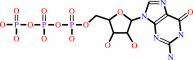 GTP
GTP
|
+
|
H(+)
|
=
|
Mo-molybdopterin guanine dinucleotide
|
+
|
 diphosphate
|
|
|
|
|
|
|
|
|
|
|
|
|
Molecule diagrams generated from .mol files obtained from the
KEGG ftp site
|
|
|
|
|
|
|
|
|
|
|
|
|
|
 |
|
|
|
|
|
|
| |
|
|
| |
|
DOI no:
|
Structure
8:1115-1125
(2000)
|
|
PubMed id:
|
|
|
|
|
|
| |
|
Crystal structure of the molybdenum cofactor biosynthesis protein MobA from Escherichia coli at near-atomic resolution.
|
|
C.E.Stevenson,
F.Sargent,
G.Buchanan,
T.Palmer,
D.M.Lawson.
|
|
|
|
|
| |
ABSTRACT
|
|
|
|
| |
|
|
BACKGROUND: All mononuclear molybdoenzymes bind molybdenum in a complex with an
organic cofactor termed molybdopterin (MPT). In many bacteria, including
Escherichia coli, molybdopterin can be further modified by attachment of a GMP
group to the terminal phosphate of molybdopterin to form molybdopterin guanine
dinucleotide (MGD). This modification reaction is required for the functioning
of many bacterial molybdoenzymes, including the nitrate reductases,
dimethylsulfoxide (DMSO) and trimethylamine-N-oxide (TMAO) reductases, and
formate dehydrogenases. The GMP attachment step is catalyzed by the cellular
enzyme MobA. RESULTS: The crystal structure of the 21.6 kDa E. coli MobA has
been determined by MAD phasing with selenomethionine-substituted protein and
subsequently refined at 1. 35 A resolution against native data. The structure
consists of a central, predominantly parallel beta sheet sandwiched between two
layers of alpha helices and resembles the dinucleotide binding Rossmann fold.
One face of the molecule bears a wide depression that is lined by a number of
strictly conserved residues, and this feature suggests that this is where
substrate binding and catalysis take place. CONCLUSIONS: Through comparisons
with a number of structural homologs, we have assigned plausible functions to
several of the residues that line the substrate binding pocket. The enzymatic
mechanism probably proceeds via a nucleophilic attack by MPT on the GMP donor,
most likely GTP, to produce MGD and pyrophosphate. By analogy with related
enzymes, this process is likely to require magnesium ions.
|
|
|
|
|
|
| |
Selected figure(s)
|
|
|
|
| |
|
|

|
|
Figure 5.
Figure 5. The Putative Substrate Binding Pocket of MobA(a)
Ribbon diagram showing the locations of strictly conserved
surface residues. The diagram was produced with MOLSCRIPT [53]
and Raster3D [54] (blue = nitrogen, RED = oxygen, YELLOW =
carbon).(b) Molecular surface displaying degrees of sequence
identity for residues in and around the pocket according to the
alignment shown in Figure 4. Warm colors indicate a high level
of sequence identity, while cold colors indicate little or no
conservation. Strictly conserved residues are shown in red.(b)
Electrostatic surface potentials of MobA. Potentials of less
than -10 kT, neutral, and greater than 10 kT are displayed in
red, white, and blue, respectively.Surfaces for (a) and (b) were
calculated with SwissPDBviewer [55] (http://www.expasy.ch/spdbv)
and rendered using POV-Ray (http://www.povray.org). In order to
get a more accurate impression of the surface conservations and
charge, those side chains that could not be confidently placed
in electron density were inserted and modeled into energetically
favorable conformations. This was necessary for only one
strictly conserved residue, namely Arg-19. All parts of this
figure display the same view of the molecule. The white line
delineates the proposed substrate binding pocket, and the labels
A-D are for use in the discussion

|
|
|
|
|
|
| |
The above figure is
reprinted
by permission from Cell Press:
Structure
(2000,
8,
1115-1125)
copyright 2000.
|
|
| |
Figure was
selected
by the author.
|
|
|
|
|
|
|
|
|
|
|
|
|
|
|
|
 |
 |
 |
|
Literature references that cite this PDB file's key reference
|
|
|
| |
PubMed id
|
|
Reference
|
|
|
|
|
|
G.Schwarz,
R.R.Mendel,
and
M.W.Ribbe
(2009).
Molybdenum cofactors, enzymes and pathways.
|
| |
Nature,
460,
839-847.
|
|
|
|
|
|
|
R.Sanishvili,
S.Beasley,
T.Skarina,
D.Glesne,
A.Joachimiak,
A.Edwards,
and
A.Savchenko
(2004).
The crystal structure of Escherichia coli MoaB suggests a probable role in molybdenum cofactor synthesis.
|
| |
J Biol Chem,
279,
42139-42146.
|
|
|
PDB code:
|
|
|
|
|
|
|
|
A.Guse,
C.E.Stevenson,
J.Kuper,
G.Buchanan,
G.Schwarz,
G.Giordano,
A.Magalon,
R.R.Mendel,
D.M.Lawson,
and
T.Palmer
(2003).
Biochemical and structural analysis of the molybdenum cofactor biosynthesis protein MobA.
|
| |
J Biol Chem,
278,
25302-25307.
|
|
|
PDB codes:
|
|
|
|
|
|
|
|
K.McLuskey,
J.A.Harrison,
A.W.Schuttelkopf,
D.H.Boxer,
and
W.N.Hunter
(2003).
Insight into the role of Escherichia coli MobB in molybdenum cofactor biosynthesis based on the high resolution crystal structure.
|
| |
J Biol Chem,
278,
23706-23713.
|
|
|
PDB code:
|
|
|
|
|
|
|
|
U.Frerichs-Deeken,
B.Goldenstedt,
R.Gahl-Janssen,
R.Kappl,
J.Hüttermann,
and
S.Fetzner
(2003).
Functional expression of the quinoline 2-oxidoreductase genes (qorMSL) in Pseudomonas putida KT2440 pUF1 and in P. putida 86-1 deltaqor pUF1 and analysis of the Qor proteins.
|
| |
Eur J Biochem,
270,
1567-1577.
|
|
|
|
|
|
|
A.Magalon,
C.Frixon,
J.Pommier,
G.Giordano,
and
F.Blasco
(2002).
In vivo interactions between gene products involved in the final stages of molybdenum cofactor biosynthesis in Escherichia coli.
|
| |
J Biol Chem,
277,
48199-48204.
|
|
|
|
|
|
|
I.Israel,
M.Sohni,
and
S.Fetzner
(2002).
Expression of the iorAB genes from Brevundimonas diminuta 7 encoding the molybdenum hydroxylase isoquinoline 1-oxidoreductase in Pseudomonas putida.
|
| |
FEMS Microbiol Lett,
210,
123-127.
|
|
|
|
|
|
|
C.Peneff,
P.Ferrari,
V.Charrier,
Y.Taburet,
C.Monnier,
V.Zamboni,
J.Winter,
M.Harnois,
F.Fassy,
and
Y.Bourne
(2001).
Crystal structures of two human pyrophosphorylase isoforms in complexes with UDPGlc(Gal)NAc: role of the alternatively spliced insert in the enzyme oligomeric assembly and active site architecture.
|
| |
EMBO J,
20,
6191-6202.
|
|
|
PDB codes:
|
|
|
|
|
|
|
The most recent references are shown first.
Citation data come partly from CiteXplore and partly
from an automated harvesting procedure. Note that this is likely to be
only a partial list as not all journals are covered by
either method. However, we are continually building up the citation data
so more and more references will be included with time.
Where a reference describes a PDB structure, the PDB
code is
shown on the right.
|
|


 Links
Links


