 |
PDBsum entry 1arh

|
|
|
|
|
|

|

|

|

|
|

|
|

|
|

|
|

|
|

|
|

|
|
|
 |

|

|
|
|
|
|
|
|
|
|
|
|
|
|
|
|
|
|
|
|
|
|
|
|
|
|
|
|
|
|
|
|
|
|
|
|
Transferase (aminotransferase)
|
PDB id
|
|
|
|
1arh
|
|
|
|
|
|
|
|
|
|
|
|
|
|
|

|

|

|
|
|
|
|
|
|
|
 |
Contents |
 |
|
|
|
|
|
|
|
|
|
|
|
|
* Residue conservation analysis
|
|
|
|
|
|
|
|
|
|
|
Enzyme class:
|
|
E.C.2.6.1.1
- aspartate transaminase.
|
|
|
|
|
|
|
Reaction:
|
|
L-aspartate + 2-oxoglutarate = oxaloacetate + L-glutamate
|
|
|
|
|
|
 L-aspartate
|
+
|
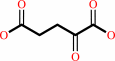 2-oxoglutarate
|
=
|
 oxaloacetate
|
+
|
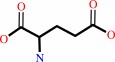 L-glutamate
|
|
|
|
|
|
|
|
|
|
Cofactor:
|
|
Pyridoxal 5'-phosphate
|
|
|
|
|
|
Pyridoxal 5'-phosphate
Bound ligand (Het Group name =
PPD)
matches with 60.00% similarity
|
|
|
|
|
|
|
Molecule diagrams generated from .mol files obtained from the
KEGG ftp site
|
|
|
|
|
|
|
|
|
|
|
|
|
|
 |
|
|
|
|
|
|
| |
|
|
| |
|
|
Eur J Biochem
232:686-690
(1995)
|
|
PubMed id:
|
|
|
|
|
|
| |
|
Changing the reaction specificity of a pyridoxal-5'-phosphate-dependent enzyme.
|
|
R.Graber,
P.Kasper,
V.N.Malashkevich,
E.Sandmeier,
P.Berger,
H.Gehring,
J.N.Jansonius,
P.Christen.
|
|
|
|
|
| |
ABSTRACT
|
|
|
|
| |
|
|
The electron distribution in the coenzyme-substrate adduct of aspartate
aminotransferase was changed by replacing active-site Arg386 with alanine and
introducing a new arginine residue nearby. [Y225R, R386A]Aspartate
aminotransferase decarboxylates L-aspartate to L-alanine (kcat = 0.04 s-1),
while its transaminase activity towards dicarboxylic amino acids is decreased by
three orders of magnitude (kcat = 0.19 s-1). Molecular-dynamics simulations
based on the crystal structure of the mutant enzyme suggest that a new hydrogen
bond to the imine N atom of the pyridoxal-5'-phosphate- aspartate adduct and an
altered electrostatic potential around its beta-carboxylate group underlie the
650,000-fold increase in the ratio of beta-decarboxylase/transaminase activity.
|
|
|
|
|
|
|
|
|
|
|
|
|
|
|
|
|
|
 |
 |
 |
|
Literature references that cite this PDB file's key reference
|
|
|
| |
PubMed id
|
|
Reference
|
|
|
|
|
|
R.Day,
X.Qu,
R.Swanson,
Z.Bohannan,
R.Bliss,
and
J.Tsai
(2011).
Relative packing groups in template-based structure prediction: cooperative effects of true positive constraints.
|
| |
J Comput Biol,
18,
17-26.
|
|
|
|
|
|
|
P.H.Lodha,
A.F.Jaworski,
and
S.M.Aitken
(2010).
Characterization of site-directed mutants of residues R58, R59, D116, W340 and R372 in the active site of E. coli cystathionine beta-lyase.
|
| |
Protein Sci,
19,
383-391.
|
|
|
|
|
|
|
L.Qu,
J.Wan,
Y.Cao,
Y.Zhang,
R.Chen,
and
Y.Huang
(2008).
Analyzing and modeling the inhibitory effect of phosphatidic acid on the GTP-gamma-S binding activity of Goalpha.
|
| |
Proteins,
71,
1732-1743.
|
|
|
|
|
|
|
S.Lima,
R.Khristoforov,
C.Momany,
and
R.S.Phillips
(2007).
Crystal structure of Homo sapiens kynureninase.
|
| |
Biochemistry,
46,
2735-2744.
|
|
|
PDB code:
|
|
|
|
|
|
|
|
L.Feng,
M.K.Geck,
A.C.Eliot,
and
J.F.Kirsch
(2000).
Aminotransferase activity and bioinformatic analysis of 1-aminocyclopropane-1-carboxylate synthase.
|
| |
Biochemistry,
39,
15242-15249.
|
|
|
|
|
|
|
R.Talwar,
J.R.Jagath,
N.A.Rao,
and
H.S.Savithri
(2000).
His230 of serine hydroxymethyltransferase facilitates the proton abstraction step in catalysis.
|
| |
Eur J Biochem,
267,
1441-1446.
|
|
|
|
|
|
|
R.Talwar,
N.A.Rao,
and
H.S.Savithri
(2000).
A change in reaction specificity of sheep liver serine hydroxymethyltransferase. Induction of NADH oxidation upon mutation of His230 to Tyr.
|
| |
Eur J Biochem,
267,
929-934.
|
|
|
|
|
|
|
A.Huber,
S.Demartis,
and
D.Neri
(1999).
The use of biosensor technology for the engineering of antibodies and enzymes.
|
| |
J Mol Recognit,
12,
198-216.
|
|
|
|
|
|
|
B.Mouratou,
P.Kasper,
H.Gehring,
and
P.Christen
(1999).
Conversion of tyrosine phenol-lyase to dicarboxylic amino acid beta-lyase, an enzyme not found in nature.
|
| |
J Biol Chem,
274,
1320-1325.
|
|
|
|
|
|
|
P.J.O'Brien,
and
D.Herschlag
(1999).
Catalytic promiscuity and the evolution of new enzymatic activities.
|
| |
Chem Biol,
6,
R91.
|
|
|
|
|
|
|
R.Graber,
P.Kasper,
V.N.Malashkevich,
P.Strop,
H.Gehring,
J.N.Jansonius,
and
P.Christen
(1999).
Conversion of aspartate aminotransferase into an L-aspartate beta-decarboxylase by a triple active-site mutation.
|
| |
J Biol Chem,
274,
31203-31208.
|
|
|
|
|
|
|
R.A.Vacca,
S.Giannattasio,
R.Graber,
E.Sandmeier,
E.Marra,
and
P.Christen
(1997).
Active-site Arg --> Lys substitutions alter reaction and substrate specificity of aspartate aminotransferase.
|
| |
J Biol Chem,
272,
21932-21937.
|
|
|
|
|
|
|
Y.Park,
J.Luo,
P.G.Schultz,
and
J.F.Kirsch
(1997).
Noncoded amino acid replacement probes of the aspartate aminotransferase mechanism.
|
| |
Biochemistry,
36,
10517-10525.
|
|
|
|
|
|
|
R.Contestabile,
and
R.A.John
(1996).
The mechanism of high-yielding chiral syntheses catalysed by wild-type and mutant forms of aspartate aminotransferase.
|
| |
Eur J Biochem,
240,
150-155.
|
|
|
|
|
|
|
W.M.Jones,
P.W.van Ophem,
M.A.Pospischil,
D.Ringe,
G.Petsko,
K.Soda,
and
J.M.Manning
(1996).
The ubiquitous cofactor NADH protects against substrate-induced inhibition of a pyridoxal enzyme.
|
| |
Protein Sci,
5,
2545-2551.
|
|
|
|
|
|
The most recent references are shown first.
Citation data come partly from CiteXplore and partly
from an automated harvesting procedure. Note that this is likely to be
only a partial list as not all journals are covered by
either method. However, we are continually building up the citation data
so more and more references will be included with time.
Where a reference describes a PDB structure, the PDB
code is
shown on the right.
|
|


 Links
Links


