
|
|
|
|
|
 |
Contents |
 |
|
|
|
|
|
|
|
|
|
|
|
 283 a.a.
|
|
|
|
|
|
|
|
|
|
|
 268 a.a.
|
|
|
|
|
|
|
|
|
|
|
 235 a.a.
|
|
|
|
|
|
|
|
|
|
|
 60 a.a.
|
|
|
|
|
|
|
|
|
|
|
* Residue conservation analysis
|
|
|
|
|
|
PDB id:
|
|
|
|
| Name: |
|
Virus
|
|
|
Title:
|
|
P1/mahoney poliovirus, single site mutant v1160i
|
|
Structure:
|
|
P1/mahoney poliovirus. Chain: 0. Fragment: virus protomer. Engineered: yes. Mutation: yes. P1/mahoney poliovirus. Chain: 1. Fragment: virus protomer. Engineered: yes.
|
|
Source:
|
|
Human poliovirus 1. Organism_taxid: 12081. Strain: mahoney. Strain: mahoney
|
|
Resolution:
|
|
|
|
Authors:
|
|
M.W.Wien,S.Curry,D.J.Filman,J.M.Hogle
|
|
Key ref:
|
|
M.W.Wien
et al.
(1997).
Structural studies of poliovirus mutants that overcome receptor defects.
Nat Struct Biol,
4,
666-674.
PubMed id:
|
|
|
Date:
|
|
|
09-Jun-97
|
Release date:
|
19-Nov-97
|
|
|
|
|
|
|
PROCHECK
|

|
|
|
|
|
Headers
|
|
|
|
References
|
|
|
|
|
|

|
|
P03300
(POLG_POL1M) -
Genome polyprotein from Poliovirus type 1 (strain Mahoney)
|
|
|
|
Seq:
Struc:
|
|
|
|
2209 a.a.
283 a.a.*
|
|

|

|
|
|
|
|
|
|
|
|
|
|
|
|

|
|
P03300
(POLG_POL1M) -
Genome polyprotein from Poliovirus type 1 (strain Mahoney)
|
|
|
|
Seq:
Struc:
|
|
|
|
2209 a.a.
268 a.a.
|
|
|

|
|
|
|
|
|
|
|
|
|
|
|
|
|
|
|
|
|
Enzyme class 2:
|
|
Chains 1, 2, 3, 4:
E.C.2.7.7.48
- RNA-directed Rna polymerase.
|
|
|
|
|
|
|
Reaction:
|
|
RNA(n) + a ribonucleoside 5'-triphosphate = RNA(n+1) + diphosphate
|
|
|
|
|
|
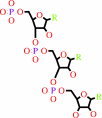 RNA(n)
|
+
|
ribonucleoside 5'-triphosphate
|
=
|
RNA(n+1)
|
+
|
 diphosphate
|
|
|
|
|
|
|
|
|
|
Enzyme class 3:
|
|
Chains 1, 2, 3, 4:
E.C.3.4.22.28
- picornain 3C.
|
|
|
|
|
|
|
Reaction:
|
|
Selective cleavage of Gln-|-Gly bond in the poliovirus polyprotein. In other picornavirus reactions Glu may be substituted for Gln, and Ser or Thr for Gly.
|
|
|
|
|
|
Enzyme class 4:
|
|
Chains 1, 2, 3, 4:
E.C.3.4.22.29
- picornain 2A.
|
|
|
|
|
|
|
Reaction:
|
|
Selective cleavage of Tyr-|-Gly bond in the picornavirus polyprotein. In other picornavirus reactions Glu may be substituted for Gln, and Ser or Thr for Gly.
|
|
|
|
|
|
Enzyme class 5:
|
|
Chains 1, 2, 3, 4:
E.C.3.6.1.15
- nucleoside-triphosphate phosphatase.
|
|
|
|
|
|
|
Reaction:
|
|
a ribonucleoside 5'-triphosphate + H2O = a ribonucleoside 5'-diphosphate + phosphate + H+
|
|
|
|
|
|
ribonucleoside 5'-triphosphate
|
+
|
H2O
|
=
|
ribonucleoside 5'-diphosphate
|
+
|
 phosphate
|
+
|
H(+)
|
|
|
|
|
|
|
|
|
|
|
|
|
Note, where more than one E.C. class is given (as above), each may
correspond to a different protein domain or, in the case of polyprotein
precursors, to a different mature protein.
|
|
|
|
Molecule diagrams generated from .mol files obtained from the
KEGG ftp site
|
|
|
|
|
|
|
|
|
|
|
|
|
|
 |
|
|
|
|
|
|
| |
|
|
| |
|
|
Nat Struct Biol
4:666-674
(1997)
|
|
PubMed id:
|
|
|
|
|
|
| |
|
Structural studies of poliovirus mutants that overcome receptor defects.
|
|
M.W.Wien,
S.Curry,
D.J.Filman,
J.M.Hogle.
|
|
|
|
|
| |
ABSTRACT
|
|
|
|
| |
|
|
In order to better understand the process of cell entry for non-enveloped
viruses, we have solved the crystal structures of five poliovirus mutants which
can infect cells expressing mutant poliovirus receptors. Four of these
structures have been solved from frozen crystals using cryocrystallographic data
collection methods. The mutations have a range of structural consequences, from
small local perturbations to significant loop rearrangements. All of the mutant
viruses are more labile to conversion to an apparent cell entry intermediate,
suggesting that these mutant viruses could compensate for the suboptimal
receptors by lowering the thermal energy required to undergo the
receptor-mediated conformational change.
|
|
|
|
|
|
|
|
|
|
|
|
|
|
|
|
|
|
 |
 |
 |
|
Literature references that cite this PDB file's key reference
|
|
|
| |
PubMed id
|
|
Reference
|
|
|
|
|
|
H.C.Levy,
M.Bostina,
D.J.Filman,
and
J.M.Hogle
(2010).
Catching a virus in the act of RNA release: a novel poliovirus uncoating intermediate characterized by cryo-electron microscopy.
|
| |
J Virol,
84,
4426-4441.
|
|
|
PDB codes:
|
|
|
|
|
|
|
|
B.H.Chua,
P.Phuektes,
S.A.Sanders,
P.K.Nicholls,
and
P.C.McMinn
(2008).
The molecular basis of mouse adaptation by human enterovirus 71.
|
| |
J Gen Virol,
89,
1622-1632.
|
|
|
|
|
|
|
E.Dedepsidis,
Z.Kyriakopoulou,
V.Pliaka,
C.Kottaridi,
E.Bolanaki,
S.Levidiotou-Stefanou,
D.Komiotis,
and
P.Markoulatos
(2007).
Retrospective characterization of a vaccine-derived poliovirus type 1 isolate from sewage in Greece.
|
| |
Appl Environ Microbiol,
73,
6697-6704.
|
|
|
|
|
|
|
K.J.Koudelka,
C.S.Rae,
M.J.Gonzalez,
and
M.Manchester
(2007).
Interaction between a 54-kilodalton mammalian cell surface protein and cowpea mosaic virus.
|
| |
J Virol,
81,
1632-1640.
|
|
|
|
|
|
|
E.Dedepsidis,
I.Karakasiliotis,
E.Paximadi,
Z.Kyriakopoulou,
D.Komiotis,
and
P.Markoulatos
(2006).
Detection of unusual mutation within the VP1 region of different re-isolates of poliovirus Sabin vaccine.
|
| |
Virus Genes,
33,
183-191.
|
|
|
|
|
|
|
J.Reguera,
A.Carreira,
L.Riolobos,
J.M.Almendral,
and
M.G.Mateu
(2004).
Role of interfacial amino acid residues in assembly, stability, and conformation of a spherical virus capsid.
|
| |
Proc Natl Acad Sci U S A,
101,
2724-2729.
|
|
|
|
|
|
|
J.M.Hogle
(2002).
Poliovirus cell entry: common structural themes in viral cell entry pathways.
|
| |
Annu Rev Microbiol,
56,
677-702.
|
|
|
|
|
|
|
J.Martín,
and
P.D.Minor
(2002).
Characterization of CHAT and Cox type 1 live-attenuated poliovirus vaccine strains.
|
| |
J Virol,
76,
5339-5349.
|
|
|
|
|
|
|
P.C.McMinn
(2002).
An overview of the evolution of enterovirus 71 and its clinical and public health significance.
|
| |
FEMS Microbiol Rev,
26,
91.
|
|
|
|
|
|
|
D.M.Belnap,
D.J.Filman,
B.L.Trus,
N.Cheng,
F.P.Booy,
J.F.Conway,
S.Curry,
C.N.Hiremath,
S.K.Tsang,
A.C.Steven,
and
J.M.Hogle
(2000).
Molecular tectonic model of virus structural transitions: the putative cell entry states of poliovirus.
|
| |
J Virol,
74,
1342-1354.
|
|
|
|
|
|
|
E.V.Grgacic,
and
H.Schaller
(2000).
A metastable form of the large envelope protein of duck hepatitis B virus: low-pH release results in a transition to a hydrophobic, potentially fusogenic conformation.
|
| |
J Virol,
74,
5116-5122.
|
|
|
|
|
|
|
J.J.Rux,
and
R.M.Burnett
(1998).
Spherical viruses.
|
| |
Curr Opin Struct Biol,
8,
142-149.
|
|
|
|
|
|
|
Z.Che,
N.H.Olson,
D.Leippe,
W.M.Lee,
A.G.Mosser,
R.R.Rueckert,
T.S.Baker,
and
T.J.Smith
(1998).
Antibody-mediated neutralization of human rhinovirus 14 explored by means of cryoelectron microscopy and X-ray crystallography of virus-Fab complexes.
|
| |
J Virol,
72,
4610-4622.
|
|
|
PDB code:
|
|
|
|
|
|
|
The most recent references are shown first.
Citation data come partly from CiteXplore and partly
from an automated harvesting procedure. Note that this is likely to be
only a partial list as not all journals are covered by
either method. However, we are continually building up the citation data
so more and more references will be included with time.
Where a reference describes a PDB structure, the PDB
codes are
shown on the right.
|

| |


 Links
Links


