 |
PDBsum entry 1a06

|
|
|
|
|
 |
Contents |
 |
|
|
|
|
|
|
|
|
|
|
* Residue conservation analysis
|
|
|
|
|
|
|
|
|
|
|
Enzyme class:
|
|
E.C.2.7.11.17
- calcium/calmodulin-dependent protein kinase.
|
|
|
|
|
|
|
Reaction:
|
|
|
1.
|
L-seryl-[protein] + ATP = O-phospho-L-seryl-[protein] + ADP + H+
|
|
2.
|
L-threonyl-[protein] + ATP = O-phospho-L-threonyl-[protein] + ADP + H+
|
|
|
|
|
|
|
L-seryl-[protein]
|
+
|
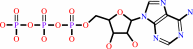 ATP
ATP
|
=
|
O-phospho-L-seryl-[protein]
|
+
|
 ADP
ADP
|
+
|
H(+)
|
|
|
|
|
|
|
L-threonyl-[protein]
|
+
|
ATP
|
=
|
O-phospho-L-threonyl-[protein]
|
+
|
ADP
|
+
|
H(+)
|
|
|
|
|
|
|
|
|
|
Cofactor:
|
|
Ca(2+)
|
|
|
|
|
|
|
|
|
Molecule diagrams generated from .mol files obtained from the
KEGG ftp site
|
|
|
|
|
|
|
|
|
|
|
|
|
|
 |
|
|
|
|
|
|
| |
|
|
| |
|
DOI no:
|
Cell
84:875-887
(1996)
|
|
PubMed id:
|
|
|
|
|
|
| |
|
Structural basis for the autoinhibition of calcium/calmodulin-dependent protein kinase I.
|
|
J.Goldberg,
A.C.Nairn,
J.Kuriyan.
|
|
|
|
|
| |
ABSTRACT
|
|
|
|
| |
|
|
The crystal structure of calcium/calmodulin-dependent protein kinase I has been
determined in the autoinhibited form. The C-terminal regulatory region of the
enzyme forms a helix-loop-helix segment that extends across the two domains of
the catalytic core, making multiple inhibitory interactions. Elements of the
first regulatory alpha helix and the loop interfere with the binding site for
peptide substrates, while the loop and the second helix interact with the
ATP-binding domain to induce conformational changes that obstruct the nucleotide
binding pocket. One part of the calmodulin recognition element protrudes away
from the catalytic domain and is potentially available for an initial
interaction with calmodulin. The structure provides a view of an intact
calmodulin target and suggests that substantial structural changes will
accompany kinase activation by calmodulin binding to the regulatory region.
|
|
|
|
|
|
| |
Selected figure(s)
|
|
|
|
| |
|
|

|
|

|
|
Figure 1.
Figure 1. Comparison of the Fold of Autoinhibited CaM
Kinase I with cAPK(A) Ribbon drawing of CaM kinase I (CaMKI;
left) and cAPK (right). The structures of autoinhibited CaMKI
and cAPK are drawn with their C-terminal lobes (helical domain
at bottom) in similar orientations. The cAPK structure is
that of [69], with the PKI peptide inhibitor colored orange and
the ATP shown in ball and stick form (entry 1ATP in the
Brookhaven Protein Data Bank). cAPK has its two domains in a
closed conformation whereas the CaMKI active site is opened
by an 18° relative rotation of the domains, with respect to
cAPK. The regulatory C-terminal sequence of CaMKI, containing
the autoinhibitory region, is colored red (residues 285–316).
The ATP-binding glycine-rich loop or P loop (colored green in
both structures; residues 23–36 in CaMKI, 46–59 in cAPK)
covers the ATP molecule in cAPK. In CaMKI, the P loop interacts
with the autoinhibitory region and adopts a distinct
conformation that distorts the ATP-binding site. Two
disordered regions of CaMKI in the crystal structure are
indicated with dotted lines (ten residues, 54–63, not modeled
in the N-terminal domain, and eighteen residues, 164–181, in
the C-terminal domain, are indicated by the corresponding number
of dots). The region of CaM kinase I that is boxed is shown in
detail in (B).(B) Stereo-diagram showing the interaction between
the CaMKI regulatory segment (red, residues 285–316) and the
catalytic core of the enzyme (gray). Selected residues of the
regulatory region are drawn in white, and residues from the
catalytic core are colored blue. Figure prepared using the
programs MOLSCRIPT ([41]) and Raster3D ( [2]).
|
|
Figure 4.
Figure 4. Solvent-Accessible Surface of Autoinhibited
CaMKIThe C-terminal sequence was omitted from the surface
calculation and, instead, is drawn as a red tube (residues
280–316). The side chains of hydrophobic residues (Ala, Cys,
Ile, Leu, Met, Phe, Trp, Tyr, and Val) that are located in the
C-terminal region are drawn in yellow. The autoinhibitory
sequence, defined by truncation mutagenesis ([25 and 65]) and by
this structural study, is drawn in magenta. Figure was generated
using the program GRASP ( [53]).
|
|
|
|
|
|
| |
The above figures are
reprinted
by permission from Cell Press:
Cell
(1996,
84,
875-887)
copyright 1996.
|
|
| |
Figures were
selected
by an automated process.
|
|
|
|
|
|
|
|
|
|
|
|
|
|
|
|
 |
 |
 |
|
Literature references that cite this PDB file's key reference
|
|
|
| |
PubMed id
|
|
Reference
|
|
|
|
|
|
J.L.Gifford,
H.Ishida,
and
H.J.Vogel
(2011).
Fast methionine-based solution structure determination of calcium-calmodulin complexes.
|
| |
J Biomol NMR,
50,
71-81.
|
|
|
PDB code:
|
|
|
|
|
|
|
|
L.Hoffman,
R.A.Stein,
R.J.Colbran,
and
H.S.Mchaourab
(2011).
Conformational changes underlying calcium/calmodulin-dependent protein kinase II activation.
|
| |
EMBO J,
30,
1251-1262.
|
|
|
|
|
|
|
C.Doerig,
and
O.Billker
(2010).
A parasite calcium switch and Achilles' heel revealed.
|
| |
Nat Struct Mol Biol,
17,
541-543.
|
|
|
|
|
|
|
M.C.Pirrung
(2010).
His-tags lighten up and lose their inhibitions.
|
| |
Proc Natl Acad Sci U S A,
107,
6123-6124.
|
|
|
|
|
|
|
P.Gruszczyński,
M.Obuchowski,
and
R.Kaźmierkiewicz
(2010).
Phosphorylation and ATP-binding induced conformational changes in the PrkC, Ser/Thr kinase from B. subtilis.
|
| |
J Comput Aided Mol Des,
24,
733-747.
|
|
|
|
|
|
|
P.Rellos,
A.C.Pike,
F.H.Niesen,
E.Salah,
W.H.Lee,
F.von Delft,
and
S.Knapp
(2010).
Structure of the CaMKIIdelta/calmodulin complex reveals the molecular mechanism of CaMKII kinase activation.
|
| |
PLoS Biol,
8,
e1000426.
|
|
|
PDB codes:
|
|
|
|
|
|
|
|
Y.Zhang,
H.Tan,
G.Chen,
and
Z.Jia
(2010).
Investigating the disorder-order transition of calmodulin binding domain upon binding calmodulin using molecular dynamics simulation.
|
| |
J Mol Recognit,
23,
360-368.
|
|
|
|
|
|
|
D.W.Pettigrew
(2009).
Oligomeric interactions provide alternatives to direct steric modes of control of sugar kinase/actin/hsp70 superfamily functions by heterotropic allosteric effectors: inhibition of E. coli glycerol kinase.
|
| |
Arch Biochem Biophys,
492,
29-39.
|
|
|
|
|
|
|
J.S.Oakhill,
J.W.Scott,
and
B.E.Kemp
(2009).
Structure and function of AMP-activated protein kinase.
|
| |
Acta Physiol (Oxf),
196,
3.
|
|
|
|
|
|
|
S.Kang,
S.Elf,
S.Dong,
T.Hitosugi,
K.Lythgoe,
A.Guo,
H.Ruan,
S.Lonial,
H.J.Khoury,
I.R.Williams,
B.H.Lee,
J.L.Roesel,
G.Karsenty,
A.Hanauer,
J.Taunton,
T.J.Boggon,
T.L.Gu,
and
J.Chen
(2009).
Fibroblast growth factor receptor 3 associates with and tyrosine phosphorylates p90 RSK2, leading to RSK2 activation that mediates hematopoietic transformation.
|
| |
Mol Cell Biol,
29,
2105-2117.
|
|
|
|
|
|
|
U.Klaschka
(2009).
A new challenge-development of test systems for the infochemical effect.
|
| |
Environ Sci Pollut Res Int,
16,
370-388.
|
|
|
|
|
|
|
A.C.Pike,
P.Rellos,
F.H.Niesen,
A.Turnbull,
A.W.Oliver,
S.A.Parker,
B.E.Turk,
L.H.Pearl,
and
S.Knapp
(2008).
Activation segment dimerization: a mechanism for kinase autophosphorylation of non-consensus sites.
|
| |
EMBO J,
27,
704-714.
|
|
|
PDB codes:
|
|
|
|
|
|
|
|
A.Ishida,
N.Sueyoshi,
Y.Shigeri,
and
I.Kameshita
(2008).
Negative regulation of multifunctional Ca2+/calmodulin-dependent protein kinases: physiological and pharmacological significance of protein phosphatases.
|
| |
Br J Pharmacol,
154,
729-740.
|
|
|
|
|
|
|
C.Johne,
D.Matenia,
X.Y.Li,
T.Timm,
K.Balusamy,
and
E.M.Mandelkow
(2008).
Spred1 and TESK1--Two New Interaction Partners of the Kinase MARKK/TAO1 That Link the Microtubule and Actin Cytoskeleton.
|
| |
Mol Biol Cell,
19,
1391-1403.
|
|
|
|
|
|
|
G.A.Wayman,
Y.S.Lee,
H.Tokumitsu,
A.J.Silva,
A.Silva,
and
T.R.Soderling
(2008).
Calmodulin-kinases: modulators of neuronal development and plasticity.
|
| |
Neuron,
59,
914-931.
|
|
|
|
|
|
|
K.Mukherjee,
M.Sharma,
H.Urlaub,
G.P.Bourenkov,
R.Jahn,
T.C.Südhof,
and
M.C.Wahl
(2008).
CASK Functions as a Mg2+-independent neurexin kinase.
|
| |
Cell,
133,
328-339.
|
|
|
PDB codes:
|
|
|
|
|
|
|
|
P.Gaines,
J.Lamoureux,
A.Marisetty,
J.Chi,
and
N.Berliner
(2008).
A cascade of Ca(2+)/calmodulin-dependent protein kinases regulates the differentiation and functional activation of murine neutrophils.
|
| |
Exp Hematol,
36,
832-844.
|
|
|
|
|
|
|
J.W.Scott,
F.A.Ross,
J.K.Liu,
and
D.G.Hardie
(2007).
Regulation of AMP-activated protein kinase by a pseudosubstrate sequence on the gamma subunit.
|
| |
EMBO J,
26,
806-815.
|
|
|
|
|
|
|
K.K.Frederick,
M.S.Marlow,
K.G.Valentine,
and
A.J.Wand
(2007).
Conformational entropy in molecular recognition by proteins.
|
| |
Nature,
448,
325-329.
|
|
|
|
|
|
|
T.A.Leonard,
and
J.H.Hurley
(2007).
Two kinase family dramas.
|
| |
Cell,
129,
1037-1038.
|
|
|
|
|
|
|
T.Pang,
B.Xiong,
J.Y.Li,
B.Y.Qiu,
G.Z.Jin,
J.K.Shen,
and
J.Li
(2007).
Conserved alpha-helix acts as autoinhibitory sequence in AMP-activated protein kinase alpha subunits.
|
| |
J Biol Chem,
282,
495-506.
|
|
|
|
|
|
|
A.Raichaudhuri,
R.Bhattacharyya,
S.Chaudhuri,
P.Chakrabarti,
and
M.Dasgupta
(2006).
Domain analysis of a groundnut calcium-dependent protein kinase: nuclear localization sequence in the junction domain is coupled with nonconsensus calcium binding domains.
|
| |
J Biol Chem,
281,
10399-10409.
|
|
|
PDB code:
|
|
|
|
|
|
|
|
D.S.Marlin,
D.González Cabrera,
D.A.Leigh,
and
A.M.Slawin
(2006).
An allosterically regulated molecular shuttle.
|
| |
Angew Chem Int Ed Engl,
45,
1385-1390.
|
|
|
|
|
|
|
L.Baekgaard,
L.Luoni,
M.I.De Michelis,
and
M.G.Palmgren
(2006).
The plant plasma membrane Ca2+ pump ACA8 contains overlapping as well as physically separated autoinhibitory and calmodulin-binding domains.
|
| |
J Biol Chem,
281,
1058-1065.
|
|
|
|
|
|
|
P.Pellicena,
and
J.Kuriyan
(2006).
Protein-protein interactions in the allosteric regulation of protein kinases.
|
| |
Curr Opin Struct Biol,
16,
702-709.
|
|
|
|
|
|
|
R.Jauch,
M.K.Cho,
S.Jäkel,
C.Netter,
K.Schreiter,
B.Aicher,
M.Zweckstetter,
H.Jäckle,
and
M.C.Wahl
(2006).
Mitogen-activated protein kinases interacting kinases are autoinhibited by a reprogrammed activation segment.
|
| |
EMBO J,
25,
4020-4032.
|
|
|
PDB codes:
|
|
|
|
|
|
|
|
A.G.Cook,
L.N.Johnson,
and
J.M.McDonnell
(2005).
Structural characterization of Ca2+/CaM in complex with the phosphorylase kinase PhK5 peptide.
|
| |
FEBS J,
272,
1511-1522.
|
|
|
|
|
|
|
E.D.Scheeff,
and
P.E.Bourne
(2005).
Structural evolution of the protein kinase-like superfamily.
|
| |
PLoS Comput Biol,
1,
e49.
|
|
|
|
|
|
|
M.Jenny,
O.A.Wrulich,
W.Schwaiger,
and
F.Ueberall
(2005).
Relevance of atypical protein kinase C isotypes to the drug discovery process.
|
| |
Chembiochem,
6,
491-499.
|
|
|
|
|
|
|
O.S.Rosenberg,
S.Deindl,
R.J.Sung,
A.C.Nairn,
and
J.Kuriyan
(2005).
Structure of the autoinhibited kinase domain of CaMKII and SAXS analysis of the holoenzyme.
|
| |
Cell,
123,
849-860.
|
|
|
PDB code:
|
|
|
|
|
|
|
|
A.P.Yamniuk,
and
H.J.Vogel
(2004).
Structurally homologous binding of plant calmodulin isoforms to the calmodulin-binding domain of vacuolar calcium-ATPase.
|
| |
J Biol Chem,
279,
7698-7707.
|
|
|
|
|
|
|
H.Tokumitsu,
N.Hatano,
H.Inuzuka,
S.Yokokura,
N.Nozaki,
and
R.Kobayashi
(2004).
Mechanism of the generation of autonomous activity of Ca2+/calmodulin-dependent protein kinase IV.
|
| |
J Biol Chem,
279,
40296-40302.
|
|
|
|
|
|
|
J.F.Harper,
G.Breton,
and
A.Harmon
(2004).
Decoding Ca(2+) signals through plant protein kinases.
|
| |
Annu Rev Plant Biol,
55,
263-288.
|
|
|
|
|
|
|
K.A.Anderson,
P.K.Noeldner,
K.Reece,
B.E.Wadzinski,
and
A.R.Means
(2004).
Regulation and function of the calcium/calmodulin-dependent protein kinase IV/protein serine/threonine phosphatase 2A signaling complex.
|
| |
J Biol Chem,
279,
31708-31716.
|
|
|
|
|
|
|
M.Y.Niv,
H.Rubin,
J.Cohen,
L.Tsirulnikov,
T.Licht,
A.Peretzman-Shemer,
E.Cna'an,
A.Tartakovsky,
I.Stein,
S.Albeck,
I.Weinstein,
M.Goldenberg-Furmanov,
D.Tobi,
E.Cohen,
M.Laster,
S.A.Ben-Sasson,
and
H.Reuveni
(2004).
Sequence-based design of kinase inhibitors applicable for therapeutics and target identification.
|
| |
J Biol Chem,
279,
1242-1255.
|
|
|
|
|
|
|
N.Fernandez-Fuentes,
A.Hermoso,
J.Espadaler,
E.Querol,
F.X.Aviles,
and
B.Oliva
(2004).
Classification of common functional loops of kinase super-families.
|
| |
Proteins,
56,
539-555.
|
|
|
|
|
|
|
N.Kannan,
and
A.F.Neuwald
(2004).
Evolutionary constraints associated with functional specificity of the CMGC protein kinases MAPK, CDK, GSK, SRPK, DYRK, and CK2alpha.
|
| |
Protein Sci,
13,
2059-2077.
|
|
|
|
|
|
|
A.Ishida,
Y.Shigeri,
T.Taniguchi,
and
I.Kameshita
(2003).
Protein phosphatases that regulate multifunctional Ca2+/calmodulin-dependent protein kinases: from biochemistry to pharmacology.
|
| |
Pharmacol Ther,
100,
291-305.
|
|
|
|
|
|
|
J.R.Hutchins,
D.Dikovskaya,
and
P.R.Clarke
(2003).
Regulation of Cdc2/cyclin B activation in Xenopus egg extracts via inhibitory phosphorylation of Cdc25C phosphatase by Ca(2+)/calmodulin-dependent protein [corrected] kinase II.
|
| |
Mol Biol Cell,
14,
4003-4014.
|
|
|
|
|
|
|
T.A.Young,
B.Delagoutte,
J.A.Endrizzi,
A.M.Falick,
and
T.Alber
(2003).
Structure of Mycobacterium tuberculosis PknB supports a universal activation mechanism for Ser/Thr protein kinases.
|
| |
Nat Struct Biol,
10,
168-174.
|
|
|
PDB code:
|
|
|
|
|
|
|
|
A.Hudmon,
and
H.Schulman
(2002).
Neuronal CA2+/calmodulin-dependent protein kinase II: the role of structure and autoregulation in cellular function.
|
| |
Annu Rev Biochem,
71,
473-510.
|
|
|
|
|
|
|
A.V.Velentza,
A.M.Schumacher,
and
D.M.Watterson
(2002).
Structure, activity, regulation, and inhibitor discovery for a protein kinase associated with apoptosis and neuronal death.
|
| |
Pharmacol Ther,
93,
217-224.
|
|
|
|
|
|
|
C.A.Chrestensen,
and
T.W.Sturgill
(2002).
Characterization of the p90 ribosomal S6 kinase 2 carboxyl-terminal domain as a protein kinase.
|
| |
J Biol Chem,
277,
27733-27741.
|
|
|
|
|
|
|
H.A.Burgess,
and
O.Reiner
(2002).
Alternative splice variants of doublecortin-like kinase are differentially expressed and have different kinase activities.
|
| |
J Biol Chem,
277,
17696-17705.
|
|
|
|
|
|
|
J.K.Kranz,
E.K.Lee,
A.C.Nairn,
and
A.J.Wand
(2002).
A direct test of the reductionist approach to structural studies of calmodulin activity: relevance of peptide models of target proteins.
|
| |
J Biol Chem,
277,
16351-16354.
|
|
|
|
|
|
|
M.Huse,
and
J.Kuriyan
(2002).
The conformational plasticity of protein kinases.
|
| |
Cell,
109,
275-282.
|
|
|
|
|
|
|
M.Ikura,
M.Osawa,
and
J.B.Ames
(2002).
The role of calcium-binding proteins in the control of transcription: structure to function.
|
| |
Bioessays,
24,
625-636.
|
|
|
|
|
|
|
P.J.Tsai,
J.Tu,
and
T.H.Chen
(2002).
Cloning of a Ca(2+)/calmodulin-dependent protein kinase gene from the filamentous fungus Arthrobotrys dactyloides.
|
| |
FEMS Microbiol Lett,
212,
7.
|
|
|
|
|
|
|
R.A.Engh,
and
D.Bossemeyer
(2002).
Structural aspects of protein kinase control-role of conformational flexibility.
|
| |
Pharmacol Ther,
93,
99.
|
|
|
|
|
|
|
W.Meng,
L.L.Swenson,
M.J.Fitzgibbon,
K.Hayakawa,
E.Ter Haar,
A.E.Behrens,
J.R.Fulghum,
and
J.A.Lippke
(2002).
Structure of mitogen-activated protein kinase-activated protein (MAPKAP) kinase 2 suggests a bifunctional switch that couples kinase activation with nuclear export.
|
| |
J Biol Chem,
277,
37401-37405.
|
|
|
PDB code:
|
|
|
|
|
|
|
|
A.J.Ablooglu,
M.Frankel,
E.Rusinova,
J.B.Ross,
and
R.A.Kohanski
(2001).
Multiple activation loop conformations and their regulatory properties in the insulin receptor's kinase domain.
|
| |
J Biol Chem,
276,
46933-46940.
|
|
|
|
|
|
|
G.Shohat,
T.Spivak-Kroizman,
O.Cohen,
S.Bialik,
G.Shani,
H.Berrisi,
M.Eisenstein,
and
A.Kimchi
(2001).
The pro-apoptotic function of death-associated protein kinase is controlled by a unique inhibitory autophosphorylation-based mechanism.
|
| |
J Biol Chem,
276,
47460-47467.
|
|
|
|
|
|
|
I.Lengyel,
A.Nairn,
A.McCluskey,
G.Tóth,
B.Penke,
and
J.Rostas
(2001).
Auto-inhibition of Ca(2+)/calmodulin-dependent protein kinase II by its ATP-binding domain.
|
| |
J Neurochem,
76,
1066-1072.
|
|
|
|
|
|
|
J.Gao,
Y.Yao,
and
T.C.Squier
(2001).
Oxidatively modified calmodulin binds to the plasma membrane Ca-ATPase in a nonproductive and conformationally disordered complex.
|
| |
Biophys J,
80,
1791-1801.
|
|
|
|
|
|
|
J.Rutter,
C.H.Michnoff,
S.M.Harper,
K.H.Gardner,
and
S.L.McKnight
(2001).
PAS kinase: an evolutionarily conserved PAS domain-regulated serine/threonine kinase.
|
| |
Proc Natl Acad Sci U S A,
98,
8991-8996.
|
|
|
|
|
|
|
M.Frankel,
A.J.Ablooglu,
J.W.Leone,
E.Rusinova,
J.B.Ross,
R.L.Heinrikson,
and
R.A.Kohanski
(2001).
Intrasteric inhibition of ATP binding is not required to prevent unregulated autophosphorylation or signaling by the insulin receptor.
|
| |
Mol Cell Biol,
21,
4197-4207.
|
|
|
|
|
|
|
S.S.Hook,
and
A.R.Means
(2001).
Ca(2+)/CaM-dependent kinases: from activation to function.
|
| |
Annu Rev Pharmacol Toxicol,
41,
471-505.
|
|
|
|
|
|
|
V.Tereshko,
M.Teplova,
J.Brunzelle,
D.M.Watterson,
and
M.Egli
(2001).
Crystal structures of the catalytic domain of human protein kinase associated with apoptosis and tumor suppression.
|
| |
Nat Struct Biol,
8,
899-907.
|
|
|
PDB codes:
|
|
|
|
|
|
|
|
A.M.Weljie,
T.E.Clarke,
A.H.Juffer,
A.C.Harmon,
and
H.J.Vogel
(2000).
Comparative modeling studies of the calmodulin-like domain of calcium-dependent protein kinase from soybean.
|
| |
Proteins,
39,
343-357.
|
|
|
|
|
|
|
A.Persechini,
K.Yano,
and
P.M.Stemmer
(2000).
Ca(2+) binding and energy coupling in the calmodulin-myosin light chain kinase complex.
|
| |
J Biol Chem,
275,
4199-4204.
|
|
|
|
|
|
|
A.Y.Jan,
E.F.Johnson,
A.J.Diamonti,
K.L.Carraway III,
and
K.S.Anderson
(2000).
Insights into the HER-2 receptor tyrosine kinase mechanism and substrate specificity using a transient kinetic analysis.
|
| |
Biochemistry,
39,
9786-9803.
|
|
|
|
|
|
|
C.D.Rasmussen
(2000).
Cloning of a calmodulin kinase I homologue from Schizosaccharomyces pombe.
|
| |
J Biol Chem,
275,
685-690.
|
|
|
|
|
|
|
D.Chin,
and
A.R.Means
(2000).
Calmodulin: a prototypical calcium sensor.
|
| |
Trends Cell Biol,
10,
322-328.
|
|
|
|
|
|
|
M.E.Wall,
S.C.Gallagher,
and
J.Trewhella
(2000).
Large-scale shape changes in proteins and macromolecular complexes.
|
| |
Annu Rev Phys Chem,
51,
355-380.
|
|
|
|
|
|
|
M.Robatzek,
and
J.H.Thomas
(2000).
Calcium/calmodulin-dependent protein kinase II regulates Caenorhabditis elegans locomotion in concert with a G(o)/G(q) signaling network.
|
| |
Genetics,
156,
1069-1082.
|
|
|
|
|
|
|
P.F.Chen,
and
K.K.Wu
(2000).
Characterization of the roles of the 594-645 region in human endothelial nitric-oxide synthase in regulating calmodulin binding and electron transfer.
|
| |
J Biol Chem,
275,
13155-13163.
|
|
|
|
|
|
|
S.J.Kolodziej,
A.Hudmon,
M.N.Waxham,
and
J.K.Stoops
(2000).
Three-dimensional reconstructions of calcium/calmodulin-dependent (CaM) kinase IIalpha and truncated CaM kinase IIalpha reveal a unique organization for its structural core and functional domains.
|
| |
J Biol Chem,
275,
14354-14359.
|
|
|
|
|
|
|
C.E.Poteet-Smith,
J.A.Smith,
D.A.Lannigan,
T.A.Freed,
and
T.W.Sturgill
(1999).
Generation of constitutively active p90 ribosomal S6 kinase in vivo. Implications for the mitogen-activated protein kinase-activated protein kinase family.
|
| |
J Biol Chem,
274,
22135-22138.
|
|
|
|
|
|
|
D.Chin,
J.L.Schreiber,
and
A.R.Means
(1999).
Calmodulin kinase II chimeras used to investigate the structural requirements for smooth muscle myosin light chain kinase autoinhibition and calmodulin-dependent activation.
|
| |
Biochemistry,
38,
15061-15069.
|
|
|
|
|
|
|
D.G.Hardie
(1999).
PLANT PROTEIN SERINE/THREONINE KINASES: Classification and Functions.
|
| |
Annu Rev Plant Physiol Plant Mol Biol,
50,
97.
|
|
|
|
|
|
|
D.Graves,
C.Bartleson,
A.Biorn,
and
M.Pete
(1999).
Substrate and inhibitor recognition of protein kinases: what is known about the catalytic subunit of phosphorylase kinase?
|
| |
Pharmacol Ther,
82,
143-155.
|
|
|
|
|
|
|
E.Yang,
and
H.Schulman
(1999).
Structural examination of autoregulation of multifunctional calcium/calmodulin-dependent protein kinase II.
|
| |
J Biol Chem,
274,
26199-26208.
|
|
|
|
|
|
|
H.A.Burgess,
S.Martinez,
and
O.Reiner
(1999).
KIAA0369, doublecortin-like kinase, is expressed during brain development.
|
| |
J Neurosci Res,
58,
567-575.
|
|
|
|
|
|
|
J.M.Sowadski,
L.F.Epstein,
L.Lankiewicz,
and
R.Karlsson
(1999).
Conformational diversity of catalytic cores of protein kinases.
|
| |
Pharmacol Ther,
82,
157-164.
|
|
|
|
|
|
|
M.Huse,
Y.G.Chen,
J.Massagué,
and
J.Kuriyan
(1999).
Crystal structure of the cytoplasmic domain of the type I TGF beta receptor in complex with FKBP12.
|
| |
Cell,
96,
425-436.
|
|
|
PDB code:
|
|
|
|
|
|
|
|
M.Matsushita,
and
A.C.Nairn
(1999).
Inhibition of the Ca2+/calmodulin-dependent protein kinase I cascade by cAMP-dependent protein kinase.
|
| |
J Biol Chem,
274,
10086-10093.
|
|
|
|
|
|
|
P.Mombaerts
(1999).
Seven-transmembrane proteins as odorant and chemosensory receptors.
|
| |
Science,
286,
707-711.
|
|
|
|
|
|
|
S.M.Bishop,
J.B.Ross,
and
R.A.Kohanski
(1999).
Autophosphorylation dependent destabilization of the insulin receptor kinase domain: tryptophan-1175 reports changes in the catalytic cleft.
|
| |
Biochemistry,
38,
3079-3089.
|
|
|
|
|
|
|
S.S.Hook,
B.E.Kemp,
and
A.R.Means
(1999).
Peptide specificity determinants at P-7 and P-6 enhance the catalytic efficiency of Ca2+/calmodulin-dependent protein kinase I in the absence of activation loop phosphorylation.
|
| |
J Biol Chem,
274,
20215-20222.
|
|
|
|
|
|
|
S.Steinbacher,
P.Hof,
L.Eichinger,
M.Schleicher,
J.Gettemans,
J.Vandekerckhove,
R.Huber,
and
J.Benz
(1999).
The crystal structure of the Physarum polycephalum actin-fragmin kinase: an atypical protein kinase with a specialized substrate-binding domain.
|
| |
EMBO J,
18,
2923-2929.
|
|
|
PDB code:
|
|
|
|
|
|
|
|
T.R.Soderling
(1999).
The Ca-calmodulin-dependent protein kinase cascade.
|
| |
Trends Biochem Sci,
24,
232-236.
|
|
|
|
|
|
|
T.Yuan,
M.P.Walsh,
C.Sutherland,
H.Fabian,
and
H.J.Vogel
(1999).
Calcium-dependent and -independent interactions of the calmodulin-binding domain of cyclic nucleotide phosphodiesterase with calmodulin.
|
| |
Biochemistry,
38,
1446-1455.
|
|
|
|
|
|
|
A.D.Cann,
S.M.Bishop,
A.J.Ablooglu,
and
R.A.Kohanski
(1998).
Partial activation of the insulin receptor kinase domain by juxtamembrane autophosphorylation.
|
| |
Biochemistry,
37,
11289-11300.
|
|
|
|
|
|
|
B.J.Graves,
D.O.Cowley,
T.L.Goetz,
J.M.Petersen,
M.D.Jonsen,
and
M.E.Gillespie
(1998).
Autoinhibition as a transcriptional regulatory mechanism.
|
| |
Cold Spring Harb Symp Quant Biol,
63,
621-629.
|
|
|
|
|
|
|
G.Zhi,
S.M.Abdullah,
and
J.T.Stull
(1998).
Regulatory segments of Ca2+/calmodulin-dependent protein kinases.
|
| |
J Biol Chem,
273,
8951-8957.
|
|
|
|
|
|
|
H.Sakaguchi,
H.Yokokura,
O.Terada,
Y.Naito,
Y.Nimura,
and
H.Hidaka
(1998).
Unique inhibitory action of the synthetic compound 2-[N-(2-aminoethyl)-N-(5-isoquinolinesulfonyl)] amino-N-(4-chlorocinnamyl)-N-methylbenzylamine (CKA-1306) against calcium/calmodulin-dependent protein kinase I.
|
| |
Biochem Pharmacol,
56,
329-334.
|
|
|
|
|
|
|
J.A.Thorson,
L.W.Yu,
A.L.Hsu,
N.Y.Shih,
P.R.Graves,
J.W.Tanner,
P.M.Allen,
H.Piwnica-Worms,
and
A.S.Shaw
(1998).
14-3-3 proteins are required for maintenance of Raf-1 phosphorylation and kinase activity.
|
| |
Mol Cell Biol,
18,
5229-5238.
|
|
|
|
|
|
|
J.Evenäs,
A.Malmendal,
and
S.Forsén
(1998).
Calcium.
|
| |
Curr Opin Chem Biol,
2,
293-302.
|
|
|
|
|
|
|
J.Krebs
(1998).
Calmodulin-dependent protein kinase IV: regulation of function and expression.
|
| |
Biochim Biophys Acta,
1448,
183-189.
|
|
|
|
|
|
|
J.Zhao,
E.Hoye,
S.Boylan,
D.A.Walsh,
and
J.Trewhella
(1998).
Quaternary structures of a catalytic subunit-regulatory subunit dimeric complex and the holoenzyme of the cAMP-dependent protein kinase by neutron contrast variation.
|
| |
J Biol Chem,
273,
30448-30459.
|
|
|
|
|
|
|
K.L.Longenecker,
P.J.Roach,
and
T.D.Hurley
(1998).
Crystallographic studies of casein kinase I delta toward a structural understanding of auto-inhibition.
|
| |
Acta Crystallogr D Biol Crystallogr,
54,
473-475.
|
|
|
|
|
|
|
M.Matsushita,
and
A.C.Nairn
(1998).
Characterization of the mechanism of regulation of Ca2+/ calmodulin-dependent protein kinase I by calmodulin and by Ca2+/calmodulin-dependent protein kinase kinase.
|
| |
J Biol Chem,
273,
21473-21481.
|
|
|
|
|
|
|
R.R.White,
Y.G.Kwon,
M.Taing,
D.S.Lawrence,
and
A.M.Edelman
(1998).
Definition of optimal substrate recognition motifs of Ca2+-calmodulin-dependent protein kinases IV and II reveals shared and distinctive features.
|
| |
J Biol Chem,
273,
3166-3172.
|
|
|
|
|
|
|
T.A.Millward,
C.W.Heizmann,
B.W.Schäfer,
and
B.A.Hemmings
(1998).
Calcium regulation of Ndr protein kinase mediated by S100 calcium-binding proteins.
|
| |
EMBO J,
17,
5913-5922.
|
|
|
|
|
|
|
T.Yuan,
A.M.Weljie,
and
H.J.Vogel
(1998).
Tryptophan fluorescence quenching by methionine and selenomethionine residues of calmodulin: orientation of peptide and protein binding.
|
| |
Biochemistry,
37,
3187-3195.
|
|
|
|
|
|
|
W.Wang,
P.Li,
A.Schettino,
Z.Peng,
and
M.McLeod
(1998).
Characterization of functional regions in the Schizosaccharomyces pombe mei3 developmental activator.
|
| |
Genetics,
150,
1007-1018.
|
|
|
|
|
|
|
D.Chin,
D.J.Sloan,
F.A.Quiocho,
and
A.R.Means
(1997).
Functional consequences of truncating amino acid side chains located at a calmodulin-peptide interface.
|
| |
J Biol Chem,
272,
5510-5513.
|
|
|
|
|
|
|
D.Chin,
K.E.Winkler,
and
A.R.Means
(1997).
Characterization of substrate phosphorylation and use of calmodulin mutants to address implications from the enzyme crystal structure of calmodulin-dependent protein kinase I.
|
| |
J Biol Chem,
272,
31235-31240.
|
|
|
|
|
|
|
F.Sicheri,
and
J.Kuriyan
(1997).
Structures of Src-family tyrosine kinases.
|
| |
Curr Opin Struct Biol,
7,
777-785.
|
|
|
|
|
|
|
J.K.Krueger,
G.A.Olah,
S.E.Rokop,
G.Zhi,
J.T.Stull,
and
J.Trewhella
(1997).
Structures of calmodulin and a functional myosin light chain kinase in the activated complex: a neutron scattering study.
|
| |
Biochemistry,
36,
6017-6023.
|
|
|
|
|
|
|
L.C.Groenen,
F.Walker,
A.W.Burgess,
and
H.R.Treutlein
(1997).
A model for the activation of the epidermal growth factor receptor kinase involvement of an asymmetric dimer?
|
| |
Biochemistry,
36,
3826-3836.
|
|
|
|
|
|
|
L.Hao,
T.Tiganis,
N.K.Tonks,
and
H.Charbonneau
(1997).
The noncatalytic C-terminal segment of the T cell protein tyrosine phosphatase regulates activity via an intramolecular mechanism.
|
| |
J Biol Chem,
272,
29322-29329.
|
|
|
|
|
|
|
N.Narayana,
S.Cox,
X.Nguyen-huu,
L.F.Ten Eyck,
and
S.S.Taylor
(1997).
A binary complex of the catalytic subunit of cAMP-dependent protein kinase and adenosine further defines conformational flexibility.
|
| |
Structure,
5,
921-935.
|
|
|
PDB code:
|
|
|
|
|
|
|
|
O.B.Peersen,
T.S.Madsen,
and
J.J.Falke
(1997).
Intermolecular tuning of calmodulin by target peptides and proteins: differential effects on Ca2+ binding and implications for kinase activation.
|
| |
Protein Sci,
6,
794-807.
|
|
|
|
|
|
|
S.Ohki,
M.Ikura,
and
M.Zhang
(1997).
Identification of Mg2+-binding sites and the role of Mg2+ on target recognition by calmodulin.
|
| |
Biochemistry,
36,
4309-4316.
|
|
|
|
|
|
|
S.Sarno,
P.Vaglio,
O.Marin,
O.G.Issinger,
K.Ruffato,
and
L.A.Pinna
(1997).
Mutational analysis of residues implicated in the interaction between protein kinase CK2 and peptide substrates.
|
| |
Biochemistry,
36,
11717-11724.
|
|
|
|
|
|
|
S.Wakabayashi,
T.Ikeda,
T.Iwamoto,
J.Pouysségur,
and
M.Shigekawa
(1997).
Calmodulin-binding autoinhibitory domain controls "pH-sensing" in the Na+/H+ exchanger NHE1 through sequence-specific interaction.
|
| |
Biochemistry,
36,
12854-12861.
|
|
|
|
|
|
|
A.Persechini,
P.M.Stemmer,
and
I.Ohashi
(1996).
Localization of unique functional determinants in the calmodulin lobes to individual EF hands.
|
| |
J Biol Chem,
271,
32217-32225.
|
|
|
|
|
|
|
B.Kobe,
J.Heierhorst,
S.C.Feil,
M.W.Parker,
G.M.Benian,
K.R.Weiss,
and
B.E.Kemp
(1996).
Giant protein kinases: domain interactions and structural basis of autoregulation.
|
| |
EMBO J,
15,
6810-6821.
|
|
|
PDB codes:
|
|
|
|
|
|
|
|
J.L.Smith,
L.A.Silveira,
and
J.A.Spudich
(1996).
Activation of Dictyostelium myosin light chain kinase A by phosphorylation of Thr166.
|
| |
EMBO J,
15,
6075-6083.
|
|
|
|
|
|
|
J.M.Aletta,
M.A.Selbert,
A.C.Nairn,
and
A.M.Edelman
(1996).
Activation of a calcium-calmodulin-dependent protein kinase I cascade in PC12 cells.
|
| |
J Biol Chem,
271,
20930-20934.
|
|
|
|
|
|
|
J.Ruan,
Q.Xie,
N.Hutchinson,
H.Cho,
G.C.Wolfe,
and
C.Nathan
(1996).
Inducible nitric oxide synthase requires both the canonical calmodulin-binding domain and additional sequences in order to bind calmodulin and produce nitric oxide in the absence of free Ca2+.
|
| |
J Biol Chem,
271,
22679-22686.
|
|
|
|
|
|
|
K.P.Wilson,
M.J.Fitzgibbon,
P.R.Caron,
J.P.Griffith,
W.Chen,
P.G.McCaffrey,
S.P.Chambers,
and
M.S.Su
(1996).
Crystal structure of p38 mitogen-activated protein kinase.
|
| |
J Biol Chem,
271,
27696-27700.
|
|
|
PDB code:
|
|
|
|
|
|
|
|
L.N.Johnson,
M.E.Noble,
and
D.J.Owen
(1996).
Active and inactive protein kinases: structural basis for regulation.
|
| |
Cell,
85,
149-158.
|
|
|
|
|
|
|
Y.Yao,
J.Gao,
and
T.C.Squier
(1996).
Dynamic structure of the calmodulin-binding domain of the plasma membrane Ca-ATPase in native erythrocyte ghost membranes.
|
| |
Biochemistry,
35,
12015-12028.
|
|
|
|
|
|
The most recent references are shown first.
Citation data come partly from CiteXplore and partly
from an automated harvesting procedure. Note that this is likely to be
only a partial list as not all journals are covered by
either method. However, we are continually building up the citation data
so more and more references will be included with time.
Where a reference describes a PDB structure, the PDB
code is
shown on the right.
|
|


 Links
Links


