 |
PDBsum entry 1a30

|
|
|
|
|
|

|

|

|

|
|

|
|

|
|

|
|

|
|

|
|
|
 |

|

|
|
|
|
|
|
|
|
|
|
|
|
|
|
|
|
|
|
|
|
|
|
|
|
|
|
|
|
|
|
|
|
|
|
Hydrolase/hydrolase inhibitor
|
PDB id
|
|
|
|
1a30
|
|
|
|
|
|
|
|
|
|
|
|
|
|
|

|

|

|
|
|
|
|
|
|
|
 |
Contents |
 |
|
|
|
|
|
|
|
|
|
|
|
|
* Residue conservation analysis
|
|
|
|
|
|
|
|
|
|
|
Enzyme class 1:
|
|
E.C.2.7.7.-
- ?????
|
|
|
|
|
|
|
Enzyme class 2:
|
|
E.C.2.7.7.49
- RNA-directed Dna polymerase.
|
|
|
|
|
|
|
Reaction:
|
|
DNA(n) + a 2'-deoxyribonucleoside 5'-triphosphate = DNA(n+1) + diphosphate
|
|
|
|
|
|
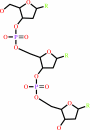 DNA(n)
|
+
|
2'-deoxyribonucleoside 5'-triphosphate
|
=
|
DNA(n+1)
|
+
|
 diphosphate
|
|
|
|
|
|
|
|
|
|
Enzyme class 3:
|
|
E.C.2.7.7.7
- DNA-directed Dna polymerase.
|
|
|
|
|
|
|
Reaction:
|
|
DNA(n) + a 2'-deoxyribonucleoside 5'-triphosphate = DNA(n+1) + diphosphate
|
|
|
|
|
|
DNA(n)
|
+
|
2'-deoxyribonucleoside 5'-triphosphate
|
=
|
DNA(n+1)
|
+
|
diphosphate
|
|
|
|
|
|
|
|
|
|
Enzyme class 4:
|
|
E.C.3.1.-.-
|
|
|
|
|
|
|
Enzyme class 5:
|
|
E.C.3.1.13.2
- exoribonuclease H.
|
|
|
|
|
|
|
Reaction:
|
|
Exonucleolytic cleavage to 5'-phosphomonoester oligonucleotides in both 5'- to 3'- and 3'- to 5'-directions.
|
|
|
|
|
|
Enzyme class 6:
|
|
E.C.3.1.26.13
- retroviral ribonuclease H.
|
|
|
|
|
|
|
Enzyme class 7:
|
|
E.C.3.4.23.16
- HIV-1 retropepsin.
|
|
|
|
|
|
|
Reaction:
|
|
Specific for a P1 residue that is hydrophobic, and P1' variable, but often Pro.
|
|
|
|
|
|
|
|
|
Note, where more than one E.C. class is given (as above), each may
correspond to a different protein domain or, in the case of polyprotein
precursors, to a different mature protein.
|
|
|
|
Molecule diagrams generated from .mol files obtained from the
KEGG ftp site
|
|
|
|
|
|
|
|
|
|
|
|
|
|
 |
|
|
|
|
|
|
| |
|
|
| |
|
DOI no:
|
Biochemistry
37:2105-2110
(1998)
|
|
PubMed id:
|
|
|
|
|
|
| |
|
Hydrophilic peptides derived from the transframe region of Gag-Pol inhibit the HIV-1 protease.
|
|
J.M.Louis,
F.Dyda,
N.T.Nashed,
A.R.Kimmel,
D.R.Davies.
|
|
|
|
|
| |
ABSTRACT
|
|
|
|
| |
|
|
The HIV-1 transframe region (TFR) is between the structural and functional
domains of the Gag-Pol polyprotein, flanked by the nucleocapsid and the protease
domains at its N and C termini, respectively. Transframe octapeptide (TFP)
Phe-Leu-Arg-Glu-Asp-Leu-Ala-Phe, the N terminus of TFR, and its analogues are
competitive inhibitors of the action of the mature HIV-1 protease. The smallest,
most potent analogues are tripeptides: Glu-Asp-Leu and Glu-Asp-Phe with Ki
values of approximately 50 and approximately 20 microM, respectively.
Substitution of the acidic amino acids in the TFP by neutral amino acids and d
or retro-d configurations of Glu-Asp-Leu results in an >40-fold increase in
Ki. Protease inhibition by Glu-Asp-Leu is dependent on a protonated form of a
group with a pKa of 3.8; unlike other inhibitors of HIV-1 protease which are
highly hydrophobic, Glu-Asp-Leu is extremely soluble in water, and its binding
affinity decreases with increasing NaCl concentration. However, Glu-Asp-Leu is a
poor inhibitor (Ki approximately 7.5 mM) of the mammalian aspartic acid protease
pepsin. X-ray crystallographic studies at pH 4.2 show that the interactions of
Glu at P2 and Leu at P1 of Glu-Asp-Leu with residues of the active site of HIV-1
protease are similar to those of other product-enzyme complexes. It was not
feasible to understand the interaction of intact TFP with HIV-1 protease under
conditions of crystal growth due to its hydrolysis giving rise to two products.
The sequence-specific, selective inhibition of the HIV-1 protease by the viral
TFP suggests a role for TFP in regulating protease function during HIV-1
replication.
|
|
|
|
|
|
|
|
|
|
|
|
|
|
|
|
|
|
 |
 |
 |
|
Literature references that cite this PDB file's key reference
|
|
|
| |
PubMed id
|
|
Reference
|
|
|
|
|
|
H.Ode,
M.Yokoyama,
T.Kanda,
and
H.Sato
(2011).
Identification of folding preferences of cleavage junctions of HIV-1 precursor proteins for regulation of cleavability.
|
| |
J Mol Model,
17,
391-399.
|
|
|
|
|
|
|
E.B.Unal,
A.Gursoy,
and
B.Erman
(2010).
VitAL: Viterbi algorithm for de novo peptide design.
|
| |
PLoS One,
5,
e10926.
|
|
|
|
|
|
|
J.M.Sayer,
J.Agniswamy,
I.T.Weber,
and
J.M.Louis
(2010).
Autocatalytic maturation, physical/chemical properties, and crystal structure of group N HIV-1 protease: relevance to drug resistance.
|
| |
Protein Sci,
19,
2055-2072.
|
|
|
PDB code:
|
|
|
|
|
|
|
|
T.Lu,
Y.Chen,
and
X.Y.Li
(2010).
An insight into the opening path to semi-open conformation of HIV-1 protease by molecular dynamics simulation.
|
| |
AIDS,
24,
1121-1125.
|
|
|
|
|
|
|
A.Leiherer,
C.Ludwig,
and
R.Wagner
(2009).
Uncoupling human immunodeficiency virus type 1 Gag and Pol reading frames: role of the transframe protein p6* in viral replication.
|
| |
J Virol,
83,
7210-7220.
|
|
|
|
|
|
|
C.Llorens,
R.Futami,
G.Renaud,
and
A.Moya
(2009).
Bioinformatic flowchart and database to investigate the origins and diversity of Clan AA peptidases.
|
| |
Biol Direct,
4,
3.
|
|
|
|
|
|
|
C.Llorens,
M.A.Fares,
and
A.Moya
(2008).
Relationships of gag-pol diversity between Ty3/Gypsy and Retroviridae LTR retroelements and the three kings hypothesis.
|
| |
BMC Evol Biol,
8,
276.
|
|
|
|
|
|
|
C.Chennubhotla,
and
I.Bahar
(2007).
Signal propagation in proteins and relation to equilibrium fluctuations.
|
| |
PLoS Comput Biol,
3,
1716-1726.
|
|
|
|
|
|
|
R.Ishima,
D.A.Torchia,
and
J.M.Louis
(2007).
Mutational and structural studies aimed at characterizing the monomer of HIV-1 protease and its precursor.
|
| |
J Biol Chem,
282,
17190-17199.
|
|
|
|
|
|
|
S.Sacquin-Mora,
E.Laforet,
and
R.Lavery
(2007).
Locating the active sites of enzymes using mechanical properties.
|
| |
Proteins,
67,
350-359.
|
|
|
|
|
|
|
Z.Li,
and
T.Lazaridis
(2007).
Water at biomolecular binding interfaces.
|
| |
Phys Chem Chem Phys,
9,
573-581.
|
|
|
|
|
|
|
A.Chatterjee,
P.Mridula,
R.K.Mishra,
R.Mittal,
and
R.V.Hosur
(2005).
Folding regulates autoprocessing of HIV-1 protease precursor.
|
| |
J Biol Chem,
280,
11369-11378.
|
|
|
|
|
|
|
L.W.Yang,
and
I.Bahar
(2005).
Coupling between catalytic site and collective dynamics: a requirement for mechanochemical activity of enzymes.
|
| |
Structure,
13,
893-904.
|
|
|
|
|
|
|
S.C.Pettit,
J.N.Lindquist,
A.H.Kaplan,
and
R.Swanstrom
(2005).
Processing sites in the human immunodeficiency virus type 1 (HIV-1) Gag-Pro-Pol precursor are cleaved by the viral protease at different rates.
|
| |
Retrovirology,
2,
66.
|
|
|
|
|
|
|
A.Fernández,
K.Rogale,
R.Scott,
and
H.A.Scheraga
(2004).
Inhibitor design by wrapping packing defects in HIV-1 proteins.
|
| |
Proc Natl Acad Sci U S A,
101,
11640-11645.
|
|
|
|
|
|
|
A.Nayeem,
S.Krystek,
and
T.Stouch
(2003).
An assessment of protein-ligand binding site polarizability.
|
| |
Biopolymers,
70,
201-211.
|
|
|
|
|
|
|
N.Whitehurst,
C.Chappey,
C.Petropoulos,
N.Parkin,
and
A.Gamarnik
(2003).
Polymorphisms in p1-p6/p6* of HIV type 1 can delay protease autoprocessing and increase drug susceptibility.
|
| |
AIDS Res Hum Retroviruses,
19,
779-784.
|
|
|
|
|
|
|
R.Ishima,
D.A.Torchia,
S.M.Lynch,
A.M.Gronenborn,
and
J.M.Louis
(2003).
Solution structure of the mature HIV-1 protease monomer: insight into the tertiary fold and stability of a precursor.
|
| |
J Biol Chem,
278,
43311-43319.
|
|
|
PDB code:
|
|
|
|
|
|
|
|
S.B.Shuker,
V.L.Mariani,
B.E.Herger,
and
K.J.Dennison
(2003).
Understanding HTLV-I protease.
|
| |
Chem Biol,
10,
373-380.
|
|
|
|
|
|
|
S.C.Pettit,
S.Gulnik,
L.Everitt,
and
A.H.Kaplan
(2003).
The dimer interfaces of protease and extra-protease domains influence the activation of protease and the specificity of GagPol cleavage.
|
| |
J Virol,
77,
366-374.
|
|
|
|
|
|
|
B.Mahalingam,
P.Boross,
Y.F.Wang,
J.M.Louis,
C.C.Fischer,
J.Tozser,
R.W.Harrison,
and
I.T.Weber
(2002).
Combining mutations in HIV-1 protease to understand mechanisms of resistance.
|
| |
Proteins,
48,
107-116.
|
|
|
PDB codes:
|
|
|
|
|
|
|
|
M.K.Hill,
M.Shehu-Xhilaga,
S.M.Crowe,
and
J.Mak
(2002).
Proline residues within spacer peptide p1 are important for human immunodeficiency virus type 1 infectivity, protein processing, and genomic RNA dimer stability.
|
| |
J Virol,
76,
11245-11253.
|
|
|
|
|
|
|
B.Mahalingam,
J.M.Louis,
J.Hung,
R.W.Harrison,
and
I.T.Weber
(2001).
Structural implications of drug-resistant mutants of HIV-1 protease: high-resolution crystal structures of the mutant protease/substrate analogue complexes.
|
| |
Proteins,
43,
455-464.
|
|
|
PDB codes:
|
|
|
|
|
|
|
|
H.C.Côté,
Z.L.Brumme,
and
P.R.Harrigan
(2001).
Human immunodeficiency virus type 1 protease cleavage site mutations associated with protease inhibitor cross-resistance selected by indinavir, ritonavir, and/or saquinavir.
|
| |
J Virol,
75,
589-594.
|
|
|
|
|
|
|
A.Velazquez-Campoy,
M.J.Todd,
and
E.Freire
(2000).
HIV-1 protease inhibitors: enthalpic versus entropic optimization of the binding affinity.
|
| |
Biochemistry,
39,
2201-2207.
|
|
|
|
|
|
|
B.Ullrich,
M.Laberge,
F.Tölgyesi,
Z.Szeltner,
L.Polgár,
and
J.Fidy
(2000).
Trp42 rotamers report reduced flexibility when the inhibitor acetyl-pepstatin is bound to HIV-1 protease.
|
| |
Protein Sci,
9,
2232-2245.
|
|
|
|
|
|
|
C.Paulus,
S.Hellebrand,
U.Tessmer,
H.Wolf,
H.G.Kräusslich,
and
R.Wagner
(1999).
Competitive inhibition of human immunodeficiency virus type-1 protease by the Gag-Pol transframe protein.
|
| |
J Biol Chem,
274,
21539-21543.
|
|
|
|
|
|
|
J.M.Louis,
E.M.Wondrak,
A.R.Kimmel,
P.T.Wingfield,
and
N.T.Nashed
(1999).
Proteolytic processing of HIV-1 protease precursor, kinetics and mechanism.
|
| |
J Biol Chem,
274,
23437-23442.
|
|
|
|
|
|
|
S.A.Ali,
H.C.Joao,
F.Hammerschmid,
J.Eder,
and
A.Steinkasserer
(1999).
Transferrin trojan horses as a rational approach for the biological delivery of therapeutic peptide domains.
|
| |
J Biol Chem,
274,
24066-24073.
|
|
|
|
|
|
|
Y.Y.Chang,
S.L.Yu,
and
W.J.Syu
(1999).
Organization of HIV-1 pol is critical for Pol polyprotein processing.
|
| |
J Biomed Sci,
6,
333-341.
|
|
|
|
|
|
The most recent references are shown first.
Citation data come partly from CiteXplore and partly
from an automated harvesting procedure. Note that this is likely to be
only a partial list as not all journals are covered by
either method. However, we are continually building up the citation data
so more and more references will be included with time.
Where a reference describes a PDB structure, the PDB
code is
shown on the right.
|
|


 Links
Links


